


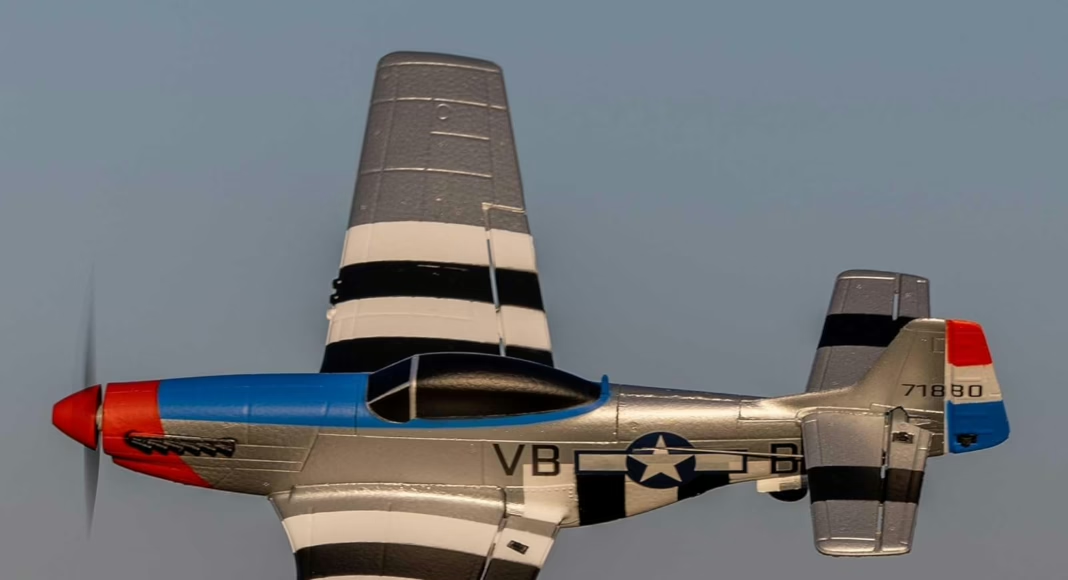

At 77.5 grams and 17.7 inches wide, the HobbyZone P-51D 450mm RTF turns any open park into a personal airshow. No field trip required.Introduction: Cutting Through the Hype
The RC aviation market in 2026 is saturated with micro-scale aircraft, and that creates a genuine paradox of choice for anyone trying to make a confident first purchase. Historically, novice pilots were limited to docile high-wing trainers, while the warbird category — those visually stunning military replicas — was strictly reserved for experienced sticks with years of muscle memory. The modern micro warbird makes a compelling promise: unbox a legendary WWII fighter, charge a battery, and fly it without piling it into the turf on the maiden voyage.
That’s an appealing pitch — but the distance between a manufacturer’s specification sheet and the realities of daily field use is frequently vast. Box art and promotional footage have led plenty of buyers straight into costly disappointment, particularly when proprietary electronics fail after a handful of flights. To cut through the hype, we subjected the HobbyZone P-51D 450mm RTF to rigorous testing across multiple real-world environments, from dead-calm indoor gymnasiums to turbulent outdoor parks with sustained winds between 5 and 15 mph, documenting crash survivability, component teardowns, and long-term mechanical wear along the way. For anyone currently navigating the landscape of the best RC planes for beginners, this is the report you need before committing.
Brief Overview
The HobbyZone P-51D 450mm RTF (model HBZ1251) is a micro-scale, electric-powered replica of the iconic North American P-51D Mustang, built specifically for backyard and park flying. Its 450mm (17.7-inch) wingspan and a ready-to-fly weight of 77.5 grams (2.7 oz.) — just 2.3 oz. (66.2g) without the battery, place it well below the 250-gram threshold for FAA registration and Remote ID compliance in the United States — a meaningful administrative advantage for anyone who wants to fly without bureaucratic overhead.
Everything arrives in a single box: the airframe, a 5-channel 2.4GHz transmitter, AA alkaline batteries for the controller, two 400mAh 1S 3.7V LiPo flight batteries, and a USB charging cable. Nothing extra is required to get off the ground.
The intended audience is the beginner to intermediate enthusiast who wants the visual and historical appeal of a military fighter without the years of stick time that traditionally came with the territory. Three engineering features are central to making that possible:
- Sensor Assisted Flight Envelope (SAFE) Technology: A 3-axis stabilization system that enforces pitch and roll limits and provides automatic self-leveling the moment the control sticks are released.
- Expanded Polypropylene (EPP) Construction: Far more impact-resistant than the older expanded polystyrene used in earlier micro aircraft, the EPP airframe flexes and recovers after crashes rather than shattering.
- Automated Aerobatics: A dedicated transmitter button triggers computer-executed loops and axial rolls on command — the kind of instant emotional payoff that reinforces a beginner’s commitment to the hobby before the learning curve turns frustrating.
Check Current Price & Availability on Amazon
The Real-World Utility Test: Setup, Flight, and Frustrations
Out-of-the-Box Assembly
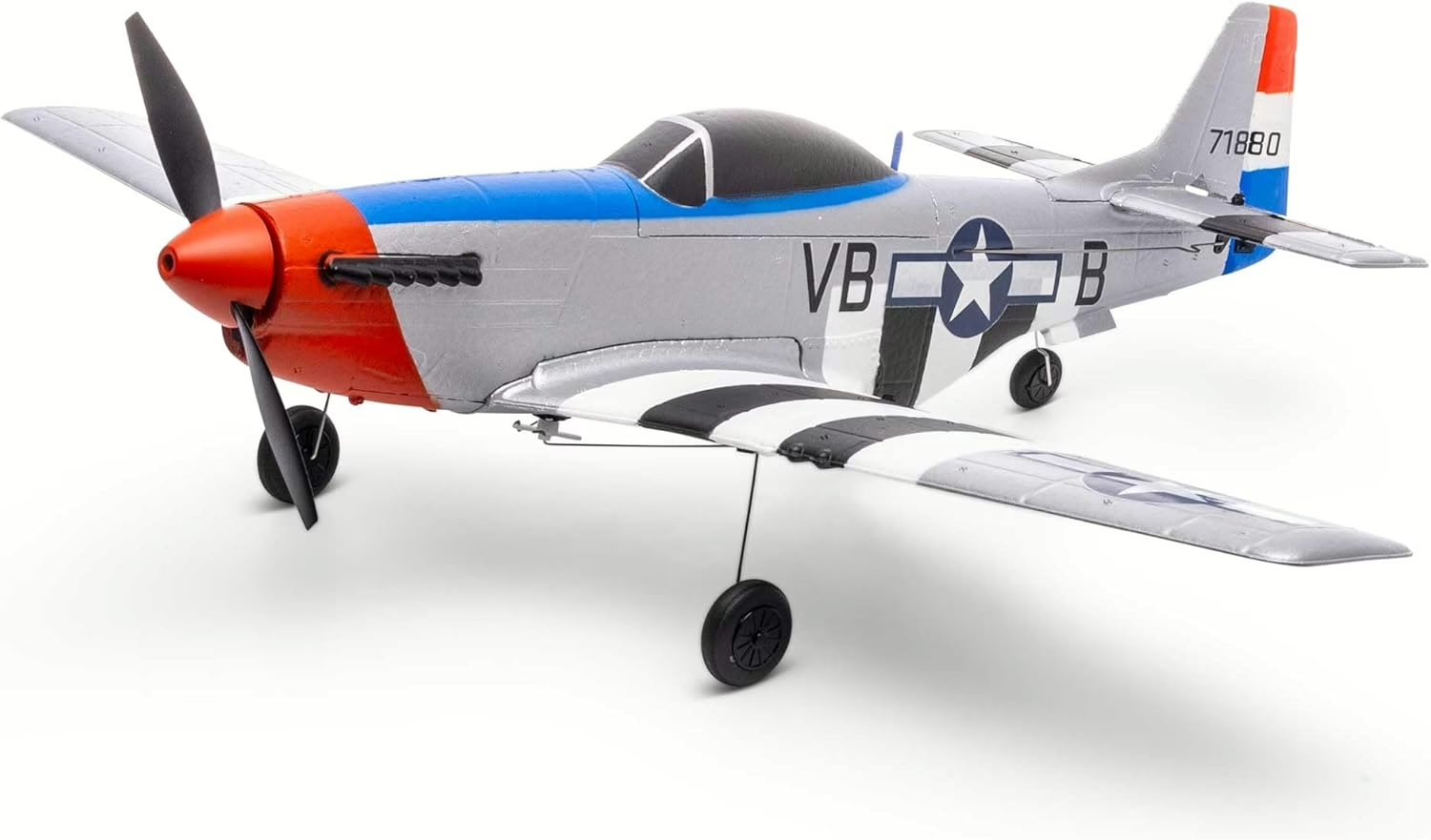
“Ready-to-Fly” is a label frequently abused in consumer electronics, sometimes hiding hours of calibration and gluing. The HobbyZone P-51D 450mm honors the designation. The airframe arrives 100% factory-assembled, complete with an authentic red, white, and blue livery. The entire setup process amounts to three physical steps: snapping the main landing gear wires into the pre-molded plastic clips beneath the wing, inserting the tailwheel into the aft fuselage slot, and loading four AA batteries into the transmitter. No glue, no epoxy, no tools required.
The only real delay between unboxing and the maiden flight is battery charging. The included USB charger takes approximately 60 minutes to replenish a fully depleted 400mAh cell, using a solid red LED to indicate charging and a solid green LED for completion. Placement of the battery inside the fuselage matters more than it might seem: the hook-and-loop strip allows adjustment along the longitudinal axis, and proper center-of-gravity alignment requires a slightly nose-heavy configuration. A tail-heavy setup significantly degrades the onboard stabilization algorithms, making the aircraft substantially harder to manage.
Flight Envelope and SAFE Technology Integration
A low-wing fighter like the P-51 is aerodynamically less stable than a high-wing trainer by design. High-wing aircraft benefit from the pendulum effect — the fuselage mass hangs below the center of lift, providing inherent self-righting tendency. Low-wing warbirds lack that geometric advantage entirely, producing a neutral or negative stability profile that demands constant pilot corrections to prevent stalls and snap-rolls. Horizon Hobby’s AS3X (Artificial Stabilization — 3-aXis) and SAFE technologies are the engineering response to that physics problem.
The flight control board provides three distinct, pilot-switchable modes:
Beginner Mode limits bank and pitch angles to approximately 30 degrees, physically preventing inversion or a fatal dive. Release the sticks and the aircraft instantly returns to straight-and-level flight. In this mode, the aggressive warbird essentially behaves with the docile characteristics of a trainer, compensating for the pilot’s lack of muscle memory.
Intermediate Mode opens the flight envelope for steeper bank angles and tighter turns while maintaining a reduced rate of self-leveling, providing a natural and progressive transition for advancing skills.
Experienced Mode removes all angle limits and self-leveling constraints, returning full unassisted control for inverted flight and advanced aerobatics. AS3X remains active in the background, counteracting external turbulence without interfering with direct pilot inputs.
At 77.5 grams, the aircraft has low wing loading by definition — normally a limitation that grounds micro aircraft in anything but still air. The background AS3X algorithm compensates effectively, executing thousands of micro-corrections per second. Field testing confirms the aircraft handles sustained winds of 5 to 15 mph with confidence, with the gyros reacting to gusts measurably faster than human reflexes allow. The result is a micro Mustang that flies with the inertial feel of a significantly larger, heavier model.
Rolling takeoffs from paved surfaces are practical, but the diminutive wheel diameter makes grass takeoffs a near-guaranteed nose-over. For most park environments, the pragmatic approach is removing the landing gear entirely and executing an underhand toss at roughly 60% throttle. Hand-launching is notably forgiving in Beginner Mode, where the gyro manages the climb gradient and prevents motor torque from rolling the aircraft into the ground.
Hidden Flaws and Mechanical Frustrations
The electronics integration is impressive, but long-term utility is hampered by identifiable mechanical weak points that deserve honest attention before purchase.
Motor Degradation: The HBZ1251 relies on an 8.5mm brushed coreless motor. Brushed motors use physical carbon brushes contacting a spinning commutator to alternate electrical current — a mechanism that generates significant heat and progressive internal wear. Aggressive users have reported total motor failure after as few as 20 to 30 flights.
The Gearbox Problem: Because the brushed motor lacks the low-end torque required to swing a scale-appropriate propeller efficiently, it relies on a plastic reduction gearbox to multiply torque. That gearbox is the single most critical failure point on the airframe. A hard nose-in crash routinely strips the nylon reduction gears or dislodges the plastic motor mount from the EPP foam nose. The exterior foam flexes and recovers; the internal rigid mechanics do not. Replacement gearbox assemblies have historically suffered from supply chain scarcity, leaving pilots grounded during backorder periods or resorting to improvised hot-glue repairs.
The Prop-Saver Paradox: The pop-off prop-saver is marketed as a fail-safe mechanism — a friction-fit snap design intended to disconnect the propeller on ground impact, absorbing shock before it strips the gearbox. In theory, it’s a sound engineering choice. In practice, the snap-fit tolerance degrades with repeated impacts and removals. Pilots consistently report the propeller ejecting in mid-flight simply from the centrifugal torque generated by rapid full-throttle application. The result is an unplanned dead-stick landing to find a prop somewhere in tall grass — a recurring frustration that erodes the seamless flying experience the manufacturer promises.
The Upgrade Ceiling: The aircraft uses an all-in-one (AIO) control board that integrates the receiver, brushed ESC, gyros, and rotary servos onto a single PCB. Converting to a brushless drivetrain means abandoning the entire factory electronics suite and installing a standalone micro receiver, a separate brushless ESC, and a new motor. It’s effectively rebuilding the airplane from scratch — not a practical upgrade path for most hobbyists.
The Value-to-Performance Ratio: Does It Justify the Investment?
Evaluating the Marketing Claims
Horizon Hobby markets this package as an “unbelievable and unbeatable value.” Measuring that claim against actual performance data tells a more nuanced story.
The primary durability claim — “incredibly durable EPP construction” — is factually accurate. Expanded Polypropylene is a shape-memory foam that resists tearing, denting, and crushing far better than the older expanded polystyrene used in earlier generations of micro aircraft. Wings and tail surfaces flex on hard grass impacts and recover their geometry almost flawlessly. The SAFE technology claim is equally sound: the software intervention is instantaneous and seamless, providing a genuine safety net that objectively accelerates the beginner learning curve without feeling artificially restrictive.
Where “unbeatable value” faces scrutiny is in the proprietary included transmitter and the rapidly degrading brushed power system. The 5-channel RTF controller resembles a generic game pad. While adequate for early training and line-of-sight park flying, it lacks the gimbal resolution, programming flexibility, telemetry feedback, and ergonomic weight of a standard hobby-grade radio.
Competitive Landscape
The micro warbird segment in 2026 is primarily contested by VolantexRC and Eachine, which produce comparable 400mm P-51D variants — aircraft with a similar feature set and competing 6-axis gyro stabilization branded as Xpilot rather than SAFE. Those models occasionally undercut the HobbyZone’s price point by a marginal percentage, and the 400mm wingspan offers slightly better portability. However, test data indicates the smaller wing area makes the Volantex marginally less stable in manual mode than the 450mm HobbyZone.
The more significant differentiator is radio protocol. A direct hardware comparison clarifies the key distinctions:
| Specification | HobbyZone P-51D 450mm | Volantex / Eachine P-51D 400mm | E-flite UMX P-51D “Detroit Miss” |
| Wingspan | 450mm | 400mm | 493mm (19.4″) |
| Stabilization | SAFE / AS3X | Xpilot (6-Axis) | SAFE Select / AS3X |
| Motor Type | 8.5mm Brushed Coreless | 10mm Brushed Coreless | Brushless Outrunner |
| Battery | 1S 3.7V LiPo (400mAh) | 1S 3.7V LiPo (360–400mAh) | 2S 7.4V or 3S 11.1V LiPo |
| Radio Protocol | Spektrum DSMX | Proprietary (V761) | Spektrum DSMX |
| Target Audience | True Beginner | True Beginner | Intermediate to Advanced |
| Format | Ready-to-Fly (RTF) | Ready-to-Fly (RTF) | Bind-N-Fly (BNF) |
Table 1: Direct comparison of primary market competitors in the micro warbird category.
The Volantex and Eachine models operate on a closed proprietary V761 protocol. A pilot who eventually purchases a professional computerized transmitter cannot bind it to those aircraft without acquiring a third-party multi-protocol module and navigating open-source firmware programming. The HobbyZone P-51D uses Horizon Hobby’s industry-standard DSMX protocol. As skills advance, the pilot can discard the toy-like RTF controller and instantly bind the P-51D to a Spektrum NX6, NX8, or iX14, gaining improved control resolution, reduced latency, and programmable exponential curves — without purchasing a new airframe.
At the premium end of the Horizon family, the E-flite UMX P-51D “Detroit Miss” abandons the brushed gearbox entirely for a direct-drive brushless motor on 2S or 3S LiPo chemistry — vastly superior in top speed, vertical climb, and motor longevity. But it’s sold exclusively as BNF, requiring a separate DSMX transmitter and a dedicated LiPo balancing charger. That changes the total entry cost substantially. The HobbyZone P-51D 450mm therefore holds its specific position as the definitive all-in-one RTF value for the true beginner.
Long-Term Durability and Return on Investment
Return on investment in RC aviation is measured in cost per flight hour. The two-battery inclusion delivers approximately 15 to 20 minutes of total flying time per park visit without a mid-session recharge. The ROI curve, however, drops sharply around the 30-to-40 flight mark, when brushed motor wear and gearbox tooth degradation produce a measurable reduction in thrust. The eventual necessity of replacing the motor and gearbox assembly must be factored into total cost of ownership. That said, because the EPP airframe resists permanent structural damage, replacing a nominal mechanical part generally restores factory-fresh performance. As an educational bridge between simulators and larger, heavier aircraft, the investment holds up — and it does so precisely because it prevents the catastrophic total-loss crashes that have driven beginners away from unassisted warbirds for decades.
Pros & Cons
| Pros | Cons |
| True RTF Convenience: Two LiPo batteries, AA cells, and a USB charger included — airborne within 60 minutes of unboxing, no supplementary purchases needed. | Finite Motor Lifespan: The 8.5mm brushed coreless motor degrades progressively; aggressive users report failure after as few as 20–30 flights. |
| SAFE & AS3X Dominance: Industry-leading stabilization prevents orientation-loss crashes and allows the 77.5g micro-plane to confidently handle sustained winds up to 15 mph. | Fragile Gearbox Architecture: Frontal impacts frequently strip the nylon reduction gears; replacement assemblies are vulnerable to supply chain delays. |
| DSMX Ecosystem Compatibility: Unlike closed-protocol V761 imports, the receiver binds directly to professional Spektrum transmitters, allowing the hardware to evolve with the pilot. | Prop-Saver Fatigue: The friction-fit propeller attachment degrades with use and can spontaneously eject the blade mid-flight under high-throttle conditions. |
| Sub-250g FAA Exemption: At 77.5g, the aircraft operates entirely free of FAA registration, Remote ID requirements, and associated regulatory restrictions. | AIO Board Upgrade Ceiling: The integrated receiver/ESC board makes conversion to a brushless drivetrain impractical without rebuilding the aircraft from scratch. |
Where the HobbyZone P-51D 450mm RTF Really Shines
The real brilliance of this aircraft isn’t found on a specification sheet — it’s in the practical problem it solves for a very specific kind of pilot. Historically, flying an RC P-51 Mustang meant months on a simulator, the meticulous assembly of a large and fragile aircraft, locating a sanctioned flying club with a paved runway, and accepting the constant anxiety of potentially destroying a significant investment in seconds. The HobbyZone P-51D 450mm eliminates every one of those barriers.
Its greatest operational strength is pure spontaneity. The 450mm footprint means it can live fully assembled in a car trunk or back seat, eliminating the logistical friction of transporting oversized, delicate models to a dedicated field. When an empty soccer park, a baseball diamond, or a quiet open lot presents itself unexpectedly, the P-51D is in the air within minutes. That frictionless, low-commitment accessibility is exactly what defines this aircraft’s value to a time-limited, urban-dwelling enthusiast.
There’s also the psychological dimension of trainer fatigue. Many beginners quickly outgrow the utilitarian aesthetics of high-wing trainers but lack the reflexes to fly standard low-wing models without incident. By enforcing the flight envelope through SAFE technology, this aircraft lets a novice pilot confidently handle an aggressive-looking fighter from day one. The automated aerobatics button amplifies that appeal further: triggering a clean, computer-executed axial roll over the center of a field provides an immediate adrenaline hit and a genuine sense of accomplishment. That emotional feedback loop directly reinforces the pilot’s decision to stay in the hobby — and it turns any minor patch of grass into a personal, stress-free airshow on demand.
For the right pilot, this airplane doesn’t just work. It becomes a ritual.
Check Current Price & Availability on Amazon
Who Should Buy It
Ideal User Profiles
- The Time-Poor Enthusiast: One of the best RC planes for pilots who lack the hours to drive to dedicated, remote club flying fields. The 450mm footprint and sub-250g weight enable legal, spontaneous, non-intrusive flights in urban parks and baseball diamonds during a lunch break or after work — no field membership, runway, or FAA registration required.
- The Spektrum Ecosystem Adopter: Pilots who already own, or plan to purchase, a computerized Spektrum transmitter for larger aircraft. The DSMX protocol allows the P-51D to serve as a permanent, ready-to-bind training companion that integrates seamlessly into an existing radio ecosystem without clunky third-party adapters.
- The Aesthetics-Driven Novice: Beginners who refuse to fly generic high-wing trainers and need the visual appeal and historical connection of a WWII military replica — but realistically need significant software assistance to prevent early crashes.
Who Should Avoid It
- The Absolute Beginner with Zero Coordination: Despite SAFE technology, the short wingspan and low mass make this aircraft noticeably more responsive than larger trainer platforms. These pilots are better served by a 1.0-to-1.5-meter high-wing trainer — such as the E-flite Apprentice STOL or the Carbon Cub S2 — which offers greater visual presence and considerably slower reaction times.
- The Power-Hungry Tinkerer: Hobbyists seeking vertical performance, unlimited 3D capability, or an easy path to brushless power will run into the AIO board wall quickly and leave frustrated.
- High-Wind Coastal Flyers: Pilots in coastal or open-plains environments with winds consistently exceeding 15 mph. AS3X is excellent at smoothing turbulence, but the 77-gram mass will ultimately yield to heavy atmospheric conditions.

Key Takeaways
- Exceptional Stability: SAFE and AS3X technology successfully tame the inherently unstable low-wing warbird design, allowing novices confident flight in sustained winds up to 15 mph.
- True RTF Convenience: Two batteries, AA cells, and a USB charger are included; the sub-250g weight bypasses FAA registration and Remote ID requirements entirely.
- Mechanical Bottlenecks: Long-term utility is limited by the finite lifespan of the 8.5mm brushed motor and a fragile reduction gearbox prone to supply chain delays.
- Ecosystem Advantage: DSMX compatibility sets it apart from closed-protocol V761 rivals, enabling seamless future integration with professional Spektrum transmitters.