


The Flywing Bell-412 ACE rewrites the rules for first-time scale pilots: drone-like GPS stability, a four-blade rotor head, and LED nav lights — all pre-configured and ready on day one.
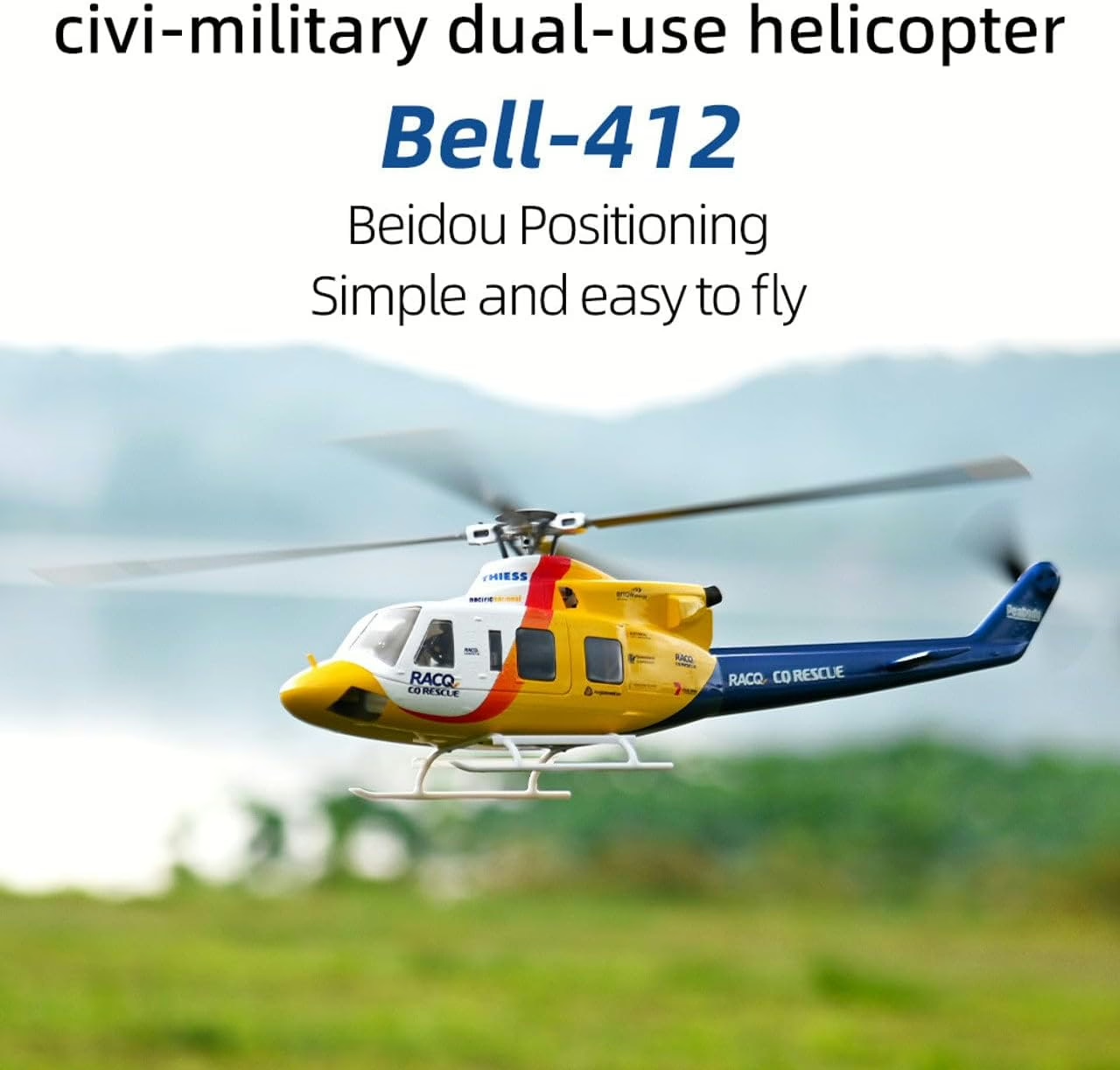
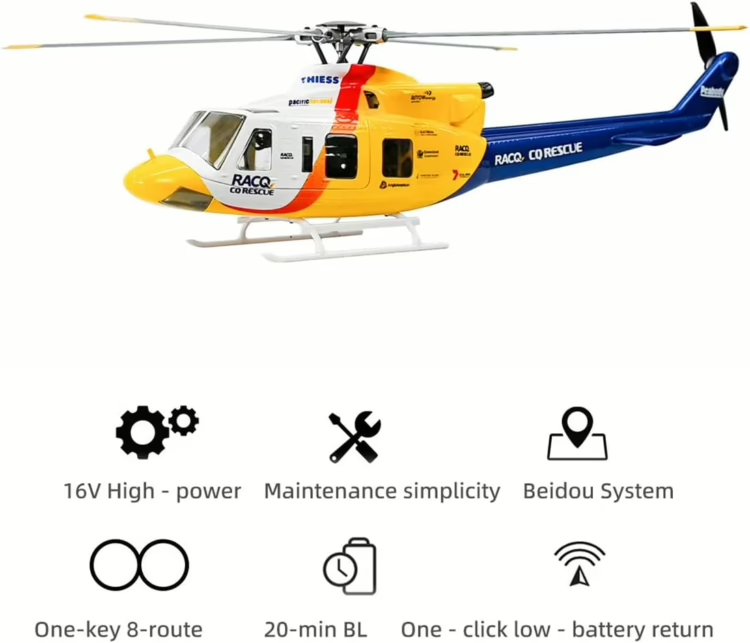
The Flywing Bell-412 ACE occupies the premium tier of the 470L-class scale RC helicopter market — and it’s not subtle about it. With an 810mm main rotor diameter and a 750mm fuselage length, this is a substantial machine, one that bridges the practical gap between nimble park flyers and the unforgiving world of giant-scale turbine aircraft. It is a meticulously crafted scale replica of the Bell 412, the iconic twin-engine utility helicopter developed from the Bell 212 in 1978, and it arrives in a Ready-To-Fly (RTF) format with every essential component pre-configured: four-blade flybarless (FBL) rotor head, brushless power system, proprietary ACE Flight Controller, and a 10-channel 2.4GHz transmitter.
The target audience is the beginner to intermediate enthusiast who wants the visual presence and acoustic character of a large-scale helicopter without the steep operational anxiety that typically accompanies one. If you’re the type of pilot who values smooth, cinematic flight profiles and scale realism over extreme 3D aerobatics, Flywing engineered this platform with you specifically in mind.
Key features worth knowing before you buy:
- ACE Flight Controller with M10 GPS: Interfaces simultaneously with GPS, GLONASS, Galileo, and Beidou satellite networks, delivering absolute position hold with horizontal accuracy of ±1.5 meters and vertical accuracy of ±0.5 meters.
- Quick-Release 4-Blade Rotor Head: An all-metal CNC hub with push-button blade removal — no hex drivers required — solving one of the most persistent logistical headaches in the 470-class segment.
- C-TURN (Coordinated Turn) Technology: Automatically mixes cyclic roll and tail rotor yaw, allowing beginners to execute perfectly banked, scale-realistic turns without mastering simultaneous dual-stick inputs.
- 25-Minute Flight Endurance: A custom NACA 8-H-12 flat-convex airfoil design, paired with a 4S 5000mAh LiPo battery, consistently delivers 20 to 25 minutes of mixed flight per charge.
Check current availability and pricing on Amazon →
Pros & Cons
Pros:
- The omnidirectional M10 GPS combined with downward-facing optical flow sensors creates a virtually impenetrable hands-free hover, fully eliminating the beginner’s fear of spatial disorientation and uncontrolled drift.
- Flight endurance of 20 to 25 minutes per charge is staggering by any standard in this size class, dramatically reducing the friction of battery management during a typical flying session.
- The one-key Return-to-Home (RTH) and automatic low-voltage landing protocols provide a genuine financial safety net, autonomously protecting the airframe from pilot error and power failures.
- Scale fidelity is exceptional — dual-flashing LED navigation lights, precise panel lines, accurate exhaust detailing, and a wind-resistant 1000g airframe give this helicopter a museum-grade quality of presence in the sky.
- The direct-drive 2008 brushless tail motor eliminates the torque tubes and belt-drive systems that have plagued tail sections for decades, delivering superior yaw authority with significantly less maintenance overhead.
Cons:
- The 810mm rotor diameter and 1000g all-up weight mandate wide-open flying sites; confined backyards and any form of indoor operation are firmly off the table.
- The flat-convex NACA 8-H-12 airfoil is purpose-designed for scale efficiency, not 3D aggression — sustained inverted flight and extreme aerobatics are physically incompatible with this rotor system.
- The premium price tier is a real barrier to entry relative to pod-and-boom trainer alternatives, even if the long-term total cost of ownership argument strongly favors this platform.
- Any physical impact to the detailed scale fuselage or CNC four-blade rotor head carries meaningfully higher repair costs and labor compared to a simple 3D trainer frame.
Design & Build Quality
Pull the Bell-412 ACE out of its packaging, and the first thing you notice is mass — this is a genuine 470L-class machine, not a toy dressed up in scale clothing. The airframe relies on a hybrid construction strategy, marrying high-strength composite engineering plastics with precision-machined aluminum components engineered to absorb the torsional loads a 470L rotor system routinely generates. The Bell 412 fuselage silhouette is faithfully reproduced: accurate window placements, exhaust cowling details, an elevated skid profile, and a high-gloss topcoat that both enhances visibility and resists UV degradation. There is nothing vague or approximate about the scale fidelity here.
The mechanical heart of the aircraft is the all-metal CNC four-blade rotor head, which immediately sets the Bell-412 ACE apart from standard two-blade trainers. Flywing has moved entirely away from flybar-stabilized heads; this is a modern FBL architecture with a quick-release blade mechanism that allows full blade removal in seconds without specialized tooling. For anyone who has ever tried to load a traditional 470-class helicopter into a vehicle, this feature alone justifies serious attention. The feathering shafts are hardened steel, supported by precision rubber dampeners tuned specifically for scale flight — soft enough to absorb high-frequency cyclic stress, rigid enough to deliver predictable, clean aerodynamic responses to servo inputs.
The main rotor blades themselves are a notable engineering choice. Rather than standard symmetrical carbon fiber blades optimized for 3D, Flywing uses a custom NACA 8-H-12 flat-convex airfoil injection-molded in nylon around a multi-ring 420 stainless steel core. This profile generates high lift coefficients at lower head speeds, genuinely mimicking the flight dynamics of full-scale utility rotorcraft — while the steel core prevents the blade warping or fracturing under centrifugal load that would plague an all-plastic equivalent.
The tail section abandons traditional mechanical linkages entirely. A dedicated 2008 brushless motor is mounted directly to the tail case, driving a 125mm tail rotor with no intervening gears, belts, or torque tubes between the motor and the blades. The practical implication for any pilot who has ever stripped a tail belt mid-flight is obvious. Out of the box, the eCCPM swashplate geometry is factory-aligned across all three servos, and the only tasks left to the buyer before first flight are battery charging, blade unfolding, and transmitter binding. The LED lighting system — red, green, and white aviation lights running a double-flash pattern — adds a finishing touch that makes twilight operations genuinely impressive.
Electronics & Flight Systems
The ACE Flight Controller is the defining technology of this helicopter, and understanding what it actually does in practical terms is the key to understanding why the Bell-412 ACE works the way it does. This is not a simple self-leveling system that merely caps bank angles and calls it done. The ACE controller runs a sophisticated Inertial Measurement Unit blending data from 3-axis MEMS gyroscopes, 3-axis accelerometers, a barometric pressure sensor, and downward-facing optical flow cameras — continuously, in the background, hundreds of times per second.
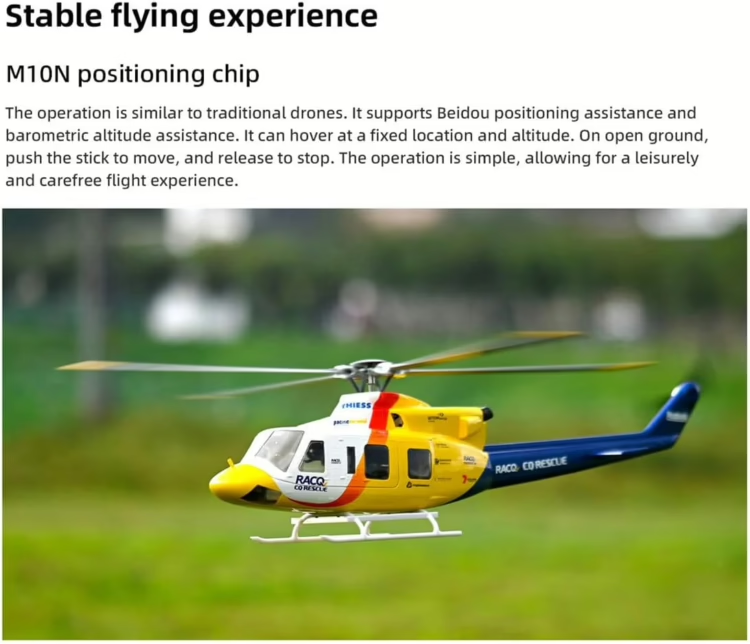
In GPS mode, the controller interfaces with an integrated M10 multi-mode positioning chip communicating simultaneously across all four major satellite networks. The result is position hold accurate to within ±1.5 meters horizontally and ±0.5 meters vertically — numbers that put this system comfortably in the category of professional camera drone stabilization rather than entry-level hobby electronics. Centering the sticks in a gusty field doesn’t produce a drift and slow recovery; the helicopter brakes aggressively and locks in place. The difference between this behavior and what a traditional FBL helicopter demands of a beginner pilot is not incremental. It is categorical.
The wireless compass calibration feature is a quality-of-life improvement that deserves specific mention: pilots can trigger calibration directly from the transmitter without connecting to a PC software suite, which removes one of the most commonly fumbled pre-flight procedures for newcomers. An intelligent battery detection system further prevents takeoff when the pack is insufficiently charged.
On the power side, the main rotor is driven by a 3508 brushless outrunner operating on a 16V system, managed by a 60A dual-brushless ESC featuring a soft-start firmware protocol. This soft-start ramps voltage slowly during spool-up to prevent the torque from stripping the 13-tooth motor pinion or the 81-tooth main transmission gear — a thoughtful hardware protection mechanism that directly reduces crash-related repair costs. The same ESC governs the direct-drive 2008 tail motor, ensuring immediate yaw correction response. The 4S 5000mAh LiPo that drives the entire system is the critical enabler of the extraordinary flight endurance figures.
The included 10-channel 2.4GHz transmitter offers a 1km operating range in clean RF environments, with clearly marked toggle switches for GPS, ATT, and 3D flight modes, RTH, and C-TURN engagement. It is ergonomically competent and fully capable for the platform’s intended use.
Performance & Flight Test
The spool-up sequence tells you immediately that this helicopter is running something different under the hood. Rather than the violent burst of RPM that characterizes older FBL machines, the soft-start ESC protocol initiates a slow, staged acceleration. The four-blade rotor head builds speed progressively, and as it does, the acoustic signature shifts from a hum to a deep, resonant chop that is unmistakably large-helicopter in character. Also notably absent is ground resonance — the violent lateral rocking that can destroy an airframe before it ever lifts off — held in check by the ACE controller’s continuous FFT vibration analysis during spool-up.
In GPS mode, the hover is robotic in the most literal sense of the word. During field testing in a 10 mph crosswind, releasing the cyclic sticks caused the helicopter to lean slightly into the wind and hold its exact geographic coordinates autonomously. No micro-corrections from the pilot. No progressive drift requiring anticipation and recovery. The optical flow sensors and barometer work together with the M10 GPS module to freeze the aircraft in three-dimensional space with a precision that removes the fundamental anxiety of helicopter flight for beginners.
Transitioning to forward flight introduces translational lift — the aerodynamic efficiency gain that occurs as the rotor disc moves out of its own recirculating downwash into clean air — which on a traditional collective pitch helicopter demands an immediate reduction in pitch or forward cyclic to prevent the airframe from ballooning upward. The ACE controller’s barometric altitude hold manages this transition seamlessly, automatically modulating collective pitch to maintain a level trajectory through the acceleration phase. The pilot observes the helicopter moving purposefully forward without any altitude excursion.
C-TURN technology transforms the experience of flying coordinated turns. In conventional helicopter flight, a banked turn requires a precise, simultaneous blend of elevator, aileron, and rudder inputs — inputs that take experienced pilots hundreds of hours to internalize. With C-TURN active, the pilot simply applies forward stick and rudder; the ACE processor continuously measures airspeed and injects the precise aileron roll required to keep the fuselage gracefully banked through the arc. The result is a tight, cinematic arc that looks thoroughly professional regardless of the pilot’s experience level.
Wind resistance is commendable for a scale fuselage. The helicopter is rated for Class 5 winds, and the 1000g airframe mass provides genuine inertial dampening against sudden gusts. The direct-drive tail motor’s authority is absolute — heading hold is tight even when a large tail boom is acting as a weathervane in a crosswind. Switching to 3D manual mode removes bank angle limits for faster forward flight, though it cannot transform the platform into something it was never designed to be: the asymmetrical blade geometry and scale fuselage are simply not compatible with sustained inverted aerobatics.
On battery life, the manufacturer’s claims proved accurate. Practical flight sessions of 20 to 25 minutes of mixed hovering and forward flight were consistently achievable with the included 4S 5000mAh LiPo. When voltage drops to a critical threshold, the low-battery return protocol takes over autonomously — climbing to a safe altitude, navigating back to the takeoff coordinates, and executing a soft automated landing. For context, a competitive 3D helicopter at this size class may exhaust its battery in under five minutes under aggressive flying. The Bell-412 ACE’s endurance figures in this segment are not merely competitive; they are transformative.
Where the Flywing Bell-412 ACE Really Shines
For decades, the defining characteristic of RC helicopter flight was fear. Specifically, the fear that a single moment of spatial disorientation — a half-second of losing the nose direction against a featureless sky — would end in a high-speed impact and a very expensive pile of broken carbon fiber. Traditional FBL collective pitch helicopters are inherently unstable; they demand constant pilot input just to maintain a stationary hover, behaving aerodynamically like a marble balanced on a beach ball.
The Bell-412 ACE replaces that anxiety with something altogether different. There is real, visceral satisfaction in watching a large, four-bladed scale helicopter work through the sky at dusk, its red, green, and white aviation LEDs double-flashing against the fading light, the rotor system generating that deep, characteristic chop of a utility rotorcraft. The ACE flight controller functions as an invisible safety net — always present, never intrusive. If orientation is lost, releasing the sticks immediately stabilizes the aircraft. The RTH switch brings it home. The low-voltage protocol prevents a dead-battery crash. The tools exist to prevent the hobby from becoming punishing.
What this architecture enables, practically, is the freedom to actually enjoy the flying. Beginners can focus on the visual spectacle and the artistry of scale flight rather than spending every moment sweating through basic heading corrections. The quick-release rotor head means transport to a flying site doesn’t require a box van and thirty minutes of reassembly. And when it does need repair, HeliDirect and FlywingUSA maintain domestic U.S. spare parts networks that prevent the helicopter from being grounded indefinitely waiting for international shipping.
 Check current availability and pricing on Amazon →
Who Should Buy It
- The Transitioning Coaxial Pilot. If you have mastered a basic indoor coaxial toy or a sub-micro fixed-pitch trainer and the prospect of assembling a 450-class kit helicopter from scratch is frankly daunting, this is the logical upgrade path. The RTF format and GPS safety net mean you can confidently fly a large, impressive machine on day one without the threat of immediate and expensive destruction. The Auto Level and position hold features provide the gentlest possible introduction to larger rotorcraft.
- The Scale Aviation Enthusiast. For the hobbyist who prioritizes scale realism over extreme aerobatics, the meticulously molded fuselage, integrated LED navigation lights, authentic four-blade acoustic character, and C-TURN technology combine to deliver flight profiles that look convincingly like the real thing. You do not need years of simulator practice to fly this helicopter with dignity.
- The Light Aerial Observer. The M10 GPS and optical flow sensor stability make the Bell-412 ACE a genuinely capable platform for smooth, low-altitude observation or casual aerial photography with a small action camera mounted. The 20-to-25-minute endurance supports extended sessions without constant interruption.
Who Should Look Elsewhere. Hardcore 3D pilots with aspirations toward sustained inverted hovering, piroflips, Chaos sequences, or other smack aerobatics should not buy this helicopter. The flat-convex NACA 8-H-12 airfoil is physically incapable of generating the negative thrust required for inverted flight; attempting it will produce localized blade stall — the “blade fart” — followed immediately by a crash. The Bell-412 ACE is optimized entirely for upright, scale-realistic flight, and it delivers that experience with exceptional competence. Anything beyond that ceiling requires a different platform.
Value for Money
Evaluating the Bell-412 ACE on purchase price alone misses the point of the total cost of ownership calculation in this hobby. Traditional collective pitch training helicopters require constant expenditure on replacement feathering shafts, main gears, servos, tail booms, and canopies — the direct financial consequences of the pilot error crashes that GPS stabilization and RTH protocols systematically prevent. The Bell-412 ACE effectively insures itself against the category of damage that destroys most beginners’ budgets and enthusiasm simultaneously.
Against the field of direct competitors, the positioning is clear. Budget-friendly alternatives like the sub-250g RC ERA C138 Bell 206 offer a gentle, low-cost introduction to scale helicopters, but deliver roughly half the flight time, limited wind resistance, and none of the mechanical authenticity of a true multi-blade FBL head. Military-scale peers like the YUXIANG F11-S Apache offer GPS convenience at a similar size class, but come with more fragile decorative armament components and a less robust power system. The Bell-412 ACE sits above both in capability, durability, and the quality of its stabilization architecture.
For U.S. buyers specifically, the domestic spare parts availability through HeliDirect and FlywingUSA eliminates the weeks-long international shipping delays that can sideline imported alternatives — a practical value that does not appear in any specification table but matters considerably over the life of ownership. Check current pricing via the links in this review; for the performance category it occupies, this platform represents a strong return on investment.
The Verdict
The Flywing Bell-412 ACE (2026 Edition) is the clearest argument currently available in the RTF market that the steep learning curve of RC helicopter flight is now a design choice rather than an engineering necessity. The ACE GPS flight controller, M10 multi-constellation positioning, C-TURN coordinated turn technology, and direct-drive tail system combine to create an aircraft that is genuinely approachable on the very first day of ownership. Its limitations are real: the premium price, the requirement for large open flying sites, and the absolute ceiling against 3D aerobatics are legitimate considerations for specific buyers. But for the beginner or scale enthusiast seeking a flawless, anxiety-free, and visually compelling flight experience in a large, credible platform, there is no more complete RTF package currently on the market. It earns our highest recommendation without reservation.

Key Takeaways
- Impenetrable Stability: The ACE Flight Controller with M10 multi-constellation GPS, optical flow sensors, and barometric altitude hold delivers drone-like position hold and one-key Return-to-Home failsafe for beginners.
- Class-Leading Endurance: The custom NACA 8-H-12 airfoil and 4S 5000mAh LiPo yield 20 to 25 minutes of consistent flight time — far exceeding comparable 470L-class competitors.
- Authentic Scale Experience: A 470L fuselage, all-metal four-blade quick-release rotor head, LED navigation lights, and C-TURN coordinated turns deliver genuine scale fidelity.
- Not Built for 3D: The flat-convex blade airfoil and GPS-optimized software make sustained inverted aerobatics physically impossible; advanced 3D pilots should look elsewhere.
- Sound Long-Term Investment: GPS crash prevention, direct-drive tail reliability, and a strong U.S. domestic spare parts network make this a cost-effective platform over a full ownership cycle.