

Military-grade aesthetics, GPS Return-to-Home, and a direct-drive brushless system — but is the F11S genuinely beginner-proof, or is it a premium price chasing an impossible promise?
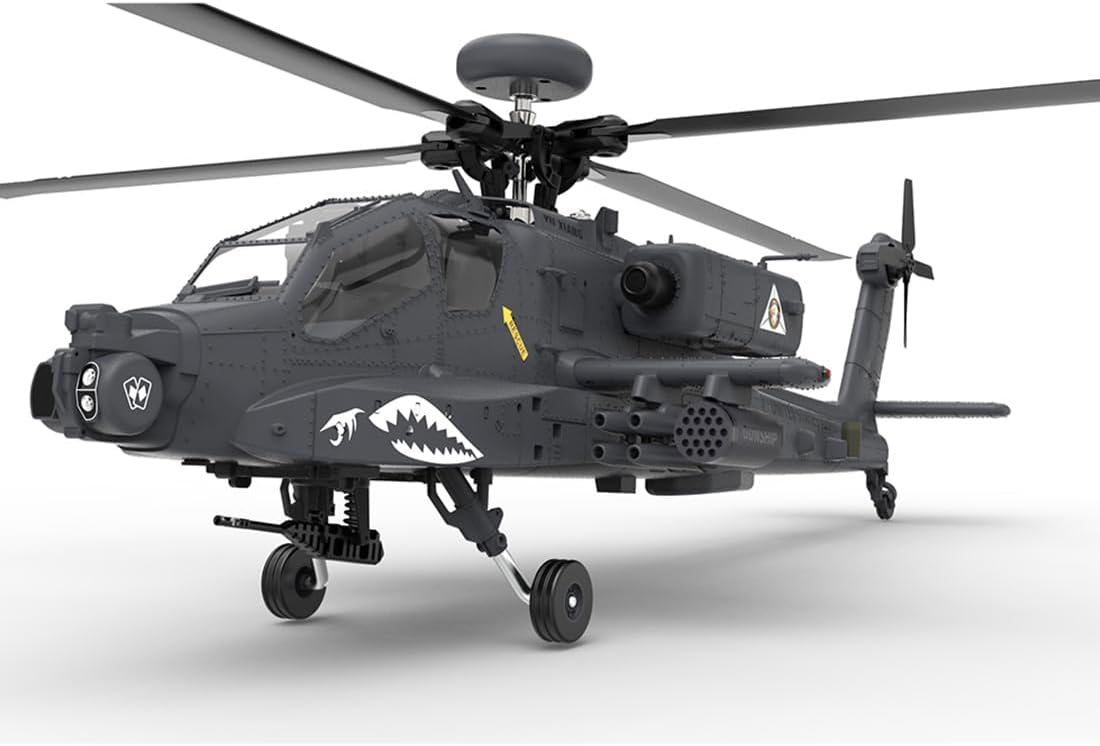
The Boeing AH-64 Apache is arguably the most recognizable military helicopter ever built. That low, forward-leaning fuselage, the tandem cockpit, the chin-mounted cannon, and those heavily loaded weapons pylons project an aggression that no other rotary-wing machine has ever quite replicated. It has always been the helicopter that beginner RC pilots dream about — and, historically, one that has been locked firmly behind an almost insurmountable wall of technical complexity.
For decades, flying a six-channel collective pitch (CP) scale helicopter required encyclopedic rotary aerodynamics knowledge, months of simulator practice, and a very high tolerance for catastrophically expensive crashes. The sheer operational anxiety — the cost, the fragility, the maintenance burden — turned away all but the most committed enthusiasts before they ever experienced the pure satisfaction of a stabilized, coordinated scale flight.
The 2026 market is a fundamentally different landscape. GPS, optical flow sensors, and sophisticated flybarless stabilization — technologies that originated in professional camera drones — have now filtered down into consumer-grade scale RC helicopters. The YuXiang F11S AH-64 Apache is built around exactly this trickle-down technology, and it makes a bold claim: that a total novice can fly a highly detailed 1/32 scale military replica on day one, without simulator time, without mechanical know-how, and without dreading the next crash.
Whether that claim holds up under a rigorous evaluation is precisely what this review determines. For broader context on where the F11S sits within the current market, we refer readers to our definitive guide on the best RC helicopters. The comprehensive Real-World Utility Test that follows breaks down the F11S’s aerodynamic performance, electronic architecture, build quality, and market positioning to deliver a clear, evidence-based verdict on its true value-to-performance ratio.
Brief Overview
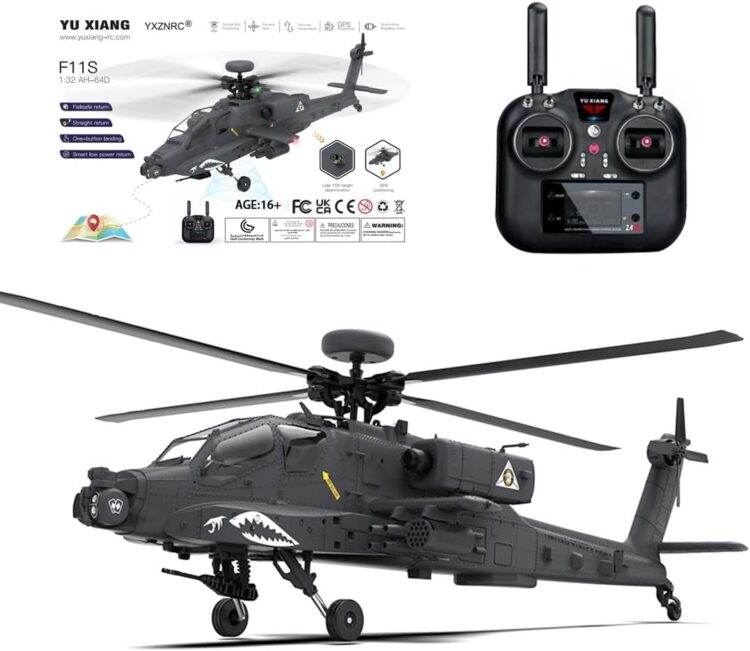
The YuXiang F11S AH-64 Apache is a 1/32 scale, GPS-stabilized military replica designed for the entry-level to intermediate RC aviation market. It is a six-channel flybarless (FBL) model built around a dual-axis co-drive brushless motor system, and it arrives as a Ready-To-Fly (RTF) package — fully assembled, mechanically tuned, and pre-bound to its included 8/9-channel high-precision 2.4GHz transmitter. The setup burden is minimal from the moment the box is opened.
The ideal buyer is a beginner or intermediate U.S. pilot who wants scale aesthetics and stress-free outdoor flight, not aggressive aerobatics. The F11S is explicitly built for those who prioritize a stable hover, realistic flight paths, and a visually imposing model over raw 3D agility or inverted flight capability.
Three core technologies define the F11S’s value for that buyer. First, the integration of GPS satellite positioning and downward-facing optical flow terrain mapping creates a fused stabilization system that actively locks the helicopter into a rigid three-dimensional spatial grid without requiring stick input. Release the controls and the aircraft brakes and hovers in place — the primary cause of catastrophic beginner crashes, orientation loss, is effectively engineered out of the experience. Second, the direct-drive 4306 560KV main motor and 1204 5200KV tail motor eliminate the fragile reduction gears, drive belts, and variable-pitch tail mechanisms of traditional scale helicopters, cutting mechanical failure points significantly while delivering high-torque wind resistance. Third, a proprietary 3S 11.1V 1800mAh 30C smart battery with integrated Battery Management System (BMS) provides 10 to 12 minutes of active flight time per charge — effectively doubling the industry average for scale models of this weight class — while automatically preventing deep-discharge damage to the cells.
At its current price tier, the F11S sits firmly in the premium entry-level bracket, demanding a higher initial outlay than standard optical-flow toy helicopters. For those who view the purchase as a long-term investment rather than a disposable experiment, that premium has clear justification.
Check current pricing and availability for the YuXiang F11S AH-64 Apache on Amazon
Pros & Cons
| Pros | Cons |
| Failsafe reliability. GPS Return-to-Home (RTH), electronic fencing, and low-battery auto-landing collectively neutralize the most common causes of total model loss for beginners. | Spatial requirements. At a 455mm rotor diameter, the F11S is entirely unsuitable for small backyards or indoor flight. Wide-open outdoor spaces are non-negotiable. |
| Wind resilience. The 4306 560KV direct-drive motor delivers immense torque, allowing the 6-axis gyro to make sub-50ms corrections and hold spatial coordinates against gusts up to approximately 12 mph. | Scale fragility. The chain gun, Hellfire missile racks, and horizontal tail stabilizers are breakable on hard, unscheduled landings. The core frame survives; the aesthetic details may not. |
| Signal integrity. The S-FHSS (Smart Frequency Hopping Spread Spectrum) protocol maintains bidirectional control up to 300+ meters while actively rejecting urban Wi-Fi and Bluetooth interference. | Proprietary battery architecture. The smart battery’s proprietary casing prevents the use of generic aftermarket LiPo packs, increasing long-term replacement costs. |
| Extended endurance. The 11.1V 1800mAh 30C architecture consistently yields 10 to 12 minutes of active flight — a meaningful step above what comparable scale models typically deliver. | Limited aerobatic envelope. A 3D mode exists, but the heavy scale fuselage, asymmetric weight distribution, and GPS-optimized flight controller programming prevent true inverted 3D aerobatics. |
| High-fidelity aesthetics. Hot runner injection molding and carbon-nylon composite blades produce a 1:32 scale presence that accurately reflects the Apache’s iconic silhouette with museum-grade consistency. | Premium initial investment. Satellite navigation, dual brushless direct-drive systems, and a 9-channel telemetry transmitter place this model in a price bracket that will deter strict budget buyers. |
Performance & Flight Experience
The true measure of the F11S is not found in a spec sheet — it is found in what actually happens from the moment a new pilot powers it up for the first time.
Setup and Calibration
While the RTF designation is accurate in its mechanical sense, operating a GPS-enabled helicopter requires completing several critical initialization steps before the first flight. After binding the 9-channel transmitter to the aircraft via the S-FHSS protocol, the single most important pre-flight task is geomagnetic compass calibration. Skipping or incorrectly performing this step produces what the manual terms the “toilet-bowl effect” — a dangerous scenario where GPS and compass data conflict, causing the helicopter to fly in erratic, widening circles during a hover attempt rather than holding position. The correct procedure requires the pilot to hold the aircraft horizontally and rotate it until the tail LED flashes green, then immediately perform a vertical rotation until a solid green lock is achieved.
Once placed on a flat surface clear of large metal structures, the Time-of-Flight (TOF) optical sensors and GPS module begin acquiring satellite lock. In an open field, achieving a minimum safe lock takes approximately 60 to 90 seconds, after which the flight controller releases its safety parameters and permits motor spool-up.
Hover Performance and Ground Effect
Liftoff with a traditional CP helicopter demands confident, smooth collective pitch input to punch through ground effect — the turbulent, unpredictable air cushion created when rotor downwash reflects off the surface within half a rotor diameter of the ground. Get it wrong and the model skids, drifts, and destabilizes.
The F11S removes this anxiety entirely. Using the auto-takeoff function, the 4306 560KV main motor spools up through a programmed sequence specifically designed to pass through the “ground resonance” danger zone — the RPM range at which rotor frequency matches the natural physical frequency of the landing gear, a potentially catastrophic vibration scenario. The flight controller manages carbon-nylon blade pitch automatically, lifting the 558g chassis cleanly through ground effect and halting at a predefined altitude.
In a GPS hover, the 6-axis gyroscope processes spatial orientation data in under 50 milliseconds. The result is a stationary, hands-off hover that a pilot can maintain indefinitely without stick input. The 1204 5200KV tail motor reacts instantly to crosswinds, maintaining absolute heading against gusts that would weather-vane a conventional tail mechanism.
Forward Flight and Wind Handling
In forward flight, the FBL system entirely masks gyroscopic precession from the pilot — the complex aerodynamic law that normally causes rotor inputs to manifest 90 degrees later in the rotation. When the cyclic stick is pushed forward, the flight controller interprets the command as a requested angle of trajectory rather than a direct mechanical servo input, calculating exact swashplate angles automatically. Banking angles are electronically limited in GPS mode, preventing the pilot from accidentally rolling past the threshold of aerodynamic recovery.
The dual brushless system actively fights wind gusts up to approximately 12 mph. When a sudden gust impacts the large scale airframe, the gyro detects the uncommanded tilt and immediately feeds maximum amperage to the main motor, altering blade pitch to hold position. GPS coordinates remain rigidly locked even as the model visibly tilts to compensate.
Battery Life and Crash Resilience
The 30C discharge rating on the smart battery allows it to deliver 54 amps of continuous current without voltage sag, ensuring the ESCs receive clean power even during high-load wind corrections. Active flight time runs 10 to 12 minutes before the low-voltage telemetry alert triggers the auto-return function. Recharge time on the included digital balance charger is approximately 90 minutes. The integrated BMS prevents deep discharge below 3.2V per cell, extending battery lifespan beyond 500 charge cycles.
For inevitable crash events, the core architecture is resilient. The CNC-machined aluminum rotor head, carbon-nylon composite blades, and direct-drive tail motor — which eliminates the fragile tail drive belt entirely — survive hard contact well. The decorative scale components, however, will break: Hellfire missile racks, the chain gun, and horizontal stabilizers are brittle. Domestic parts availability means a broken aesthetic component does not ground the aircraft.
Scale Fidelity & Build Quality
The AH-64’s silhouette is defined by its flat-plate canopy, tandem cockpit seating configuration, and aggressive, forward-leaning stance. The F11S captures these proportions with precision. The fuselage is manufactured via a hot runner injection molding process using high-strength composite engineering plastics — a technique that eliminates the visible seam lines and plastic sink marks associated with budget toy-grade molds, producing a smooth, continuous surface that successfully replicates the heavy armor plating aesthetic of the full-scale aircraft.
Scale detailing extends throughout the airframe: rivet patterns, recessed panel lines, and deep engine exhaust moldings are all present. The scale accessories are substantive — twin weapon pylons carry finely molded rocket pods and AGM-114 Hellfire missiles, a chin-mounted 30mm M230 chain gun and aerial refueling probe are accurately reproduced, and high-intensity LED navigational lights make twilight flights genuinely immersive. Two livery options are available: Desert Yellow or tactical Gray, both finished in a matte, durable paint application that avoids the glossy sheen typical of lesser toy-grade products.
Beneath the fuselage, the rotor head is a fully CNC-machined aerospace aluminum FBL design. The metallic hub and swashplate assembly eliminate the mechanical slop common in plastic linkages, ensuring servo micro-adjustments are translated into blade pitch changes instantaneously. The carbon-nylon composite main blades balance aerodynamic stiffness with just enough flex to survive minor blade strikes against grass or branches.
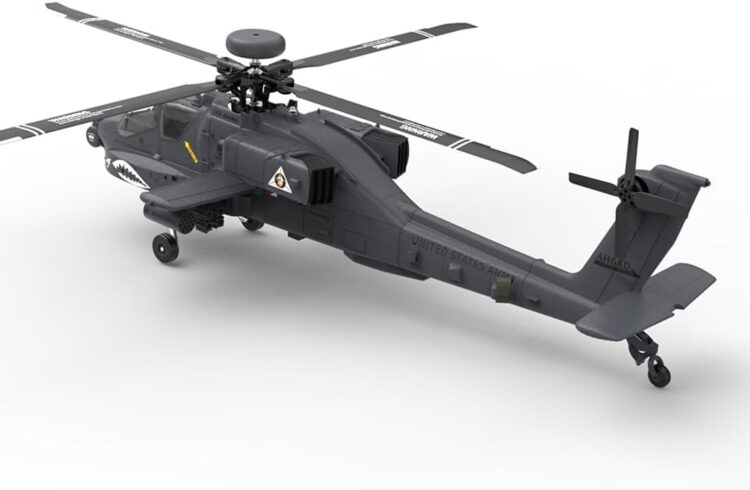
The tail features a four-blade rotor driven by the dedicated direct-drive secondary motor, maintaining the aesthetic of the modern Longbow Apache while delivering authoritative yaw control. Three 4.3g metal-gear digital servos actuate the CNC swashplate — units that offer superior centering precision and torque retention compared to analog plastic-gear alternatives, ensuring the swashplate holds position under aerodynamic load in high winds.
The 4306 560KV main motor uses magnetic steel rated to 150°C, ensuring full field strength and clean power delivery throughout extended summer sessions. The included 8/9-channel 2.4GHz transmitter features an HD LCD screen providing real-time telemetric data: battery voltage, absolute altitude, distance from home point, and GPS satellite lock strength. Control gimbals operate at 1,024 levels of resolution. The entire RTF package ships in a custom-molded, high-density carrying case housing the helicopter, transmitter, smart charger, spare blades, and maintenance tools.
Where the YuXiang F11S AH-64 Apache Really Shines
The F11S’s genuine strength is not found in any single specification. It is found in how all of these technologies work together to break a cycle that has quietly destroyed countless beginners’ enthusiasm for scale RC helicopters.
Historically, learning to fly a six-channel collective pitch helicopter meant this: three seconds of hover, a catastrophic crash, two weeks waiting for replacement parts to arrive, an afternoon rebuilding tail-belt assemblies and bent feathering shafts, and repeating the entire sequence the following weekend. The sheer operational weight of that experience — the cost, the anxiety, the technical burden — drove people away before they ever reached the moment that makes the hobby genuinely rewarding.
The F11S completely dismantles that cycle. A pilot with no prior rotary-wing experience can spool up 455mm composite rotors, hear the deep hum of the direct-drive brushless motor, and watch a highly detailed 1/32 scale AH-64 Apache lift perfectly vertically into the sky, hold position against a breeze, and execute sweeping, coordinated turns that convincingly mimic the heavy, deliberate momentum of the real aircraft. That experience — accessible on the very first battery — is what the F11S delivers that no specification table can adequately convey.
The invisible safety net of fused GPS and optical flow positioning, combined with RTH failsafes and smart battery protection, means the model’s lifespan is spent in the air providing actual enjoyment rather than on a workbench in pieces. For any pilot who has previously been turned away from scale helicopters by anxiety, cost, or complexity, the F11S makes a compelling and justified case for a second look.
View the YuXiang F11S AH-64 Apache and available bundles on Amazon
Who Should Buy It
Buy it if you are:
- A scale aviation enthusiast. If military accuracy, finely molded panel lines, and a recognizable weapons loadout matter to you, the F11S delivers an unmatched 1/32 scale experience — equally at home in the air and on a display shelf.
- A well-funded beginner. GPS and optical flow stabilization allow someone with zero prior rotary-wing experience to hover, navigate, and land safely from day one. No simulator time required.
- A relaxed weekend flyer. Intermediate pilots who want stress-free, cinematic outdoor flights without the elevated reaction demands of manual helicopters will find the F11S’s auto-return failsafes genuinely liberating.
- A tech-savvy hobbyist. Live telemetry readouts, smart battery management, and the option to integrate a 5.8GHz FPV camera for immersive cockpit-view flight will satisfy pilots who appreciate modern digital integration.
Look elsewhere if you are:
- A hardcore 3D aerobatic pilot. The heavy fuselage and GPS-optimized flight controller are stability-focused by design. For aggressive inverted flight, tic-tocs, and pirouetting maneuvers, look at dedicated machines such as the OMPHOBBY M2 V3 PRO or the Goosky Legend RS4.
- An indoor or small-backyard flyer. The 455mm main rotor diameter and 558g weight make this physically dangerous in confined spaces. Sub-micro models under 150g — such as the Blade Infusion 120 or the RC ERA C138 Bell 206 — are the correct choice for restricted environments.
- A strict budget consumer. The premium price and ongoing cost of proprietary smart battery replacements require a real financial commitment. Simpler optical-flow-only models like the YuXiang F11-N or standard micro-coaxial toys are the appropriate entry point for buyers on a tight budget.

Key Takeaways
- Beginner-proof stability. GPS, optical flow, and a 6-axis FBL flight controller deliver genuinely hands-off hovering for absolute novices — eliminating the orientation loss that defines most first-timer crashes.
- Resilient direct-drive mechanics. The 4306 560KV and 1204 5200KV brushless motors remove fragile belts and gears, withstand ~12 mph wind gusts, and survive tail strikes.
- Museum-grade scale presence. Hot runner injection molding, weapons detail, and LED nav lights produce a 1:32 Apache that stands apart from anything in this class.
- Strong long-term ROI. RTH, auto-land, signal-loss recovery, and a 500-cycle smart battery protect the investment from common pilot errors.
- Not a 3D machine. The F11S is a scale cruiser. Inverted flight and aggressive aerobatics are outside its envelope by design.