


We cut through the marketing noise to reveal which RC helicopters actually survive real-world flying — and deliver the highest return on your investment in 2026.
The RC Helicopter Market in 2026: What You Need to Know
The modern RC aviation market is simultaneously the most exciting and most treacherous it has ever been for buyers. Manufacturer catalogs overflow with studio-perfect photography and performance claims that rarely survive contact with actual aerodynamics, let alone the learning curve every new pilot inevitably faces. Sorting genuine value from expensive disappointment demands more than a cursory read of the spec sheet.
Our approach here is deliberate: we apply the Buyer’s Investment Matrix to every model in this roundup, evaluating each helicopter not merely as a consumer product but as a long-term investment of time, money, and what we call daily friction — the real-world effort required to actually get the machine airborne on a regular Tuesday afternoon. A helicopter gathering dust in a closet, regardless of its on-paper credentials, delivers zero ROI.
Alongside that framework, a Feature-to-Function Reality Check strips away the marketing jargon to assess what each machine actually delivers in the field — where it excels, where it falls short, and whether the asking price is justified by real-world performance.
What Is an RC Helicopter, After All? And What Makes RC Helicopters So Special?
An RC helicopter is one of the most mechanically complex objects in the hobby world — a dynamically unstable machine that achieves flight by driving its rotor blades through the air rotationally, rather than relying on forward airspeed the way a fixed-wing aircraft does. That fundamental architectural difference is what makes helicopters both endlessly fascinating and historically challenging to master.
The physics involved are intense. A rotating blade experiences immense centrifugal force; even a small polycarbonate or carbon fiber blade weighing three to five ounces can generate between 150 and 200 pounds of outward centrifugal force at high RPM. Lift distribution across the rotor disk is entirely non-linear — because lift is a function of the square of velocity, the outer blade sections travel significantly faster than the root, concentrating the spanwise center of lift at approximately 75% of the blade’s radius (0.75R). Operating at Reynolds Numbers between 250,000 and 500,000 at the blade tips, airfoil shape critically impacts the lift-to-drag ratio and center of pressure travel.
Managing these forces requires precise swashplate mechanics, highly responsive servos, and advanced flybarless (FBL) electronic stabilization systems to counter the inherent torque and gyroscopic precession that define rotary-wing flight. Understanding this mechanical reality — not just the marketing copy — is what separates informed buyers from disappointed ones.
Best RC Helicopters Compared at a Glance
| Model | Category | Life Span / Scalability | Daily Utility | Overall ROI |
| Flywing Bell-412 ACE | Best for Absolute Beginners | ★★★★☆ | ★★★★★ | ★★★★★ |
| RC ERA C138 Bell 206 | Best Beginner-Intermediate Value | ★★★☆☆ | ★★★★★ | ★★★★☆ |
| OMPHOBBY M2 V3 PRO | Best Small-Scale 3D Performance | ★★★★★ | ★★★★☆ | ★★★★★ |
| Flywing MH-60T Jayhawk | Best for Detailed Scale Realism | ★★★★☆ | ★★★☆☆ | ★★★★☆ |
| Goosky Legend RS4 | Best for High-End 3D Aerobatics | ★★★★★ | ★★★☆☆ | ★★★★☆ |
| JCZK 300C PRO | Best Premium Professional Collectors | ★★★★★ | ★★☆☆☆ | ★★★☆☆ |
| Blade Infusion 120 | Best Indoor/Backyard Progression | ★★★☆☆ | ★★★★★ | ★★★★☆ |
| YUXIANG F11-S Apache | Best GPS-Stabilized Military Scale | ★★★★☆ | ★★★★☆ | ★★★★☆ |
| RC ERA C032 Huey | Best for Iconic History Enthusiasts | ★★★☆☆ | ★★★★★ | ★★★★☆ |
| Blade Fusion 360 Smart | Best Advanced 400-Class Precision | ★★★★☆ | ★★★☆☆ | ★★★★☆ |
What Is the Best RC Helicopter in 2026?
Naming a single “best” RC helicopter without first asking best for whom is an exercise in futility. A 700-class 3D competition machine offers peak mechanical performance but creates enormous daily friction for a pilot with access only to a small suburban park. Conversely, a micro-scale model delivers high daily utility while lacking the mass to handle outdoor wind conditions effectively. The optimal helicopter is the one that integrates cleanly into your flying life over the long term — not the one with the most impressive spec sheet.
That said, one model in our 2026 roundup comes closest to a universal recommendation for the largest segment of the market.
Best RC Helicopter Overall: Flywing Bell-412 ACE (ideal for Absolute Beginners)

The Flywing Bell-412 ACE is a technological landmark in the 470L-class scale helicopter market, fundamentally rewriting the rules for beginner rotary flight. Equipped with the proprietary ACE Flight Controller and an M10 GPS module, it bridges the formidable gap between a traditional collective pitch helicopter and the push-button stability most pilots associate with consumer camera drones.
Applying the Feature-to-Function Reality Check here yields a surprising result: the manufacturer’s claims of effortless flying actually hold up under scrutiny. GPS hold and optical flow sensors keep the aircraft locked in a three-dimensional spatial grid even in moderate breezes, eliminating the steep learning curve normally associated with 400-sized helicopters. The result is a machine with the aesthetic presence, mechanical hum, and physical scale of a serious hobby-grade aircraft — paired with the daily friction profile of a beginner trainer.
Why It Wins
The FW-B412 earns the top overall spot by delivering an unprecedented balance of scale realism, exceptional flight time of up to 20 minutes, and technological fail-safes that protect the pilot’s financial investment. One-key return-to-home (RTH) and auto-hovering drastically reduce the likelihood of catastrophic crashes, producing the highest overall ROI in the beginner category.
Who Should Buy This RC Helicopter
This model is the quintessential choice for absolute beginners with larger budgets, scale aviation enthusiasts, and older hobbyists who want the look, feel, and sound of a large collective-pitch helicopter without the anxiety and constant repair costs associated with full-manual 3D flying.
Why You’ll Simply Love It
The sheer absence of operational anxiety sets this machine apart from everything else in its class. Release the transmitter sticks and the Bell-412 stops, brakes, and locks into a perfectly stable hover — using barometric and GPS sensors to hold altitude flawlessly — allowing you to admire the aircraft rather than fight to keep it off the ground. For a beginning pilot, that experience is genuinely transformative.
Key Features
- ACE Flight Controller & M10 GPS: Delivers drone-like stability, coordinated scale banking turns, and reliable Return-to-Home functionality that automatically lands the aircraft if signal is lost or battery voltage drops critically low.
- Quick-Release 4-Blade Rotor Head: Enhances scale authenticity while utilizing an FBL structure that provides a heavier, more realistic control feel than traditional two-blade DFC heads.
- Omnidirectional Positioning: Supports semi-automatic assisted flight modes including precision figure-8 routing and circumferential flight, producing smooth, cinematic movement without demanding advanced cyclic stick skills.
Technical Specifications
- Dimensions (L/W/H): 750mm / 240mm / 170mm
- Main Rotor Diameter: 810mm; Tail Rotor: 125mm
- Weight: 1,000g (excluding battery)
- Motors: 3508 Brushless Outrunner (Main) / 2008 Brushless (Tail)
- Battery/ESC: 4S 5000mAh LiPo/ 60A Dual Brushless ESC
- Flight Time: Approximately 20–25 minutes
Build Quality
Construction integrity relies on a robust mixture of metal components and high-quality electronic hardware. The 470L-level main mast and cross shafts provide immense structural durability against the centrifugal forces generated by the four-blade rotor head. The fuselage features excellent paint detailing, panel lines, and pre-installed navigation lights that elevate its scale presence well above typical trainer helicopters.
Pros and Cons
- Pros: Exceptional GPS-assisted stability; long flight times reduce battery-swap friction; striking scale detail; invaluable panic recovery and RTH features.
- Cons: High initial financial investment; the large 810mm rotor diameter requires a dedicated, wide-open flying field; not designed or capable of inverted 3D aerobatics.
Expected Experience With This RC Helicopter
Flight testing reveals a machine that completely removes the panic normally associated with RC helicopter flying. Push the cyclic stick and the Bell-412 moves deliberately and gracefully; release it and the helicopter stops cold. The brushless direct-drive tail motor delivers immediate yaw authority, countering main rotor torque flawlessly. The resulting experience feels deeply professional and entirely accessible — a combination this category has rarely achieved before.
What Are the Best RC Helicopters This Year?
The Bell-412 dominates the beginner scale segment, but the 2026 RC helicopter market caters to a wide spectrum of aerodynamic desires and skill sets. The following models represent the peak of their respective categories — from indestructible micro-3D trainers to premium collector pieces that command their own dedicated maintenance regimen.
Best RC Helicopters — In-Depth Reviews
2. RC ERA C138 Bell 206 – Best for Beginner-Intermediate
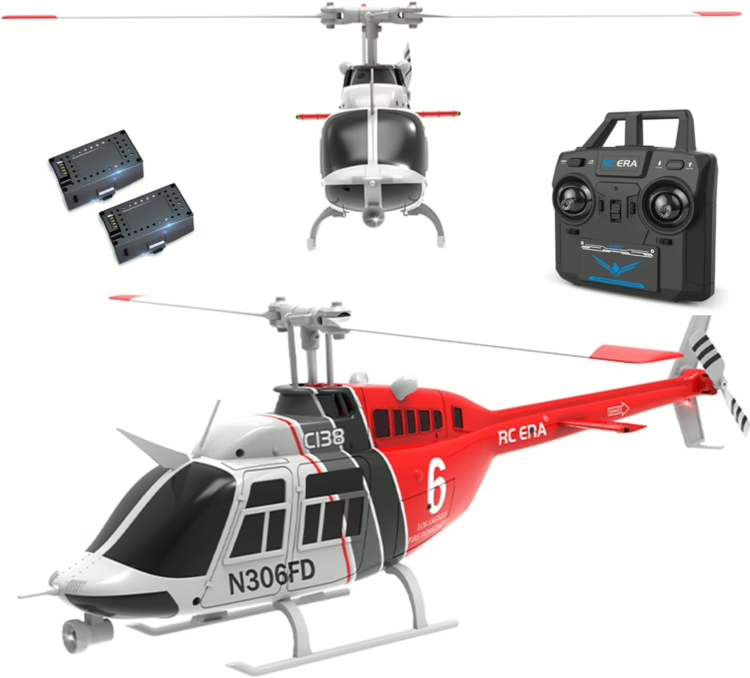
The RC ERA C138 Bell 206 is a 1/33-scale, sub-250g helicopter representing the pinnacle of beginner-friendly value in the current market. A 6-axis gyro, optical flow sensors, and barometric altitude hold bring advanced drone-style stabilization into a highly affordable, crash-resistant package.
The Reality Check: it looks like a complex scale model but flies with the inherent simplicity of a coaxial toy. It excels at low-friction daily utility — flights in a backyard or large living room are entirely feasible — but struggles in moderate winds, where the optical flow sensor fails to hold position against gusts, resulting in noticeable drift.
Who Should Buy This RC Helicopter
Budget-conscious beginners seeking their very first single-rotor experience, or enthusiasts wanting a stress-free indoor/backyard flyer that bypasses FAA Remote ID registration requirements entirely due to its sub-250g weight.
Why You’ll Simply Love It
One-key takeoff and landing mean the pilot can be hovering confidently within sixty seconds of opening the box, bypassing the hours of simulator practice traditionally required for single-rotor flight.
Key Features
- Optical Flow & Barometer System: Visually tracks the ground beneath the aircraft and monitors air pressure to lock altitude with remarkable stability.
- Modular Smart Battery: Proprietary 7.4V 350mAh pack with intelligent power management; yields 10–12 minutes of flight per charge.
- Flybarless Rotor Design: Reduces mechanical complexity while providing adequate lift and self-stability.
Technical Specifications
- Dimensions (L/H): 312mm / 101mm; Rotor Diameter: 306mm
- Weight: 95g–110g
- Motors: 1002 Brushed (Main) / 720 Brushed Coreless (Tail)
Build Quality
Constructed from PA/PC (Polyamide/Polycarbonate) plastics engineered to absorb impact rather than shatter. The injection-molded fuselage features surprisingly good panel line detail and vibrant colorways — Police, Red/White, and Camouflage — for the price point.
Pros and Cons
- Pros: Exceptionally affordable; crash-resistant materials; 12-minute flight time; sub-250g weight means no FAA registration required.
- Cons: Brushed motors have a fundamentally limited lifespan compared to brushless alternatives; easily pushed around outdoors by wind; proprietary batteries limit third-party charging options.
Expected Experience With This RC Helicopter
A highly relaxed flight envelope with smooth, predictable banking. The 6-axis stabilization governs aggressive inputs, making the C138 a supreme confidence-builder rather than a performance machine — a visual treat in the air without the pilot sweat normally associated with collective pitch mechanics.
3. OMPHOBBY M2 V3 PRO — Best Small-Scale 3D Performance

The OMPHOBBY M2 V3 PRO is a masterclass in micro-helicopter engineering. Redesigned from the ground up, this 200-class 3D helicopter shaves 25 grams off its predecessor while simultaneously increasing flight times by up to 25% during hard 3D maneuvers. The advanced OFS3 flight control system and dual brushless direct-drive motors deliver violent, instantaneous collective pitch response.
The Reality Check is blunt: this is not a toy. It excels at hardcore 3D aerobatics — tic-tocs, piro-flips, hurricanes — but demands a substantial time investment before a novice can safely manage its aggressive cyclic response.
Who Should Buy This RC Helicopter
Intermediate to advanced pilots who want an aggressive, high-performance 3D trainer capable of being flown at a local park without the logistical complexity — and danger — of transporting a 700-class competition machine.
Why You’ll Simply Love It
The tail authority is nothing short of legendary. The R13X-3 direct-drive tail motor combined with the OFS3 system locks the tail with the rigidity of much larger belt-driven helicopters, enabling flawless backward inverted flight without tail blowouts.
Key Features
- OFS3 Flight Controller: Delivers unmatched stability, complete deadband removal, and crisp collective response that mimics premium full-size FBL units.
- Direct-Drive Motors (R40X-3 & R13X-3): Eliminates main gears and belts, reducing parts count, mechanical noise, and crash-related maintenance dramatically.
- Carbon Fiber & Black Anodized Aluminum Airframe: Ultra-rigid construction survives minor crashes and prevents frame flex under heavy G-loads during aggressive pitch pumps.
Technical Specifications
- Dimensions (L/H): 415mm / 134mm; Main Rotor: 434mm / Tail: 89mm
- Weight: 320g (with 3S 750mAh 60C battery)
- Servos: DS2710MG full-metal gear
Build Quality
Engineering tolerances are exquisite. The shorter rotor head geometry and upgraded dampeners allow extreme cyclic rates and immediate response. One friction point worth noting: the battery is secured by a compression plastic flange that some pilots find fiddly during rapid field swaps, adding a minor degree of daily friction.
Pros and Cons
- Pros: Outstanding power-to-weight ratio; virtually zero mechanical slop in the swashplate; highly durable direct-drive system; exceptional tail hold.
- Cons: Battery swapping requires canopy removal; aggressive cyclic response can easily overwhelm novices; carries a premium price tag for a micro-sized helicopter.
Expected Experience With This RC Helicopter
Taking off with the M2 V3 PRO is a sensory overload. The APEX 190 main blades produce a satisfying smack during rapid collective pitch pumps. It flies “floaty” for its size, allowing complex 3D maneuvers with noticeably less collective input than older micro models required. It demands respect — and rewards precise, confident stick inputs perfectly.
4. Flywing MH-60T Jayhawk — Best for Detailed Scale Realism
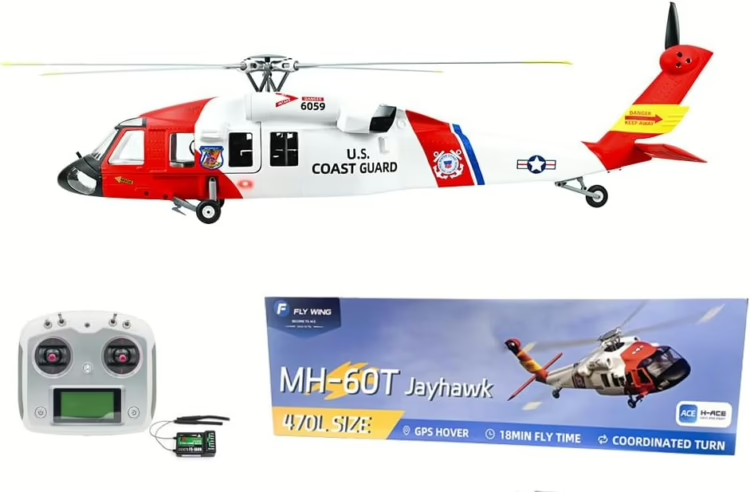
The Flywing MH-60T Jayhawk is a visually stunning 470L-size, 6-channel scale replica of the U.S. Coast Guard search and rescue helicopter. Sharing the Bell-412’s ACE flight controller and M10 GPS hardware, it delivers auto-hover, position hold, and RTH in an 850mm fuselage weighing 1,328g without battery.
The Reality Check: this helicopter heavily prioritizes visual majesty over agility. It excels in smooth, drone-like cruising and delivers scale detail that commands attention at any flying field. Fly it like a sport helicopter and the heavy fuselage and 4-blade rotor head will sustain catastrophic damage.
Who Should Buy This RC Helicopter
Scale enthusiasts, intermediate pilots, and collectors who prioritize visual authenticity, long flight times, and relaxed, stabilized cruising over high-speed maneuvers or aerobatics.
Why You’ll Simply Love It
Functional aviation lights, shock-absorbing landing gear, and authentic Coast Guard livery combine to make watching this massive 810mm rotor-disc machine execute an automated slow-speed figure-8 genuinely mesmerizing.
Key Features
- ACE Flight Controller & M10 GPS: Low-battery RTH and loss-of-signal recovery act as a digital safety net for the heavy fuselage.
- High-Efficiency Power System: The 3508 brushless main motor paired with a 4S 5000mAh LiPo yields 18–25 minutes of flight time, drastically reducing charging friction.
- Museum-Level Scale Details: Enhanced rivets, panel lines, transparent cockpit, and custom NACA 8-H-12 flat convex propellers designed for lift efficiency rather than aerobatics.
Technical Specifications
- Dimensions (L/H): 850mm / 180mm; Main Rotor: 810mm
- Weight: 1,328g (without battery)
- Motors: 3508 Brushless (Main) / 2008 Brushless (Tail)
Build Quality
A handcrafted painted monocoque body is fitted over a metal and electronic chassis with a beautifully machined quick-release 4-rotor system. The high mass — over 1.5kg flying weight — means any crash will involve significant kinetic energy transfer and expensive damage.
Pros and Cons
- Pros: 20-plus minute flight times; gorgeous authentic scale details; stress-free GPS stability; fully functional navigation lighting.
- Cons: Very expensive initial investment; large footprint requires wide-open spaces; high repair costs and maintenance friction following any significant crash.
Expected Experience With This RC Helicopter
Flight is methodical, heavy, and genuinely majestic. GPS mode locks the chassis into a rock-solid hover while fighting wind drift automatically. Transitioning to ATT (Attitude) mode enables smooth forward flight with coordinated banking that accurately mimics full-scale Coast Guard operations. The tail rotor emits a noticeable, realistic hum — a joy to fly low and slow.
5. Goosky Legend RS4 — Best for High-End 3D Aerobatics
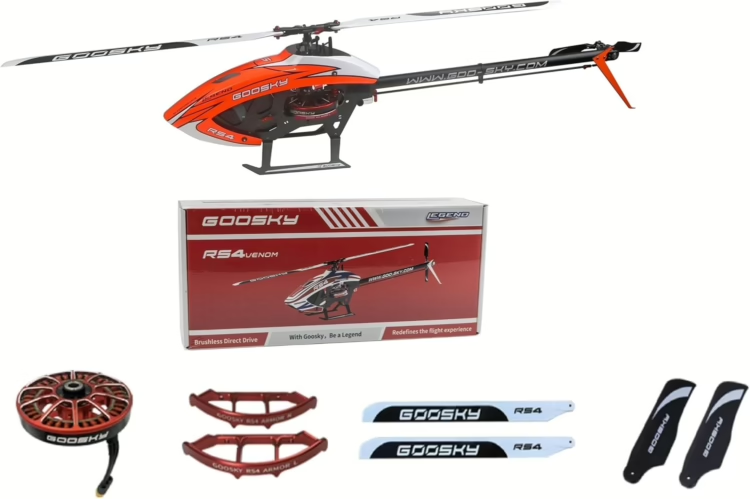
The Goosky Legend RS4 is a 380/400-class collective pitch powerhouse designed to dominate the mid-size 3D market. Its hybrid mechanical architecture pairs a massive direct-drive brushless main motor with a traditional belt-driven tail rotor — combining the maintenance advantages of both approaches in a single platform.
The Reality Check: this is high-time, high-money territory aimed squarely at serious pilots. It excels in mechanical grip and power delivery, but its PNP/Kit configuration requires the buyer to supply their own receiver and integrate the FBL system — setup friction that will immediately overwhelm any novice.
Who Should Buy This RC Helicopter
Experienced 3D pilots seeking a highly capable, 6S-powered helicopter that bridges smaller park flyers and massive 700-class competition machines.
Why You’ll Simply Love It
The direct-drive main motor completely removes gear-stripping concerns during hard collective stops, while the belt-driven tail maintains absolute mechanical authority under extreme aerodynamic loads — eliminating the tail blowouts sometimes seen on motor-driven alternatives.
Key Features
- Hybrid Drive System: Combines the maintenance-free nature of direct-drive with the locked-in reliability of a robust belt-driven tail.
- 390mm Carbon Fiber Blades: Generate immense lift and the aggressive blade “fart” sound during hard cyclic maneuvers.
- Goosky GTS+ FBL Controller (combo version): Delivers punchy, locked-in flight performance right out of the box.
Technical Specifications
- Dimensions (L/W/H): 833mm / 95mm / 217mm; Main Rotor: 872mm / Tail: 186mm
- Take-off Weight: 1,300g
- Battery: 6S 1600–1800mAh 70C LiPo required
Build Quality
Top-notch metal anodizing and an updated servo layout that accepts various third-party micro servos. The 1,300g take-off weight creates heavy disk loading, which Goosky compensates for with sheer motor wattage on 6S power.
Pros and Cons
- Pros: Bulletproof direct-drive main motor; terrifying 6S power delivery; top-tier machining and parts quality; highly agile and precise.
- Cons: Heavy disk loading requires high head speeds; demands a dedicated 6-channel radio, receiver, and advanced setup expertise.
Expected Experience With This RC Helicopter
In the air, the RS4 feels like a tethered beast. The 6S battery pushes the 390mm blades with terrifying authority. Pitch pumps send the aircraft rocketing skyward instantly, while the FBL system keeps the rotor disk perfectly level during rapid rolls.
6. JCZK 300C PRO — Best for Premium Professional Collectors

The JCZK 300C PRO is a massive 470-size, master-crafted replica of the Schweizer 300C piston-powered trainer. Governed by the H1 PRO smart flight controller on a 12-channel radio system, and built almost entirely of anodized and sandblasted alloy at 3,300g, it is an absolute statement piece of RC engineering.
The Reality Check: spectacular aesthetic ROI paired with significant daily friction. At an elite-tier financial commitment, crashes are punishing given the all-alloy construction. The approximately 10-minute flight time on the included 4S 4000mAh pack means frequent charging sessions are part of the deal.
Who Should Buy This RC Helicopter
Premium collectors, scale aviation purists, and advanced hobbyists who want a stunning, fully functional display piece that doubles as a highly stable GPS-assisted flyer.
Why You’ll Simply Love It
The craftsmanship is unparalleled in the RTF market. Opening cockpit doors, intricate instrument panels, and full-metal alloy mechanics turn heads and command respect at any flying field.
Key Features
- H1 PRO Flight Controller: GPS/BeiDou positioning, auto-hover, and one-touch RTH.
- Triple Rotor DFC Head: Flybarless alloy design lowers the center of gravity and reduces aerodynamic drag for precise scale handling.
- Full-Metal High-Voltage Servos: Alloy gears minimize backlash for accurate swashplate positioning of a 3,300g airframe.
Technical Specifications
- Dimensions (L/W/H): 700mm / 125mm / 230mm; Main Rotor: 820mm / Tail: 180mm
- Product Weight: 3,300g
- Motor: 1150W Brushless; ESC: 60A V4 Platinum; Flight Time: ~10 minutes
Build Quality
Built like a tank from anodized and sandblasted alloy throughout. Spring-damped landing gear protects the heavy chassis during hard touchdowns. The construction is genuinely impressive — though that same all-metal architecture makes crash repairs extraordinarily tedious and expensive.
Pros and Cons
- Pros: Masterpiece-level scale detailing; GPS makes hovering effortless despite the weight; high-quality alloy components throughout.
- Cons: Exorbitantly expensive; highly complex mechanical setup makes repairs tedious; heavy weight limits agility and vastly amplifies crash damage severity.
Expected Experience With This RC Helicopter
Flying the 300C PRO is about savoring the mechanics rather than fighting the sticks. The rotors spool up with a deep, realistic sound as centrifugal force locks the three blades into plane. Once airborne, the H1 PRO system holds the heavy alloy frame motionless in the sky — heavy, deliberate, and faithful to the physics of its full-size counterpart.
7. Blade Infusion 120 — Best for Indoor/Backyard 3D Progression

The Blade Infusion 120 is a sub-micro, collective pitch helicopter designed specifically to facilitate the transition from coaxial toys to 3D aerobatics. Direct-drive brushless motors for both main and tail rotors eliminate gears entirely, slashing maintenance friction and parts count in one stroke.
The Reality Check: it excels as an indoor or backyard 3D trainer. Its lightweight, gearless construction means it essentially bounces off the grass in a crash. Outdoors in anything beyond dead-calm conditions, however, the 123g airframe lacks the mass to penetrate ground effect smoothly or resist turbulence effectively.
Who Should Buy This RC Helicopter
Pilots seeking a highly durable, low-cost stepping stone into collective pitch flying, or experienced 3D pilots who want a stress-free machine to practice inverted orientations in small spaces.
Why You’ll Simply Love It
Because there is no main drive gear, stripping gears during a crash is simply not possible. Pick it up, brush off the grass, and keep flying.
Key Features
- Direct-Drive Power: 2305-1300Kv Main and 0803-12000Kv Tail brushless outrunners deliver instant torque with zero mechanical drivetrain friction loss.
- AS3X and SAFE Technology: AS3X smooths minor environmental turbulence; SAFE provides optional self-leveling and bank-angle limits for novices learning orientations.
- Linear Servos: Mounted directly to the 120-degree CCPM swashplate for immediate, slop-free cyclic response.
Technical Specifications
- Dimensions (L/H): 298mm (11.75″) / 95mm (3.75″); Main Rotor: 308mm (12.12″) / Tail: 49mm (1.92″)
- Weight: 123g (4.34 oz)
- Battery: 2S 280–300mAh LiPo
Build Quality
Impact-resistant plastics throughout the frame, canopy, and blades flex rather than break on impact. The flight control board uses rubber vibration isolation mounts — a premium mechanical detail that protects sensitive gyros from motor high-frequency oscillations.
Pros and Cons
- Pros: Outstanding crash durability; no gears to strip; SAFE tech aids learning; Spektrum Smart telemetry feedback.
- Cons: Too light for windy outdoor flying; requires a proprietary Spektrum DSMX transmitter (BNF Basic format); linear servos need occasional cleaning to prevent sticking.
Expected Experience With This RC Helicopter
In SAFE mode, the Infusion 120 flies smoothly, auto-leveling as soon as the sticks are released. Flip to 3D mode and the direct-drive motors bark to life, enabling flips, rolls, and inverted hovering with surprising agility for a sub-micro machine. It teaches essential collective pitch mechanics without the fear of expensive rebuilds.
8. YUXIANG F11-S Apache — Best for GPS-Stabilized Military Scale

The YUXIANG F11-S is a 1/32-scale replica of the Boeing AH-64 Longbow Apache. The Smart Version integrates GPS, downward optical flow, and laser radar for an exceptionally stable flight envelope in a historically accurate shell, with a control range exceeding 300 meters.
The Reality Check: it excels at blending scale realism with modern drone technology, making a complex attack helicopter accessible to beginners. However, the heavy reliance on 6G electronic stabilization masks the true physics of rotary flight, and the intricate scale weapon mounts are fragile during hard landings.
Who Should Buy This RC Helicopter
Military aviation enthusiasts, scale modelers, and beginners who want a visually imposing helicopter that will not immediately crash due to pilot error.
Why You’ll Simply Love It
From the shock-absorbing landing gear to the 4-blade tail rotor and detachable weapon pods, it looks like a static display model but flies with the push-button ease of a consumer drone.
Key Features
- Multi-Sensor GPS Stabilization: Combines GPS, optical flow, and barometric data for hands-free hovering and one-key RTH.
- Dual-Axis Co-Drive Motors: 4306 560KV brushless main and 1204 5200KV tail motors provide quiet, efficient power without complex gear trains.
- Intelligent Modular Battery: 3S 1800mAh 30C pack with built-in charge and health indicators; yields approximately 12 minutes of flight.
Technical Specifications
- Dimensions (L/H): 485mm / 155mm; Rotor Diameter: 455mm
- Weight: 558g; Control Range: Over 300 meters
Build Quality
High-strength composite engineering materials formed via hot runner injection molding create an elastic, tough airframe. The CNC machined rotor head reduces weight and vibration, ensuring optical sensors are not disrupted by mechanical noise.
Pros and Cons
- Pros: Gorgeous 1/32-scale details; GPS makes it extremely difficult to lose; smooth brushless power; respectable flight time.
- Cons: Fragile scale accessories; high price tier for the S version; 6G mode restricts true aerodynamic agility.
Expected Experience With This RC Helicopter
After a brief compass calibration, lifting off is as simple as pushing the throttle. The F11-S climbs and parks itself in the sky while the flight controller battles wind to maintain heading. One-key figure-8 mode makes simulating a combat patrol effortless — no cyclic skill required.
9. RC ERA C032 Huey — Best for Iconic History Enthusiasts

The RC ERA C032 captures the iconic profile of the UH-1 Huey in a compact 1/48-scale package. Like its sibling, the C138, it deploys optical flow, TOF (Time of Flight) laser, and barometric sensors to manage altitude and position automatically, yielding approximately 13 minutes of flight time.
The Reality Check: a fantastic low-friction entry point for history enthusiasts in indoor and calm outdoor environments. The pilot will, however, quickly reach a skill ceiling where the helicopter’s programming prevents the development of advanced cyclic inputs.
Who Should Buy This RC Helicopter
New pilots who love Vietnam-era military history and want an affordable, ready-to-fly model that requires absolutely zero building, tuning, or mechanical setup.
Why You’ll Simply Love It
The TOF obstacle detection — a rare feature at this price point — gives the helicopter a sixth sense about walls and floors, making living room flights genuinely furniture-safe.
Key Features
- Triple-Sensor Positioning: Barometer, optical flow, and TOF laser work in tandem for rock-solid altitude holds.
- Brushless Main Motor: Smoother and more durable than the brushed motors found on cheaper alternatives like the C138.
- One-Button Inverted Flight: A novelty feature that automatically flips the helicopter without requiring actual pilot skill.
Technical Specifications
- Dimensions (L/H): 297mm / 92mm; Rotor Diameter: 315mm
- Weight: 115g; Battery: 7.4V Li-ion (~13 minutes flight time)
Build Quality
Flybarless head design and PA/PC impact-resistant plastics throughout. Main rotors are designed to fold backward on impact, transferring kinetic energy away from the rotor hub and protecting servo gears during crashes.
Pros and Cons
- Pros: Excellent value; highly crash-resistant; 13-minute flight time; smart obstacle avoidance.
- Cons: Proprietary charging system limits daily utility; struggles against outdoor wind; automated stunts do not teach real 3D mechanics.
Expected Experience With This RC Helicopter
Press auto-takeoff and the Huey rises to eye level and holds position. The three digital servos provide crisp but heavily governed responses — perfect for slow, methodical scale flying while enjoying the LED navigation lights and military aesthetic without breaking a sweat over pitch curves.
10. Blade Fusion 360 Smart — Best for Advanced 400-Class Precision

The Blade Fusion 360 Smart is an advanced 400-class collective pitch helicopter designed to bridge park flyers and professional 3D machines. It integrates Spektrum’s Smart ecosystem directly into the ESC and receiver, delivering real-time telemetry — voltage, current, RPM, temperature — to the transmitter over a single wire.
The Reality Check: superb for Spektrum-ecosystem pilots wanting a fully integrated BNF experience with carbon fiber mechanics and zero assembly. The trade-off is complete lock-in to the Spektrum platform. Running on 3S power, the 915g airframe also lacks the violent “pop” of 6S competitors without a power system upgrade.
Who Should Buy This RC Helicopter
Intermediate pilots who already own a Spektrum transmitter and want a mid-sized, highly durable 3D trainer without the build friction of assembling a kit from scratch.
Why You’ll Simply Love It
The SAFE technology provides a programmable panic button — pressing the switch during a disorienting aerobatic maneuver instantly levels the rotor disk, potentially saving hundreds of dollars in crash damage.
Key Features
- Spektrum 6250HX FBL & Avian 45A Smart ESC: Real-time telemetry via single-wire integration prevents battery overdischarge and provides live motor health data.
- SAFE Technology: Self-leveling and bank-angle limits assist pilots safely learning new orientations.
- Carbon Fiber & Aluminum Frame: Rigid construction ensures cyclic inputs translate directly to the rotor head without frame flex robbing control authority.
Technical Specifications
- Dimensions (L/H): 685mm (26.96″) / 190mm (7.48″); Main Rotor: 796mm (31.33″) / Tail: 350mm (13.77″)
- Weight: 915g (32.27 oz)
- Battery: 3S 2200mAh 50C LiPo (IC3 connector)
Build Quality
Top-tier engineering for a BNF model. Features 350mm carbon fiber main blades, an oversized tail boom that eliminates the need for boom supports, and sub-micro digital metal-geared servos that resist stripping during hard 3D flying.
Pros and Cons
- Pros: Superb telemetry integration; SAFE panic recovery; stiff and durable CF frame; zero assembly required.
- Cons: 3S power is conservative for hardcore 3D; requires a Spektrum transmitter; expensive for a BNF model.
Expected Experience With This RC Helicopter
The Fusion 360 feels planted and precise. In normal modes it is a docile sport flyer; engage idle-up and the 800Kv outrunner provides enough head speed for loops, rolls, and inverted flight. Wide-stance landing gear makes autorotation practice highly forgiving, and smart telemetry ensures the pilot never accidentally drains a battery past the point of chemical damage.
What to Look for in a High-Quality RC Helicopter?
The Selection Criteria Explained
Every helicopter in this roundup was evaluated through three core criteria of the Buyer’s Investment Matrix — a methodology designed to strip away marketing hyperbole and focus strictly on real-world operational value.
- Life Span (Durability and Scalability): A high-quality RC helicopter must survive the learning curve. This means evaluating the elasticity of plastics, the rigidity of carbon fiber components against centrifugal force, and whether the flight controller allows the pilot to unlock higher performance modes as skills improve. Models that shatter easily or offer no progression pathway score poorly here.
- Daily Utility (Low Daily Friction): How much effort does it actually take to fly? Battery charging ecosystems, transportation requirements, and setup times all factor in. A sub-micro helicopter that charges via USB and flies safely in a backyard offers high daily utility. A 700-class machine requiring a 6S charging station and a 30-minute drive to a dedicated AMA field presents high daily friction — which is precisely how expensive helicopters end up gathering dust rather than flying hours.
- Overall Return on Investment (ROI): This is the Feature-to-Function Reality Check in practice. Does the mechanical and aerodynamic performance justify the total cost of ownership? Spare parts availability and pricing, servo quality, and whether the stabilization technology actually performs as advertised in real-world wind conditions all factor into the final verdict.
How to Choose the Right RC Helicopter for You
Three questions cut to the heart of every RC helicopter purchase decision.
- Assess your honest skill level. If you have never flown an RC aircraft, avoid 6-channel collective pitch (CP) helicopters that require full manual control. Invest instead in models equipped with 6-axis gyros, optical flow sensors, or GPS — such as the RC ERA C138 or Flywing Bell-412 ACE — that automatically self-level, preventing instant crashes and reducing time friction dramatically.
- Evaluate your flying environment. Don’t purchase a 400-class or larger helicopter if your only available space is a small backyard. Heavy rotor blades demand large, open spaces due to the massive centrifugal forces involved. For indoor or small-yard flying, choose a sub-micro model under 150g — the Blade Infusion 120 is purpose-built for exactly these constraints.
- Calculate the true total cost of ownership. The initial purchase price is only one part of the financial investment. Research spare blade costs, tail boom pricing, and battery availability before committing. A “cheap” helicopter becomes a poor investment if replacement parts are unavailable, proprietary, or prohibitively expensive. Prioritize established brands with robust domestic parts support.
You Bought It, Now What?
RC Helicopter Flying Tips
Once your helicopter arrives, understanding the aerodynamics and mechanics of rotary flight separates pilots who progress from those who simply repair. Manufacturer manuals teach you how to turn it on — physics teaches you how to fly it.
- Respect centrifugal force and safety: Never stand in the tip-path-plane — the horizontal plane where the blades spin — while a rotor is spinning. Centrifugal forces on blades are immense; a metal fatigue failure at the feathering spindle bolt can detach a blade at full RPM. Ensure all bolts are tight and apply thread-locker during maintenance.
- Escape ground effect quickly: When hovering inches off the ground, the downwash recirculates and creates a turbulent cushion of air known as “ground effect,” causing the helicopter to twitch erratically. Smoothly punch the collective to lift the aircraft at least two to three feet into clean air for a stable hover.
- Watch for ground resonance: Certain FBL rotors can experience ground resonance — a destructive mechanical vibration that occurs when rotor RPM matches the natural frequency of the landing gear. If the helicopter begins shaking violently on the skids while spooling up, immediately lift off into a hover to break the resonance cycle, or shut the throttle down completely.
- Understand gyroscopic precession: When you push the cyclic stick forward, the swashplate changes blade pitch 90 degrees before the blades reach the front of the helicopter. Modern FBL controllers calculate this phase angle automatically, but understanding it helps diagnose mechanical tracking issues.
- Use training gear: For your first flights with a manual collective pitch machine, attach training gear — carbon rods with ping-pong balls on the ends — to the skids. This mechanically lowers the center of gravity, widens the footprint to counter the Centrifugal Restoring Moment (CRM), and dramatically reduces the chances of a dynamic rollover during clumsy landings.
Final Words
Investing in an RC helicopter in 2026 is no longer a mechanical gamble for pilots who do their homework. Advanced GPS modules, direct-drive brushless motors, and smart telemetry have collectively stripped away much of the friction that historically plagued the hobby’s entry points. The Buyer’s Investment Matrix makes the path forward clear: the “best” model is dictated entirely by your specific lifestyle, flying environment, and honest skill level.
For the absolute beginner who wants zero friction and rock-solid scale stability, the Flywing Bell-412 ACE is the undisputed champion. For the seasoned pilot seeking raw power and 3D supremacy in a compact package, the OMPHOBBY M2 V3 PRO and Goosky Legend RS4 offer the highest performance ROI in their respective classes. Choose the model that fits your operational reality, respect the mechanics of rotary flight, and conquer the sky.
FAQs
What is the difference between Fixed Pitch (FP) and Collective Pitch (CP)?
Fixed Pitch helicopters change altitude by varying motor RPM. They are mechanically simpler but respond slowly and struggle in wind due to slow motor response times. Collective Pitch helicopters maintain a constant, high rotor RPM and change altitude by altering the pitch angle of the blades. CP models are far more agile, handle wind better, and are capable of inverted flight.
Do I need to register my RC helicopter with the FAA?
In the United States, any RC aircraft weighing 250 grams (0.55 lbs) or more must be registered with the FAA, and the pilot must comply with Remote ID regulations. Micro helicopters like the RC ERA C138 (95g) are fully exempt from this requirement.
What does a Flybarless (FBL) system do?
Older helicopters used a mechanical flybar with paddles above the main rotor to physically dampen and stabilize cyclic inputs. Modern FBL systems replace that mechanical bar with a 3-axis electronic gyroscope computer that instantly adjusts the servos to keep the rotor disk stable, automatically managing gyroscopic precession that would otherwise destabilize the airframe.

Key Takeaways
- GPS technology has transformed the beginner scale market: The Flywing Bell-412 ACE and MH-60T Jayhawk use M10 GPS and ACE flight controllers to deliver drone-like stability in large-scale, highly realistic airframes — making 470L-class helicopters genuinely accessible to novice pilots.
- Direct-drive is the new performance benchmark: The OMPHOBBY M2 V3 PRO and Goosky Legend RS4 eliminate gear trains via brushless direct-drive main motors, reducing maintenance friction and maximizing 3D aerobatic responsiveness.
- Sub-250g models maximize beginner accessibility: The RC ERA C138 and C032 Huey use optical flow and barometric sensors to deliver crash-resistant, FAA-registration-exempt platforms ideal for indoor and low-risk outdoor flying.
- Daily friction — not specifications — determines real-world ROI: Skill level, flying environment, and total cost of ownership should drive every purchasing decision in this category. The best helicopter on paper is rarely the best helicopter for you.