


A published 157 grams, three SAFE modes, and a Panic button. The catch? This BNF Basic needs your radio, battery, and charger, and “anywhere” still means a big field and calm air.
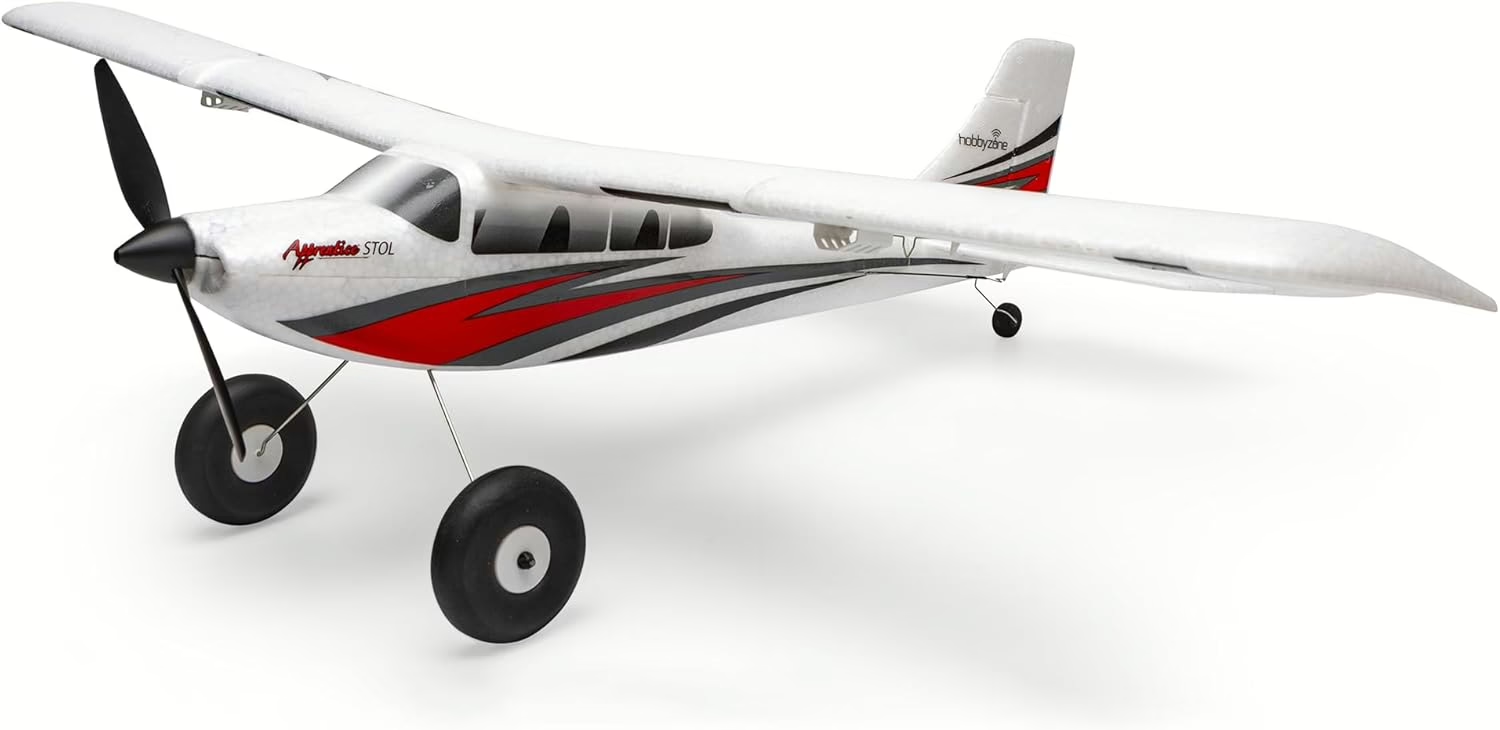
Plenty of first airplanes end up grounded for reasons that have nothing to do with flying: the box lacked a radio, or the field was too small. If you’ve been shopping the best RC planes for a first trainer, the HobbyZone Apprentice STOL S 700 BNF Basic (HBZ6150) is probably on your list. Yes, it flies under 250 grams with its recommended pack. No, “anywhere” doesn’t mean your backyard: HobbyZone’s own manual calls for lots of open space and calm air, and FAA recreational rules still apply.
Quick Verdict
Buy the Apprentice STOL S 700 BNF Basic if you already own a compatible 6+ channel Spektrum DSMX transmitter (or the Spektrum SLT6LP), can reach a large open field, and will wait for calm days. For that pilot, it packs a well-documented beginner toolkit into a compact airframe:
- Staged help: three SAFE (Sensor Assisted Flight Envelope) modes plus a Panic Recovery button.
- Light weight: a published 5.5 oz (157 g) with the recommended 2S 300mAh pack, under the FAA’s 250-gram registration threshold for recreational flyers.
- Installed brushless power: Spektrum motor, Smart Lite ESC (electronic speed control), four servos, and a dual-protocol receiver.
The decisive caveat: this Bind-N-Fly (BNF) Basic ships without a transmitter, battery, or charger. Starting from zero? Price out the Ready-To-Fly (RTF) version, HBZ6100, first. The manual also asks for calm conditions below 5–7 mph.
Here’s what it really takes to get airborne, and how it stacks up against the Timber, Sport Cub, and AeroScout.
Brief Overview
What it is
The Apprentice STOL S 700 is a 27.6-inch (700 mm) span, high-wing RC (radio-controlled) trainer from HobbyZone, distributed by Horizon Hobby, LLC, which rates it Skill Level 1. Four 2.2 g linear servos drive the two ailerons, elevator, and rudder; the ESC handles throttle. HobbyZone markets it as a STOL (short takeoff and landing) design with oversized tires and a steerable tailwheel; it has no flaps.
Who it’s for
The closest fit is a first-time or returning pilot who already owns supported Spektrum gear, has a large field, and can fly on calm days. Instructors may find its staged assistance useful. Still comparing? See our best RC planes for beginners.
Standout features
- SAFE in three steps. Beginner limits pitch and roll and self-levels; Intermediate widens the limits; Experienced drops them but keeps AS3X stabilization.
- Light, brushless package. A Spektrum 1810-2000Kv brushless outrunner on a 2S 300mAh pack.
- Serviceable airframe. Slot-in gear, a two-thumb-screw wing, repairable foam, and a full parts list.
AT A GLANCE
- Model: Apprentice STOL S 700mm BNF Basic with SAFE (HBZ6150)
- Manufacturer/Distributor: HobbyZone / Horizon Hobby, LLC
- Wingspan: 27.6 in. (700 mm)
- Length: 19.29 in. (490 mm)
- Weight: 5.5 oz (157 g) with recommended 2S 300mAh pack; 4.9 oz (140 g) without
- Pilot skill level: Beginner (Horizon Skill Level 1)
- Assembly: Slot-in gear; wing attaches with two thumb screws
- Power req’d: 2S 7.4V 300mAh LiPo, 3-pin JST-PH connector
- Radio req’d: 6+ channel Spektrum DSMX, or Spektrum SLT6LP
- Price: Check current price
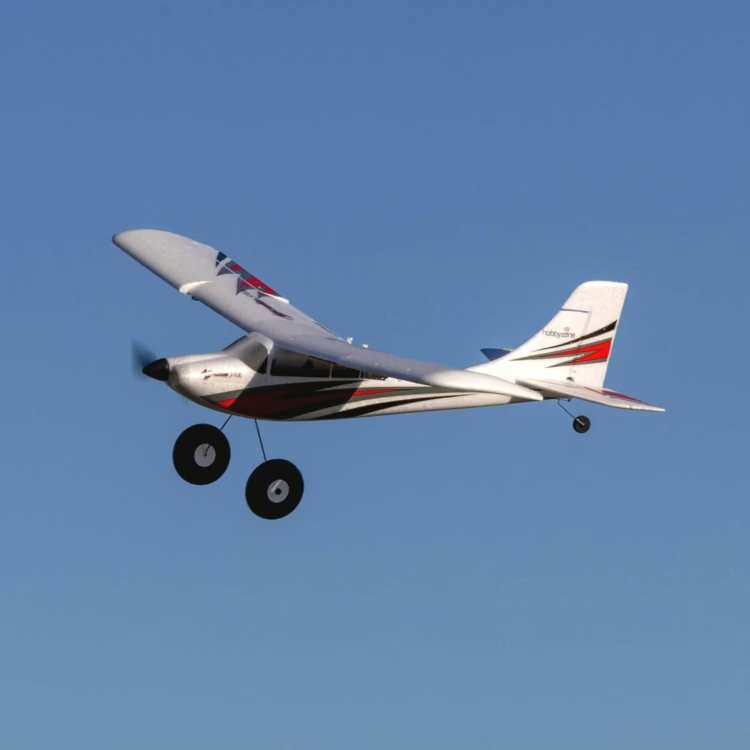
Already flying a compatible Spektrum radio with a 2S charger on the bench? Check the current price and availability of the HobbyZone Apprentice STOL S 700 BNF Basic on Amazon, and confirm the listing is the HBZ6150 BNF Basic. Stock note: on Oct. 14, 2026, Horizon Hobby listed it on backorder (January 2027 estimate); Tower Hobbies showed the same January 2027 estimate.
Pros & Cons
HITS
- Three SAFE modes plus Panic Recovery build skills in stages
- Published 157 g: no FAA registration for recreational flight (the FAA’s TRUST test still required)
- Installed brushless power with telemetry on compatible Spektrum radios
- Minimal assembly: slot-in gear, two thumb screws
- Repairable foam backed by a full parts list
MISSES
- No transmitter, battery, or charger included
- Calm air only: below 5–7 mph per the manual
- 1,300 feet of recommended clearance, far beyond a backyard
- No flaps, and no published measurements back the STOL label
What the BNF Basic Really Takes to Fly
Many pilots read “Bind-N-Fly” as “bind your transmitter and go.” This one isn’t that simple. Horizon’s HBZ6150 listing asks you to supply:
- A 6+ channel transmitter. The manual documents setup for Spektrum DSMX radios in the DX, NX, and iX families, plus the SLT6LP (SPMR1275); it lists the NX6 (SPMR6775) as an option.
- A 2S 7.4V 300mAh LiPo with a 3-pin JST-PH connector, such as the recommended Spektrum SPMX3002S30.
- A compatible 2S charger. Spektrum’s 2S USB-C charger (SPMXC0020) also needs a USB-C power supply and cable.
- An FAA TRUST certificate. The Recreational UAS Safety Test is free and online.
WARNING: The manual cautions that SLT transmitters other than the SLT6LP won’t deliver full functionality, and it documents no other radio brands. Confirm that flight modes, Panic Recovery, and throttle cut all work before flying.
BNF or RTF? The HBZ6100 RTF adds the SLT6LP, battery, USB-C charger, four AA batteries, and a RealFlight Trainer Edition trial key. Horizon’s RTF page says nothing else is needed, but the manual still calls for a USB-C power supply and cable. Our rule: own a supported radio, buy the BNF; starting from scratch, compare the RTF’s complete package against the BNF plus separate gear.
Budget for extra packs, spare 6 x 3.5 props (HBZ6105), and a landing gear set (HBZ6110). The limited warranty excludes crash damage.
Worth the Price? How It Stacks Up
Value hinges on your flight box. For a supported-radio owner wanting a registration-free assisted trainer, the BNF is a logical buy; zero-gear buyers and short-field enthusiasts have better fits.
| Model | Published weight | Battery | Assistance | FAA registration (recreational) | Best for |
| Apprentice STOL S 700 BNF Basic (HBZ6150) | 157 g with 2S 300mAh | 2S 300mAh, JST-PH | SAFE: three modes + Panic | Not required under 250 g | Owners of supported radios |
| Apprentice STOL S 700 RTF (HBZ6100) | Same airframe and pack | Battery and charger included | Same | Not required under 250 g | Buyers starting from zero |
| E-flite UMX Turbo Timber Evolution BNF Basic (EFLU8950) | 153 g with 3S 300mAh | 2S/3S 280–300mAh, JST-RCY (adapter for JST-PH) | SAFE Select + AS3X; functional flaps, optional slats | Not required under 250 g | Pilots ready for Skill Level 2 |
| HobbyZone Sport Cub S 2 BNF Basic (HBZ44500) | 61 g with 1S 150mAh | 1S 150–200mAh, ultra-micro connector | SAFE | Not required under 250 g | Shoppers wanting a smaller 1S trainer |
| HobbyZone AeroScout S 2 1.1m BNF Basic (HBZ385002) | Well over 250 g | 3S 1300–2200mAh, EC3/IC3 | SAFE | Required, plus a Remote ID route | Pilots wanting a larger trainer |
- RTF: the same airplane, fewer shopping decisions.
- UMX Turbo Timber Evolution: flaps and a 3S option, but rated Skill Level 2, a logical second airplane.
- Sport Cub S 2: smaller and lighter on 1S power; no published head-to-head data compares wind handling.
- AeroScout S 2: larger, but it brings registration plus either a Remote ID module or flying at an FAA-recognized identification area (FRIA).
Expected Experience with HobbyZone Apprentice STOL S 700 BNF Basic
HobbyZone’s instruction manual sets the routine: brief mechanical assembly, then real effort on radio setup and preflight.
Unboxing and assembly
The gear slides into a slot under the fuselage. Plug both aileron leads into the Y-harness with tabs and wire colors aligned, seat the wing’s front tabs without pinching wires, and snug the two thumb screws gently.
Radio setup on your Spektrum transmitter
On a DX, NX, or iX radio, the manual’s sequence runs:
- Create a new airplane model.
- Assign Channel 5 (Gear) to Switch B for the three modes and Channel 6 (Aux1) to Button I for Panic.
- Set rates on switches F, C, and G: 100%/10% expo high, 70%/5% expo low; never below 50%.
- Put throttle cut on Switch H at -100%, then bind and confirm every control and mode.
- On compatible AirWare radios, set the telemetry low-voltage alarm to 3.4V per cell and motor poles to 12.
Preflight checks
With the recommended pack installed, check the center of gravity (CG): 35–40 mm (about 1.4–1.6 in.) behind the leading edge at the wing root. Keep the airplane still while it initializes. Check control direction in Experienced mode with throttle cut on. Range-test before every session using your transmitter’s range-check mode, and set a 6–8-minute timer.
First flights in Beginner mode
The manual recommends Beginner mode, low rates (high-rate elevator for landing), and a ground takeoff from hard, level ground, or a helper’s hand launch. Advance progressively to full throttle with gentle up elevator, steering into the wind with rudder. SAFE assists; it isn’t an autopilot. The Academy of Model Aeronautics offers an Intro Pilot Ground School and recommends mentor-guided training, and RealFlight Trainer Edition (RFL1205D) adds simulator practice.
Wind, space, and the STOL promise
HobbyZone’s marketing cites winds up to 5 mph and smaller spaces. The manual is stricter: 1,300 feet (400 m) of clear space in all directions and calm conditions below 5–7 mph. We’d plan around the manual’s space figure and the 5 mph wind number. As of Oct. 14, 2026, no published independent test documents this model’s takeoff distance or wind handling.
Durability, repairs, and support
The airframe is EPO foam; the manual allows hot glue, CA (cyanoacrylate), or epoxy for common repairs. Reaching the receiver or tail servos means cutting the decal along the fuselage seam, then rejoining it with clear tape. When low-voltage cutoff (LVC) pulses the motor, land immediately; repeated flights to LVC damage the pack. The manual lists two receiver part numbers (SPMAS6420A and SPMAS6420AA), so confirm any replacement with Horizon. No published long-term test documents crash survival or repair times.
Where the HobbyZone Apprentice STOL S 700 BNF Basic Really Shines
The Apprentice’s real strength is a graduated path. Start in Beginner mode, where neutral sticks bring the wings level, then step up to Intermediate and Experienced as confidence builds, with Panic Recovery in reserve when there’s room to use it. That can make early sessions feel more like practice than survival.
Two thumb screws, small packs, and no registration requirement keep field prep simple, though the CG, control, range, and wind checks still come first. Instructors get a self-leveling Beginner mode and Panic Recovery to lean on with a student, and owners of compatible Spektrum AirWare radios get live voltage, current, and temperature telemetry from the Smart ESC.
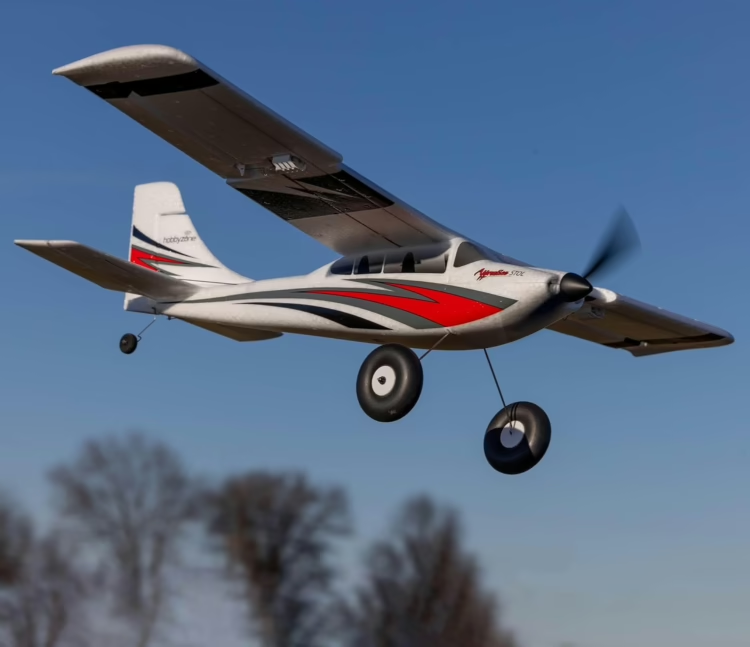
HobbyZone Apprentice STOL S 700 BNF Basic Three-mode SAFE training at a published 157 g, for pilots who already fly a supported Spektrum radio. Check price on Amazon
Who Should Buy It (and Who Shouldn’t)
Buy it if you are:
- A first-timer who already owns a 6+ channel Spektrum DSMX radio (or the SLT6LP) and 2S charging gear.
- An instructor or club mentor wanting a compact SAFE trainer and a big field to teach on.
- A returning pilot wanting a registration-free recreational trainer for calm mornings at a large park or club field.
Skip it if you are:
- Starting with no radio; the RTF (HBZ6100) bundles the gear.
- Flying a radio outside HobbyZone’s documented setup path.
- Limited to a backyard or regularly windy sites.
- After flaps, optional slats, and 3S power; the UMX Turbo Timber Evolution fits better.
- Buying for a child under 14; the manual says it isn’t for children under 14 and isn’t a toy.
FAQ
Q: Is the HobbyZone Apprentice STOL S 700 BNF Basic a good first RC plane if I’ve never flown before?
A: The Apprentice STOL S 700 BNF Basic is a reasonable first trainer if you have supported equipment, a large field, and some guidance.
- Beginner mode limits pitch and roll and self-levels with centered sticks.
- Panic Recovery needs height and clear space to work.
- Simulator time and a mentor help; no electronic aid guarantees a crash-free first flight.
Q: What transmitter do I need to fly the Apprentice STOL S 700 BNF Basic, and will my FlySky or RadioMaster radio work?
A: The Apprentice STOL S 700 BNF Basic is documented for a 6+ channel Spektrum DSMX transmitter or the Spektrum SLT6LP.
- The manual covers DX, NX, and iX setup, plus the SLT6LP.
- It documents no FlySky or RadioMaster setup, so full function of the modes and Panic Recovery is unconfirmed.
- If your radio isn’t on that path, the RTF removes the guesswork.
Q: Do I need to register the Apprentice STOL S 700 with the FAA or pass any test before I fly it in the U.S.?
A: A stock Apprentice STOL S 700 flown recreationally under 250 grams needs no FAA registration, but you must pass the free TRUST test and carry proof.
- Fly within visual line of sight and give way to crewed aircraft.
- Stay at or below 400 feet in Class G airspace; controlled airspace needs prior authorization.
- Follow a community-based organization’s safety guidelines, per the FAA’s recreational flyer rules.
Q: How long does the Apprentice STOL S 700 fly on one battery, and how long does charging take?
A: The Apprentice STOL S 700 manual tells you to set a 6–8-minute timer on the recommended 2S 300mAh pack.
- That’s a timer setting, not a measured flight time.
- The RTF’s USB-C charger (SPMXC0020) needs about 45–60 minutes for a fully discharged pack; times vary with the USB-C power source, which should deliver at least 1 amp.
- Land when LVC pulses the motor; extra packs extend sessions.
Q: How much wind and space do I really need to fly the Apprentice STOL S 700 safely?
A: The Apprentice STOL S 700 manual calls for at least 1,300 feet (400 m) of clear space in all directions and calm conditions below 5–7 mph.
- HobbyZone’s marketing cites winds up to 5 mph; treat that as your ceiling.
- The manual notes that wind at flying altitude can be stronger than at ground level.
- The clearance figure is HobbyZone’s recommendation, not an FAA rule, and doesn’t replace landowner permission.
Q: What should I do step by step if I lose orientation or the plane starts oscillating in flight?
A: For lost orientation on the Apprentice STOL S 700, use Panic Recovery; for oscillation, slow down and land.
- Lost orientation: hold the Panic button and neutralize the sticks (height and clearance permitting).
- Release once the airplane is in stable level flight, then resume a gentle climb.
- Oscillation: reduce airspeed and throttle, then land.
- Disconnect the battery and check for a damaged or imbalanced prop, vibration, a loose receiver or controls, and worn parts.

Key Takeaways
- The Apprentice STOL S 700 BNF Basic pairs three SAFE modes and Panic Recovery with a published 157 g flying weight.
- The BNF needs a supported transmitter, a 2S 300mAh JST-PH pack, and a charger; no-radio buyers should compare the RTF.
- Plan for calm air and a large field; staying under 250 grams skips registration, not TRUST.
- Choose the UMX Turbo Timber Evolution for flaps and 3S power, or the AeroScout S 2 for a larger format.