
The Blackbird once outran missiles. E-flite’s twin-40mm EDF brings that Cold War icon down to earth — but only pilots who respect its delta-wing demands will keep it airborne.
Scaling an Aerospace Legend
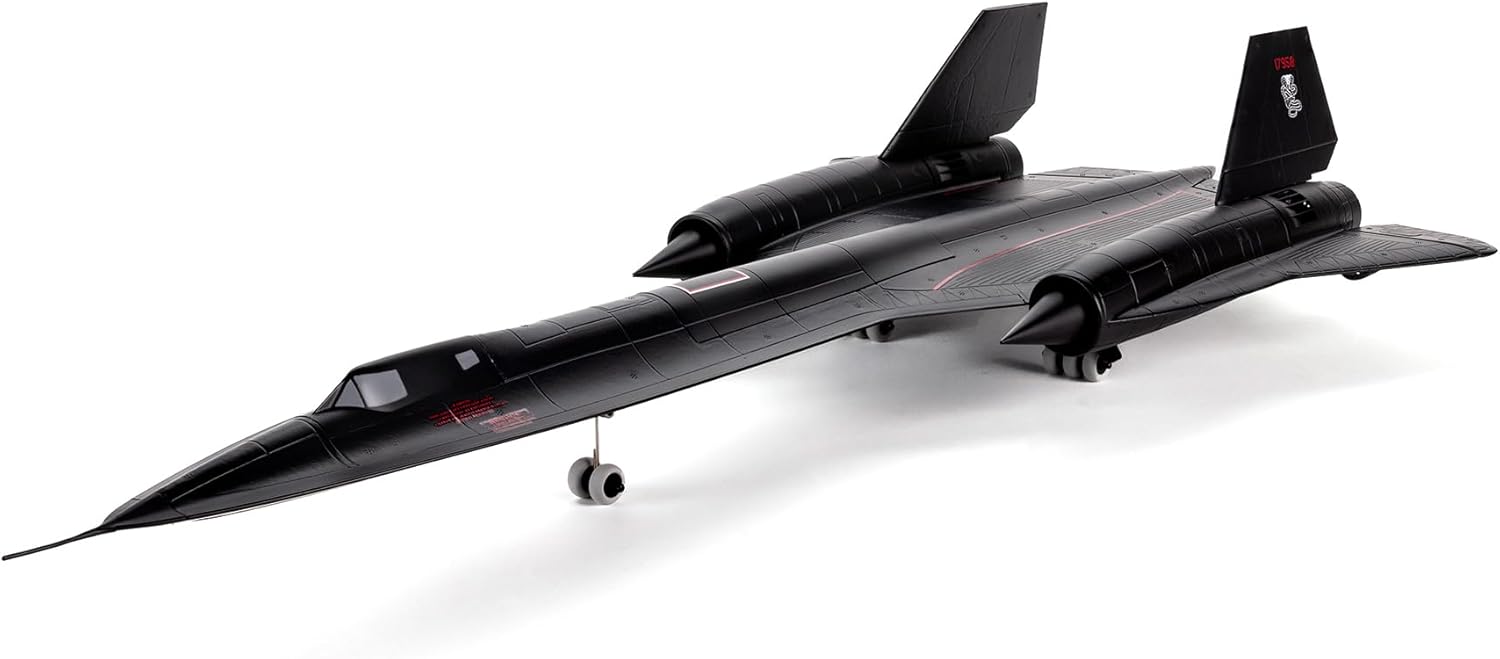
The Lockheed SR-71 “Blackbird” was engineered in the 1960s by Skunk Works to be unhittable. Flying at a sustained altitude of 85,069 feet and recording a top speed of Mach 3.3 (2,193.2 mph), it outran every interceptor and surface-to-air missile in the Soviet arsenal. Its highly swept delta wing and prominent fuselage chines weren’t designed for aesthetics — they were shaped by the physics of hypersonic shockwave management. That same design heritage is precisely what has made the SR-71 one of the most historically difficult airframes in aviation to successfully translate into a viable, mass-market RC model.
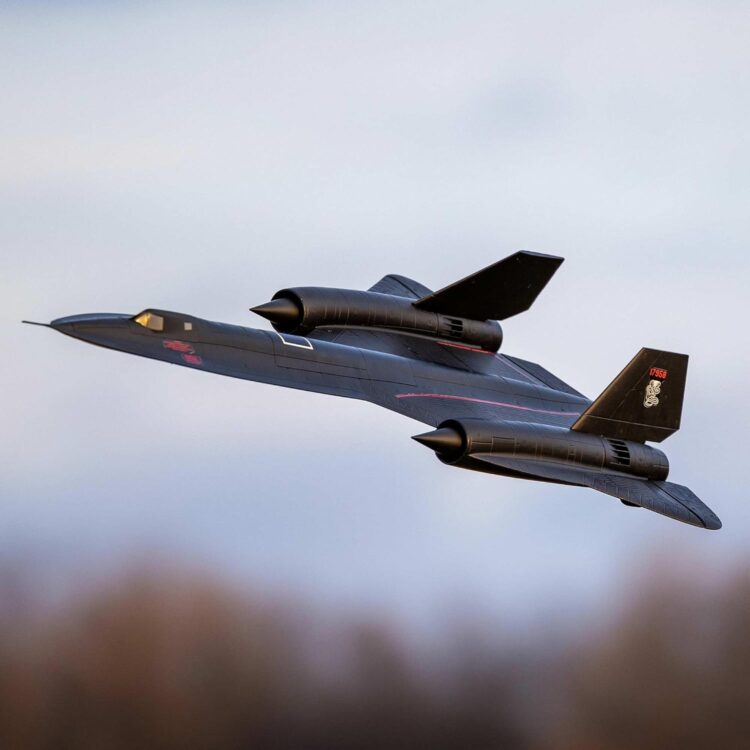
Previous attempts in the 64mm EDF class were notoriously compromised — overweight airframes requiring excessive thrust to overcome extreme wing loading, with vicious stall characteristics that routinely ended flights during launch or landing. E-flite’s SR-71 Blackbird Twin 40mm EDF (EFL02050) is a direct response to that history. By shrinking the platform to a 19.88-inch wingspan, leveraging modern EPO foam molding, and integrating the Spektrum A3240A all-in-one flight controller with AS3X, SAFE, and a dedicated Hand Launch Assist algorithm, E-flite has taken a fundamentally new engineering approach to an old problem.
When evaluated against the best RC planes on the market, the criteria that matter most are the balance between scale ambition and operational practicality. This review cuts through the marketing to evaluate the SR-71 on real-world terms: power system performance, flight-envelope demands, total cost of ownership, and the honest question of who should — and who absolutely should not — put this aircraft in their hangar.
Brief Overview
The E-flite SR-71 Blackbird Twin 40mm arrives as a Bind-N-Fly (BNF) Basic — meaning the airframe ships fully factory-assembled with every primary electronic component pre-installed and pre-wired: servos, motors, speed controllers, and the integrated flight controller. To achieve flight readiness, the buyer must independently supply a 5+ channel transmitter with Spektrum DSMX/DSM2 2.4GHz technology, a 4S 14.8V 2200mAh LiPo battery at a minimum continuous discharge rating of 30C, and a compatible balance charger. The aircraft measures 37.6 inches (955mm) in length with a 19.88-inch (505mm) wingspan and comes in at 29.4 ounces (834 grams).
The central avionics package is the Spektrum A3240A Flight Controller — a single, all-in-one printed circuit board that simultaneously handles the DSMX 2.4GHz receiver, dual brushless ESCs for both 40mm fans, and the AS3X/SAFE gyroscopic stabilization system. Collapsing those four functions onto one board is what allows the total flying weight to land at 29.4 oz — a figure that would be nearly impossible to achieve with discrete components crammed into the SR-71’s characteristically narrow fuselage.
A critical note on audience: this is a Skill Level 3 or 4 aircraft, depending on the retailer. Pilots researching the best RC planes for beginners will find far more appropriate entry points in the E-flite Apprentice STS or HobbyZone AeroScout S 2 — high-wing trainers built around aerodynamic forgiveness. The SR-71 is engineered for intermediate to advanced pilots who have already accumulated meaningful stick-time on swept-wing EDF jets like the E-flite Habu SS 50mm or the Arrows Viper 70mm.
QUICK SPECS
| Model | E-flite SR-71 Blackbird Twin 40mm EDF |
| Item No. | EFL02050 |
| Completion | BNF Basic |
| Wingspan | 19.88 in. (505mm) |
| Length | 37.6 in. (955mm) |
| Flying Weight | 29.4 oz (834g) |
| Battery Req. | 4S 14.8V 2200mAh LiPo — 30C minimum |
| Skill Level | 3–4 — Intermediate / Advanced (verify with retailer) |
| Flight Ctrl. | Spektrum A3240A (AS3X + SAFE + Dual ESC + Receiver) |
| Telemetry | RPM, battery voltage, current draw, throttle %, FET & BEC temperatures |
Four Features That Define the Package
- Spektrum A3240A all-in-one flight controller integrating AS3X stabilization, SAFE flight envelope protection, dual ESCs, and DSMX receiver on a single lightweight PCB
- Hand Launch Assist (HLA) algorithm — uses onboard accelerometers to automatically apply pitch offset during the throw sequence, significantly reducing launch-phase stall risk over grass
- Smart Telemetry: live RPM, battery voltage, instantaneous current draw, and FET/BEC temperature readout to compatible Spektrum AirWare transmitters
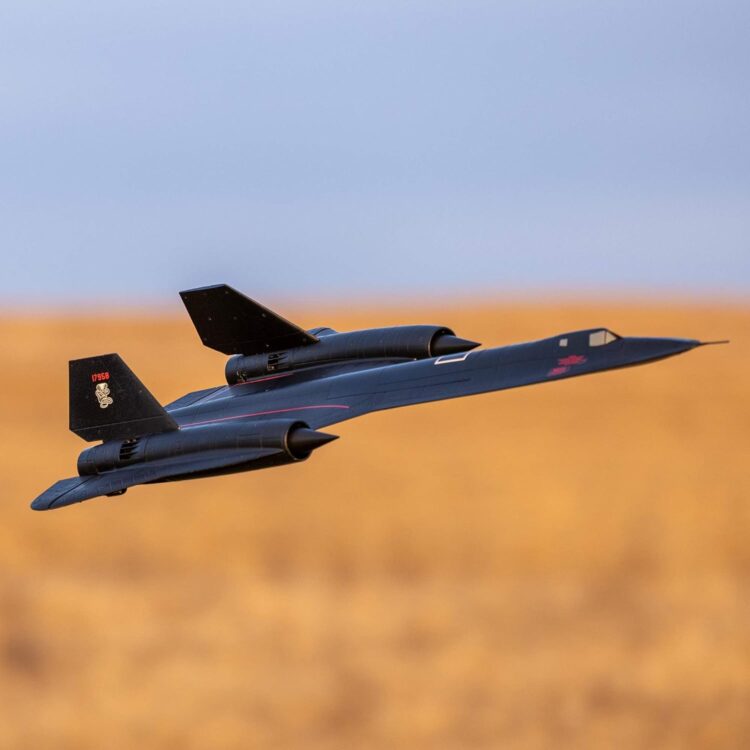
- Two vertical fin sets (black for scale fidelity, red-painted for sky contrast) plus fully removable landing gear for paved-runway or belly-lander/hand-launch operation
Check Current Pricing & Availability on Amazon
Pros & Cons
Pros
- Avionics integration: A3240A integrates receiver, dual ESCs, AS3X, and SAFE onto one board — exceptional engineering for a 29.4-oz model
- Hand Launch Assist: The PID-controlled HLA algorithm automates post-launch pitch offset, compensating for the torque-roll and pitch-down tendencies that make manual EDF launches hazardous
- Smart Telemetry: Live RPM, battery voltage, current draw, throttle %, FET, and BEC temperature data streams continuously to compatible Spektrum transmitters — genuine operational safety, not a spec-sheet checkbox
- Turnkey BNF format: No adhesive required; factory-complete BNF assembly with friction-lock fin sets and removable nose cone means the aircraft reaches the field in a single evening
- Scale accuracy: Accurate panel lines, plastic-reinforced fuselage chines, and scale-diameter tires reference the titanium-skinned Mach 3 original with fidelity unusual at this size class
Cons
- Not for beginners: A Skill Level 3–4 delta wing is an unforgiving second aircraft, not a first — the high stall speed and abrupt high-alpha behavior demand genuine energy management experience
- Premium LiPo mandatory: Inferior 4S cells sag hard under twin-motor load, triggering premature Low Voltage Cutoff; budget-battery owners will need to upgrade before their first flight
- Paved runways only with gear installed: Scale tire diameter generates excessive rolling resistance on turf; all grass operations require removing the gear and transitioning to hand-launch/belly-lander configuration
- Spektrum ecosystem lock-in: The A3240A’s proprietary micro-connectors and integrated ESC architecture make receiver protocol conversion or flight controller replacement technically and economically prohibitive
Airframe Design, Materials & Structural Quality
E-flite’s material and structural choices for the SR-71 reflect a clear hierarchy of priorities: scale fidelity, impact resilience, and minimum weight. The airframe is molded entirely from Expanded Polyolefin (EPO) foam — a meaningful step above the Expanded Polystyrene (EPS) found in budget foam models. Where EPS is brittle, crushes on impact, and melts on contact with standard cyanoacrylate (CA) adhesive, EPO flexes and rebounds. For a belly-lander aircraft that will inevitably skid across an asphalt runway on a hard landing, that material distinction is not academic.
The injection-molding quality is immediately evident. Panel lines, aerodynamic fairings, and the SR-71’s signature fuselage curves are rendered with a surface fidelity that would have been unachievable in foam a decade ago. Structurally, E-flite has embedded plastic-reinforced chines along the leading edges of the fuselage. These serve a deliberate dual function: they replicate the Blackbird’s most visually distinctive feature, and they stiffen the long, narrow fuselage against the torsional stress of high-G pullouts that would otherwise cause longitudinal flexing and mid-air structural failure. Carbon fiber composite spars embedded in the wing and nose sections lock in the airframe’s rigidity without measurable weight penalty.
Out-of-box assembly is minimal by design. No adhesive is required anywhere. The two vertical fin sets — black for scale appearance, red-painted for improved sky contrast in overcast conditions — click in via friction-lock mechanisms that allow rapid field replacement. The rubber nose cone, incorporating a scale pitot tube, is designed to detach easily, protecting the nose section during transport and runway overruns. The landing gear system features a steerable nose wheel and two fixed main gear struts. The scale-diameter tires are adequate for paved surfaces and synthetic runway fabrics, but generate too much rolling resistance against turf — the reason E-flite designed the entire gear assembly to be fully removable. Belly-lander and hand-launch configurations are the operational standard at most grass fields.
Power System & Flight Performance
Propulsion Architecture
The propulsion system pairs two 40mm Electric Ducted Fans with 1820-6800Kv brushless 6-pole outrunner motors. Operating on a fully charged 4S LiPo at 16.8V peak, these motors are spinning their impellers at rotational speeds exceeding 114,000 RPM. Unlike conventional propellers, which move large volumes of air at moderate velocity, EDFs accelerate a smaller volume of air to extreme efflux speed. The aerodynamic consequence is immense current draw and an inherent efficiency trade-off — EDFs are loud, power-hungry, and distinctly unforgiving of weak batteries. The twin-fan arrangement pushes the thrust-to-weight ratio toward 1:1 in the clean, gear-off configuration, which is the minimum necessary to manage the SR-71’s delta planform at a survivable speed margin above stall.
Delta-Wing Aerodynamics and Flight Dynamics
Standard straight-wing trainers generate lift via cambered airfoils and stall predictably when the critical angle of attack is exceeded — the nose drops, the pilot recovers. The SR-71’s highly swept delta wing operates by different physics entirely. At higher angles of attack, the plastic-reinforced fuselage chines act as Leading-Edge Root Extensions (LERX), shedding controlled vortices that sweep across the wing surface, delay airflow separation, and maintain lift at alpha attitudes that would instantly stall a conventional wing. The aerodynamic penalty for this vortex lift is severe induced drag at low speeds. As airspeed drops and angle of attack climbs, drag spikes exponentially. If throttle management lapses on final approach, the aircraft doesn’t mush gently — it sinks at a rate that cannot be instantly arrested by slamming the throttle forward. EDF spool-up latency means power demand and power delivery are separated by a critical window of time. Pilots must fly the aircraft onto the deck, modulating glide slope almost entirely with throttle rather than elevator inputs.
Additionally, the spanwise airflow characteristics of the delta planform produce a slight “wing rock” in turbulent conditions and high-alpha attitudes. This is a recognized aerodynamic behavior inherent to the design — not a calibration fault in the stabilization system.
AS3X, SAFE & the Hand Launch Assist Algorithm
This is where the A3240A earns its weight. The AS3X gyroscopic system continuously corrects for attitude disturbances in three axes, smoothing out the wing rock and crosswind sensitivity that would otherwise demand constant stick input. SAFE’s flight envelope protection layers on top of that, establishing pitch and bank angle limits that prevent the beginner-to-intermediate pilot from inadvertently entering an irrecoverable attitude.
The Hand Launch Assist algorithm is the most operationally significant feature for grass-field pilots. With SAFE engaged and throttle at 100%, the A3240A’s accelerometers monitor for the kinetic spike of the throw. When detected, the flight controller automatically applies a pre-programmed pitch offset — up-elevator — for a designated duration while the EDFs build sufficient static thrust to establish a sustainable climb angle. Telemetry data and field reports consistently confirm that attempting a hand launch in pure AS3X mode, without HLA, drastically increases the probability of a post-release pitch-down crash. Human reflexes are simply not fast enough to compensate for the torque roll and inertial nose-drop of a heavily loaded delta wing departing the hand at zero airspeed.
Center of Gravity & Battery Selection
The manual specifies CG placement at exactly 5mm behind the indicated panel line on the aircraft’s underside, measured with the recommended 2200mAh 4S battery pushed fully forward in the battery compartment. A tail-heavy delta wing is operationally untenable — the center of lift migrates forward of the center of mass, inducing uncontrollable pitch-up and immediate stalling. Battery selection is equally non-negotiable: inferior cells with high internal resistance will sag under the twin-motor’s combined current demand, triggering the ESC’s Low Voltage Cutoff prematurely and converting the SR-71 into an expensive, unpowered glider at the worst possible moment.
Where the E-flite SR-71 Blackbird Twin 40mm Really Shines
There is no foam jet on the flightline that generates attention the way the SR-71 does. That silhouette — the long black needle of a fuselage, the swept-back delta disappearing into a speck against the sky, the twin-EDF sound that doesn’t so much growl as scream — is unmistakable. Aviation enthusiasts at your local club will walk across the flight line to look at it on the bench. This is one of the rare models where the subject matter does half the emotional work before the transmitter is even turned on.
The turnkey BNF experience genuinely changes the equation for pilots making the jump from prop-driven aircraft to jets. The technical intimidation of a twin-EDF build is real. Having the airframe arrive fully assembled, with the A3240A already calibrated and every servo linkage verified at the factory, compresses the path from box to first flight dramatically. The first evening with this aircraft is spent reviewing telemetry settings and configuring transmitter alarms — not troubleshooting an ESC wiring harness or hunting for a mysterious servo bind.
The Spektrum Smart Telemetry integration transforms the in-flight experience in ways that matter to pilots still developing their LiPo management habits. Watching live battery voltage hold steady under load, reading instantaneous current draw, receiving FET temperature warnings before a thermal issue becomes a failure — these are not features that show up in first-flight impressions. Their value compounds over hours of operation, building the kind of confidence and situational awareness that separates pilots who consistently bring jets home from those who don’t. For anyone who has ever flown an EDF jet on a countdown timer and landed hot to find the cells at 3.2V/cell, the telemetry ecosystem represents a genuine operational upgrade.
→ View the E-flite SR-71 Blackbird Twin 40mm on Amazon
Value for Money & Competitive Context
The SR-71 occupies the mid-range bracket within the BNF micro-EDF category. Check the current Amazon price via the links in this review — the sticker cost alone is not the full picture. To that figure, add a quality 4S 2200mAh 30C+ LiPo and a DSMX-compatible 5+ channel transmitter (the Spektrum NX or iX series extracts the full Smart Telemetry capability), and the total investment climbs materially above the model price. That total cost of ownership must be factored honestly into any purchase decision.
Competitive Matrix
| Feature | SR-71 Twin 40mm | Habu SS 50mm | Arrows Viper 50mm | FMS F-15 64mm |
| Propulsion | Twin 40mm EDF (1820-6800Kv) | Single 50mm EDF | Single 50mm EDF | Single 64mm EDF |
| Battery | 4S 2200mAh 30C+ | 3S 1300–2200mAh (flexible) | 3S 1300–2200mAh | 4S 2200mAh |
| Flight Ctrl. | A3240A SAFE/AS3X/Telemetry | AR631 SAFE/AS3X/Telemetry | Standard PWM | Standard PWM |
| Stall Behavior | Abrupt sink / wingtip drop | Gentle, forgiving | Predictable | Requires energy mgmt. |
| Landing Gear | Fixed scale wheels (paved only) | Fixed, steerable nose | None (belly-lander) | Fixed |
| HLA Mode | Yes | No | No | No |
Against the E-flite Habu SS 50mm — widely regarded as the premier introductory EDF jet — the SR-71 is demonstrably more demanding in every dimension. The Habu runs efficiently on lighter, less expensive 3S 1300 to 2200mAh packs, offers conventional sport-wing aerodynamics with highly forgiving stall characteristics, and represents the logical first EDF for a pilot transitioning from trainer aircraft. The Arrows Viper 50mm undercuts the SR-71 on price and is a capable flier, but arrives without landing gear, Smart Telemetry, or any equivalent of the HLA algorithm. The FMS F-15 64mm provides more physical presence on the same 4S power budget, but lacks integrated SAFE stabilization and telemetry out of the box.
The SR-71’s premium is not justified by ease of use or flight-time economics. It is justified by the convergence of uncompromising scale authenticity and a legitimate aerospace avionics package — integrated AS3X, SAFE, HLA, and full Smart Telemetry — that no direct competitor currently matches at this wingspan and price point. For the pilot who wants to fly a meticulously scaled piece of aviation history and has the skills to do it, the return on investment is real.
Who Should Buy It
The Right Buyer
The ideal SR-71 purchaser has already completed the Habu SS 50mm or a comparable entry-level EDF jet and arrived at the other side understanding energy management, EDF spool-up behavior, and the demands of swept-wing flight dynamics. They have consistent access to a smooth paved runway, or the hand-launching experience to operate the aircraft safely in gear-off configuration. They are invested in the Spektrum DSMX ecosystem — or prepared to invest in it — because the Smart Telemetry features are only fully realized through AirWare-equipped NX or iX series transmitters. And critically, the SR-71’s subject matter carries personal meaning. This is not a casual sport-jet purchase; it is the acquisition of one of the most iconic aircraft shapes in aviation history, in a package capable of genuine scale-flight impression.
Who Should Look Elsewhere
First-time RC pilots have no business near this aircraft — and that recommendation comes from the aerodynamics, not from elitism. High-wing trainers with self-leveling electronics exist precisely because delta wings cannot provide what beginners need: immediate, forgiving feedback. Pilots primarily interested in 3D aerobatics or aggressive 6G maneuvers should equally redirect their budget: the SR-71 is a scale fast-flier built for sweeping circuits and high-speed passes, not knife-edge or harrier flight. And any buyer operating exclusively on open-source transmitter firmware — EdgeTX, OpenTX — should note that while binding via a multi-protocol module is achievable, the full telemetry and HLA capability depend on the Spektrum ecosystem.

Key Takeaways
- The E-flite SR-71 Blackbird Twin 40mm (EFL02050) is a Skill Level 3–4 BNF Basic — factory-assembled and technically capable, but absolutely not an entry-level aircraft.
- The Spektrum A3240A flight controller integrates AS3X stabilization, SAFE flight envelope protection, dual ESCs, and a DSMX receiver on a single board — a genuine engineering achievement at this weight and price point.
- The Hand Launch Assist algorithm is operationally essential for grass-field pilots; attempting a manual hand launch in pure AS3X mode significantly elevates the risk of a post-release crash.
- Budget beyond the model price: a premium 4S 2200mAh 30C+ LiPo and a DSMX-compatible 5+ channel transmitter are non-negotiable additions to the total cost of ownership.
- For the experienced EDF pilot who has cleared the Habu SS and wants a historically significant, avionics-rich second jet, the SR-71 delivers an unmatched combination of scale presence and operational sophistication.