


A compact powered glider with AS3X and SAFE Select, and a catch: the BNF Basic box has no radio, battery, or charger, and it’s rated Skill Level 2. Here’s who should buy it and who should start elsewhere.

Quick Verdict
Bottom line: The E-flite UMX Conscendo BNF is worth shortlisting as a compact next-step powered glider, provided you have already flown a trainer and your radio, battery, and charger fit its requirements. For a true beginner, it is better treated as a second airplane than a first.
- Why it earns a look: The airframe arrives with its motor, servos, and receiver/ESC unit installed, carries AS3X stabilization with selectable SAFE, accepts 2S or 3S packs, and is designated under 250 grams by the manufacturer.
- The cost catch: BNF Basic means the transmitter, flight battery, and charger are all extra. The airplane alone will not get you to a first flight.
- The skill catch: Horizon Hobby rates it Skill Level 2. If you have never flown and own no radio, we’d point you to its Skill Level 1 trainer, the HobbyZone AeroScout S 2, first.
One more thing before you order: no documented wind limit, landing distance, or 2S-versus-3S runtime exists for this model. Read on for what the manual promises and what the first flight really requires.
Brief Overview
What It Is
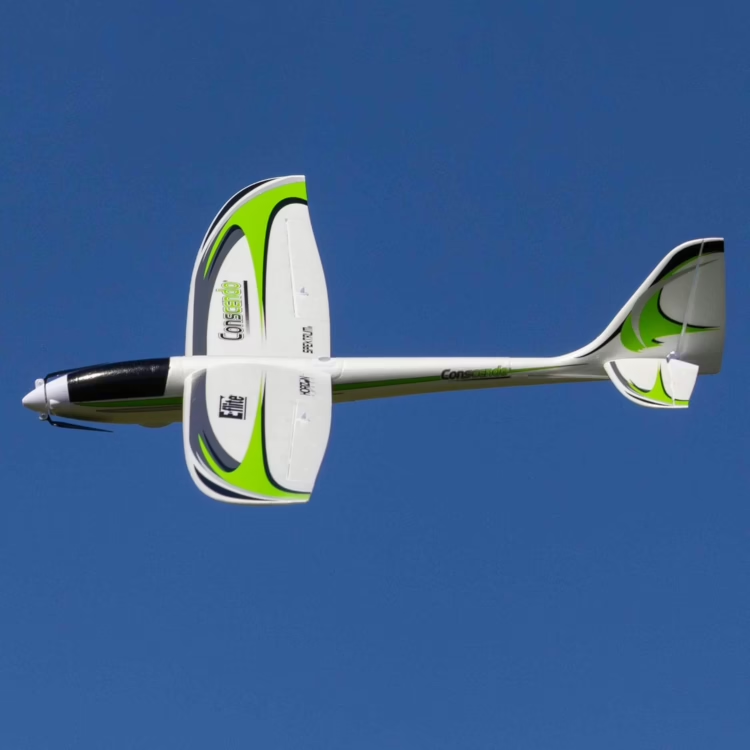
The UMX Conscendo is an ultra-micro (UMX) electric powered glider from E-flite, a Horizon Hobby brand, sold as the E-flite UMX Conscendo BNF Basic with AS3X and SAFE Select under item number EFLU32050. Horizon Hobby presents it as a scaled-down version of the Conscendo Evolution 1.5m that combines soaring, sport, and aerobatic flying. That is the manufacturer’s positioning. If you are still surveying the best RC planes, this one sits at the small end of the field.
Who It Is For
The natural buyer is a pilot moving beyond a trainer who already owns a compatible Spektrum transmitter, as Horizon Hobby’s Skill Level 2 rating suggests. If you have not yet soloed, start with the best RC planes for beginners.
Standout Features
- AS3X (Artificial Stabilization 3-axis) → stabilization intended to smooth out the disturbances a light airframe feels. No published test measures its effect on this model.
- SAFE (Sensor Assisted Flight Envelope) Select → self-leveling with pitch and bank limits, switchable from the transmitter.
- 2S or 3S power → one airframe, two approved battery options.
At a Glance
Model: UMX Conscendo BNF Basic with AS3X and SAFE Select
Item number: EFLU32050
Manufacturer: E-flite (Horizon Hobby)
Wingspan: 31.6 in. (802 mm)
Length: 20.6 in. (524 mm)
Flying weight: 4.8 oz. (137 g) with 3S 300mAh pack, per the manual
Power system: Brushless outrunner motor, Spektrum receiver/ESC unit
Servos: Four linear, per the product page (the manual’s parts table lists two A201 servos)
Battery req’d: 2S 7.4V or 3S 11.1V 280–300mAh Li-Po
Radio req’d: Full-range 5+ channel Spektrum DSMX/DSM2-compatible transmitter
Pilot skill level: Skill Level 2

Ready to check the numbers? See the current price and package details for the UMX Conscendo, and confirm the listing is the EFLU32050 BNF Basic. The transmitter, battery, and charger are separate purchases.
Pros & Cons
Pros
- Motor, four linear servos, and receiver/ESC unit come installed.
- AS3X stabilization, with SAFE self-leveling available on a transmitter switch.
- Approved for both 2S and 3S 280–300mAh packs.
- Compact: a 31.6-inch span and 20.6-inch length.
- Designated under 250 grams by the manufacturer, which matters for FAA registration.
Cons
- No transmitter, flight battery, or charger in the box.
- Rated Skill Level 2, so it is not the manufacturer’s idea of a first airplane.
- Needs a Spektrum DSMX/DSM2-compatible radio; no other system is confirmed to work.
- No documented, independent flight test establishes its wind tolerance, landing distance, or durability as of October 5, 2026.
No recurring fault has been documented either. That is an absence of evidence, not a clean bill of health.
Expected Experience with the E-flite UMX Conscendo BNF
Here is what the manufacturer’s documents tell you to expect. Independent, fully documented assembly and flight reports are not available as of October 5, 2026.
Out of the Box: What You Get and What You Still Need
The BNF Basic package holds the airplane, four installed Spektrum linear servos, an installed brushless outrunner motor, an installed Spektrum receiver/ESC control unit, and the manual. BNF means bind-and-fly: you bind the installed receiver to your own transmitter.
You still need:
- A full-range 5+ channel Spektrum DSMX/DSM2-compatible transmitter.
- A 2S 7.4V or 3S 11.1V 280–300mAh Li-Po with a JST-RCY connector, or a JST-PH pack with a suitable adapter sold separately.
- A compatible Li-Po charger.
One example basket from Horizon Hobby: the Spektrum DX6e 6-channel DSMX transmitter (SPMR6655), the Spektrum 3S 11.1V 300mAh 30C LiPo with RCY connector (SPMX3003SJ30), and the Spektrum S155 55W AC G2 Smart Charger (SPMXC2050). The battery also needs a JST-RCY charge lead; Spektrum sells an IC3 battery/JST-RCY device adapter (SPMXCA310). Check connection and polarity before plugging in.
Assembly: How Much Work to Expect
Expect a final wing installation, not zero assembly. The instruction manual directs you to connect the wing lead without pinching it, then rotate the wing bolt clockwise one quarter-turn. No independent report documents the fit, tools, or time involved.
Radio Setup, Binding, and SAFE Select
Flight-mode selection on this model is not made during binding. SAFE is enabled by default, and channel 5 on your transmitter selects SAFE (position 0) or AS3X (position 1).
In SAFE mode the airplane self-levels and limits pitch and bank. In AS3X mode it does neither. AS3X activates once the throttle first exceeds 25 percent and stays active until you disconnect the battery.
The manual’s binding sequence, in brief:
- Configure the transmitter; keep the flight battery disconnected and the transmitter off.
- With the airplane level and out of the wind, connect the battery and wait for the flashing LED.
- Center the controls, set throttle and trim low, and start binding.
- A solid LED confirms the bind. Verify controls and flight modes.
Balance the model at the manual’s center of gravity (CG): 1.26 inches (32 mm) aft of the wing’s leading edge, plus or minus 2 mm.
Permanently disabling SAFE is a powered procedure with its own propeller precautions, so follow the manual in full. We’d leave SAFE available.
WARNING: Li-Po charging Use a correctly configured Li-Po-compatible charger, and never leave a charging pack unattended. Inspect the pack before every charge, including after a hard arrival, and never charge a damaged pack, per the S155 charger manual. With a conventional pack, connect the balance lead and set chemistry, cell count, and current yourself.
In the Air: Launch, Handling, Wind, Soaring, and Landing
Launch. The manual calls for SAFE mode, high rates, and full power, launched into the wind with an overhand throw, wings level and nose slightly raised.
Flight time. The manual estimates about 2.5 minutes at high throttle, roughly 3 to 4 minutes of mixed flying, and about 6 to 8 minutes when you mainly glide. It recommends a three-minute timer for initial flights. The manual does not break those figures out by 2S and 3S.
Everything else. As of October 5, 2026, no named flight test with documented equipment and conditions establishes this model’s wind tolerance, SAFE recovery behavior, 2S-versus-3S climb or speed, glide ratio, thermal performance, landing distance, or measured endurance.
Retailer Nankin Hobby’s listing describes a folding propeller and no landing gear, but neither prop dimensions nor belly-landing outcomes are independently established.
Durability, Repairs, and Parts
Horizon Hobby lists key spares: a replacement wing (EFLU32051), a spinner and prop assembly (EFLU32056), the Spektrum receiver/ESC (SPMA3197), and a Spektrum 1408-2050Kv brushless motor (SPMXAM3700).
A parts list helps you plan repairs; it does not prove the airplane is easy or cheap to fix. No long-term durability report, documented repair result, or confirmed warranty term is available as of October 5, 2026.
TIP: First flight Keep SAFE on its switch, launch as the manual describes, and set the three-minute timer. Stabilization is not a wind rating.
Value Check: Total Cost and How It Compares With Rivals
The Real Cost of the First Flight
You already fly a compatible Spektrum radio. Check your gear against the requirements above before buying anything. A matching radio does not mean a matching flight pack or charge lead; E-flite’s own UMX Radian, for one, uses a 1S pack with a different connector.
You are starting from nothing. Judge the airplane plus radio, battery, and charger against a trainer package.
The Federal Aviation Administration (FAA) requires every recreational flyer to pass The Recreational UAS Safety Test (TRUST), which is free, and to carry proof. You must also keep visual line of sight, yield to other aircraft, follow the safety guidelines of an FAA-recognized community-based organization, get authorization in controlled airspace, and stay under 400 feet in Class G airspace.
FAA registration guidance exempts aircraft under 250 grams flown exclusively for recreation. The manual’s 137 grams falls under that line, but weigh your own airplane if accessories or repairs change it. Remote ID applies to aircraft that must be registered or already are. Low weight removes one chore; it does not give you permission to fly in any park.
How It Compares With Rival Models
| Model | Wingspan | Type | Stabilization | What’s included | Best for |
| E-flite UMX Conscendo BNF Basic (EFLU32050) | 31.6 in. (802 mm) | Powered glider | AS3X / SAFE Select | Motor, four servos, receiver/ESC | Post-trainer pilot who wants compact size |
| E-flite Conscendo Evolution 1.5m BNF Basic (EFL01650) | 1.5 m class | Powered glider | AS3X / SAFE Select | Motor, 30A telemetry ESC, four servos, AR637TA receiver | Buyer who wants a larger glider |
| HobbyZone AeroScout S 2 1.1m RTF Basic (HBZ380002) | 1.1 m class | Trainer | SAFE | Motor, 30A ESC, four servos, AR631+ receiver, DXS transmitter, RealFlight Trainer Edition | First-timer who needs a radio |
| E-flite UMX Radian BNF Basic (EFLU2950) | 28.7 in. (730 mm) | Powered glider | AS3X / SAFE Select | Motor, gearbox, folding prop, receiver/ESC/two-servo unit | Buyer weighing another small glider |
All three BNF Basic models need a radio, battery, and charger; the two larger models are listed by size class, not measured span. No matched flight test shows which handles wind better, lands shorter, or lasts longer.
The Evolution needs a far larger 3S 1300–2200mAh or 4S 1000–2200mAh pack. The AeroScout is rated Skill Level 1 and includes a transmitter, but still needs a 3S 1300–2200mAh pack and a charger despite its ready-to-fly (RTF) label. The UMX Radian is rated Skill Level 3 and runs on a 1S 150–200mAh pack.
The Value Verdict
Pick the UMX Conscendo when its compact format and equipment list match what you own. If you need a transmitter and a first airplane, the AeroScout package fits better.
Where the E-flite UMX Conscendo BNF Really Shines
The UMX Conscendo’s documented strengths are practical ones.
- It is small and nearly complete. With the motor, servos, and receiver/ESC installed, a pilot with a compatible radio on the shelf faces a wing bolt, a bind, and a CG check.
- Its flight modes are clearly documented. SAFE is on by default, and one switch moves you to AS3X when you are ready.
- It sits under the FAA’s 250-gram registration line for purely recreational flying, at the manual’s stated weight.
About that trunk: the size makes the idea plausible, but we wouldn’t leave a Li-Po pack sitting in a car. Carry the batteries with you.
E-flite UMX Conscendo BNF Basic (EFLU32050) Transmitter, battery, and charger not included
- 31.6 in. span; motor, servos, and receiver/ESC installed
- AS3X with switchable SAFE self-leveling
- Flies on 2S or 3S 280–300mAh Li-Po packs
Check current price on Amazon and verify the listing shows the BNF Basic package.
Who Should Buy It (and Who Should Skip It)
Buy It If…
- You have trainer experience and your radio, battery, and charger meet the requirements above.
- Compact size matters more than a larger airframe. Don’t assume any particular yard is big enough.
- You want to explore powered gliders and accept that its soaring performance is not independently documented.
Skip It If…
- You have never flown and own no transmitter. Look at the HobbyZone AeroScout S 2 RTF Basic, and budget for its pack and charger.
- You want a larger glider. Compare the Conscendo Evolution 1.5m. Nothing published proves it handles wind better.
- Your radio is not DSMX/DSM2-compatible. Hold off until you confirm compatibility.
FAQ
Q: Is the E-flite UMX Conscendo BNF Basic a good first RC plane for a complete beginner, or should I learn on something else first?
A: The E-flite UMX Conscendo BNF Basic is better treated as a second airplane than a first.
- Horizon Hobby rates it Skill Level 2; its AeroScout S 2 trainer is rated Skill Level 1.
- SAFE self-leveling does not replace pilot skill, and no independent trial with first-time pilots has been published.
Q: What exactly do I need to buy to fly the E-flite UMX Conscendo BNF Basic, and which transmitter, battery, and charger work with it?
A: The E-flite UMX Conscendo BNF Basic needs a transmitter, a flight battery, and a charger, none of which are in the box.
- Transmitter: full-range, 5+ channel, Spektrum DSMX/DSM2-compatible.
- Battery: 2S or 3S 280–300mAh Li-Po, JST-RCY connector.
- Charger: Li-Po compatible, with a matching charge lead.
Q: How do I bind the E-flite UMX Conscendo to my Spektrum transmitter and turn SAFE Select on or off?
A: Binding the E-flite UMX Conscendo and choosing its flight mode are two separate steps.
- Bind with the four-step manual sequence; a solid LED confirms it.
- Use channel 5 to choose SAFE (0) or AS3X (1).
Q: Should I fly the E-flite UMX Conscendo on a 2S or a 3S battery, and how long will each flight last?
A: The E-flite UMX Conscendo is approved for both 2S and 3S packs, but no measured runtime exists for each.
- The manual’s estimates run from about 2.5 minutes at high throttle to 6 to 8 minutes of mostly gliding.
- Those figures are not split by cell count; start with the recommended three-minute timer.
Q: How much wind can the E-flite UMX Conscendo handle, and how much space do I need to launch and land it?
A: No verified wind limit or launch and landing space figure exists for the E-flite UMX Conscendo as of October 5, 2026.
- The manual specifies a full-power hand launch into the wind in SAFE mode.
- Choose conservatively for your skill and site.
Q: Do I need to register the E-flite UMX Conscendo with the FAA or pass a test before flying it in the United States?
A: Flying the E-flite UMX Conscendo recreationally requires passing the free TRUST; registration and Remote ID depend on weight and use.
- Aircraft under 250 grams flown exclusively for recreation are exempt from registration.
- Remote ID covers aircraft that must be registered or already are; an FAA-Recognized Identification Area (FRIA) is one way to comply.
- Airspace and site rules apply at any weight.

Key Takeaways
- Verdict: A compact next-step powered glider worth shortlisting if you have trainer experience and compatible gear.
- The catch: BNF Basic means no transmitter, battery, or charger. Budget for all three.
- Skill fit: Rated Skill Level 2. First-timers without a radio are better served by the AeroScout S 2 RTF Basic.
- Setup: SAFE is on by default; channel 5 switches between SAFE and AS3X, separately from binding.
- Limits: Wind tolerance, landing distance, and durability are undocumented. TRUST is required, and the manual’s 137-gram weight sits under the FAA’s registration line for recreational flying.