

Three famous names, nine shortlisted airbrushes, and plenty of ways to waste money. This airbrush comparison shows where Iwata, Badger, and Paasche earn your dollars—and the extra costs to plan for before you buy.
Straight to the Point – for the Busy Reader
A useful airbrush comparison starts with your model, not the logo on the box. All three brands offer airbrushes suited to model aircraft; the right one for you depends on the finishes you want, the paints you use, and the complete setup you can afford.
If you want camouflage and shading control, start your shortlist with a gravity-feed, double-action airbrush. If you mostly spray primers, gloss coats, and single colors, a single-action brush with a preset paint flow may be all you need.
Leading recommendations, each with its main catch:
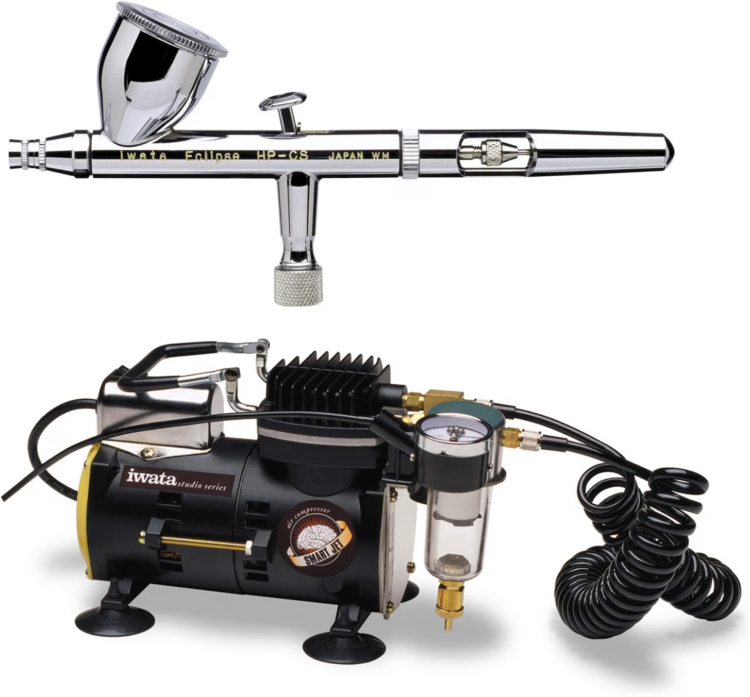
- Versatile one-brush pick: Iwata Eclipse HP-CS (ECL4500). Gravity-feed double action with a compression-fit nozzle. Limitation: Iwata warns of counterfeits on major marketplaces, and the full system costs well beyond the brush.
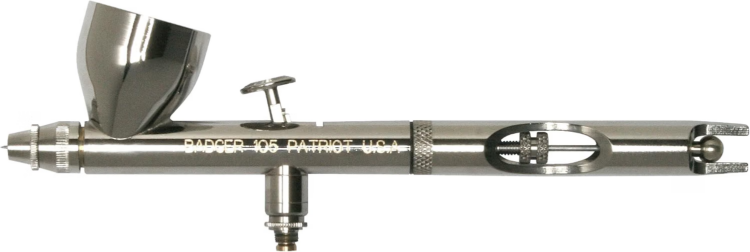
- American-made all-rounder: Badger Patriot 105. Gravity-feed double action from a Bellwood, Ill., maker. Limitation: confirm the exact tip configuration and current warranty terms before you buy.
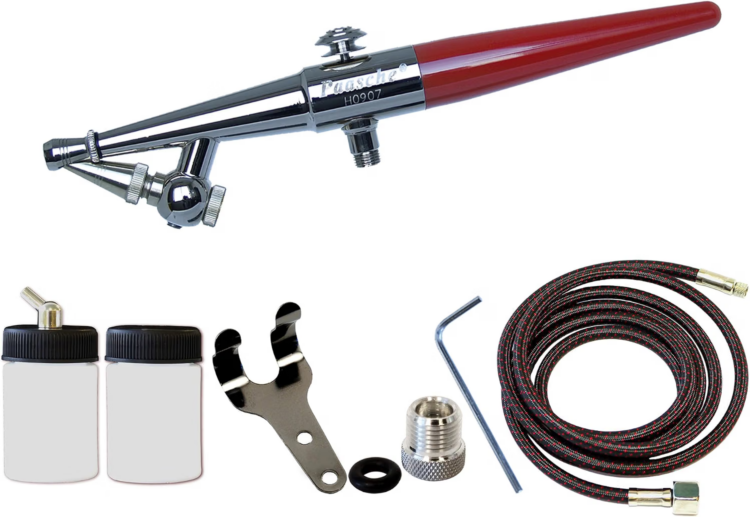
- Simplest start for primers and solid coats: Paasche H (H-3AS set). Single action, external mix, siphon feed. Limitation: paint flow is set separately, so it can’t vary a freehand pattern mid-pass.
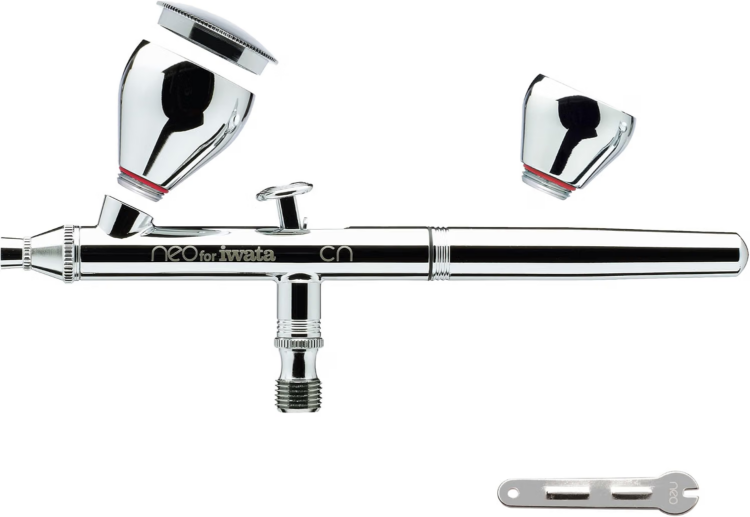
- Lower-pressure Iwata-branded option: NEO for Iwata CN (N4500). Gravity-feed double action with an 8–20 psi optimal working pressure, per Iwata. Limitation: its screw-on nozzle and parts belong to a different family than the Eclipse’s, and Iwata’s direct store listed it as sold out as of Oct. 1, 2026, so check current availability before you buy.
The qualification that matters most: the airbrush is only part of the purchase. You’ll also need regulated air, moisture control, a matching hose and fittings, cleaning supplies, the right thinner, and ventilation and respiratory protection suited to your paint. If that complete setup doesn’t fit your budget yet, sticking with spray cans and paintbrushes for a few more kits is a sound decision.
Before you add anything to your cart, spend 10 minutes below. The gap between a first airbrush you love and one that gathers dust can come down to a few specs, one compressor fitting, and the seller’s name on the listing.
Who This Guide Is For (and Who Should Skip It)
This guide is for beginners ready to evaluate real options. You’ll likely recognize yourself here:
- The spray-can graduate. You’ve finished a few kits with rattle cans and brushes and now want soft camouflage demarcations, panel shading, or exhaust staining.
- The small-batch or big-coverage builder. You paint small fighters that need fine marks, large airframes that need broad coverage, or both.
- The fixed-budget first buyer. You have a total in mind, and the whole system has to fit inside it.
- The returning modeler. You own an older Badger or Paasche and wonder whether an upgrade would solve a real problem.
- The spare-room painter. You’re judging whether your space can support airbrushing safely. (The safety warning in the pitfalls section covers what low pressure and low-odor paint can’t do for you.)
Who should skip or postpone: builders who finish a few single-color subjects a year and are happy with spray cans; anyone who can’t ventilate a painting area yet; and readers looking for a full compressor review. Compressors appear here only as part of the budget.
Scope: Iwata (including NEO for Iwata), Badger, and Paasche.
Still choosing the aircraft you’ll paint first? Our roundup of the best model airplane kits pairs well with this guide.
Iwata vs. Badger vs. Paasche at a Glance
Choose a design and a specific set first, then compare support terms. A full-system purchase can reverse a decision you’d make on the brush alone.
Brand comparison table
| Criterion | Iwata / NEO for Iwata | Badger Air-Brush Co. | Paasche Airbrush Company |
|---|---|---|---|
| U.S. base | Packaging in Portland, Ore. | Bellwood, Ill. | Kenosha, Wis. |
| Where it’s made (maker’s statement) | Iwata airbrushes: Japan; NEO origin unconfirmed | Factory outlet advertises American-made airbrushes | H and VL: U.S.-made; Talon TG: made and assembled in the USA |
| Shortlisted designs | Eclipse HP-CS, Revolution HP-CR, NEO CN | Patriot 105, 200 series, Sotar 20/20 | H, VL, Talon TG |
| Head system | Compression-fit E3 (Eclipse); screw-on N3 (NEO) and R5 (Revolution) | Confirm the tip set for each item | Numbered heads that differ in size from model to model |
| Warranty | Five-year limited; original buyer; authorized seller; wear parts excluded | Service page lists no warranty terms; ask before buying | Confirm airbrush warranty terms before buying |
| Main thing to check | Seller authenticity and total system cost | Exact configuration and service terms | Whether action and airflow suit your work |
Shortlisted models table
For most aircraft work, the deciding factors are action, feed, and the head you’ll spray through—not the brand.
| Model (item no.) | Action / feed | Head and cup, as published | Best fit | Main limitation |
|---|---|---|---|---|
| Iwata Eclipse HP-CS (ECL4500) | Double / gravity | E3 compression-fit (0.35 mm per retailer parts listing); 7 ml cup | One brush for varied work | Counterfeits; system cost |
| NEO for Iwata CN (N4500) | Double / gravity | N3 screw-on; 3 ml and 7 ml cups; 8–20 psi | Lower-pressure entry | Separate parts family |
| Iwata Revolution HP-CR (R4500) | Double / gravity | R5 screw-on; 7 ml cup; 20–30 psi | General coverage | Confirm nozzle diameter |
| Badger Patriot 105 (Blick item 25091-1009) | Double / gravity | 0.5 mm, per seller | General-purpose all-rounder | Confirm tip set and terms |
| Badger 200 series | Single / bottom (siphon) | Varies by variant | Preset color coats | Identify the exact variant |
| Badger Sotar 20/20 | Double / gravity | Confirm current tip sizes | Specialist detail work | Not an automatic beginner upgrade |
| Paasche H (H-3AS) | Single / siphon, external mix | No. 1/3/5 = 0.45/0.65/1.05 mm | Primers, solid coats, stencils | No paint control mid-pass |
| Paasche VL (VL-3AS) | Double / siphon, internal mix | VLT-1/3/5 = 0.55/0.75/1.05 mm | Sustained coverage | Sizes differ from H and TG |
| Paasche Talon TG (TG-3AS) | Double / gravity, internal mix | Heads 1/2/3 = 0.25/0.38/0.66 mm; 0.4 oz cup; fan aircap | Configurable gravity option | Fan cap depends on your air supply |
How to Choose an Airbrush for Model Aircraft: The Criteria That Matter
Work through the criteria in this order: whether you can afford and house the whole system, how much paint control you need, which feed suits your batches, how the head matches your paint, what support stands behind it, and how much cleaning you’ll tolerate.
First, jot down the aircraft you build most, the smallest freehand mark you want, the widest area you cover, your paint family, your current compressor, and how much maintenance you’ll accept. Buy for that recurring workload, not for a technique you hope to try someday.
1. Budget the whole system, not the airbrush
Badger’s AIRBRUSH 101 technical guide recommends a regulator to set pressure and explains that a moisture trap catches water that could otherwise travel down the hose onto your work. It also advises setting pressure with air flowing through the brush.
Your shopping list:
- an air supply suited to airbrushing
- a regulator and gauge, plus moisture control
- a hose matched to brush and compressor, with any adapters
- a holder, a cleaning container, and a suitable cleaner
- thinner matched to your paint
- a likely replacement needle and nozzle
- ventilation and respiratory protection for your materials
A quick disconnect is convenient but can wait.
Pressure is measured in pounds per square inch (psi); airflow in cubic feet per minute (CFM). Ask for a compressor’s delivered airflow at the pressure you’ll spray, not just its maximum pressure or horsepower, and check whether that figure covers a fan cap. Paasche publishes 0.5 CFM at 20 psi for both its siphon H-3AS and gravity TG-3AS sets, so don’t assume siphon always means more air.
Pressure guidance varies with context. Iwata’s HP-CS page gives 25–35 psi as optimal working pressure, while its Eclipse manual describes a recommended beginner compressor that supplies approximately 20–25 psi. In Airbrushing Scale Model Aircraft (2018), Robin Carpenter describes 25–30 psi as a typical modeler’s maximum and notes an unregulated setup can develop 80 psi or more. Treat these as starting points; your paint’s instructions govern the actual setting.
Tip: A tire inflator isn’t ruled out by its label alone. What matters is rated pressure, delivered airflow, duty cycle, regulation, and fittings. If you can’t confirm those, don’t count on it.
2. Single action vs. double action
In a double-action (or dual-action) airbrush, pressing the trigger down releases air and pulling it back releases paint; the farther you pull, the more paint flows. In a single-action airbrush, the trigger controls the air while a separate adjustment sets paint flow.
- Double action lets you vary paint output during a pass, which suits freehand mottles and shading.
- Single action holds a repeatable setting for primers, clear coats, and stencil work without coordinating two motions.
Double action is the more flexible start for most aircraft modelers, but it isn’t the only route to a good finish. Carpenter notes that some beginners and people with dexterity difficulties prefer a linear trigger style. If you can, try the grip and trigger before ordering.
3. Feed type: gravity, siphon (bottom), or side
- Gravity feed draws paint from a cup on top of the brush. Iwata describes it as suited to small amounts, and Badger notes gravity designs can run at lower pressure for detail work.
- Siphon feed (bottom or bottle feed) pulls paint up from a reservoir below. Badger notes these designs accommodate larger reservoirs for coverage. Bottles also let you store mixed colors.
- Side feed uses a side-mounted cup or bottle. It may improve your sight line but isn’t inherently more precise.
Gravity is a practical first choice for small mixes and variable detail. If you already own a siphon brush, keep it for big coats and add gravity only when small-batch control solves a recurring problem—two brushes mean two sets of cleaning and spares.
4. Nozzle size versus scale and paint
The nozzle (or tip) and its matched needle set the range of paint a brush handles. Badger’s guide cautions that line fineness depends on nozzle size, needle shape, pigment, and pressure together. A fine label describes a suitable paint category, not a guaranteed line width.
Carpenter’s 2018 guide groups sizes roughly this way:
- 0.15–0.2 mm: very fine work
- 0.3–0.35 mm: fine to medium coverage
- 0.4–0.5 mm: medium and larger areas
- 0.6–0.8 mm: broad coverage
Use these bands for orientation. A small fighter and a large airliner in the same scale, as Carpenter’s comparison shows, need very different coverage and reservoir capacity. Define the smallest effect and largest area you actually paint.
Warning: Compare millimeters, not names. Paasche H No. 1 is 0.45 mm, VL No. 1 is 0.55 mm, and Talon TG Head 1 is 0.25 mm. One maker’s fine never automatically equals another’s.
5. Parts, service, and warranty
Iwata’s limited warranty covers defects for five years for the original purchaser who buys from an Authorized Iwata Seller and keeps proof of purchase. It excludes needles, nozzles, the internal seal, packings, and O-rings, plus misuse, maintenance problems, and nonstandard parts. You pay freight both ways. Keep the receipt and box.
Badger’s historical Patriot 105 manual described one year of defect coverage, lifetime factory labor, and lifetime coverage of the PTFE needle bearing, with shipping and repair-part costs after the first year. Its service page didn’t restate those terms when checked Oct. 1, 2026, so get them in writing. For Paasche, confirm the airbrush warranty with the seller or maker; compressor warranties don’t stand in for it.
Head systems differ, too. The Eclipse uses a compression-fit E3 nozzle; the NEO CN and Revolution use screw-on nozzles. Iwata’s FAQ says head parts are model-specific and warns against unnecessary nozzle removal, cross-threading, overtightening, and separating the two parts of the HP-CS nozzle.
Tools need matching, as well. In a 2014 Scale Modelling Now trial on an Iwata HP-CH, reviewer Bill Curtis judged Iwata’s nozzle wrench a tool “which will be used with each cleaning” and found it easier than his earlier method—yet the packaging he described excluded the Eclipse.
Tip: A five-year warranty isn’t five years of free wear parts. Check U.S. stock of your model’s needle, nozzle, and seals before you buy the brush.
6. Paint compatibility and cleanup
Iwata describes the Eclipse and Revolution needle packings as solvent resistant. Paasche lists solvent-resistant PTFE (polytetrafluoroethylene) packing for the VL and Talon and solvent-compatible packing for the H. That doesn’t mean you should soak an assembled brush.
Match thinner and cleaner to the paint. Tamiya says its X-20A Acrylic Thinner dilutes and cleans Tamiya Color Acrylics; GSI Creos documents its Mr. Color Thinner range separately. For natural metal, Alclad II’s directions call for a primer under regular finishes, a glossy base under high-shine finishes, and 12–15 psi for the application described. No airbrush upgrade replaces that surface prep.
Tip dry is paint drying on the exposed needle and nozzle. Carpenter discusses matched flow additives as one remedy; follow your paint maker on dosage.
Paasche describes flushing the H as straightforward, but every design rewards prompt, thorough cleanup.
Features you can safely skip at first
A separate micro air-control (MAC) valve, a preset handle (optional on the Eclipse), a fan aircap upgrade, extra head sizes, and an ultra-fine specialist brush can all wait until they solve a named task. A preset limits how far the trigger can be pulled back; you still control consistency, pressure, distance, and movement.
Brand by Brand: Strengths, Weaknesses, and Who Should Buy
Iwata: Versatility and Authenticity Checks
Verdict: The Eclipse HP-CS is a defensible one-brush choice for varied aircraft work, provided you buy a genuine unit and budget for the full system.
Strengths: Iwata says the Eclipse sprays fine to wide patterns, needs less thinning than some brushes, and uses a compression-fit nozzle and cutaway handle. Mark Stanton, in Scale Aircraft Modelling (2002), praised the Eclipse’s feel and machining and credited its versatility to greater trigger and needle travel. The range offers clear steps: NEO CN as the entry option, Revolution HP-CR below the Eclipse, and the Eclipse as the all-rounder.
Weaknesses: Iwata’s authenticity notice warns of counterfeit Eclipse HP-CS units on Amazon, eBay, and Alibaba, says it is working with platforms and authorities, and recommends authorized sellers. The notice names no individual sellers and gives no count of affected listings; the marketplaces’ responses weren’t sought for this guide. The warranty also depends on an authorized purchase. NEO’s N3 parts don’t interchange with the Eclipse’s E3 system.
Buy if: you want one versatile brush and the complete system still fits your budget.
Choose another model or brand if: your budget is tight and you mostly prime and spray single colors, or a NEO or Revolution matches your paint and pressure needs better.
Check current price at Iwata’s direct store, and confirm the exact ECL4500, N4500, or R4500 item.
Badger: American-Made Brushes in Distinct Roles
Verdict: The Patriot 105 is a practical general-purpose candidate when its sale configuration suits you and Badger confirms acceptable service terms.
Strengths: Badger is based in Bellwood, Ill., and its factory outlet advertises American-made airbrushes. Badger’s technical guide groups the Patriot and Sotar 20/20 with dual-action gravity designs for detail-oriented finishing and lists the Model 200 as a single-action, bottom-feed brush for preset color coats, giving you distinct roles from one maker.
Weaknesses: Badger’s service page lists no warranty terms. Confirm tip sizes for the exact Patriot, 200 variant, or Sotar package before ordering; don’t assume one 200 variant matches another. Ask the seller to match your hose to the exact brush.
Buy if: you value an American-made brush, want a gravity double action for general work, or want a single-action 200 as a dedicated coating brush.
Choose another brand if: you need fully published specifications and warranty terms before you’ll commit.
Check current price at BLICK Art Materials for item 25091-1009, and compare contents and service terms before calling it the best value.
Paasche: Three Designs for Three Jobs
Verdict: Choose the H for preset spraying, the VL for siphon-fed coverage, or the Talon TG for gravity feed with three head sizes.
Strengths: Paasche describes the H as suited to solid coats, uniform lines, and stencil work, with simpler initial operation than double-action models. The VL adds double-action control to a siphon system with PTFE packing. The TG-3AS brings gravity feed, heads from 0.25 to 0.66 mm, a 0.4 oz cup, and a fan aircap. The H-3AS and TG-3AS use a Paasche ¼-20 air inlet and include a 1/8 BSP (British Standard Pipe) adapter.
Weaknesses: The H can’t vary paint flow during a pass, so it doesn’t suit changing freehand mottles. Each model’s head numbering is its own, so compare actual sizes. Confirm the airbrush warranty before buying.
Buy if: you want a dedicated primer and clear-coat brush, a siphon double action for larger subjects, or a gravity brush with several heads in one box.
Choose another model or brand if: most of your work is tight freehand camouflage and you’re considering the H.
Check current price at Paasche’s direct store for the TG-3AS, where the H-3AS and VL-3AS are also sold, and compare set contents and stock before ordering.
Matching the Right Airbrush to Your Next Aircraft Project
The scale on the box describes the task; it doesn’t dictate a single correct nozzle.
| Your project | Setup to shortlist | Named candidates | Decisive check |
|---|---|---|---|
| Small WWII fighter with freehand mottles (e.g., Bf 109, Fw 190) | Gravity double action, head matched to the mark | Eclipse HP-CS; Talon TG with Head 1; Sotar 20/20 once tip sizes are confirmed | Practice the mark with your actual paint |
| Typical 1/48 military aircraft with coverage and shading | General-purpose gravity double action | Eclipse HP-CS; Patriot 105; NEO CN | Include compressor, cleaning, and spares in the total |
| Large airframes and broad uniform coats | Larger reservoir; gravity or siphon | Revolution HP-CR; Paasche VL; an identified Badger 200 variant | Choose for area and paint volume, not scale alone |
| Natural metal finishes | Compatible packing and careful surface prep | Any shortlisted design whose packing suits the finish | Follow the finish maker’s primer and pressure instructions |
| Primers, gloss before decals, flat clears | Preset single action or larger head | Paasche H; Badger 200; a larger head on a gravity brush | Check the coating’s own nozzle and pressure guidance |
Two-brush strategy: Keep an existing coverage brush and add a detail brush only when a recurring task outgrows your setup. A dedicated primer brush is a workflow choice, not a requirement for a clean finish. If one brush does the job, a second just adds cleaning and spare parts.
Pitfalls, Limitations, and Buying Mistakes
Each trap below comes with a check you can make before you spend.
- Counterfeit Eclipse listings. Iwata documents the problem. Check: identify the actual seller rather than trusting brand name or fulfilled by wording, and use Iwata’s authenticity steps in the FAQ below. Gray-market selling isn’t the same as counterfeiting, but either can cost you warranty coverage.
- A cheap brush that leaves no budget for air. Check: price the full shopping list in the criteria section before you choose. If the total doesn’t fit, postpone or choose a simpler route.
- A familiar size label hiding a different head. Check: compare millimeters and the installed head system; skip a listing that can’t identify them.
- Mismatched fittings. An included adapter doesn’t make every hose fit. Check: match brush and compressor ends, and order an adapter identified for that connection.
- Expecting the warranty to cover wear parts. Iwata excludes needles, nozzles, and seals. Check: read current terms and budget for consumables.
- An undersized air supply. Check: confirm delivered airflow at your spraying pressure, including any fan cap you plan to use.
- Used and vintage bargains. Check: identify the exact model and confirm the manual and parts match before buying.
- The upgrade trap. Check: rule out paint consistency, pressure, distance, and cleaning before buying a new brush; upgrade for a limitation you can name.
- Confusing a warranty with a return window. A defect warranty doesn’t cover a change of mind. Check: read the seller’s return terms and ask before spraying if you’re unsure.
Safety warning: your paint and cleaner decide your protection. Read the safety data sheet (SDS) for every paint, thinner, and cleaner you’ll spray, and follow its ventilation, fire, and respiratory-protection instructions. The National Institute for Occupational Safety and Health (NIOSH) explains that filtering facepiece respirators remove particles but don’t protect against gases or vapors, and that fit and use matter—so an N95-type mask isn’t solvent-vapor protection. Where vapor and paint mist are both present, don’t assume a vapor cartridge alone covers both; use suitable equipment and get competent advice if you’re unsure. Never spray in an unventilated room, and keep ignition sources away from flammable paints and cleaners. Low pressure, low odor, and a cleaning pot don’t by themselves make a room safe.
When to postpone: you can’t ventilate your painting space, you can’t fund regulated air and protection, or your builds are infrequent single-color subjects that spray cans already handle.
Before-You-Buy Checklist
- Name your usual aircraft and finish; choose for the smallest mark and largest area you’ll spray.
- Identify the exact model, set or item number, and installed head system.
- Confirm the action and feed against the maker’s current description.
- Verify the seller, especially for an Eclipse.
- Read the warranty: term, exclusions, proof of purchase, repair costs, and shipping.
- Check U.S. stock of the replacement needle, nozzle, and seals you’ll need.
- Match brush, hose, and compressor fittings; add the right adapter.
- Confirm regulated pressure, moisture control, and adequate delivered airflow.
- Check your paints and cleaners against the brush’s seals and each SDS.
- Plan ventilation and the correct respiratory protection.
- Read the return terms. Paasche’s direct-sale refund policy, for example, asks for a return request within 30 days of receipt, requires unused items with tags, original packaging, and proof of purchase, doesn’t refund shipping, and excludes sale items and gift cards. Other sellers differ.
- Add thinner, cleaner, a holder, and any missing supplies before comparing totals.
When the box arrives, inspect the model, installed parts, and packaging before you break seals or spray.
The Conclusion: A Sound Default for Undecided Buyers
Each brand earns its place differently. Iwata offers a clear ladder from the NEO CN to the versatile Eclipse. Badger offers American-made brushes in distinct roles, from the Patriot to the single-action 200. Paasche offers simple preset spraying in the H and configurable double actions in the VL and Talon.
A sound default: a genuine Iwata Eclipse HP-CS from an authorized seller, paired with regulated, moisture-controlled air and a properly ventilated workspace. If the full setup strains your budget, a NEO CN or a confirmed Patriot 105 configuration may be the better buy. If most of your spraying is primers and clear coats, a Paasche H or an identified Badger 200 suits that role.
And if you already own a brush that does what you need, keeping it is a legitimate outcome.
Buy for the finish you need, verify the parts and the air supply, and practice with your actual paint before judging the brush.
Frequently Asked Questions
Q: Which airbrush should I buy first if I build mostly 1/48 scale military aircraft and have never airbrushed before?
A: A general-purpose gravity-feed, double-action airbrush is the most sensible first shortlist for 1/48 military aircraft.
- Compare the Iwata Eclipse HP-CS, the Badger Patriot 105, and the NEO for Iwata CN.
- Choose around your paint, the effects you want, and the full-system budget.
- Note the head difference: Blick lists its Patriot 105 at 0.5 mm, while a retailer parts listing gives the Eclipse’s E3 nozzle as 0.35 mm.
- Don’t expect scale or nozzle size alone to guarantee a freehand result.
Q: Is an expensive Iwata airbrush really worth the extra money compared to a Badger or Paasche for a beginner?
A: An Iwata Eclipse is worth the extra money when its design solves a task you face regularly and the complete setup still fits your budget.
- Compare the Eclipse’s compression-fit head and warranty with what a Badger or Paasche alternative offers.
- Buy from an authorized seller, or you risk a counterfeit and lose warranty coverage.
- Treat praise for its feel as one author’s opinion, not a measured result.
- A less expensive brush that suits your workflow may be the better purchase.
Q: Should a beginner start with a single-action or a double-action airbrush for painting model airplanes?
A: A double-action airbrush is the more flexible start for freehand camouflage on model airplanes, while a single-action airbrush remains a good choice for preset coats.
- Choose double action to vary paint flow during a pass for mottles and shading.
- Choose single action, such as the Paasche H or Badger 200, for primers, solid colors, and clear coats.
- Try the trigger feel before buying, if you can.
Q: What else do I need to buy besides the airbrush to start painting model aircraft, and what will it cost overall?
A: Airbrushing model aircraft requires a complete air, cleaning, and safety setup, and the total varies too much by brand and bundle for one figure.
- Air supply with a regulator and gauge
- Moisture trap
- Matching hose and adapters
- Cleaning container, cleaner, and holder
- Thinner matched to your paint
- Spare needle and nozzle
- Ventilation and respiratory protection for your materials
Compare equivalent sets; a body-only airbrush and a multi-head kit aren’t the same purchase.
Q: How can I tell if an Iwata airbrush I’m buying on Amazon or eBay is genuine and not a counterfeit?
A: Confirm an Iwata Eclipse HP-CS is genuine by checking the actual seller and following Iwata’s current authenticity checklist.
- Identify the seller; don’t rely on fulfillment wording.
- Inspect the packaging before opening. For Eclipse HP-CS units bought from third-party marketplaces after Nov. 1, 2025, Iwata shows a hologram left of the UPC and above the safety marks, a faint swoosh above the logo, and two 1.5-inch circular seals.
- If the box is open, compare the engraving with Iwata’s reference photos.
- If in doubt, ask Iwata for authentication help and start a return through the platform.
Q: What nozzle size airbrush do I need for painting 1/72 scale aircraft camouflage compared with 1/32 scale models?
A: The right airbrush nozzle size for 1/72 or 1/32 aircraft depends on the smallest mark, largest area, and paint you’ll spray, not on scale alone.
- For tight 1/72 mottles, shortlist a gravity double action with a small matched head, such as the Talon TG’s 0.25 mm Head 1, and test your paint.
- For broad 1/32 coverage, consider a larger head and a bigger cup or siphon bottle.
- Compare published millimeter sizes, not brand labels.

Key Takeaways
- Choose for your paint and intended finish, then compare specific models.
- Budget for the complete system: regulated air, moisture control, fittings, cleaning, and safety equipment.
- A gravity-feed double action suits varied work; a preset single action suits repeated coats.
- Buy an Eclipse only from a verified seller, and check the packaging.
- Compare head sizes in millimeters, and confirm spare parts, warranty, and return terms before ordering.