


The E-flite UMX P-51D “Detroit Miss” packs a 3000Kv brushless outrunner, dual-voltage ESC, and Spektrum Smart telemetry into a sub-250-gram warbird. Here’s whether it’s worth every dollar.
The P-51 Mustang occupies a singular position in RC aviation — not just as the most iconic warbird subject on the market, but as the aircraft that nearly every developing pilot eventually wants to fly. The problem has always been getting there safely. Traditional scale fighters carry demanding aerodynamics that routinely overwhelm novice reaction times: narrow-track landing gear, unforgiving tip-stall behavior, and ground-handling quirks that a high-wing tricycle-gear trainer never adequately prepares you for. The ultra-micro (UMX) format, refined steadily over recent years, has quietly rewritten that calculus. By compressing the airframe into a sub-250-gram package and integrating sophisticated electronic stabilization, E-flite has made the warbird experience genuinely achievable at the beginner-to-intermediate level.
The 2026 E-flite UMX P-51D “Detroit Miss” (Item No. EFLU7350) is the current benchmark of that effort — positioned not as a high-wing primary trainer, but as a technologically supported bridge aircraft for pilots who have already mastered fundamental flight on something like an AeroScout or Carbon Cub and are ready to step into low-wing fighters. When comparing the best RC planes at this skill level, the Detroit Miss stands out as a highly specialized option. Whether it’s the right one for you depends heavily on the gear you already own and where you fly.
At a Glance
| Specification | Technical Detail |
| Model | E-flite UMX P-51D Mustang “Detroit Miss” |
| Item No. | EFLU7350 |
| Wingspan | 19.4 in. (493 mm) |
| Airframe Weight (Unladen) | 3.2 oz (92 g) |
| Flying Weight | 3.95 oz (112 g) with 3S 300mAh battery |
| Skill Level | Level 2 (Beginner to Intermediate) |
| Motor | 3000Kv 180-size brushless outrunner |
| Power Required | 2S 7.4V or 3S 11.1V 280–300mAh LiPo |
| Radio Required | 5+ channel Spektrum DSMX/DSM2 compatible |
| Technology | Spektrum DSMX 2.4GHz receiver with AS3X and SAFE Select |
| Format | Bind-N-Fly (BNF) Basic |
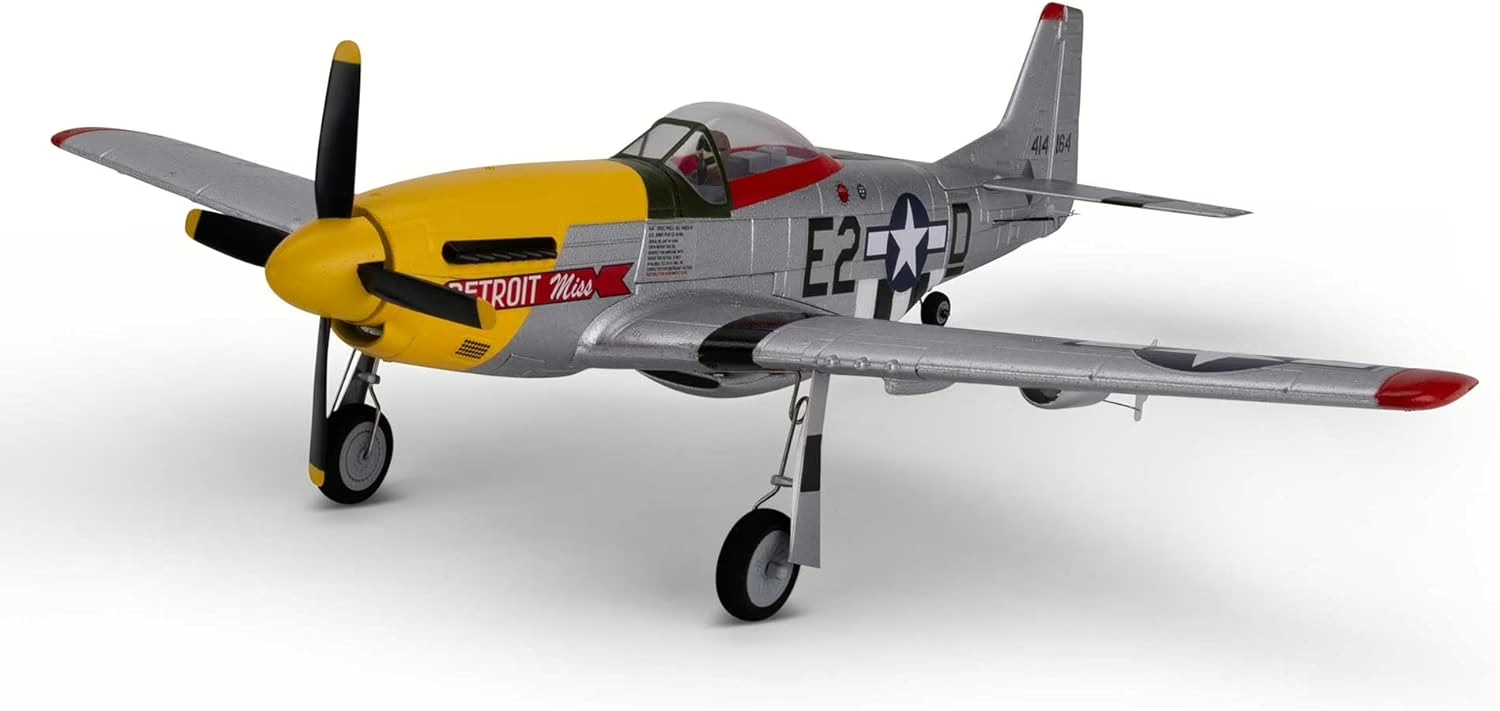
The “Detroit Miss” is a UMX scale EPS foam electric warbird, built on the same aerodynamic framework E-flite established for its UMX Voodoo racer. What’s changed is the historical and cosmetic identity: this airframe wears the livery of USAAF pilot Urban “Ben” Drew, whose P-51D is famous for intercepting and destroying two German Messerschmitt Me 262 jet fighters in October 1944 — one of the most remarkable single-sortie achievements of the entire air war. The model arrives as a BNF Basic unit, meaning the airframe is entirely factory-assembled and ready to bind to an existing Spektrum transmitter. Operators must separately provide a 5+ channel Spektrum DSMX/DSM2 compatible radio, a 280–300mAh LiPo battery in either 2S or 3S configuration, and a charger.
E-flite designed this aircraft for a specific buyer: the developing pilot who has logged meaningful time on a high-wing trainer, understands basic orientation and throttle management, and is ready for an aircraft that behaves like an actual fighter. Beyond that transitioning pilot, the Detroit Miss holds strong appeal for urban and suburban fliers locked out of traditional club runways, and for warbird collectors who want a flyable, historically accurate P-51D that doesn’t require a dedicated vehicle to transport or a large open field to fly.
Cool Features
- AS3X Stabilization Technology: This proprietary 3-axis gyro system operates imperceptibly in the background, executing thousands of micro-corrections per second to smooth out turbulence and counteract the torque roll generated by the high-powered brushless motor. The aircraft tracks with a locked-in authority that completely defies its 112-gram flying weight.
- SAFE Select Flight Envelope Protection: When activated, SAFE Select imposes hard mathematical limits on pitch and bank angle and delivers automatic self-leveling the instant the control sticks are released. For a nervous beginner entering a first steep bank, it is the electronic equivalent of an infallible onboard co-pilot.
- Dual-Voltage Power System: The ESC dynamically processes both 2S (7.4V) and 3S (11.1V) LiPo inputs, giving the pilot direct control over the aircraft’s performance envelope. On 2S, the aircraft is a manageable cruiser. On 3S, it has unlimited vertical climbing capability.
- Spektrum Smart Telemetry: When paired with an AirWare-equipped Spektrum transmitter (DX, NX, or iX series), the onboard ESC transmits real-time flight battery voltage directly to the pilot’s display. This eliminates arbitrary flight timers, protects LiPo cells from over-discharge, and prevents dead-stick emergencies.
Ready to take the ‘Detroit Miss’ to the skies? Check current pricing and availability on Amazon.
Pros & Cons
Pros
- The AS3X and SAFE Select combination effectively democratizes warbird flight. A beginner can engage SAFE Select and experiment with aggressive banks and low passes without the constant fear of losing orientation and spiraling in — then progressively disable it as confidence builds, revealing the full fighter flight envelope underneath.
- The 19.4-inch wingspan fits in any vehicle, any backpack, and permits flight operations at any municipal park or calm-day backyard. For urban pilots without access to club runways, this operational flexibility is genuinely transformative.
- The dual-voltage brushless power system provides two distinct aircraft personalities in one airframe: a docile 2S cruiser for orientation and proficiency work, and a high-energy 3S machine capable of aggressive aerobatics and unlimited vertical climbs.
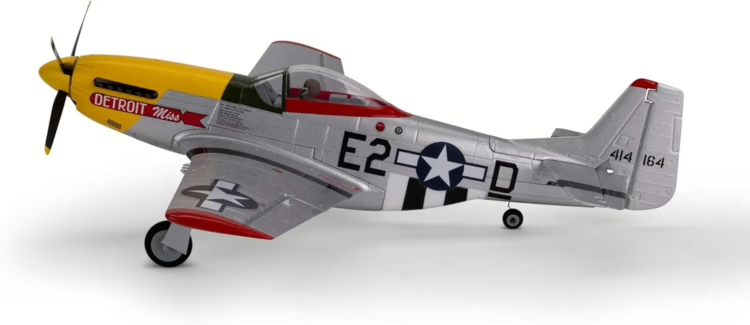
- The historically accurate “Detroit Miss” livery satisfies warbird collectors with authentic scale panel lines, exhaust stacks, a period-correct four-blade propeller, and accurate markings replicating Ben Drew’s actual combat aircraft.
- BNF Basic format means near-zero setup friction — bind to your Spektrum transmitter and fly within minutes of opening the box.
Cons
- At 112 grams, the Detroit Miss is fundamentally a fair-weather machine. Wind speeds beyond mild breezes induce a volatile flight path, severely restricting practical flying windows to calm mornings or evenings.
- Pilots who don’t already own a compatible Spektrum DSMX/DSM2 transmitter face a substantial secondary cost. The proprietary receiver cannot communicate with open-source or third-party radios, making this a poor entry point for pilots starting from zero equipment.
- The scale tail-dragger landing gear — narrow-track main wheels, small-diameter tires, and a steerable tailwheel — demands active, progressive rudder management during the takeoff roll to prevent a ground loop. This is markedly more demanding than the tricycle gear found on standard high-wing trainers.
- The rigid four-blade scale propeller is highly vulnerable to turf damage during belly landings. Precise throttle-cut discipline immediately before grass contact is non-negotiable to protect the propeller blades and motor shaft.
Features & Performance Analysis
Design & Build Quality
The airframe is molded from an Expanded Polystyrene (EPS) foam blend — a material choice that enables the precise replication of scale surface details, including recessed panel lines, engine exhaust stacks, and the accurate wing geometry of the P-51D’s laminar flow airfoil. The gray and olive-drab paint scheme is historically correct for the “Detroit Miss,” though the matte military finish can blend into overcast skies, making visual orientation slightly more challenging than the brightly colored neon variants in the UMX lineup, such as the Voodoo.
The 19.4-inch wingspan is the central logistical advantage over larger warbird formats. This model transports fully assembled in virtually any vehicle and eliminates the assembly and teardown friction that accompanies 1.2-meter scale models. EPS foam does have finite compression limits — a direct, high-velocity impact with hard infrastructure will fracture the fuselage — but the low mass keeps kinetic energy in crashes minimal. Fractures are readily bonded using foam-safe cyanoacrylate adhesives, returning the airframe to service quickly with negligible aerodynamic degradation.
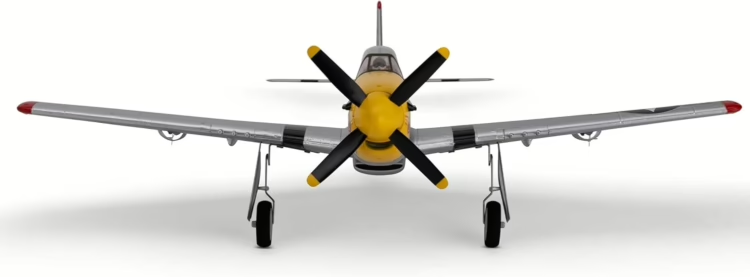
The landing gear configuration warrants specific attention before purchase. The scale tail-dragger geometry performs adequately on smooth asphalt or tightly packed dirt surfaces, where the steerable tailwheel provides directional authority. On standard grass, however, the small-diameter wheels generate immense drag, and a rolling takeoff from an unmanicured lawn will almost certainly result in the wheels digging in and the aircraft nosing over violently. E-flite addresses this directly by making the main gear and tailwheel removable in seconds, converting the airframe to a hand-launch and belly-landing configuration optimized for grass operation.
Power System & Electronics Architecture
The propulsion system is a 3000Kv 180-size brushless outrunner — a meaningful generational step over the brushed coreless motors that previously dominated the ultra-micro segment. This motor interfaces with a proprietary Spektrum control board that integrates the DSMX receiver, linear servos, and a dual-voltage ESC capable of dynamically processing both 2S and 3S LiPo inputs without manual reconfiguration.
On a 2S 300mAh battery, the brushless system delivers a predictable, manageable cruising speed that affords developing pilots adequate time to process control inputs and establish orientation. Advance to a 3S pack and the dynamic changes dramatically: the aircraft produces unlimited vertical climbing capability, enabling power-through loops, Cuban Eights, split-S maneuvers, and sustained inverted flight with minimal forward stick correction required to hold altitude.
One practical setup note: positioning the 3S 300mAh battery entirely to the rear of the battery tray optimizes the Center of Gravity, preventing a nose-heavy attitude that would otherwise require excessive up-elevator trim during cruise flight.
The AS3X algorithm operates through Micro-Electro-Mechanical Systems (MEMS) sensors, continuously detecting environmental turbulence, torque roll, and uncommanded attitude deviations, then instantly actuating precise counter-deflections across all control surfaces to maintain the commanded flight path. Without this electronic damping, rapidly advancing to full throttle on a 3S pack would cause the high-powered motor’s torque to snap-roll the 112-gram airframe violently to the left. AS3X is not merely a convenience feature here — it is the engineering solution that makes a high-powered sub-250-gram warbird manageable by human reflexes.
Flight Performance
Takeoff: The tail-dragger physics are immediately apparent during the ground roll. As the pilot advances throttle, torque from the rigid four-blade propeller generates significant P-factor, inducing a strong left-yaw tendency. Progressive right rudder application is required to track the centerline. Up-elevator must be held to pin the tailwheel to the surface for directional steering until sufficient airspeed develops; releasing it prematurely or over-advancing throttle risks a propeller strike.
In-Flight Stability: Once airborne, the AS3X system demonstrates its value immediately. The aircraft tracks through the air with a rigid, locked-in quality that is entirely inconsistent with its flying weight. In moderate, smooth breezes, gyro corrections are imperceptible to the pilot, allowing perfectly axial passes. The four-blade propeller and brushless outrunner combination generates minimal mechanical noise — a practical advantage for suburban flying areas.
Aerobatics: On a 3S pack with SAFE Select disabled and control throws at 100%, the Detroit Miss is a capable aerobat. The linear servos provide a rapid, crisp roll rate. The aircraft executes large loops, Cuban Eights, split-S maneuvers, and sustained inverted flight with only minimal forward stick pressure required to maintain altitude.
Stall Behavior: The miniaturized laminar wing requires kinetic energy to sustain lift. Chopping throttle and holding up-elevator will eventually produce a tip stall — a sharp, asymmetric wing drop. With SAFE Select active, this risk is entirely mitigated; the algorithm prevents the nose from pitching to the critical angle of attack. For pilots still building their instincts, this protection is substantial.
Landing: The 112-gram airframe carries minimal inertia and cannot glide meaningfully without power. The pilot must carry steady throttle through the descent to manage the sink rate. Upon touchdown with gear installed, throttle must be cut instantly while applying up-elevator to pin the tail and prevent a nose-over. On grass without the landing gear fitted, a belly landing requires a precisely timed throttle cut immediately before turf contact to protect the rigid four-blade propeller from catching the vegetation and causing mechanical stress to the motor mount.
Value for Money
The Detroit Miss occupies a premium market position. The full cost of entry — BNF airframe, a compatible 5+ channel Spektrum transmitter (such as the DXS or NX6), a compatible balancing charger, and 300mAh 3S batteries — represents a substantial cumulative investment for an unequipped beginner.
Against alternatives like the VolantexRC 400mm series the value proposition hinges entirely on technological differentiation. Cheaper competitors rely on brushed coreless motors and mechanical gearboxes that lack the longevity, sheer torque, and unlimited vertical performance of the E-flite 180-size brushless outrunner. Competitor gyros provide basic attitude leveling; Spektrum’s AS3X code delivers a substantially higher resolution of micro-corrections, eliminating robotic flight characteristics and producing a fluid, connected feel at the transmitter gimbals. The Smart telemetry integration is absent on budget competitors entirely. For pilots already invested in the Spektrum ecosystem, this aircraft delivers exceptional value for what it provides. For pilots starting from zero equipment, the total acquisition cost warrants serious consideration against purpose-built RTF trainers.
Where the E-flite UMX P-51D “Detroit Miss” Really Shines
The unique satisfaction of the “Detroit Miss” is difficult to fully capture in a specification table. There’s a specific experience in grabbing a flyable, historically significant P-51 Mustang from a flight bag, walking to the end of a suburban soccer field on a calm morning, and flying it through a sequence of loops and low-level passes — with no truck, no club membership, no airspace scheduling, and no other pilots to wait for.
The aircraft’s sub-250-gram flying weight entirely bypasses FAA Remote ID requirements, delivering uninhibited local flight operations. In winter months, the precise, gyro-aided tracking makes the Detroit Miss a standout performer at AMA-sanctioned indoor gymnasium events, where its slow-flight capability can be maximized in a zero-wind environment — a scenario where larger warbirds are simply not viable.
The SAFE Select system’s psychological impact on the developing pilot should not be understated. For a nervous beginner contemplating their first steep bank in a warbird, the fear of a catastrophic loss of orientation is genuinely overwhelming. With SAFE Select active, that pilot can experiment with low passes and aggressive throttle applications without the paralysis. If visual orientation of the gray airframe against the sky is momentarily lost, releasing the sticks is sufficient — the software instantly arrests any developing spiral and snaps the aircraft back to a level horizon. It replaces the traditional buddy-box instructor methodology with a system that is always present, always responsive, and never loses focus.
And beyond the technology, there is the collector dimension. An ungainly foam high-wing trainer is utilitarian. A meticulously detailed, flyable P-51D “Detroit Miss” sitting on the desk — one that replicates the personal aircraft of a pilot who shot down two German jets in a single combat sortie — delivers something fundamentally different. It’s that romanticized fighter pilot experience that drew most of us to this hobby in the first place.
E-flite UMX P-51D “Detroit Miss” — Check current pricing and availability on Amazon.
Who Should Buy It
Buy It If…
- You’re a transitioning Spektrum pilot. If you’ve successfully mastered fundamental flight orientations on a high-wing trainer, currently own a Spektrum DSMX/DSM2 compatible transmitter, and want a technologically supported bridge into scale low-wing warbird flight, this is exactly the aircraft the market has been building toward.
- You’re constrained by urban geography. Pilots who lack access to club runways but demand a high-performance, fully aerobatic aircraft capable of operating in the airspace of local parks and sports fields on calm days will find the UMX footprint genuinely liberating.
- You’re a traveling intermediate. Experienced RC operators seeking a compact, packable, fully assembled aircraft that can live permanently in a flight bag for spontaneous sessions during travel will find nothing more capable at this size and weight.
- You’re a micro-scale warbird collector. Aviation enthusiasts who prioritize historically significant liveries and flyable authenticity, but refuse to compromise on brushless power and 4-channel aerobatic authority, have their definitive option here.
Skip It If…
- You live in a consistently windy region. AS3X is exceptional, but 112 grams imposes hard physical limits. Consistent heavy winds or coastal gales will turn every flight into a survival exercise rather than an enjoyable one.
- You’re a day-one beginner without Spektrum gear. Absolute beginners who lack a compatible transmitter and want an all-in-one Ready-to-Fly solution in a single box will find the accumulated cost of radio, charger, and batteries far exceeds the logic of a purpose-built RTF trainer.
- Your only option is deep, unmanicured grass. Pilots whose available flying sites feature heavy vegetation — and who expect to perform rolling takeoffs and wheel landings — will fight the narrow-track tail-dragger geometry perpetually. Unless you’re willing to commit exclusively to hand-launches and belly landings, this aircraft will frustrate more than it rewards.

Key Takeaways
- AS3X + SAFE Select is the key differentiator: these technologies make historically demanding low-wing warbird flight genuinely accessible for developing beginners without permanently sacrificing the aggressive flight characteristics of a fighter.
- Dual-voltage brushless power (2S docile / 3S unlimited vertical) provides two distinct performance personalities in a single airframe.
- Smart telemetry streams real-time battery voltage to compatible Spektrum radios, protecting both the pilot and the LiPo cells.
- Wind is the hard limit: at 112 grams, operations above mild breezes are impractical and unrewarding.
- Ideal buyer: a transitioning Spektrum pilot with limited flying space who demands a flyable, historically accurate warbird with built-in electronic safety nets.