

In 1965, a nuclear strike jet retrained as a MiG hunter changed the air war over North Vietnam—not by engaging the enemy, but by making them too afraid to fight.
It was the spring of 1965, and the air war over North Vietnam was turning against the United States. Strike packages were bleeding. On April 3, three North Vietnamese Mikoyan-Gurevich MiG-17 Frescos hit a formation near the Dong Phuong Thong Bridge—roughly 70 miles south of Hanoi—damaged a U.S. Navy Vought F-8 Crusader, and disappeared before anyone could react. The following day was worse. MiG-17s ambushed four Republic F-105 Thunderchiefs sitting in a pre-strike orbit and shot two of them out of the sky, again slipping away clean. Both times, the enemy jets had sidestepped the F-100 Super Sabre escorts as though they weren’t there.
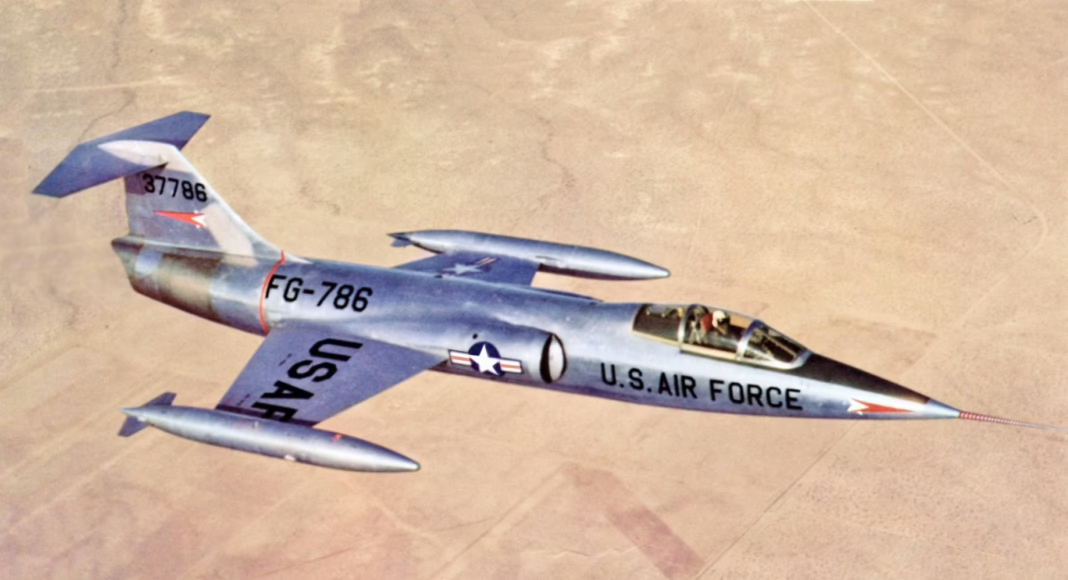
Something had to change. And what changed it wasn’t a new missile, a revised doctrine, or a surge in kill ratios. It was a slender, needle-nosed Mach 2 jet that its own air force had long regarded as a problem child—the Lockheed F-104C Starfighter.
Within days of the first F-104Cs reaching Da Nang, the picture shifted. North Vietnamese MiG pilots stopped pressing attacks against U.S. strike packages covered by Starfighters. They also began giving the slow, vulnerable EC-121 airborne early warning aircraft—platforms worth every effort to destroy—a conspicuous wide berth. Over 96 days, the 476th Tactical Fighter Squadron flew 1,182 combat sorties, lost a single aircraft, and went home without a confirmed air-to-air kill. And yet the men who flew alongside them, and the commanders who studied the results, reached the same conclusion: the F-104 had accomplished something most fighters never do. It had won its air superiority mission without having to fight for it.
A Troubled Thoroughbred
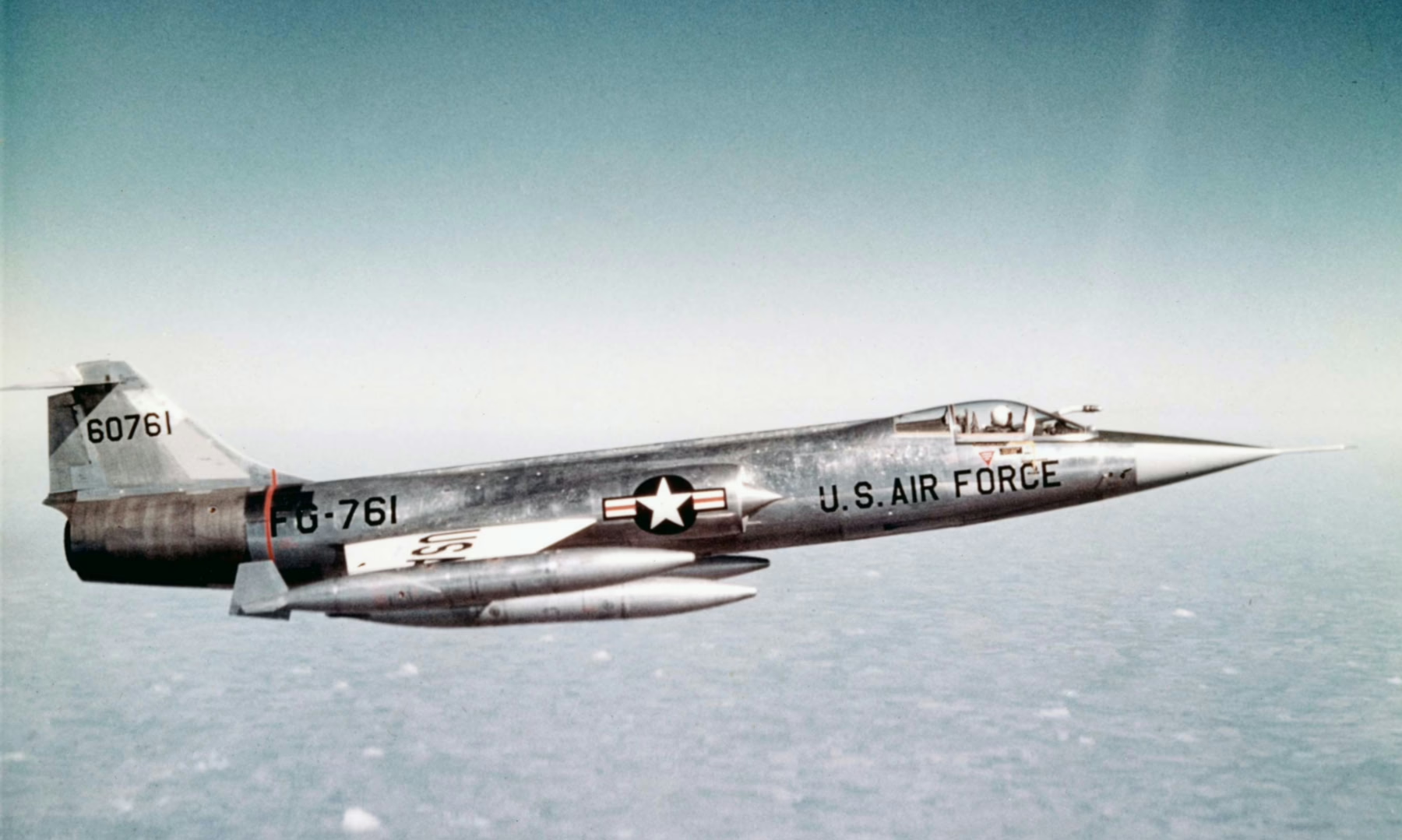
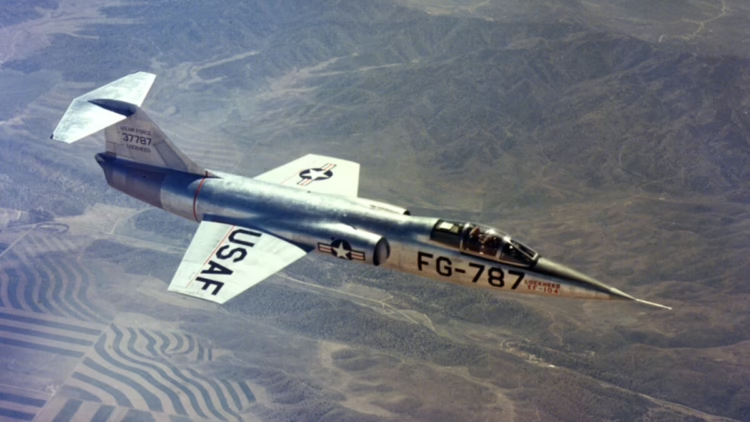
The Starfighter’s road to Vietnam was anything but smooth. Conceived by Lockheed’s Clarence “Kelly” Johnson and his secretive Skunk Works design team, the F-104 was a deliberate break from the heavy, complex fighters that had dominated the early Cold War. The XF-104 prototype first flew on March 4, 1954, at Edwards Air Force Base in California, with company test pilot Tony LeVier at the controls. It was arresting to look at: a fuselage that seemed built around its engine, married to wings so short and thin they barely appeared capable of sustaining flight. That was largely the point. Speed and climb rate were the currency of this design.
The F-104A, the first operational version, reached its initial unit—the 83rd Fighter Interceptor Squadron (FIS) of the USAF’s Air Defense Command (ADC)—at Hamilton AFB, California, on January 29, 1958. Operational service began three weeks later. The problems started almost immediately. The General Electric J79-GE-3A turbojet and its variable afterburner nozzle proved chronically unreliable: regular flameouts, oil leaks, backfires, and ignition failures plagued the early fleet. By April, after barely three months of service, the F-104A was grounded. A more dependable variant—the J79-GE-3B, rated at 14,800 pounds of thrust—was retrofitted across the fleet, and the Starfighter returned to flight status that July. Despite that fix, the type’s safety record continued to compare unfavorably against its Century Series stablemates.
External scrutiny arrived quickly. In June 1958, Roland “Bee” Beamont, chief test pilot of Britain’s English Electric, flew the F-104A and came away sharply critical. He found inadequate directional damping, evidenced by a persistent low-amplitude, short-period oscillation throughout most of the flight regime. The thin, highly loaded wing produced excessive break-out forces from the power-controlled ailerons and degraded turning performance. At high angles of attack, the high-set stabilator would stall in the wing’s downwash, likely resulting in a departure from controlled flight and entry into a flat spin from which recovery could be difficult. Subsonic handling, Beamont concluded, was unpleasant and particularly hazardous during takeoff and landing; the aircraft also lacked an all-weather capability—a near deal-breaker for an interceptor. Based on his assessment, Beamont predicted a high accident rate. He was proved right. By December 1983, the F-104’s cumulative destroyed rate in USAF service stood at 25.2 aircraft per 100,000 flight hours.
Col. Edgar R. “Gris” Grischkowsky, who logged more than 1,000 hours on the type, offered a more measured view. “When the F-104 first appeared in 1958, there was no other fighter that could compete,” he recalled, “as long as its pilots fought in it the way it was intended—namely to capitalize on its speed, difficulty of detection and climb rate, and made correct use of the armaments provided.” The Starfighter delivered on its design promise, Grischkowsky argued, provided pilots resisted old instincts. “One glance at the F-104’s wing area told us everything we needed to know about the advisability of engaging in a turning fight with other fighters!” The jet was not a dogfighter. But at what it was built to do—close fast, engage hard, break away—it had no equal.
The ‘C’ Model Takes Shape
The variant that went to Vietnam was a different proposition entirely. Tactical Air Command had been pushing for a supersonic tactical strike fighter to bridge the gap between its F-100C Super Sabres and the Mach 2-capable Republic F-105 Thunderchief still in development. Existing orders for the ‘A’ model had already been slashed from 722 to just 170 as range limitations and modest payload capacity made it increasingly unsuitable for the strike role. A 1956 contract for 56 ‘A’ models was renegotiated to the ‘C’—a variant then being drawn up at Lockheed—and later expanded to 77 airframes when a second order was placed.
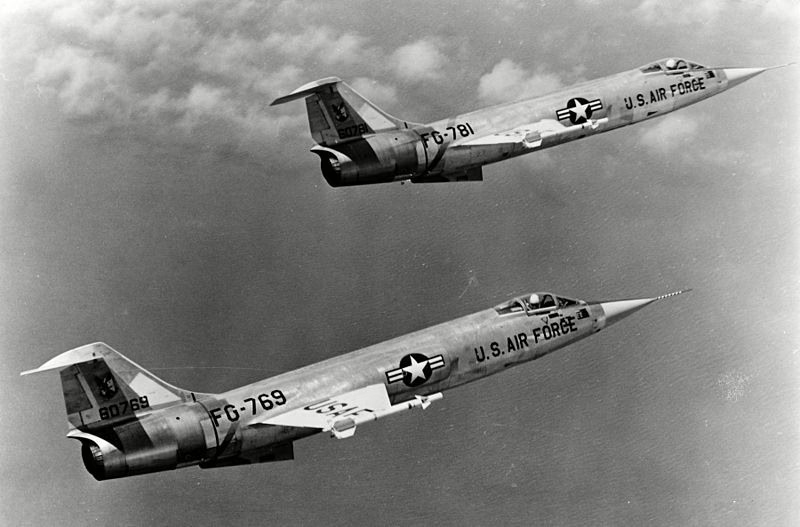
The F-104C first flew on July 24, 1958, referred to at the time as the YF-104C. Just two months later, the first three operational examples reached the 476th Tactical Fighter Squadron (TFS), the “Blue Knights” of the 479th Tactical Fighter Wing (TFW), at George AFB, California. Deliveries to the 434th, 435th, and 436th TFS followed, with as many as nine jets reaching the units each month between October 1958 and June 1959. Production eventually ran to exactly 77 airframes after orders for another 363 were cancelled when the USAF terminated its Starfighter production plans.
The ‘C’ brought meaningful improvements over the ‘A’. Its J79-GE-7 engine delivered approximately 15,000 pounds of thrust in afterburner — around 1,000 pounds more than the J79-GE-3B — along with improvements in reliability. It gained a second pair of underwing pylons for AIM-9B Sidewinders, an upgraded AN/ASG-14T-2 fire-control radar that conferred a degree of night capability, and a fixed but removable inflight refueling probe on the port side of the fuselage—a feature the ‘A’ lacked entirely. The nuclear strike mission remained central: the ‘C’ could carry a weapon on its centerline pylon.
In October 1961, the first ‘C’ was assigned to Project Grindstone, a Lockheed-led upgrade initiative. The most prominent addition was a centerline “catamaran” double stores rack enabling a second pair of AIM-9 Sidewinders to be carried. The concept made sense on paper but proved unpopular in service: the pylon generated drag, and the Sidewinder’s glass seeker heads were prone to scratching and pitting from debris kicked up by the nosewheel. The catamaran also blocked the center pylon, eliminating the nuclear store option when fitted. More operationally relevant was Grindstone’s expanded air-to-ground weapons suite—a pair of 19-shot 2.75-inch rocket pods, napalm canisters, and general-purpose bombs up to 1,000 pounds. Lockheed completed the final upgraded aircraft in early 1963.
Powerplant reliability had remained a persistent concern. Some 40 incidents over five years had destroyed 24 aircraft and killed nine pilots. In May 1963, General Electric launched Project Seven Up, a modification program that re-equipped the ‘C’ fleet with more dependable engines. Results were substantial, and when the last upgraded jet rolled out in June 1964, the F-104C was considered no less reliable than other contemporary types. Within a year, the Starfighter would be at war.
The Cuban Missile Crisis had already given the 479th TFW a preview of operational pressure. On October 20, 1962, the wing deployed 12 jets to Key West, Florida, prepared to strike Cuba just 90 miles to the south. From there they would have defended the southern United States, hit targets, and escorted strike packages across the island. With the confrontation resolved after 13 days, the Starfighters returned to California. Whether nuclear weapons would have been part of the F-104C’s loadout at Key West is unknown, though its stated role made that more than likely.
The Air War Turns
By early 1965, the air war over North Vietnam was exposing real weaknesses in U.S. tactical planning. The MiG-17 attacks of April 3 and 4 made clear that existing fighter coverage and early warning assets were insufficient to protect strike packages from enemy air defense. The U.S. Pacific Air Forces (PACAF) moved quickly: assets flowed into the region, including Lockheed EC-121D “Big Eye” aircraft from the 552nd Airborne Early Warning and Control Wing, which deployed to Taiwan’s Tainan Air Station in April. Four EC-121s were subsequently sent to Tan Son Nhut AB in South Vietnam, flying their first missions on April 16.
Protecting those EC-121s became the Starfighter’s first assignment. TAC had actually proposed deploying F-104s to the region as early as late 1964, and again in January 1965 to relieve pressure on overtaxed Super Sabre units. PACAF initially encouraged both proposals before reversing course each time, reasoning that introducing another type would create logistical complications and that the MiG threat did not yet warrant a unit dedicated solely to air superiority. The April attacks ended that debate.
On April 7, TAC issued the 479th TFW a deployment order. Five days later, 24 F-104Cs from the 476th TFS arrived at Kung Kuan Air Station in Taiwan. The plan called for 14 jets to rotate forward to Da Nang in South Vietnam—roughly 1,000 miles to the southwest—with four to six aircraft cycling through the temporary deployment every ten days to maintain full strength. The remaining ten stayed at Kung Kuan on standby.
The mission handed to the Da Nang-based pilots was not the one they had trained for. These were nuclear strike crews. Now they were flying combat air patrols against North Vietnamese fighters—MiGCAPs, in the parlance of the day—over the most contested airspace in Southeast Asia. Three flights of four F-104Cs, each loaded with 725 rounds of 20mm ammunition and four Sidewinders, would patrol at various altitudes between the strike packages’ objectives and the Hanoi-Haiphong area, with CAP points 225 to 275 miles northwest of Da Nang. The northeastern edge of the patrol zone sat just 15 miles from the Chinese island of Hainan, where many MiGs were based. Missions typically ran up to five hours; on-station time ranged from 40 to 90 minutes, with Strategic Air Command tankers available for extended operations.
Guarding the Eye in the Sky
The first F-104s arrived at Da Nang on April 19. The following day, the Starfighters entered combat—not toward Hanoi, but over the Gulf of Tonkin, escorting Big Eye EC-121Ds.
The EC-121 was irreplaceable and extraordinarily exposed. Slow, unarmed, and flying at low altitude, it offered exactly the profile an enemy fighter crew would relish. Operating in pairs, often at night and in poor weather, one “Big Eye” would hold a 50-mile racetrack pattern between 50 and 300 feet altitude, just 30 miles offshore—Alpha Orbit—while the other flew a similar track 10,000 feet further out to sea as Bravo Orbit, ready to provide radar coverage or fill in for the lead. Each EC-121 typically stayed on station for up to five hours.
The aircraft’s AN/APS-45 altitude-measuring radar was effective to roughly 70 miles. A technique refined during Cuban Missile Crisis patrols over the Florida Straits—bouncing radar energy off the water using the underside AN/APS-95 search radar—extended detection range to approximately 150 miles and provided a reliable coverage arc of around 100 miles. That was enough to watch both the urban approaches to Hanoi and the MiG base at Phúc Yên simultaneously.
Close escort of the lumbering EC-121Ds at 290 miles per hour was not practical for Mach 2 fighters. The 476th TFS instead mounted barrier combat air patrols—BARCAPs—consisting of three flights of four F-104Cs, supported by tankers, holding between 15,000 and 20,000 feet. Four Starfighters covered each EC-121D directly while the others cycled through the tanker before relieving the jets on Bravo Orbit, which in turn relieved those on Alpha Orbit, maintaining seamless coverage. If the MiGCAP could not rendezvous for any reason, the EC-121 missions were cancelled outright. On occasion, the BARCAP was reduced to pairs, but the standard held: the Big Eyes did not fly without their shield.
The results were extraordinary. By the time the EC-121 flew its final operation on August 15, 1973, the fleet had accumulated 98,000 accident-free flying hours across 13,921 combat missions. In that span, they assisted in the shoot-down of 25 MiGs and supported the rescue of 80 downed aircrew—all without losing a single aircraft. The doctrine that made it possible had been established by the 476th TFS.
 The Effect Was Immediate
The most remarkable element of the F-104’s Vietnam record was what did not occur.
Capt. Tom “Sharkbait” Delashaw, a 476th TFS pilot during the deployment, described it directly: “The F-104’s effect on MiG operations was immediate—they avoided contact with any USAF strike packages being covered by F-104s. They also gave the EC-121s a wide berth. Much to our frustration, there was only two fleeting encounters with MiGs during the 476th’s deployment.”
Two encounters. In 96 days, with 14 jets flying continuous patrols over heavily contested airspace, the 476th made visual contact with enemy fighters exactly twice—and neither encounter ended in a merge.
The first came when a pair of F-104s was vectored toward a MiG-21 Fishbed that had just departed Hainan Island, roughly 300 miles northeast of Da Nang. The Starfighters gave chase at Mach 1.4 before being forced to break off as the Soviet-built jet crossed back into Chinese territory.
The second was stranger. Four F-104s returning to Da Nang from a MiGCAP were approximately 30 miles south of Hanoi when a Chinese-built Shenyang J-6—the Chinese production version of the MiG-19 Farmer—materialized out of cloud cover barely a mile ahead of them. Delashaw was among the four: “Before any of us could react, the J-6 lit both afterburners and dove into the clouds. In my opinion, it had been under ground-controlled interception control and had been warned about the F-104s.”
The Starfighter’s performance and reputation had already done the work. Post-war evidence suggests that MiG pilots had received no specific training to counter the F-104—and whether through calculated caution, genuine fear, or institutional unpreparedness, North Vietnam’s fighter force had elected not to find out what a head-on engagement with a Mach 2 jet actually produced.
Delashaw was unequivocal about the 476th’s edge: “We were over in Vietnam strictly to counter any efforts by the MiGs to intercept the bombers or EC-121s. By 1962, the Starfighter had established a reputation as almost unbeatable in air combat maneuvering—in 1965 we maintained that edge.”
More Than One War
With the MiG threat neutralized by deterrence if not by combat, command attention shifted. PACAF—which had never fully embraced the single-mission Starfighter’s presence in theater—began assigning the 476th to roles well outside its original mandate. Weather reconnaissance, close air support across the south, and strike missions into the north were layered onto an already demanding schedule. Many in TAC and the U.S. Department of State acknowledged the Starfighter’s contribution to air superiority; PACAF framed the picture differently, focusing on what it characterized as the inefficiency of maintaining a single-mission aircraft in theater.
Weather reconnaissance missions typically involved two F-104s flying close enough to a target area to assess pre-strike conditions without telegraphing the intended objective. Tanker support was standard. Close air support in South Vietnam, coordinated with airborne forward air controllers, produced results that surprised the FAC community: the F-104 earned a reputation for near-pinpoint accuracy with its cannon and bombs, and controllers began requesting Starfighters by name. Jets could reach targets 250 miles from Da Nang within 40 minutes of an alert—including the ten minutes it took a pilot to reach his aircraft.
The deployment’s single combat loss came on June 29, 1965, during a close air support sortie. Capt. Richard Cole was forced to eject from aircraft serial 56-0937 following a hydraulic system failure. The official cause of loss was recorded as “AAA fire received during roll-in for a dive bomb pass,” though several 476th pilots believed pilot error during the pitch-up had caused the aircraft to depart controlled flight. Cole survived and was recovered by helicopter. Twelve days later, on July 11, the 476th’s temporary deployment ended with the arrival of the 436th TFS.
The Final Accounting
The statistics tell a story of sustained performance under grueling conditions. In 96 days, the Blue Knights flew 1,182 combat sorties: 52 percent EC-121 escort, 24 percent MiGCAP, 18 percent ground attack—including 21 strike and anti-aircraft artillery suppression sorties against targets in the north—and 5 percent weather reconnaissance.
Sustaining that pace in Southeast Asia’s heat demanded everything the ground crews had. Lockheed technical representative Ben McAvoy captured it in a report to the company: “A seven-day work schedule had enabled the squadron to fly 12 aircraft as many as 90 hours per day in support of our mission there. Crew chiefs, maintenance and munitions personnel worked in shifts around the clock. When ground temperatures reach 106° on the flightline at Da Nang, these dedicated troops take a break in the only shade there is—under the wing of an F-104!” Throughout the deployment, the 476th maintained an in-service rate of 94.7 percent. “The credit for this achievement went to the maintenance troops,” McAvoy noted. The Blue Knights had succeeded despite parts and spares shortages, relentless sortie rates, and diminishing aircraft serviceability.
The broader contribution of the F-104C would outlast the 476th’s tour. What the Blue Knights established—the BARCAP doctrine, the EC-121 escort procedures, the standard of deterrence that emptied the sky of MiGs through reputation alone—became the operational foundation for the wings that followed.
No assessment of the Starfighter’s Vietnam record has improved upon the one that has followed it since the jet departed Southeast Asian skies for the last time in 1967: “If the F-104C is judged against other US aircraft for its ability to sustain battle damage, to deliver large bombloads or to conduct operations in bad weather, the ‘104 rates as an also-ran. If, however, the F-104C is judged for its ability to deter MiGs, to ensure the safety of the aircraft entrusted to its escort, or to out-perform any aircraft in existence at the time, it is unrivalled. The F-104 had a mission in SEA: air superiority—a mission it performed brilliantly.”
The jet that never had to fire a shot had done something rarer still. It had won.

Key Takeaways
- The F-104C’s speed and combat reputation deterred North Vietnamese MiG pilots from engaging U.S. strike packages, achieving air superiority without a single confirmed air-to-air kill during the 476th TFS’s 96-day deployment.
- The 476th TFS’s BARCAP escort doctrine protected EC-121 Big Eye aircraft through 13,921 combat missions and 98,000 accident-free flight hours, assisting 25 MiG kills and 80 aircrew rescues.
- The Blue Knights flew 1,182 combat sorties at a 94.7% in-service rate, losing only one aircraft, while operating in temperatures reaching 106°F on the Da Nang flightline.
- Available post-war evidence indicates MiG pilots had received no specific training to counter the F-104, compounding the deterrence effect of its formidable reputation.Judged on its actual mission—MiG deterrence and escort protection—the F-104C was, by its own post-war assessment, “unrivalled.”