


On August 1, 1955, a Lockheed test pilot set out to taxi a radical new aircraft across the Nevada desert. He never intended to leave the ground. What happened next would shape Cold War history.
Deep in the Nevada desert, at a remote and restricted test site known only as Area 51, Lockheed test pilot Tony LeVier climbed into the cockpit of a peculiar-looking aircraft in the summer of 1955. Long-winged, feather-light, and unlike anything that had rolled down a production line, the machine had been assigned the clinical designation Article 341. LeVier’s assignment that August 1 afternoon was unambiguous: a routine taxi trial to gauge how the aircraft handled at low speed. He had no intention of going airborne.
The aircraft had different plans.
As LeVier advanced the throttle and the aircraft began to accelerate in what he intended as a normal ground run, the U-2’s enormous wings, combined with its lightweight structure, responded to natural ground effect. Article 341 lifted off. What was supposed to be a low-speed handling evaluation became, without ceremony or preparation, the first flight of what would become America’s most consequential intelligence-gathering aircraft.
A Program Born in Secrecy
The U-2 had taken shape inside a secure section of Lockheed’s facility at Burbank, California — a division that would come to be known as the Skunk Works. The program, designated Project Aquatone, was run by the Central Intelligence Agency, though the U.S. Air Force and other government agencies were involved from the outset.
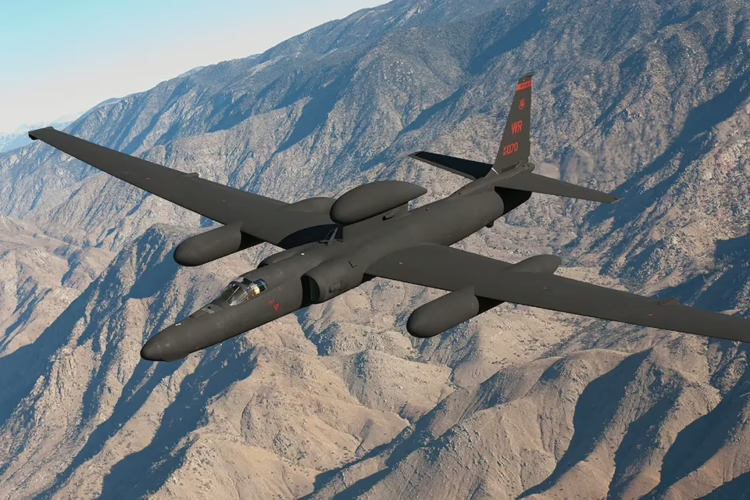
The aircraft Lockheed produced was, in engineering terms, a study in radical simplicity. Essentially a powered glider, it incorporated a single engine, an exceptionally lightweight airframe, and a bay designed to house photographic equipment. Everything about its design was subordinated to two performance goals: extreme altitude and long range. By the time the program reached operational capability in early 1956, the U-2 had demonstrated a ceiling of 72,000 feet and a range of 2,950 miles — performance figures that placed it beyond the reach of any existing interceptor or surface-to-air missile system.
One strategic advantage the program enjoyed at the outset would soon evaporate: satellite imagery had yet to become reality. Soviet intelligence had no way to observe what was being assembled at Burbank or prepared for flight in Nevada. The CIA used that window to build not just an aircraft but an entire clandestine infrastructure.
The Architecture of Concealment
Moving the U-2 from California to Nevada required meticulous operational security. Each aircraft was disassembled at Burbank, wrapped in protective covers to conceal its identity, loaded aboard a Douglas C-124 Globemaster transport aircraft, and flown to Area 51. Once unloaded, each aircraft was reassembled inside a hangar, and security remained tight throughout. The remote location of Area 51, deep within a restricted section of the Nevada desert, kept the program effectively invisible.
The official first flight — a formal event staged before selected officials from Lockheed, the government, and the military — followed a week after the accidental liftoff, taking place on August 8, 1955. By early 1956, several U-2s had been delivered to Area 51. With the required altitude ceiling and range confirmed, sufficient aircraft available, and the necessary film processing infrastructure established in Washington, D.C., the CIA was ready to begin operations.
What was needed next was a base in the right part of the world.
Deploying the Dragon Lady
The first overseas deployment settled on RAF Lakenheath in England, which received four aircraft and their essential support elements by May 4, 1956. To shield the program from scrutiny, the aircraft were assigned to Weather Reconnaissance Squadron (Provisional) 1 — a cover designation that obscured the CIA’s operational role. Personnel from the agency, the Air Force, and Lockheed referred to the arrangement simply as Detachment A, or Det A.
Lakenheath presented problems almost immediately. Several incidents threatened to embarrass the British government, prompting a hasty relocation. The operation moved to Wiesbaden, West Germany, where the deployment arrived on June 11, 1956. But Wiesbaden proved unsuitable as well — the base occupied a populated area, making it difficult to keep the U-2s out of public view. A third move was arranged, this time to Giebelstadt, 100 miles to the east.
Before that repositioning was complete, the agency flew its first overflights.
Operation Overflight: Piercing the Iron Curtain
On June 20, 1956 — still before the move to Giebelstadt had concluded — a CIA U-2 flew the program’s inaugural overflight of Eastern Europe. It was the first of many. Early sorties photographed key areas across the Soviet Union’s satellite states, including Bulgaria, Czechoslovakia, the German Democratic Republic, Hungary, Poland, and Romania. Each country operated Soviet military equipment, making them priority targets for Western intelligence.
Two additional missions flew on July 2, 1956. One covered Czechoslovakia, Hungary, and Bulgaria; the second photographed East Germany, Poland, Hungary, and Romania. The film was transported to a processing laboratory in Washington, D.C., and the results were encouraging.
The program’s ambitions extended well beyond Eastern Europe. CIA project officer Richard Bissell had already briefed President Dwight D. Eisenhower on plans to penetrate Soviet territory itself. Eisenhower, who personally approved each overflight mission and harbored deep concern about the diplomatic fallout a shootdown might trigger, had remained uneasy throughout — despite reassurances from senior aides and intelligence assessments of Soviet defensive capabilities. The dilemma, however, was intensified by public anxiety about a perceived Soviet advantage in strategic bomber production. The president gave his authorization.
On July 4, 1956, Article 347 — serial number 56-6680 — flew the first mission over Soviet territory. The aircraft crossed above Poznan, Poland, where riots had taken place days earlier, then continued north over Belorussia to Leningrad, and returned via the Baltic States. The following day, a second mission covered areas east of Moscow, permitting limited photography of the city itself — the only time the Soviet capital was targeted — along with production plants and test facilities at Ramenskoye.
Soviet radar had detected the incursions sufficiently to scramble MiG-15 and MiG-17 interceptors — but tracking proved inconsistent, radar coverage around Moscow and Leningrad was unexpectedly thin, and Soviet command remained unaware that a U-2 had overflown both cities.” The U-2 was, for the moment, untouchable.
Expanding the Network
As the program deepened its reach into Soviet territory, its basing network expanded accordingly. Detachment B was established at Adana, Turkey — later renamed Incirlik — along with locations within the Indian subcontinent. Detachment C operated from Naval Air Facility Atsugi, Japan; Detachment G from Edwards Air Force Base, California; and Detachment H from T’ao-yuan, Taiwan. Cover designations followed the Lakenheath model: Weather Reconnaissance Squadrons (Provisional) 2, 3, and 4 were created for Incirlik, Atsugi, and Edwards, respectively. Aircraft and crews shifted within their areas of responsibility as mission requirements evolved.
One of the program’s most ambitious sorties came on May 1, 1960, departing from Peshawar in northwestern Pakistan with a plan to traverse the Soviet landmass, overfly the Kazakh region and the Urals, and land at Bodo, Norway. By then, however, the Soviet Union’s defensive capabilities had advanced significantly. Batteries of S-75 Dvina surface-to-air missiles — designated SA-2 Guideline by NATO — were operational across the country. One of multiple SA-2s fired that day detonated close enough to fatally cripple the aircraft. The U-2 went down near Sverdlovsk. Pilot Gary Powers ejected, was captured, stood trial, and was imprisoned. The incident forced President Eisenhower to halt all overflights of Soviet territory and compelled the CIA to transfer U-2 operations in the region to the Air Force.
NASA and the Cover That Failed
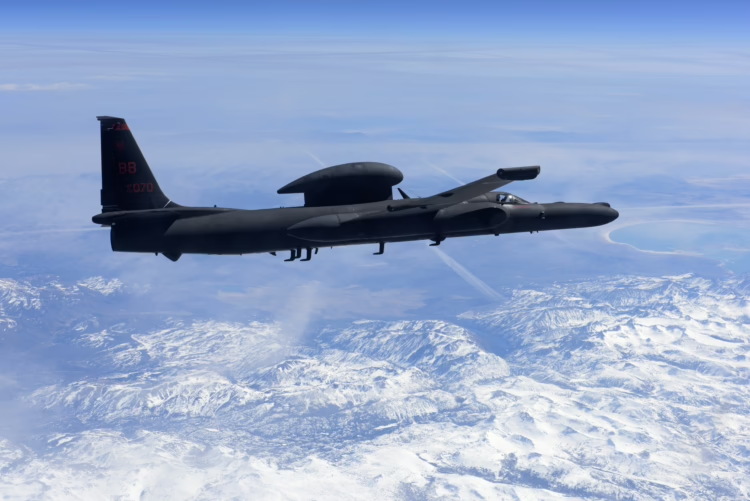
NASA and its predecessor, the National Advisory Committee for Aeronautics, had borrowed U-2s for weather research, logging some 200 sorties by 1960. Following Powers’ shootdown on May 1 of that year, NASA hurriedly staged an all-black U-2 painted with a NASA tail stripe and the fictitious serial 55741 outside the agency’s hangar at Edwards Air Force Base, in an attempt to characterize the program as purely civilian atmospheric research. The ruse collapsed the following day when Soviet leader Nikita Khrushchev revealed that Powers had been captured alive.
NASA subsequently received two U-2Cs formally assigned to the agency — registered N708NA and N709NA — both of which had previously served the CIA as Articles 348 and 349 and had been among the first four aircraft deployed to Lakenheath and Wiesbaden. Both aircraft conducted earth survey work before being replaced by a pair of brand-new ER-2s: N706NA (serial 80-1063), acquired in June 1981 and later re-registered as N806NA, and N809NA (serial 80-1097), acquired in March 1989. Both ER-2s remain in service with the Armstrong Aircraft Operations Facility at Palmdale, California, conducting high-altitude earth sciences missions in the Airborne Science Program.
Strategic Air Command Takes the Controls
Shortly after the CIA acquired its first U-2s, the decision was made for Strategic Air Command to stand up its own U-2 operation. The Air Force could provide credible cover for agency activities and offered a supply of pilots who could be “sheep-dipped” into government service. Of the first 20 aircraft produced, all went to the CIA; the next 29 carried Air Force serial numbers and went to the military. A further six were ordered in 1959 for CIA service. The assignment of Air Force serials to CIA aircraft enabled exchanges between the two operators.
The 4080th Strategic Reconnaissance Wing at Laughlin Air Force Base, Texas — already operating the high-altitude Martin RB-57D — became the Air Force’s initial U-2 home. The 4028th Strategic Reconnaissance Squadron stood up on April 1, 1957, with U-2A 56-6696 believed to be the first aircraft assigned. The squadron’s initial tasking was the High-Altitude Sampling Program (HASP), designed to collect radioactive particulates in the upper atmosphere generated by Russian, Chinese, and French nuclear weapons tests. Missions flew from Ramey Air Force Base in Puerto Rico, Plattsburgh Air Force Base in New York, and overseas locations. Aircraft carried sampling equipment in the nose and on the port fuselage; filter membranes inside those units trapped particulates as the aircraft flew straight north-to-south passes — informally called Crow Flight missions. The 1963 Partial Nuclear Test Ban Treaty brought the HASP program to a close, and sampling equipment was replaced with photographic cameras and electronic sensors.
Laughlin was later earmarked as a pilot training facility, prompting the 4080th to relocate to Davis-Monthan Air Force Base, Arizona, on July 1, 1963. The 100th Strategic Reconnaissance Wing replaced the 4080th on June 25, 1966, with the 4028th renumbered as the 349th Strategic Reconnaissance Squadron. The U-2 operation remained at Davis-Monthan until September 30, 1976, when SAC consolidated its high-altitude reconnaissance assets under a single parent wing at Beale Air Force Base, California, where the 9th Strategic Reconnaissance Wing already operated the Lockheed SR-71A Blackbird. On September 19, 1991, the 9th was redesignated, and in June 1992, with Strategic Air Command itself passing into history, the wing and its assets transferred to the newly formed Air Combat Command.
The TR-1: A New Identity for the Same Mission
Two decades after Gary Powers made world headlines, the U-2 name remained politically toxic. When the Air Force sought to reopen the production line for a battlefield surveillance variant, senior officials opted for a new designation. An order for 37 aircraft was placed in November 1979, using existing jigs and tooling at Palmdale. Most were to carry the TR-1 designation; some retained the U-2 designation despite identical external appearance.
The first TR-1A — serial 80-1066 — rolled out from the Palmdale line on July 15, 1981, and was delivered to Beale Air Force Base in September. Of the 37 aircraft ordered, eight were designated U-2Rs, one was a dedicated U-2R(T) trainer, two were ER-2s for NASA, two were TR-1B two-seat trainers, and the remaining 24 were operational TR-1A variants.
TR-1A 80-1068 was the first to visit Europe, arriving for display at the 1982 Farnborough Air Show on August 30, 1982, with hopes of generating export orders from the United Kingdom and West Germany. No further interest materialized. TR-1s were subsequently based at RAF Alconbury in England, where the 17th Reconnaissance Wing and its flying component, the 95th Reconnaissance Squadron, activated on October 1, 1982, accountable to SAC’s 7th Air Division at Ramstein Air Base, West Germany. The first pair of TR-1As — 80-1068 and 80-1070 — arrived at Alconbury in February 1983.
Deliveries were slow, largely because the dedicated sensor systems were under development. Sorties routinely covered West Germany and the Baltic Sea, monitoring Warsaw Pact nations, with missions lasting up to nine hours. By 1989, 13 hardened aircraft shelters had been constructed at Alconbury. With the Cold War’s end, however, the rationale for a forward-deployed TR-1 force in Europe largely dissolved. The 17th Reconnaissance Wing inactivated on June 30, 1991. In October 1991, all surviving TR-1As were redesignated as U-2Rs.
From Kuwait to the Balkans
U.S. Air Force U-2s, alongside other intelligence, surveillance, and reconnaissance assets, had been in continuous operational demand for six decades, providing coverage through the Cuban Missile Crisis of October 1962, the Vietnam War, and every subsequent major campaign.
When Iraqi forces invaded Kuwait in early August 1990, the U-2 was among the assets ordered to the Middle East. The Air Force established Operating Location — Camel Hump (OL-CH) at Tail-King Fahd Air Base in the south of Saudi Arabia, receiving two U-2Rs initially, followed a week later by a pair of TR-1As from RAF Alconbury. By mid-October, the complement had grown to six aircraft; by February 22, 1991, it had expanded further to six U-2Rs and six TR-1As — quite possibly the largest concentration of the type assembled for any single military operation in the aircraft’s history.
Aircraft were assigned missions ranging from photographic coverage to real-time, high-resolution radar detection of stationary and moving ground targets using the Advanced Synthetic Aperture Radar System, designated ASAR-2. During the six weeks of Operation Desert Storm, TR-1As flew 89 missions and U-2Rs flew 149, with the majority exceeding eight hours’ duration. Following the February 28 ceasefire, most aircraft departed, though some remained to monitor Iraqi activity, particularly in the central region where Saddam Hussein retained control.
The deteriorating situation in the Balkans subsequently required regular monitoring. In April 1992, the 95th Reconnaissance Squadron supported a temporary deployment of a Beale-based U-2 equipped with the Senior Span system to Naval Air Station Sigonella, Sicily, and later to Aviano Air Base, Italy. Neither facility was ideally suited for Balkans coverage, and subsequent sorties were flown from Alconbury. The 95th inactivated on September 15, 1993, its activities falling under Operating Location — United Kingdom (OL-UK). Three aircraft relocated to RAF Fairford, Gloucestershire, on March 15, 1995, which remains the operational home for OL-UK and supports transit flights between the United States, RAF Akrotiri, Cyprus, and the Middle East.
Fleet Attrition and Program Expansion
Of the original 55 U-2s built, just 11 survived the program’s early operational years, the remainder lost to accidents and operational attrition. Aircraft are preserved at museums across the United States; former U-2CT 56-6682 resides at the Imperial War Museum at Duxford, England, and 56-6953 at the Norsk Luftfartsmuseum at Bodo, Norway. The wreckage of U-2A 56-6691 is displayed at a museum in Beijing, China, while the remains of Gary Powers’ aircraft — U-2A 56-6693 — are held at the Central Armed Forces Museum in Moscow.
The loss rate, combined with an unrelenting demand for high-altitude reconnaissance, led to a new contract for an enlarged variant. Eight U-2Rs were ordered in August 1966, with four more added three months later — with six allocated to the CIA and the remainder going to the 100th Strategic Reconnaissance Wing. The U.S. government also quietly supported the Nationalist Chinese government by loaning U-2s to its air force for missions over mainland China, flown by native pilots; the CIA provided support for these missions until mid-1974, when agency funding transferred to the Air Force and four U-2Rs were reassigned from August 1 of that year.
The Dragon Lady Today
The Pratt & Whitney J75 had powered the U-2 since the program’s earliest days. Engine development eventually produced a more powerful and lighter replacement: the General Electric F118-GE-101. Integration proved difficult — protracted trials and delayed funding pushed the F118 from its first installation in May 1989 to service entry in October 1994, at which point aircraft receiving the new engine were redesignated U-2S and TU-2S. Thirty-seven aircraft received F118 engines in total: both NASA ER-2s, all four TU-2S trainers, and 31 U-2S aircraft.
The U-2S remains the Air Force’s only manned, strategic, high-altitude, long-range ISR platform, capable of collecting signals intelligence (SIGINT), imagery intelligence (IMINT), and measurement and signature intelligence (MASINT) simultaneously. Sensors can be installed in interchangeable noses and within slipper tanks positioned on both wings, accommodating advanced optical, multispectral, synthetic aperture radar, SIGINT, and other payloads. Major systems include Raytheon’s ASAR-2A advanced synthetic aperture radar, the UTC Aerospace SYERS-2A Senior Year electro-optical imagery system, and the enhanced ASIP airborne signals intelligence payload. Data gathered in flight is transmitted via satellite to ground exploitation stations through the Senior Span and Senior Spur systems, housed in a large elliptical radome atop the center fuselage. The legacy optical bar camera system remains in use for broad-area imagery.
Block 20 upgrades have added a glass cockpit, digital autopilot, a modernized electronic warfare system, and updated datalinks. The fleet is now moving to Block 20.1 standard, adding ASAR-2B — which significantly improves deep-look radar performance in ground mapping, moving target, and maritime modes — along with next-generation SIGINT capability, avionics and navigation improvements, and modernization of the Link-16 datalink and the multi-function advanced datalink. Two ASAR-2B-equipped aircraft were scheduled to begin flight testing in fiscal year 2022, with initial operational capability projected for fiscal year 2023. Aircraft are also receiving stellar and GPS navigation, quick-change modular mission systems, and multispectral sensor and electronic warfare upgrades.
Lockheed Martin supports airframe integration, with Northrop Grumman supporting the ASIP, Raytheon the ASAR, and UTC Aerospace the SYERS and Optical Bar Camera systems. At the time the source material was compiled, the Air Force inventory comprised 27 U-2S and four TU-2S aircraft, with one additional U-2S on long-term rebuild at Palmdale following a serious fire at Al Dhafra Air Base in the UAE.
Beale Air Force Base in northern California houses the 9th Reconnaissance Wing, with the 1st Reconnaissance Squadron serving as the formal training unit — flying the TU-2S, U-2S, and T-38C Talon — and the 99th Reconnaissance Squadron as the operational unit. Overseas, the 5th Reconnaissance Squadron at Osan Air Base in the Republic of Korea monitors activity on the Korean peninsula, China, and eastern Russia. Detachment 1 at RAF Akrotiri, Cyprus, covers North Africa and the eastern Mediterranean, while the 99th Expeditionary Reconnaissance Squadron at Al Dhafra Air Base in the UAE conducts ISR missions across the Middle East and southwest Asia and retains operational responsibility for U-2S operations at RAF Fairford. Ongoing test and evaluation is conducted by Detachment 2, 563rd Test and Evaluation Group at Beale, using aircraft from the host wing.
Various government organizations have at different times attempted to retire the U-2, arguing that unmanned aerial vehicles and satellites could perform its mission functions. On each occasion, the U-2 demonstrated capabilities and flexibility that neither satellites nor unmanned systems could replicate, and the aircraft prevailed. Under current arrangements, the U-2 carries a guaranteed service life to at least 2025; Lockheed Martin assesses that the airframes are structurally capable of supporting operations to at least 2050.
In the end, the machine that Tony LeVier never meant to fly that August afternoon in the Nevada desert has flown on — through the Cold War, through the Gulf, through the Balkans, and into the digital age — still doing, in its eighth decade of service, precisely what it was built in secrecy to do. The spy plane that was never supposed to fly has never stopped.

Key Takeaways
- On August 1, 1955, Lockheed test pilot Tony LeVier unintentionally flew the first U-2 during a taxi trial at Area 51; the official first flight followed on August 8, 1955.
- Built under CIA Project Aquatone at Lockheed’s Skunk Works in Burbank, the U-2 achieved a 72,000-foot ceiling and a 2,950-mile range, placing it beyond the reach of any interceptor or SAM of the era.
- The first Eastern European overflight was conducted on June 20, 1956; the first Soviet overflight followed on July 4, 1956, with MiG-15 and MiG-17 interceptors unable to reach the aircraft’s altitude.
- Despite repeated government attempts to retire the program in favor of drones and satellites, the U-2 has outlasted every replacement proposal; the current U-2S fleet is undergoing Block 20.1 upgrades and is assessed as structurally capable of operating to at least 2050.The U-2 remains the Air Force’s only manned, strategic, high-altitude, long-range ISR platform, operating from four locations worldwide and collecting SIGINT, IMINT, and MASINT simultaneously.