Wright Flyer History
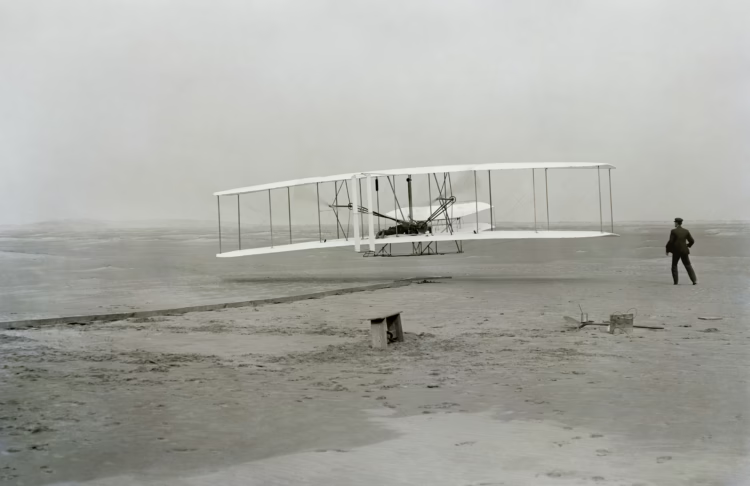 Today it is so readily taken for granted that ‘everybody knows’ that the first genuine powered flights were made by the Wright brothers in 1903 that one tends to forget that not until 1942 was the preeminence of their achievement recognized officially by that respected American body, the Smithsonian Institution. It may also be as well to reaffirm exactly what, at this point, they had achieved, which was the making of the first controlled and sustained flight by a powered airplane; not for another two years could they (or did they) claim to have developed a fully Practical airplane. But by then they were so far ahead of the fumbling European pioneers that the latter could accept only with a poor grace the reports of the Wrights’ progress — until Wilbur Wright came to France in 1908 and showed them.
Both Orville (1871—1948) and Wilbur Wright (1867—1912) are rightly acknowledged for their painstaking and methodical scientific approach to the problems of flight. Although powered flight was always their ultimate goal, they prepared the ground thoroughly, first by reading every available piece of literature on the subject and then by working matters out for themselves by building gliders on which they taught themselves the craft of pilotage. They made their machines deliberately unstable, so that voluntary control by the pilot was essential, and this was the cornerstone of their success. The method of control was the simple but effective one of warping, or twisting, the outer ends of the wings in opposing directions, a principle first tried out in a kite that they built in 1899. In October 1900, their first glider was flown (usually without a pilot) at Kitty Hawk, and in July/August 1901 at the nearby Kill Devil Hills, the larger Wright No. 2 glider was flown with one or the other of the brothers lying prone across the lower wing. There then followed a period of reappraisal during which they rejected the theories and calculations of Otto Lilienthal (on which their own had hitherto been founded) and indulged in a fresh program of research and aerodynamic testing based on their own experiments, which reached fruition in the No. 3 glider flown in September/ October 1902. Once the original pair of fixed rear fins on this machine was replaced by a single controllable rudder, this performed to the Wrights’ highest expectations, and they were ready to consider a powered machine.
This set them a fresh problem, for no existing internal combustion engine that could offer sufficient power was light enough for the task. The Wrights, therefore, had to design not only the airplane but the engine and the propellers as well. The propellers, in particular, were remarkably efficient considering the almost complete lack of knowledge of this subject; in Europe, propellers of comparable efficiency did not begin to appear for at least another five years, Work on the Wright Flyer I was started in the summer of 1903, and it followed generally the pattern of the No. 3 glider except that it had twin rear rudders and a biplane elevator at the front. After an unsuccessful attempt at flight by Wilbur Wright on 14 December, the Flyer I made its first proper take-off three days later with Orville at the controls. Altogether it flew four times that day, the longest flight being of 59 seconds, made by Wilbur and covering more than half a mile (0080 km.) through the air. It was nearly four years before Henry Farman, in the Voisin-Farman I, made a better flight than this in Europe, lasting 11/4 minutes, and by that time the Wright airplane could stay aloft for about three-quarters of an hour.
The second biplane, or Flyer II, was flown for the first time on 23 May 1904. The Wrights’ flying was now done from the Huffman Prairie, a site with more privacy but less unrestricted space than the Kill Devil Hills, and where take-offs were dependent upon suitable weather conditions. Early in September 1904, therefore, the Wrights introduced a form of assisted take-off to overcome this restriction. Their take-off technique hitherto had involved the use of a rail, the aircraft being restrained at one end while the engine was run up and then released to travel along the rail until it became airborne. Originally, this system contributed no artificial acceleration during take-off, but at Huffman Prairie, a weight-and-derrick apparatus was devised that was used successfully in thousands of subsequent take-offs. Later, on 20 September, the Flyer II made its first circuit flight, and on 9 November 1904, covered 23/4 miles (4.50 km) in a flight lasting over 5 minutes. It was generally similar to the Flyer I, but had a new 16 hop. Wright engine and reduced wing camber. In 1905, after being offered to, and rejected (unseen) by, both the U.S. and British War Departments, it was broken up.
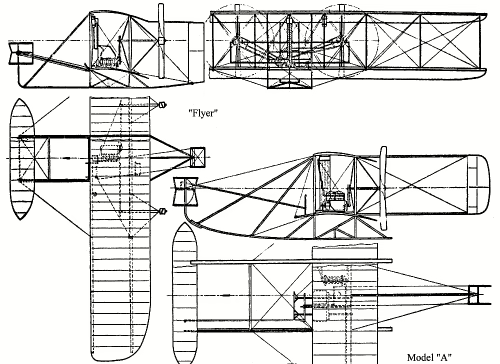
Various components, including the engine, were utilized in completing the Flyer Ille Longitudinal and directional control was much enhanced in this machine by increasing the length of the booms carrying the forward elevator and the rudders, and the Flyer III could bank, turn, circle, and perform figure-of-eights with ease. It was the Wrights’ first fully practical machine, and had made up to fifty flights by mid-October, two of them lasting over half an hour. Remarkably, there then followed a period of more than 2} years during which the Wrights did no flying at all. They had achieved a practical airplane: they now consolidated the design of this and developed it into the Flyer Type A, capable of taking up a passenger. The next occasion on which either brother went into the air was on 6 May 1908, when Wilbur Wright began to brush up his piloting skill prior to visiting France for a demonstration tour. The significance of this visit, which began in August 1908, can scarcely be overstated. It demonstrated conclusively the superiority of the Americans’ work over anything yet accomplished in Europe, which Europe had been reluctant to believe; but, more important still, it showed the European aviators why they had achieved so little, by emphasizing the value of voluntary lateral control, How quickly Europe learned the lesson can be gauged by the variety of airplanes at the great Rheims meeting only one year later, and by their performances at that meeting.
While Wilbur was busy in Europe — arranging, incidentally, the production of Wright biplanes under license in Britain (by Shorts), France (by Voisin, with Bariquand & Marre engines), and Germany — Orville Wright was demonstrating the Type A Flyer to the U.S. War Department. In America, no less than in Europe, there was no shortage of disbelievers, but in February 1908, the Army had finally awarded the Wrights a contract for an evaluation aircraft. In September, it was demonstrated before Signal Corps officials at Fort Myer, Virginia, making ten flights, four of which were over an hour in duration, and proving, as one witness put it, that the Wrights really were fliers, not liars (Europe’s best at that time was 30 minutes 27 seconds by the Voisin-Delagrange III biplane). The Military Flyer crashed after its tenth flight, on 17 September 1908, but was later rebuilt and returned on 29 June 1909 when fresh military trials were started with it as a faster, shorter-span machine. This was subsequently purchased by the U.S. Army as the Signal Corps No. I. This machine, along with the original Flyer I, is now in the National Air and Space Museum in Washington.
Later designs included the Type B of 1910, which took off conventionally using a wheel-and-skid undercarriage and was the first Wright type to have no frontal elevator. Two Type B’s were supplied to the US Army in 1911. The Type R or Roadster of 1910 was a 30 hp civil single-seater, of which the Baby Wright was a smaller racing version. On a modified short-span Roadster, Ralph Johnstone set up an altitude record of 9,714 ft. (2,998 m.) at Belmont Park, New York, in October 1910. During this meeting, the British pilot A. Ogilvie flew a Baby Wright into third place in the race for the Gordon Bennett Trophy. Seven Type C’s and two Type D’s were built in 1912—13 for the U.S. Army, being respectively 2-seat and single-seat scouts with 50 hp Wright engines.
Wright Flyer Specifications
| Country: |
| USA |
| Manufacturer: |
| Wright Cycle Company |
| Aircraft Type: |
| Experimental airplane |
| Dimensions: |
| Wingspan: 40 ft 4 in (12.29 m) |
| Length: 21 ft 1 in (6.43 m) |
| Height: 9 ft 0 in (2.74 m) |
| Weight: |
| Empty: 605 lb (274 kg) |
| Gross: 745 lb (338 kg) |
| Power plant: |
| 1 × Wright straight-4 water-cooled 201.1 cu in (3,295 cc) piston engine |
| Performance: |
| Maximum speed: 30 mph (48 km/h, 26 kn) |
| Ceiling: 30 ft (9.1 m) |