
Swap from 3S to 4S and the Scrappy transforms from a relaxed park flyer to a vertical-climbing aerobat—without touching a single setting. But that second battery comes with a legal catch.
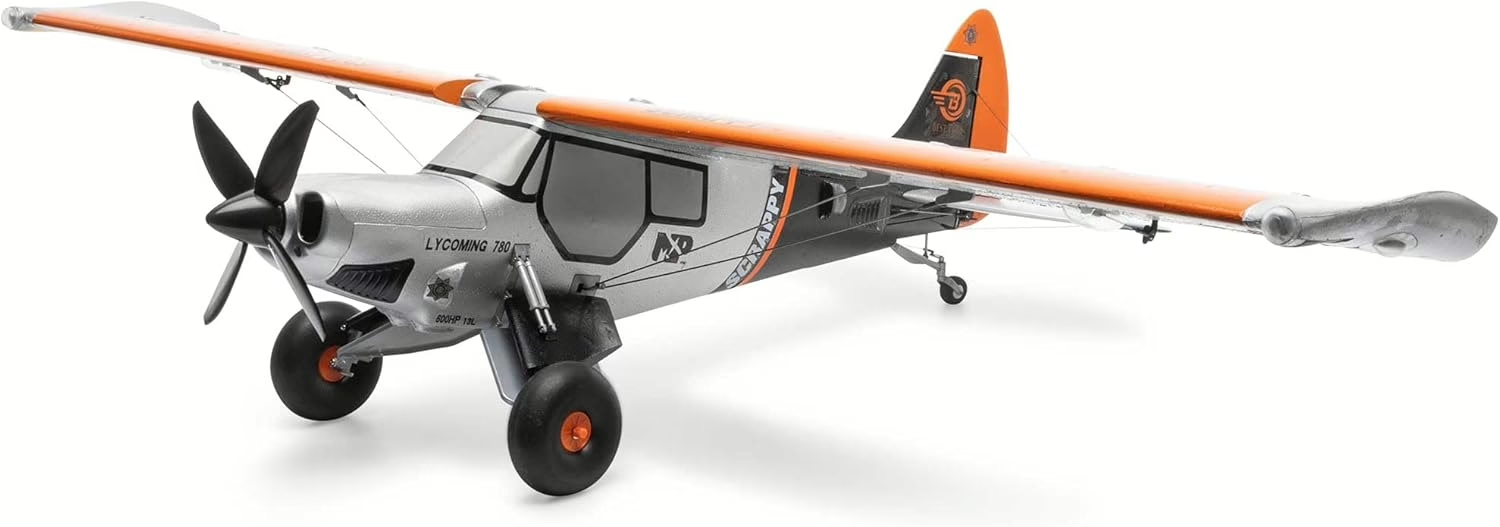
Most micro RC aircraft ask you to accept a compromise: either the model looks good on the shelf or it flies well in the air, but rarely both. The E-flite Micro Scrappy 800mm BNF Basic (EFL02150D) is a genuine effort to close that gap—and a legitimate contender among the best RC planes in the micro sport category. It’s a meticulously scaled replica of Mike Patey’s legendary backcountry bush plane—the tundra tires, the V-struts, the four-blade prop, the full Sheriff Search & Rescue paint scheme—all in a 820mm wingspan airframe that can legitimately operate from a driveway or baseball diamond.
We’ve flown it extensively, and the honest report is a nuanced one. The engineering is legitimately impressive: dual-voltage power, factory-fitted AS3X stabilization, functional flaps, and real-time telemetry have no direct equivalent at this price. But the Micro Scrappy is not a beginner’s trainer. Its stall behavior is sharp, its Spektrum-only radio ecosystem is restrictive, and the FAA’s 250-gram regulatory threshold looms directly over its battery choices. Here’s what pilots actually need to know before buying one.
Brief Overview
What It Is
The Micro Scrappy 800mm is a sport/STOL micro aircraft modeled on Mike Patey’s full-scale “Scrappy” backcountry bush plane. It’s sold at the BNF Basic completion level, meaning the 1412-1500Kv brushless outrunner motor (SPMX-1020), integrated ESC, receiver, and all five servos arrive factory-installed. To achieve flight readiness, pilots must provide a compatible full-range 6+ channel Spektrum DSMX/DSM2 transmitter—a DX6e, NX7e, or iX14 will all work—plus a 300mAh LiPo in either 3S or 4S configuration, and a suitable charger. Nothing else in the box flies it for you.
Target Audience
Horizon Hobby designates this a Skill Level 2 aircraft—explicitly not recommended for first-time pilots. The ideal buyer is someone who has already graduated from a dedicated trainer such as the HobbyZone AeroScout S2 and is ready to step into scale STOL flying and basic aerobatics. Its compact 820mm footprint and sub-250g capability on a 3S battery also make it a strong choice for pilots who lack access to a full club field and need a capable, portable aircraft that can work on confined terrain.
Cool Features
Three capabilities set the Micro Scrappy apart in a competitive micro market. First, the integrated ESC accepts both 3S (11.1V) and 4S (14.8V) 300mAh LiPo batteries natively, delivering two distinctly different performance profiles from the same airframe without any reprogramming. Second, Spektrum’s AS3X (Artificial Stabilization – 3-aXis) technology works continuously to counter turbulence and gusts/turbulence, giving this 9-ounce aircraft a locked-in tracking feel well beyond its weight class. Third, the optional SAFE (Sensor Assisted Flight Envelope) Select technology adds hard pitch and bank angle limits with automatic self-leveling—a genuine safety net for transitional pilots still building their throttle-management instincts. Add functional LED navigation, landing, and strobe lights, operational flaps, and molded-in panel lines and rivets, and you have a level of scale fidelity that’s rare at this price.
Pros & Cons
Pros
- + Dual 3S/4S battery compatibility delivers two distinct performance personalities — relaxed scale cruising or aggressive aerobatics — with no ESC reprogramming required
- + AS3X and SAFE Select allow confident flight in conditions that would ground similar micro models
- + Oversized tundra tires and a highly steerable tailwheel enable authentic bush-plane ground handling, including 180-degree turns within the aircraft’s own wingspan
- + Single-piece wing with integrated ribbon cable and magnetic battery hatch make for sub-five-minute field assembly
- + On a 3S 300mAh battery, flying weight clocks in at 248.9g — legally clearing the FAA’s 250-gram registration and Remote ID threshold
Cons
- — Stall behavior is sudden and aggressive: airspeed decay in a slow turn produces an abrupt tip-drop, not a trainer-style mush
- — Strict Spektrum DSMX/DSM2 ecosystem; pilots on FrSky, RadioMaster, or Futaba systems cannot bind without a multiprotocol module or a new transmitter
- — On a 4S battery (258.4g), the aircraft crosses the FAA’s 250-gram threshold, triggering registration and Remote ID compliance requirements
- — EPS foam construction enables superior scale detail but is more brittle and susceptible to compression damage and paint chipping than EPO alternatives
- — The asymmetrical V-struts have a non-intuitive forward/aft orientation that catches first-time builders off guard
Specs At a Glance
| Specification | Detail |
| Wingspan | 32.3 in (820 mm) |
| Overall Length | 20.2 in (513 mm) |
| Airframe Material | EPS Foam |
| Flying Weight (3S 300mAh) | 8.8 oz (248.9 g) |
| Flying Weight (4S 300mAh) | 9.1 oz (258.4 g) |
| Powerplant | 1412-1500Kv Brushless Outrunner, 12-Pole (SPMX-1020) |
| Propeller | 4-Blade, 128mm x 85.4mm |
| Battery Required | 3S or 4S 300mAh LiPo, JST-RCY connector |
| Radio Required | Full-range 6+ channel Spektrum DSMX/DSM2 |
| Stabilization | AS3X + SAFE Select |
| Telemetry | Real-time voltage, current draw, motor RPM |
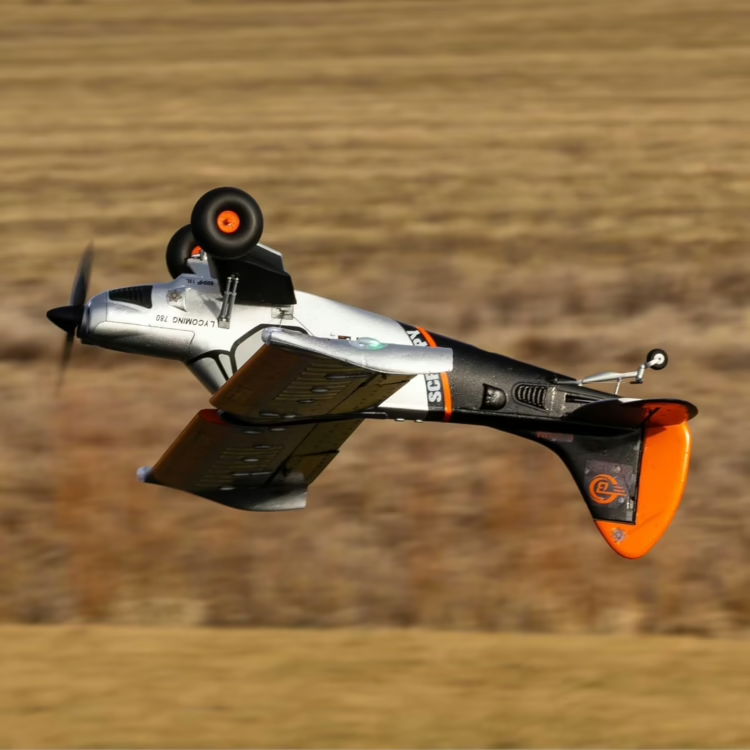
Up Close — Build Quality & Design
E-flite’s decision to mold the Micro Scrappy in Expanded Polystyrene (EPS) foam—rather than the EPO or EPP used in most modern RC trainers—is entirely intentional. EPS allows tighter molding tolerances, which is how the factory achieves the microscopic panel lines, corrugated control surfaces, and rivet details that make this airframe visually convincing at arm’s length. The fully painted Sheriff Search & Rescue trim scheme commands immediate attention on the flightline. EPS’s inherent rigidity also resists airframe twist during high-G maneuvers, a real advantage when flying on the higher-voltage 4S setup.
The trade-off is durability. EPS is more brittle than EPO and its painted surface doesn’t flex under impact. Compression dents and paint chips—what the hobby calls “hangar rash”—accumulate more readily than on a standard foam trainer. Repairs are manageable with foam-safe CA glue or Foam-2-Foam adhesive, but this aircraft requires a degree of careful handling that pilots accustomed to rubbery EPO models may not initially anticipate.
Internally, plastic structural inserts and threaded nuts reinforce the fuselage at key stress points. The five factory-installed Spektrum linear servos weigh approximately 1.3g each, compared to the roughly 1.7g of comparable rotary units—a deliberate 2-gram reduction that matters at this weight class.
Wing attachment is the assembly standout. The single-piece wing connects via a plastic tab at the leading edge, a single M2 x 18mm machine screw at the rear, and a multi-pin ribbon cable that handles all four wing servo connections simultaneously—no individual leads to route or plug. Field assembly runs under five minutes.
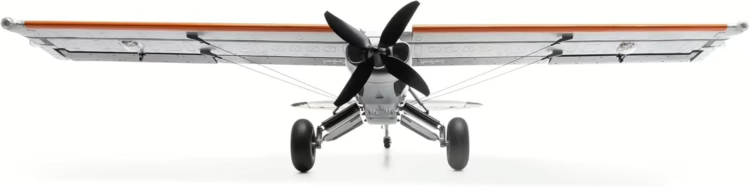
One real quirk: the V-shaped wing struts are asymmetrical. The longer leg of the “V” must face forward, toward the leading edge. Install them reversed, and the ball links will not seat on the receptacles. It’s a non-intuitive orientation that the instruction sheet doesn’t make immediately obvious, but once understood, the struts snap on firmly and function as genuine structural braces under aerodynamic loads.
The battery hatch is a magnetic top-access panel allowing rapid swaps without inverting the aircraft. The steerable tailwheel and oversized, soft-compound tundra tires with spring-loaded simulated suspension handle rough terrain with convincing authority.
In the Air — Flight Performance
The Micro Scrappy runs a conventional tail-dragger configuration—two main wheels forward of the center of gravity, steerable tailwheel at the rear. On the ground, AS3X’s continuous rudder corrections combined with the tailwheel’s exceptional deflection range actively counter the ground-looping tendency inherent to this layout. A brief pulse of up-elevator during the takeoff roll pins the tailwheel for directional authority; as airspeed builds over the horizontal stabilizer, easing off levels the fuselage, reduces induced drag, and the aircraft departs in a genuinely short roll. The STOL performance here is real.
Airborne on 3S, the AS3X system is immediately apparent. Onboard MEMS gyroscopes detect uncommanded pitch, roll, and yaw from turbulence and dispatch micro-corrections to the linear servos before the pilot registers the disturbance. The result is a locked-in feel that allows this 8.8-ounce model to track smoothly through 5 mph crosswinds. Flight times on 3S run approximately five to seven minutes under moderate throttle management—longer with restraint, shorter if the nose is pointed skyward often.
Engaging SAFE Select redefines the experience for transitional pilots: hard pitch and bank angle limits go active, and releasing the sticks commands the aircraft back to wings-level automatically. For pilots stepping up from a trainer, it meaningfully lowers the stakes.
On 4S, the Scrappy becomes a different machine. Theoretical motor speed jumps to over 22,200 RPM, vertical climbs become effortless, and loops, rolls, flat spins, and inverted flight are well within reach—the flat-bottomed, high-wing design does require slight down-elevator input to hold altitude inverted. Flight time drops to roughly four minutes, and the increased wing loading at 258.4g demands higher approach speeds to stay out of trouble.
The stall behavior warrants explicit attention. This is not a trainer. When airspeed decays past the critical angle of attack in a slow, tight turn, the inside wing stalls first and the aircraft snaps into a sharp downward spiral. Altitude is the only recovery currency. Pilots who maintain airspeed awareness and approach with energy will handle it without drama; pilots who don’t will find the Scrappy unforgiving.
Landing correctly means flying the backside of the power curve: throttle controls the sink rate, elevator manages airspeed. Deploying the functional flaps increases both lift and drag; power is carried all the way to the runway surface, then a coordinated throttle cut and elevator flare arrest the descent. The tundra tires and spring-loaded suspension absorb the touchdown cleanly—provided the pilot resists the urge to hard-turn before the aircraft has fully bled its speed, as the high center of gravity makes it prone to tipping on tight post-landing turns.
One critical point for 2026 buyers: the battery choice here is also a regulatory choice. On a 3S 300mAh battery, flying weight is 248.9g—legally under the FAA’s 250-gram threshold, no registration or Remote ID required. Swap in a 4S battery and the weight rises to 258.4g, crossing the threshold and triggering FAA registration and Remote ID broadcast requirements outside a FRIA. Adding a Remote ID module (approximately 10–15g) pushes weight closer to 270g, further increasing wing loading and worsening stall characteristics. For most pilots flying parks and neighborhood fields, 3S is the correct answer—and conveniently, it’s also the better everyday flying experience.
Why You’ll Simply Love This Plane
What the spec sheet cannot convey is the experience of pulling this aircraft out of its box for the first time. The scale V-struts, the four-blade prop, the twin exhaust stacks, the LED lighting that actually illuminates at dusk—the model earns its place on the flightline before the battery even goes in. Push the throttle forward and watch the oversized tundra tires articulate over gravel as the tail lifts, and it mirrors what you’ve seen Mike Patey do on video with startling accuracy. A suburban driveway stops being a driveway.
In the air, the AS3X system means you’re not fighting conditions—the aircraft actively works with you to track precisely through gusty air that would rattle a comparable micro model. The gusty days that park a lot of micro aircraft become flying days. There’s a confidence that comes from that, and it translates directly into more time in the air and less time repairing foam.
For pilots who have earned their stripes on a trainer and want their next step to be something genuinely rewarding rather than just incrementally harder, the Micro Scrappy delivers. It’s a miniaturization triumph that manages to be technically sophisticated and emotionally engaging at the same time.
Who Should Buy It
This Plane Is Perfect For:
Pilots already invested in the Spektrum ecosystem—particularly those running a DX, NX, or iX series transmitter—will get full value from the first bind: AS3X and SAFE Select work immediately, and real-time telemetry data (voltage, current draw, motor RPM) flows straight to compatible AirWare transmitters. Intermediate pilots who’ve mastered a basic trainer and want to explore scale STOL flying, confined-space operations, and basic aerobatics will find the Scrappy a natural and rewarding next step. Pilots without access to a full RC club field, who need a compact model that can genuinely operate from a driveway, dirt access road, or baseball diamond on a 3S battery, also have a compelling option here. And scale enthusiasts who want the visual impact of Mike Patey’s design without committing to a complex kit build will not be disappointed.
You Might Want to Look Elsewhere If:
Absolute beginners should complete their training on a high-dihedral trainer first—the Micro Scrappy’s sharp tip-stall characteristics are not forgiving of the control errors that new pilots inevitably make. Pilots flying FrSky, RadioMaster, Futaba, or ELRS radio systems cannot bind this BNF Basic model without investing in a multiprotocol module or a new Spektrum transmitter. And for pilots whose primary goal is the slowest, most forgiving micro STOL available—maximum float, minimum drama—the UMX Turbo Timber Evolution is the superior aerodynamic tool, even though it lacks the Scrappy’s scale presence and stalls with a gentle mush rather than an abrupt wing drop.

Key Takeaways
- Battery = regulatory decision: On 3S (248.9g), the Micro Scrappy legally clears the FAA’s 250-gram threshold—no registration or Remote ID required; on 4S (258.4g), federal compliance is mandatory.
- Dual power envelope: The 3S profile delivers 5–7 minute scale flights; 4S unlocks vertical aerobatics at roughly 4 minutes, with higher approach speeds required on landing.
- Skill Level 2 — not a trainer: AS3X and SAFE Select lower the skill floor considerably, but the unforgiving tip-stall demands proper airspeed management throughout the flight envelope.
- Spektrum ecosystem only: Non-Spektrum pilots need additional hardware before this aircraft will fly.
- Scale fidelity, stabilization technology, real-time telemetry, and dual-voltage versatility in a sub-250g (3S) airframe — nothing at its price matches the complete package.