


SAFE self-leveling, a pre-bound Spektrum radio, and a sub-250-gram airframe make this little Cub a tempting first plane. The catch? A 0–5 mph wind window and a 5-minute flight timer. Here’s what that means for you.
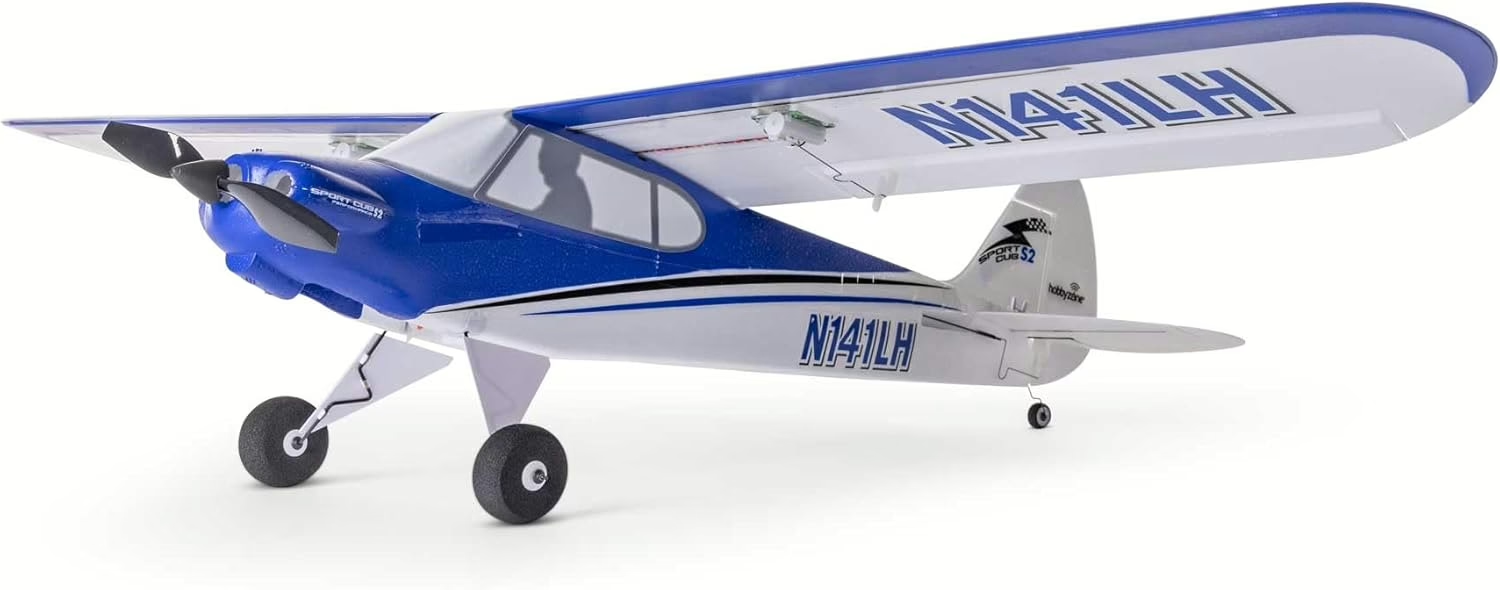
The HobbyZone Sport Cub S 2 RTF puts a factory-assembled airplane, transmitter, battery, and charger in one box. But the manual attaches conditions that decide whether it fits your field and your weather.
This HobbyZone Sport Cub S 2 RTF review weighs HobbyZone’s claims against the manual, owner feedback, and the closest stablemates. Still surveying the whole field? Start with our roundup of the best RC planes.
Quick Verdict
No airplane is the best beginner RC plane for every buyer. The Sport Cub S 2 is a strong conditional pick: a notably complete ready-to-fly (RTF) trainer package, provided you can fly on calm days.
- Buy it if you want a factory-assembled trainer with radio, battery, and charger included, plus stabilization you can dial back as you improve.
- Skip it if your local wind rarely drops to 5 mph or less, or you want more spare batteries per dollar.
- The deciding qualification: HobbyZone’s manual illustrates launches and landings in winds of 0–5 mph.
- The rival to check first: the HobbyZone XCub 450mm RTF with SAFE (HBZ-1250) lists for less and includes two batteries and a spare prop.
Before you click Buy, read on: the battery routine, preflight checks, and rival comparison below reveal more than any spec sheet.
Brief Overview
What It Is
The Sport Cub S 2 RTF with SAFE (item no. HBZ444000) is a four-channel radio-controlled (RC) taildragger with throttle, rudder, elevator, ailerons, and a steerable tailwheel. Horizon Hobby says it arrives 100% factory-assembled in expanded polystyrene (EPS) foam, with the motor, two Spektrum linear servos, and a receiver/electronic speed control (ESC) unit running two more servo functions installed.
Watch the item numbers. HBZ444000 is the current RTF, with a USB Type-C Spektrum MLP6DSM transmitter. Horizon lists the earlier RTF, HBZ44000, as discontinued; the bind-and-fly (BNF) Basic, HBZ44500, omits radio, battery, and charger. Horizon describes telemetry as the S 2’s addition to the original Sport Cub S, which shared the 24.3-inch span and 1S 150mAh power.
Who It’s For
Horizon rates it Skill Level 1 and recommends it for ages 14 and up, with direct adult supervision of children. That points to adult first-timers and supervised teens. If you’re weighing other first airplanes, see our guide to the best RC planes for beginners.
Features That Target Common Beginner Problems
- SAFE (Sensor Assisted Flight Envelope). Beginner mode limits pitch and bank and self-levels when you center the sticks. Intermediate allows more freedom without automatic leveling. Experienced removes the limits. Panic Recovery has its own button.
- Flight-battery telemetry. A transmitter LED shows green above 3.7V per cell, yellow from 3.3 to 3.7V, and red below 3.3V. It reports voltage, not minutes remaining.
- Sub-250-gram weight. At 2.1 oz (61 g) with battery, it needs no FAA registration when flown purely for recreation. You still must pass TRUST.
- Simulator trial. Horizon advertises a RealFlight Trainer Edition trial (Steam key, up to 100 minutes). You supply the USB-C cable; the full edition (RFL1205) is sold separately.
AT A GLANCE Model: Sport Cub S 2 RTF with SAFE (HBZ444000) Manufacturer: HobbyZone (Horizon Hobby) Wingspan: 24.3 in. (617mm) Length: 16.3 in. (414.5mm) Weight: 2.1 oz (61 g) with battery; 2 oz (57 g) without; 2.7 oz (77 g) with optional floats Pilot skill level: Beginner (Skill Level 1) Time to assemble: None (factory-assembled); about 45 minutes to charge Power: E-flite 3.7V 150mAh 1S 25C LiPo (EFLB1501S25), included Radio: Spektrum MLP6DSM 2.4GHz DSMX with USB-C (SPMRMLP6C), included Receiver/ESC: Spektrum SPMA3179, installed Price: Check current price
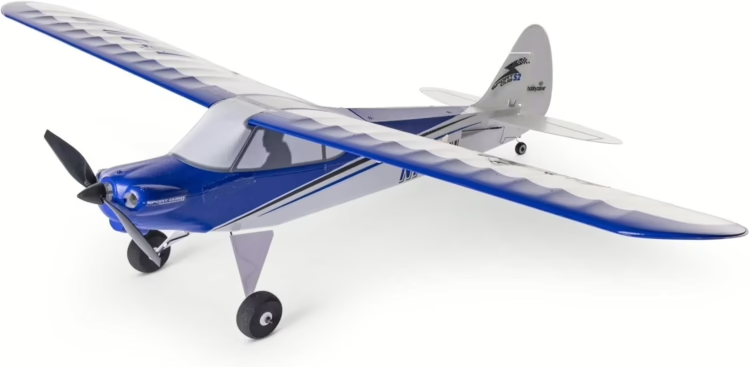
Does it fit your field? If calm-air flying suits your plans, check the current Sport Cub S 2 RTF listing on Amazon and confirm item number HBZ444000 before you buy.
Pros & Cons
WHAT WE LIKE
- Complete equipment: Transmitter, four AA cells, flight battery, and USB charger are included.
- No assembly: Arrives factory-assembled, electronics installed.
- Selectable assistance: Three SAFE modes plus Panic Recovery.
- Voltage telemetry: Supports good battery habits from the first flight.
- Documented parts: Replacements down to the motor, receiver/ESC, and servos.
WHAT WE DON’T
- Narrow weather window: 0–5 mph launch and landing guidance.
- Short sessions: A 5- to 6-minute flight timer against a roughly 45-minute charge.
- One battery, no spare prop: Per Horizon’s box contents.
- Invasive motor service: Requires cutting fuselage tape and decals.
Expected Experience with the HobbyZone Sport Cub S 2 RTF
Out of the Box and Charging
There’s nothing to build, and the transmitter comes bound. Charge the flight pack on the E-flite 1S USB lithium polymer (LiPo) charger (EFLC1008, 300mA output). Per the official Sport Cub S 2 instruction manual, a fully discharged (not over-discharged) 150mAh pack takes about 45 minutes; the solid red LED goes out when it’s done. Supervise every charge, and never charge a swollen or damaged pack. With one battery in the box, plan sessions around that recharge.
Radio and SAFE Setup
The manual’s preflight checklist, condensed, with its first-flight mode advice added:
- Find a safe, open area.
- Charge and install the flight battery.
- Run the Control Direction Test in Experienced mode.
- Run the SAFE Control Direction Test.
- Plan for the day’s field conditions.
- Set a five-minute flight timer.
- Select Beginner mode for your first flights.
A three-position channel 5 switch selects Beginner, Intermediate, and Experienced (positions 0, 1, 2); channel 6 triggers Panic Recovery. BNF buyers note: a two-position channel 5 switch can’t reach all three modes.
⚠️ WARNING: Let SAFE initialize. After connecting the battery, keep the airplane upright on its gear, motionless, and out of the wind for five seconds. The manual links movement during this step, or mechanical centering, to off-center control surfaces, so rule both out before blaming the receiver. Restrain the airplane during SAFE checks, because the first throttle input can arm the propeller.
Documented Flight Behavior
As of September 30, 2026, we found no published independent flight test of HBZ444000 that documents its stall behavior, glide, tracking, wind penetration, or flight time. Here’s HobbyZone’s guidance.
Stability: Beginner mode’s angle limits and self-leveling cap how far an over-correction can go.
Launch: As a taildragger, it needs a helper’s hand launch or a hard, level runway, with rudder keeping the takeoff roll straight.
Aerobatics: HobbyZone markets aerobatic capability, including loops, rolls, and inverted flight. Panic Recovery needs altitude, especially when inverted, because the airplane can lose height while recovering.
Landing: Point into the wind, keep the wings level, and reduce to about 25% throttle. Near the ground, pull the throttle fully back and apply elevator. Never try to catch the airplane in flight.
What Owners Report
Published owner feedback covers the earlier RTF and the BNF, not HBZ444000. In a June 6, 2020, HobbyTown customer review of the older RTF (HBZ44000), verified owner Michael Breth wrote: “Great trainer and very forgiving! Easy to set up, change batteries, etc.”
Verified owners reviewing the BNF Basic (HBZ44500) at AMain Hobbies are split:
- Samuel Krieger (June 19, 2022) describes teaching inexperienced friends and praises the slow handling.
- Robin Chambers (April 13, 2022) reports easy binding and slow flight, then broken battery and aileron wiring after roughly three flights.
- Joe Martin (July 6, 2020) reports reduced motor output before ten uses and a failed USB charger.
None details setup or conditions, so these older-package accounts can’t establish a reliability trend for HBZ444000.
Durability, Repairs, and the True Cost of Ownership
The manual specifies foam-compatible cyanoacrylate (CA) glue or clear tape for repairs. Motor access means cutting the fuselage tape and decals, which can lift paint. Leave the gearbox in the airframe, and disconnect the battery before touching the prop or motor.
Listed replacements include the HobbyZone 130 x 70 prop and spinner (HBZ4401) and motor (HBZ4429), the Spektrum receiver/ESC (SPMA3179) and 2.3-gram linear servo (SPMSA200), plus an optional E-flite float set (EFLUA1190). As of September 30, 2026, we found no published crash-cycle, motor-life, or repair-time data for this package.
💡 TIP: Order a spare prop (HBZ4401) and an extra E-flite 150mAh pack (EFLB1501S25) with the airplane. They won’t cover every mishap, but a broken prop or a charging pack needn’t ground you.
How the Sport Cub S 2 RTF Stacks Up: Value vs. Rivals
Relative prices reflect Horizon Hobby’s September 30, 2026, listings.
| Model | Relative price | Wingspan / weight | In the box | Key trade-off |
| Sport Cub S 2 RTF with SAFE (HBZ444000) | Reference | 24.3 in. / 2.1 oz (61 g) | Transmitter, one 150mAh pack, USB charger, four AA cells; simulator trial | Complete small trainer; 0–5 mph guidance |
| XCub 450mm RTF with SAFE (HBZ-1250) | Lower | 17.7 in. / 2.48 oz (70.4 g) | Five-channel transmitter, two 400mAh packs, charger, spare prop/prop saver | More session spares; expanded polypropylene (EPP) foam marketed as durable |
| Duet S 2 RTF (HBZ05300) | Lowest | 20.6 in. / 1.5 oz (43 g) | Transmitter, 150mAh pack, charger, four AA cells | Lowest entry cost; twin-motor steering arrangement |
| Carbon Cub S 2 1.3m RTF Basic (HBZ320001) | Higher, plus battery and charger | 51 in. / about 2.8 lb (1,285 g) with 3S 2200mAh pack | DXS transmitter; battery and charger sold separately | Larger airplane; over 250 g, so FAA registration and Remote ID apply |
The XCub also has ailerons, three SAFE modes, and an unrestricted Experienced mode, and no matched crash test compares its EPP with the Sport Cub’s EPS. The Carbon Cub weight is from its current manual; one HobbyZone storefront lists a different figure. On September 30, Horizon showed the XCub and Duet S 2 backordered, with October 2026 estimates.
Our take: The XCub’s two packs and spare prop are a concrete value advantage. The Sport Cub S 2 counters with a larger wingspan, a dedicated Panic Recovery button, and the simulator offer, though a bigger wing alone doesn’t prove easier learning.
Where the HobbyZone Sport Cub S 2 RTF Really Shines
The real strength is a complete package with documented training aids and nothing extra to buy before your first flight.
A skill ladder on one switch. Three SAFE modes let you remove the training wheels one position at a time, with Panic Recovery on its own button.
Battery discipline from day one. The green-yellow-red voltage LED isn’t glamorous, but it’s a genuine standout that can help you learn to land before the pack runs low.
Sized for smaller spaces. Horizon markets it for large yards, parks, soccer fields, and other suitable spaces, though you should still check local rules and airspace.
💡 PRO TIP: The manual recommends simulator practice and contact with experienced pilots before your first flight. Start with the RealFlight trial.
HobbyZone Sport Cub S 2 RTF with SAFE — HBZ444000
- 3-in. wingspan; 2.1 oz (61 g) with battery
- Three SAFE modes plus Panic Recovery
- Spektrum MLP6DSM transmitter with voltage telemetry
- Battery and USB charger included; no FAA registration for purely recreational flying under 250 g
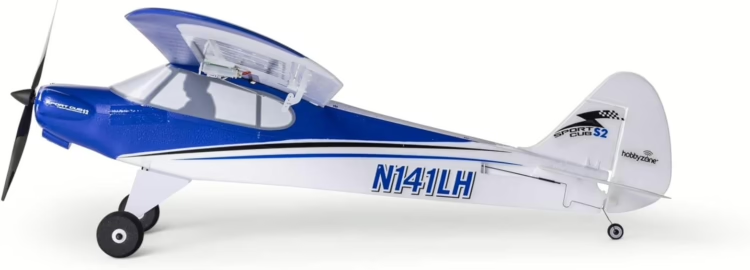
See the Sport Cub S 2 RTF on Amazon
Who Should Buy It
Good fits:
- The self-taught first-timer who wants an all-in-one package. SAFE doesn’t replace an instructor; the manual recommends finding experienced pilots and clubs, and the Academy of Model Aeronautics (AMA) describes club mentoring as a way to help new pilots learn.
- The parent-and-teen team, with a pilot 14 or older under adult supervision.
- The flexible-schedule flyer with an open, legal site who can wait for calm air.
Look elsewhere if:
- Your area is usually windy. A larger trainer like the Carbon Cub S 2 is one route, though no matched wind test backs it; budget for its battery, charger, FAA registration, and Remote ID compliance.
- You want the lowest entry cost or more packs in the box. Consider the Duet S 2 or XCub 450mm.
- You own a compatible Spektrum radio and charger. Compare the HBZ44500 BNF Basic, but count the total cost.
- Your only runway is rough grass. Plan on a helper’s hand launch or a hard, level surface.
FAQ
Q: Is the HobbyZone Sport Cub S 2 RTF a good first RC plane for someone who has never flown before?
A: The HobbyZone Sport Cub S 2 RTF is a solid first-plane option when its operating requirements match your site and weather.
- HobbyZone rates it Skill Level 1, with Beginner mode and Panic Recovery.
- Fly in calm air (0–5 mph), and seek experienced help if you can.
Q: How long does the HobbyZone Sport Cub S 2 fly on one battery, and how long does it take to recharge?
A: The Sport Cub S 2 manual recommends a flight timer rather than stating a measured flight time.
- The checklist says five minutes; the flying section says six. Start with five.
- Recharging a fully discharged (not over-discharged) pack takes about 45 minutes.
Q: Do I need to register the HobbyZone Sport Cub S 2 with the FAA or take a test before flying it in the U.S.?
A: The Sport Cub S 2 needs no FAA registration in its normal under-250-gram configuration if you fly purely for recreation, but you must pass TRUST and carry proof.
- TRUST (The Recreational UAS Safety Test; UAS stands for unmanned aircraft system) is free and online.
- Keep the airplane in visual line of sight, yield to other aircraft, and stay at or below 400 feet in Class G airspace.
- Controlled airspace requires prior authorization. See the FAA guidance for recreational flyers.
Q: Why does my HobbyZone Sport Cub S 2’s motor pulse or cut out in the middle of a flight, and how do I fix it?
A: The Sport Cub S 2 manual links motor pulsing followed by power loss to the receiver/ESC’s low-voltage cutoff (LVC), though other power problems have other causes.
- Land promptly when the motor pulses.
- Disconnect the battery and inspect the airplane.
- Check the charge and connection; the manual also lists damaged power components and a tight prop-shaft nut.
- Recharge the battery, or replace it if it performs poorly.
- Contact Horizon Hobby product support if power loss repeats.
Q: What should I buy along with the HobbyZone Sport Cub S 2 RTF so a crash doesn’t end my flying day?
A: For the HobbyZone Sport Cub S 2 RTF, a spare prop and an extra flight battery are the sensible first add-ons, though no kit covers every crash.
- Prop (HBZ4401) and pack (EFLB1501S25)
- Foam-compatible CA glue and clear tape
- A USB-C cable for the simulator
Q: How can I make sure I’m buying the genuine HobbyZone Sport Cub S 2 RTF and not an older version or a look-alike?
A: To confirm the current HobbyZone Sport Cub S 2 RTF, match the listing to item number HBZ444000 and the USB-C MLP6DSM transmitter, then check the delivered box.
- HBZ44000 is the discontinued RTF; HBZ44500 is the BNF with no radio, battery, or charger.
- The VolantexRC Sport Cub S2 (model 762-2) is a different brand’s two-channel product, not a counterfeit.
- Some HBZ444000 listings show 20.6 in. and 38 g, not the manual’s 24.3 in. and 61 g, so check more than the name.

Key Takeaways
- The HobbyZone Sport Cub S 2 RTF is a complete, factory-assembled trainer package with three SAFE modes, Panic Recovery, and voltage telemetry.
- The deciding condition is the manual’s 0–5 mph wind guidance.
- Plan around a 5- to 6-minute timer, a 45-minute recharge, and one included pack.
- The XCub 450mm offers more session spares for less money; the Sport Cub offers a larger wing, a dedicated Panic Recovery button, and a simulator trial.
- As of September 30, 2026, we found no published independent flight or durability test of the current package.