


Beginner mode today, rolls and knife-edge next season. The Carbon Cub S 2 is the rare RTF trainer you won’t outgrow after your first dozen flights.
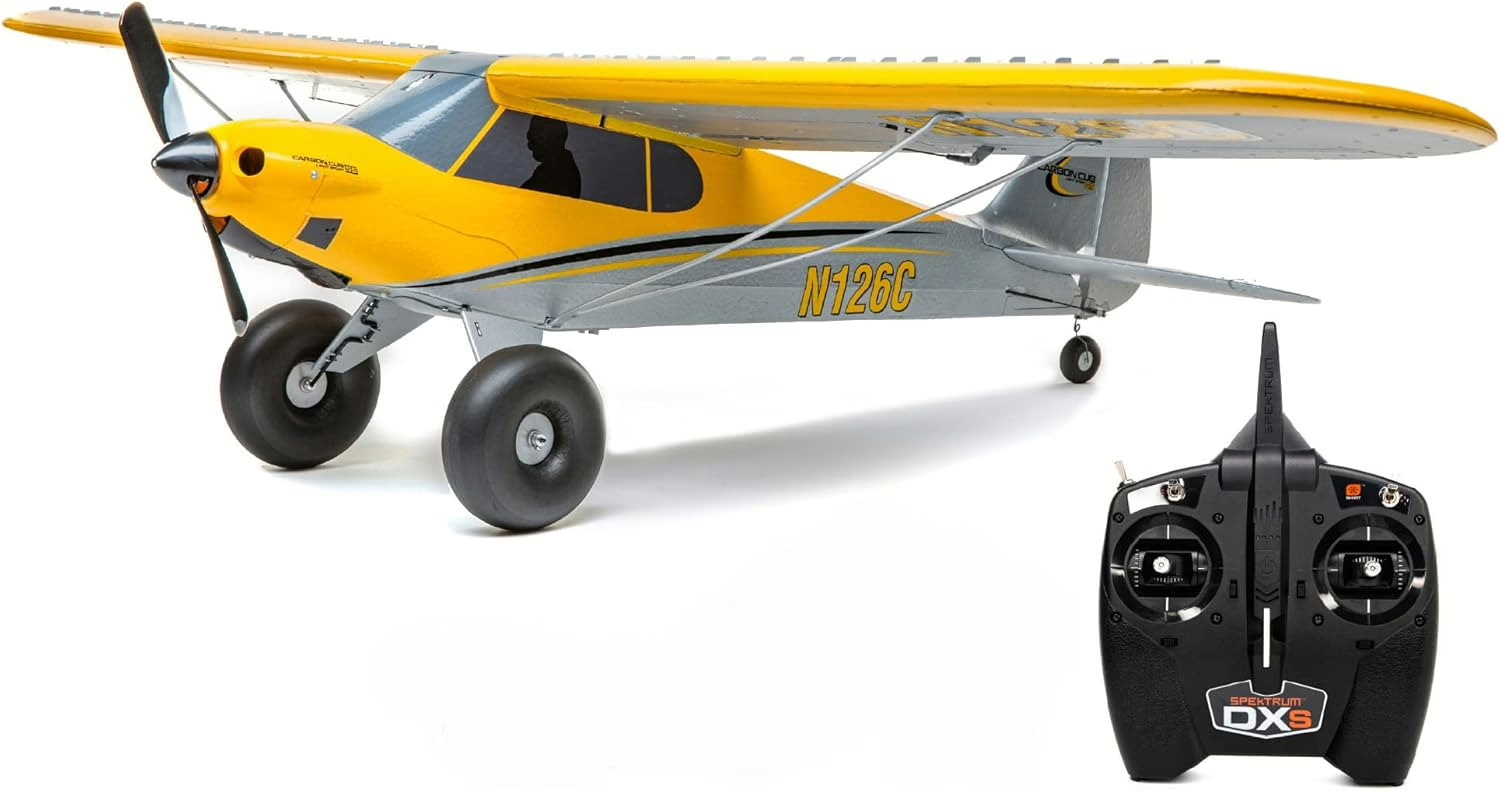
The HobbyZone Carbon Cub S 2 1.3m is a Ready-to-Fly Basic (RTF Basic) electric trainer modeled after the full-scale CubCrafters Carbon Cub, the modern high-performance Light Sport Aircraft that became the best-selling LSA in the United States after its 2009 introduction. It’s a perennial contender among the best RC planes purpose-built for beginners, and that reputation is grounded in genuine design choices rather than marketing. That heritage shows up in every decision: the high-wing tail-dragger stance, the oversized tundra tires, the bush-plane silhouette. HobbyZone, a brand under Horizon Hobby, has successfully captured the spirit of that lineage in a durable EPO foam airframe rated at Skill Level 1 — the lowest difficulty tier in Horizon’s product lineup.
Power comes from a 480-size brushless outrunner motor (960 Kv) paired with a 30-amp telemetry-capable ESC. All the electronics — four sub-micro servos, a Spektrum 3230A flight controller, and a Spektrum 4650C DSMX serial receiver — arrive pre-installed. The included Spektrum DXS 2.4GHz DSMX transmitter rounds out the package. Assembly requires no glue, no special tools, and takes under an hour.
The aircraft’s defining technology is Horizon Hobby’s SAFE (Sensor Assisted Flight Envelope) system, which uses multi-axis sensors and flight control software to provide attitude awareness and electronic flight envelope protection across three pilot-selectable modes: Beginner, Intermediate, and Experienced. A dedicated Panic Recovery button, active in all three modes, can instantly return the aircraft to level flight at any time.
Critical note for buyers: The RTF Basic (HBZ320001) does not include a flight battery or charger. A 3S 11.1V 1300–2200mAh LiPo with an EC3 or IC3 connector is required to fly. The recommended Spektrum Powerstage 2 bundle (SPMXPSA200) — a 3S 2200mAh Smart G2 LiPo and S120 USB-C Smart charger will increase the ready-to-fly cost.
Who it’s for: True first-timers, returning modelers, and casual weekend fliers who want a scale-looking trainer capable of operating from grass, dirt, gravel, and paved surfaces without requiring a dedicated RC club field.
Standout features:
- SAFE with three flight modes + Panic Recovery — structured skill progression from self-leveling Beginner mode through full aerobatics in Experienced mode, with a one-button emergency save in any mode
- Tundra-style tires and welded-aluminum landing gear — handles terrain that grounds most competing trainers in this size class
- Telemetry-capable ESC — Telemetry-capable ESC — approximate flight battery status (charge level) delivered to the DXS transmitter via LED indicators; full real-time telemetry (RPM, current draw, detailed voltage) requires a separately purchased, compatible AirWare-equipped transmitter (e.g., NX6, NX8, DX6e).
- Optional float kit compatibility — the HBZ7390 float set adds water operations for pilots ready to expand beyond land flying
Pros & Cons
Pros
- SAFE delivers on its promise. Beginner mode provides genuine self-leveling protection — release the sticks and the aircraft returns to wings-level flight automatically, with bank and pitch angles electronically limited. Multiple field users confirm the Panic Recovery button works as advertised under real pressure.
- Clear progression path in one airframe. Beginner → Intermediate → Experienced means pilots can develop from their very first flight all the way through loops, rolls, knife-edge, and inverted flying without ever needing a second airplane.
- Fly-anywhere terrain capability. The tundra tires and steerable tailwheel handle grass, gravel, and dirt that would stop a standard-gear trainer cold. A local park or quiet field becomes a viable airstrip.
- Attractive scale design. The Carbon Cub silhouette gives new pilots an airplane worth being proud of. That emotional connection matters — it keeps people flying.
- Upgrade path built in. The platform supports optional SAFE Plus GPS (SPMA3173) for AutoLand, Virtual Fence, and Holding Pattern; a Landing Assist Sensor (SPMA3180) for smoother touchdowns; flaps for improved slow-speed control; and floats for water operations. The DXS transmitter is also compatible with other Bind-N-Fly Basic aircraft.
Cons
- The “RTF” label requires a closer read. The price is competitive — until you factor in the required battery and charger. Buyers should verify which version they’re purchasing, as a full RTF version (HBZ32000) that includes a battery and charger also exists.
- Flight times are short. Realistic sessions under active flying conditions average 5–7 minutes per 3S 2200mAh pack. Retailer claims of 10–15+ minutes reflect very gentle, low-throttle cruising — not beginner practice with takeoffs, landings, and orientation drills. Budget for two to three batteries for a productive field visit.
- Tail-dragger ground handling has a learning curve. The steerable tailwheel helps, but compared to a tricycle-gear trainer, the Carbon Cub S 2 demands more pilot attention during taxi, takeoff rolls, and landing. Unlike the Apprentice STS, which can be dead-sticked in on a glide, the Carbon Cub needs some throttle maintained on approach.
- Landing gear is a known weak point. The welded-aluminum wire gear is relatively thin. Firm arrivals or rough field operations can bend it, after which the aircraft won’t track straight on the ground. Aftermarket landing gear solutions exist for pilots who fly from hard or uneven surfaces regularly.
Performance & Real-World Flying Experience
Setup and ground handling: Final assembly — wing attachment, servo lead connections, horizontal stabilizer installation, and prop mounting — takes most fliers 30–45 minutes. With a 2200mAh battery installed, the CG typically falls at the correct 2.4–2.7 inches from the leading edge without adjustment. On the ground, the tail-dragger stance means the nose rides high and the tail sits low, and crosswind sensitivity during taxi is real. The tundra tires shine here on rough terrain, absorbing bumps and providing generous prop clearance, but directional discipline during the takeoff roll demands rudder input that a nose-wheel trainer would not.
In the air: In Beginner mode, the Carbon Cub S 2 is as docile as the airframe’s reputation promises. Stick release returns the aircraft to wings-level, bank and pitch are bounded, and the net effect is that a pilot’s early mistakes don’t compound into crashes. The 480-size brushless motor lifts the aircraft off in a short ground roll, and the climb rate is moderate — strong enough to gain altitude quickly, measured enough not to panic a beginner. Switching to Intermediate mode removes auto-leveling but keeps bank angle limits in place, letting pilots begin developing genuine stick-and-rudder coordination. In Experienced mode, the aircraft performs loops, rolls, and knife-edge with what reviewers describe as good rudder authority — though vertical performance shows some limitation near the top of loops.
The aircraft is described by field fliers as “quicker reacting” than the larger Apprentice STS, which is worth knowing for first-timers: the Carbon Cub S 2 has sharper control responses than the most forgiving alternatives in its class. In light winds it is stable and manageable; in moderate to gusty conditions, its relatively light weight (~32.2 oz without battery) means it gets pushed around. First flights should be planned for calm days.
Landings: The tail-dragger configuration requires technique. Approaches need some power carried to the flare — a habit that takes several sessions to develop. The optional Landing Assist Sensor (SPMA3180) provides automatic flare control that minimizes bouncing on touchdown and is a worthwhile add-on for anyone who struggles with arrivals. Optional flaps, installed via an additional servo and extension cable, improve slow-speed control and widen the approach envelope considerably.
Durability: The EPO foam airframe is repairable with Foam Tac or Zacki adhesive, and Horizon Hobby maintains a full replacement-parts catalog. One long-term user’s assessment captures the real-world picture well: after a full year of flying and multiple crashes, the aircraft was always mendable — with replacement props, servo wire repairs, and foam gluing keeping it airborne. Propellers are noted as relatively brittle; carrying spares to the field is strongly recommended.
Why You’ll Simply Love This Plane
There’s a particular moment in every new RC pilot’s journey when the fear leaves, and the fun starts. With the Carbon Cub S 2, that transition happens faster than it would on almost any competing trainer. Knowing that a single button press will bring the aircraft back to level flight — regardless of how disoriented you’ve become, regardless of how much the wind just shoved the wing — removes the psychological weight that derails beginners. That freedom accelerates learning.
Beyond the electronics, the airplane itself earns affection. Flying a scale-replica bush plane that looks like something a real backcountry pilot would tie down at a gravel strip is a different experience than flying a generic foam wing. “Every time I bring the Carbon Cub S2 to the field, it never fails to put a smile on my face,” one long-term user noted — and that sentiment is echoed consistently across the community. The emotional investment keeps pilots coming back, and coming back is how people learn to fly.
The tundra gear makes regular practice realistic for pilots without access to a paved runway or a sanctioned RC club field. A grassy schoolyard or a quiet open space becomes a training ground. The platform also grows: the progression from Beginner through Intermediate to Experienced mode, and then on to optional GPS-assisted features and float flying, gives the aircraft a useful lifespan well beyond first flights.
Who Should Buy It
Buy it if:
- You’re a true first-timer who has never held an RC transmitter and wants the most forgiving introduction to powered flight this side of a simulator.
- You’re buying it as a gift — the scale appearance makes an impact out of the box, and the RTF format (especially the full RTF version with battery and charger included) eliminates the “what else do I need?” confusion.
- You want to fly from informal fields, parks, or grass areas without needing a paved runway or a dedicated club site.
- You value a platform you can actually grow with — from self-leveling first flights through to aerobatics — without replacing the aircraft.
Look elsewhere if:
- You’ve already outgrown SAFE-assisted flying and want a more demanding, higher-performance aircraft.
- You’re on a tight budget and the ready-to-fly cost is a concern — lower-cost foam trainers can deliver a comparable learning experience with fewer features.
- You want the easiest possible ground handling for your first flights. The E-flite Apprentice STS 1.5m (RTF Basic) offers wide-stance tricycle landing gear, a steerable nose wheel, a larger 59-inch wingspan, and official AMA trainer status — it is the simpler aircraft to land and the right choice for pilots learning at a club with an instructor.
- You expect 15–20-minute flight sessions per charge. The Carbon Cub S 2’s 5–7 minutes per 2200mAh pack under active flying will frustrate pilots with that expectation.
QUICK SPECS
| SKU | HBZ320001 |
| Wingspan | 51.18 in (1,300 mm) |
| Overall Length | 34.06 in (865 mm) |
| Flying Weight (no battery) | ~32.2 oz (913 g) |
| Motor | 480-size brushless outrunner, 960 Kv |
| ESC | 30A telemetry-capable |
| Propeller | 9 × 6 |
| Battery | 3S 11.1V 1300–2200mAh LiPo (sold separately) |
| Radio | Spektrum DXS 2.4GHz DSMX (included) |
| Technology | SAFE: Beginner / Intermediate / Experienced + Panic Recovery |
| Landing Gear | Welded-aluminum, tundra tires, steerable tailwheel |
| Approx. Flight Time | 5–7 min (3S 2200mAh, active flying) |
| Assembly Time | Under 1 hour |

Key Takeaways
- The RTF Basic does not include a battery or charger; factor in the Spektrum Powerstage 2 bundle before committing.
- SAFE technology with Panic Recovery is the standout feature: three structured flight modes take pilots from self-leveling first flights to full aerobatics within a single airframe.
- Tundra tires deliver genuine terrain versatility — grass, gravel, and dirt fields are all fair game, expanding where beginners can practice.
- Honest limitations matter: 5–7-minute flight times per pack, a tail-dragger landing curve, and bendable landing gear wire are manageable but real.
- Best fit: self-teaching beginners flying from informal fields who want scale good looks and room to grow; pilots learning at AMA clubs with instructor support should consider the Apprentice STS 1.5m instead.