


One wrong FBL setting and your motor dies mid-flight. You’ll discover the critical setup mistake that’s triggering mid-flight power losses in RS4 Venoms—and how to prevent it.

The 400-class collective-pitch helicopter sits at a peculiar crossroads. It’s too capable to be dismissed as a beginner toy, yet small enough to haul to a park in the trunk of a standard sedan. For years, pilots in this category quietly endured a frustrating compromise: either accept the gear-mesh noise, the stripped main gears after every crash, and the inevitable maintenance carousel of traditional drivetrains—or shell out serious money for a boutique European model.
The Goosky Legend RS4 Venom Edition arrived claiming to dissolve that compromise entirely. It positions itself squarely among the best RC helicopters in the 400-class segment by eliminating the gear train, widening the battery tray, and standardizing the servo mounts—changes that sound incremental on paper but carry real consequences in the field. We’ve spent considerable time evaluating the RS4 Venom from every angle: electronics, airframe geometry, real-world flight dynamics, ESC thermal behavior, and competitive value. The findings are detailed, occasionally sobering, and—we believe—exactly what you need before committing your money.
Brief Overview
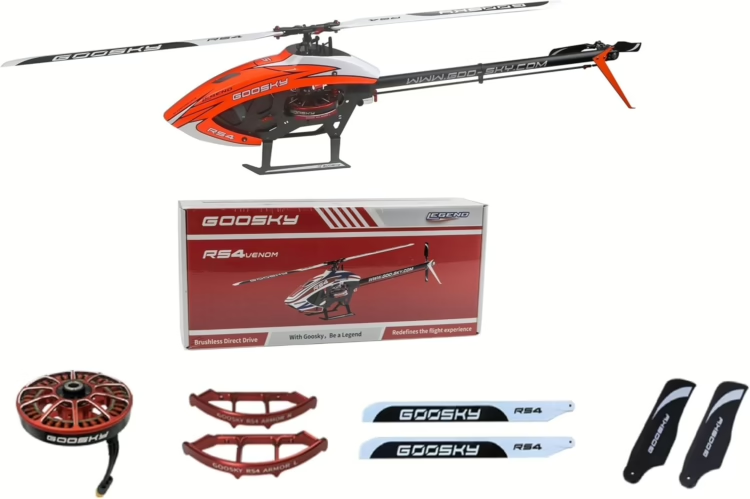
The Goosky Legend RS4 Venom Edition is a 400-class, Flybarless (FBL) collective-pitch 3D helicopter designed to serve as a critical bridge between micro indoor practice models and giant-scale 700-class machines. It swings 390mm carbon fiber main blades on a direct-drive brushless motor, spanning a main rotor diameter of 872mm across an overall airframe length of 833mm. At approximately 1,300 grams takeoff weight, the RS4 Venom carries enough rotational inertia to mimic the composed, predictable flight behavior of a much larger machine while remaining genuinely portable.
The Venom Edition is a targeted refinement of the standard Goosky RS4, and the changes aren’t cosmetic. Goosky responded directly to enthusiast community feedback by redesigning the cyclic servo mounting layout from proprietary to a universal four-screw system, widening the chassis compartment to accept 6S LiPo packs from 1,800mAh to 2,200mAh, and upgrading the brushless main motor with a hand-wound stator and premium Neodymium-Iron-Boron (NdFeB) magnets for substantially improved torque delivery. Red anodized aluminum brackets and a heavy-duty motor protector round out the physical upgrades.
The ideal user is an intermediate-to-advanced pilot—someone who has outgrown micro helicopters and is ready for the complexity, power, and precision this platform demands. It is not, under any circumstances, a beginner’s first collective-pitch aircraft.
→ See the Goosky Legend RS4 Venom Edition on Amazon
Pros & Cons
Pros
- Direct-drive architecture eliminates the main gear — no pinion to set, no primary gear to strip during a crash, and genuinely instant torque delivery with significantly reduced acoustic noise.
- Universal four-screw servo mount — pilots can install premium aftermarket electronics such as the Torq CL0508, ending dependence on factory-only replacements.
- Expanded battery compartment — accommodates 6S packs from 1,800mAh to 2,200mAh, enabling approximately four to six minutes of aggressive flight and CG optimization.
- Robust anodized hardware and motor protector — red anodized aluminum brackets act as heat sinks; the heavy-duty motor protector shields the stator during hard landings and inverted contacts.
Cons
- Stock head dampeners are too soft for hardcore 3D — factory compliance causes excessive feathering shaft displacement, mushy cyclic response, and, in extreme cases, tail boom strikes; aftermarket Synergy dampers are not optional for serious pilots.
- Critical ESC overload risk with improper FBL pitch settings — erroneously allowing 27 degrees of collective pitch instead of the required 12–13 degrees will thermally overload the ESC and trigger mid-flight motor shutdowns.
- Extreme sensitivity to battery quality — budget cells with inflated C-ratings (e.g., Zeee) cause severe voltage sag under direct-drive loads, inducing premature low-voltage cutoffs even when the pack appears fully charged.
Design, Build Quality, and Setup
The RS4 Venom’s physical construction communicates its engineering priorities without subtlety. The carbon fiber side frames are reinforced specifically to handle the torsional loads generated by a 6S (22.2V) direct-drive power system—a non-trivial engineering requirement that cheaper airframes in this class struggle to meet. The red anodized aluminum brackets and mounts serve a dual purpose: they’re visually distinctive, and they actively draw thermal energy away from the brushless stator coils during sustained flight.
The direct-drive motor itself is the mechanical heart of the machine. By mounting the main rotor hub directly to the bell of a massive, low-KV outrunner brushless motor, Goosky eliminates the gear train entirely. The hand-wound stator features an iron core with NdFeB magnets—the strongest class of permanent magnets commercially available—providing the magnetic flux density required to directly overcome the aerodynamic drag of aggressive collective pitch inputs without any intermediate reduction gear. High-speed ball bearings support the motor housing, which is enclosed in a high-precision shell. The result: absolutely instantaneous torque delivery with zero gear lash.
Tail architecture choices are equally deliberate. The Venom Edition uses a high-speed, belt-driven tail assembly driving 186mm-diameter, 71mm-length tail blades. The tail boom has been redesigned to be structurally stiffer than the legacy RS4, which raises its natural resonance frequency and prevents low-frequency vibrations from the tail rotor from contaminating the MEMS gyroscopes in the flight controller. The tail pitch slider mechanism has been overhauled for ultra-smooth, bind-free traversal.
Setup complexity is moderate. The universal servo mount system is a genuine quality-of-life improvement—pilots familiar with standard micro-servo geometry will find the installation intuitive. However, the build demands respect: belt tension must be calibrated precisely (too tight causes parasitic drag; too loose risks tooth-skipping under load), and the FBL pitch limits must be locked to ±12–13 degrees before any power-on testing. This is not an aircraft you configure casually.
Performance Evaluation and Real-World Utility
The RS4 Venom Combo packages are supplied with high-capacity 70A to 80A ESCs from manufacturers such as Hobbywing or Xdfly. Kit-version builders frequently integrate the Spektrum Avian 80A ESC to leverage seamless telemetry integration with Spektrum NX-series transmitters. Combo packages include the proprietary Goosky GTS+ FBL unit, which features a 3-axis gyroscope and a 3-axis accelerometer with Bluetooth connectivity to the Goosky smartphone app—a legitimately useful field tool for wirelessly adjusting gyro gain, feed-forward speed, and maximum agility without dragging a laptop to the flying field.
For pilots choosing the unassembled kit route, the airframe accepts industry-standard third-party FBL systems including the MSH Brain, iKon 2, and Spektrum FC6350HX. Premium aftermarket units add capabilities like Fast Fourier Transform (FFT) vibration logging, which mathematically pinpoints failing bearings or unbalanced tail blades from in-flight resonance data. All modern FBL systems also provide the critical Bailout/Rescue Mode function: a momentary switch on the transmitter triggers the FBL to snap the disc level and inject positive collective, recovering the aircraft from spatial disorientation at low altitude.
Battery selection is not a secondary concern on this machine—it’s a primary variable. The direct-drive motor makes no allowances for weak discharge capability. The Goosky OEM 1,800mAh 70C pack provides excellent baseline performance with neutral CG. The upgraded Goosky 2,200mAh 70C pack extends flight duration and punch. Community testing consistently identifies Liperior and Ovonic packs in the 1,800mAh to 65–80C range as the most reliable third-party options, owing to their true discharge ratings and low internal resistance. Budget cells—even those labeled “120C”—have demonstrated a documented pattern of voltage sag under direct-drive loads that triggers ESC low-voltage cutoffs mid-flight. The distinction between a premium and a budget cell is the difference between a locked-in five-minute session and an unexpected descent from altitude.
The most consequential performance variable, however, is the FBL collective pitch configuration. Community diagnostic data on the RS4 platform identifies a specific failure vector: pilots who inadvertently allow the flight controller to command up to 27 degrees of positive and negative collective pitch. Aerodynamic drag scales exponentially with blade pitch, not linearly. Commanding 390mm carbon fiber blades to 27 degrees creates aerodynamic resistance that forces the direct-drive motor to draw current that exceeds the ESC’s burst rating, triggering thermal shutdown or overcurrent protection. The fix is non-negotiable bench work: mechanically and electronically verify that collective pitch limits are capped at ±12–13 degrees before the first flight. When correctly configured, an 80A ESC operates comfortably within its thermal envelope throughout the entire 3D flight envelope.
The stock rotor head dampeners are the platform’s most overlooked mechanical liability for pilots who intend serious 3D flying. During tic-tocs and other maneuvers involving rapid transitions between extreme positive and negative pitch, excessive head dampener compliance absorbs swashplate input rather than transmitting it to the blades. The response feels disconnected. In worst-case scenarios, the feathering shaft displaces far enough to allow blade flex into the tail boom. The aftermarket Synergy polyurethane dampeners, paired with precision blade shims, eliminate lateral slop and vertical play in the feathering shaft. The transformation from stock to Synergy setup is not subtle—the rotor head goes from soft and vague to immediate and locked-in.
Where the Goosky Legend RS4 Really Shines
The most compelling argument for the RS4 Venom isn’t found in a specification table. It’s found in the psychological shift it produces in the pilot.
For anyone who has spent sessions at the flying field quietly dreading the sound of a blade strike—knowing it means stripping main gear teeth, sourcing replacement parts, and spending an evening on the bench—the direct-drive architecture is genuinely transformative. An imperfect auto-rotation, a blade scrape during a low-altitude inverted approach: these events no longer carry the same consequence. The RS4 Venom’s direct-drive motor has no gear to strip. That knowledge, internalized over a flying season, changes how a pilot approaches new maneuvers. Experimentation becomes possible in a way that traditional drivetrains quietly suppress.
In the air, after proper setup, the RS4 Venom delivers an experience that outperforms its size class. In hover, it demonstrates a hands-off stability that belies its sub-1.5-kilogram mass. As it transitions into forward flight, translational lift dramatically increases rotor disc efficiency, and the acceleration is immediate. During 3D aerobatics, the belt-driven 186mm tail rotor exhibits absolute heading authority—refusing to blow out even when the pilot punches collective from -12 to +12 degrees instantaneously. The direct-drive motor shows virtually zero RPM sag under these extreme loads. The acoustic signature of the 390mm carbon fiber blades under hard cyclic stops—the sharp, aggressive “blade fart” that serious 3D pilots recognize as confirmation of genuine aerodynamic loading—echoes across the field with a presence that micro helicopters simply cannot replicate.
When executing a Chaos—the continuous pirouetting flip sequence that tests every axis simultaneously—the Venom tracks with a robotic precision that builds genuine pilot confidence. That combination of scaled-up feel, portability, and direct-drive durability is where the RS4 Venom converts skeptics.
→ See the Goosky Legend RS4 Venom Edition on Amazon
Value Comparison and Market Context
The RS4 Venom competes directly against two primary alternatives: the OMPHOBBY M4 and the SAB Goblin RAW 420 Competition.
The SAB Goblin RAW 420 represents the boutique echelon of this market segment. SAB’s manufacturing tolerances and carbon fiber molding are held in high regard within the community—blade grip pockets, for instance, are machined to capture retaining nuts flush, eliminating the need to wrench both ends during assembly. That level of detail reflects genuine Italian engineering investment. A fully equipped RAW 420 Competition build, however, will demand a total outlay of $1,100 to $1,600. Crash parts carry commensurate costs. The RS4 Venom Combo can be acquired and flown for approximately half that figure. Both platforms perform with rock-solid cyclic and tail authority in the air. The Goosky delivers the overwhelming majority of the SAB’s in-flight performance at a fraction of the investment and ongoing maintenance cost.
Against the OMPHOBBY M4, the competitive dynamic is tighter. Both platforms share nearly identical direct-drive architecture and target the same pilot demographic. Both are capable of violent 3D aerobatics. The differentiating factor is ecosystem flexibility: the Venom Edition’s universal four-screw servo mount gives pilots freedom to select premium aftermarket electronics, while the OMPHOBBY M4 retains proprietary servo designs. The RS4 Venom’s wider battery tray further broadens third-party LiPo compatibility for pilots managing an existing fleet of 6S packs.
For U.S. operators, one additional cost consideration is unavoidable: at approximately 1,300 grams, the RS4 Venom far exceeds the FAA’s 250-gram Remote ID threshold. Pilots must either operate exclusively within a sanctioned FRIA (typically an AMA club field) or affix an FAA-approved Remote ID broadcast module to the airframe and display their federal registration number on the canopy. Pilots must also pass the FAA TRUST (The Recreational UAS Safety Test)—a free, mandatory online safety exam required for all recreational UAS operators. The RS4 Venom’s carbon fiber side frames and fiberglass canopy provide adequate mounting locations, but the module must be isolated from high-frequency frame vibrations to avoid interfering with the FBL sensors.
Who Should Buy It
The ambitious intermediate pilot who has successfully mastered basic smaller collective-pitch helicopters—such as the Goosky S2 or Blade 230S—and is ready to step up to a larger, more stable platform for learning inverted flight, hurricanes, and funnels. The 390mm rotor disc provides the hang-time and predictability needed to develop muscle memory for complex stick inputs.
The veteran 3D pilot using this as a practice platform. Advanced operators who own expensive 700-class machines but want a capable, lower-cost aircraft for rehearsing high-risk maneuvers. Crashing the RS4 Venom does not carry the financial consequences of crashing a large-scale machine.
The engineering enthusiast who genuinely derives satisfaction from the build process—setting belt tension, wiring ESCs, tuning PID loops via Bluetooth, and selecting aftermarket servos. The kit version rewards builders who appreciate high-quality anodized aluminum and precise carbon fiber assembly.
This helicopter is not for absolute beginners. Pilots who have never flown a collective-pitch aircraft or trained on an RC flight simulator should not purchase this model. The kinetic energy of 390mm carbon fiber blades at operational RPM represents a serious safety hazard in inexperienced hands. The configuration requirements—FBL pitch limits, belt tension, battery quality standards—presuppose a baseline of mechanical and technical familiarity that first-time buyers typically don’t yet possess.

Key Takeaways
- Direct-drive durability: Eliminating the main gear removes the most common crash-related failure point, delivering instant torque and substantially reduced acoustic noise.
- Mandatory setup steps: Collective pitch limits must be capped at ±12–13 degrees in the FBL; exceeding this will thermally overload the ESC mid-flight.
- Upgrade the dampeners: Factory head dampeners are too compliant for 3D flight—Synergy aftermarket dampers are essential, not optional.
- Battery quality is non-negotiable: Premium, true high-discharge 6S packs (Liperior, Ovonic) are required; budget cells trigger voltage sag and in-flight shutdowns.
- FAA compliance required: At ~1,300g, Remote ID is legally mandatory outside of FAA-recognized FRIA club fields.