


While every intended successor — from the Mach 2 B-58 Hustler to the Mach 3 XB-70 Valkyrie — is now a museum piece, the “BUFF” continues to fly and redefine the future of American strategic airpower.
The Bomber at the End of the Century
The tarmac shimmers and distorts under the immense, radiating heat of eight shrieking Pratt & Whitney TF33 turbofan engines as the heavy bomber begins its agonizingly slow, thunderous roll. Thick, ominous plumes of black smoke trail behind the massive, swept-wing leviathan as it gathers momentum, its 185-foot wingspan flexing upward under the sheer weight of the fuselage. The outrigger wheels of its highly unusual bicycle landing gear lift from the concrete, and the aircraft ascends at a characteristic six-degree nose-down angle. It is a visceral, mechanical scene straight out of the early 1950s — yet it plays out routinely at military installations across the globe in the 2020s.
This is the Boeing B-52H Stratofortress, lifting off into an airspace it was theoretically never supposed to survive.
The sheer absurdity of the B-52’s continued operational dominance represents the greatest irony in modern military aerospace engineering. Every sleek, supersonic, and technologically revolutionary aircraft specifically designed to render it obsolete has long since been retired, scrapped, or relegated to the static displays of aviation museums. The aircraft climbing into the sky bears a silhouette finalized when Harry Truman occupied the White House and jet aviation was still in its infancy. Yet the Stratofortress remains the undeniable, load-bearing backbone of the United States Air Force’s global strike capability — and, thanks to sweeping modernization programs currently underway, it is officially projected to remain in active combat service well into the 2050s.

Why This Story Matters
To truly comprehend the gravity-defying longevity of the B-52 Stratofortress, one must examine the aircraft not in isolation, but through the analytical lens of the challengers that attempted — and spectacularly failed — to replace it. The history of American strategic airpower is littered with the wreckage of highly ambitious, single-variable-optimized bombers. The Convair B-36 Peacemaker, the Boeing B-47 Stratojet, the Convair B-58 Hustler, the North American XB-70 Valkyrie, and the General Dynamics FB-111 all represented the absolute pinnacle of aerospace engineering in their respective eras. Each was built to fly higher, faster, or more dynamically than the Stratofortress. Each was heralded by defense planners as the inevitable future of the Strategic Air Command.
Yet each ultimately fell victim to rapidly changing geopolitical realities, shifting tactical doctrines, or the brutal economics of military procurement. The B-52’s longevity is best understood by dissecting the specific failures of these supposed successors — bombers that sacrificed the foundational requirements of true strategic airpower, namely global range, massive payload capacity, and structural adaptability, in pursuit of a single extreme performance metric.
As the U.S. Air Force introduces the Northrop Grumman B-21 Raider, a next-generation stealthy penetrating strike bomber designed for the highly contested environments of the Indo-Pacific theater, the B-52 will not be replaced by it but will fly alongside it. The case for that arrangement is written entirely in the failures described below.
Born in a Hotel Room: The Van Cleve Weekend
The genesis of the most enduring strategic bomber in history was not the product of a protracted design committee, but a frantic, 72-hour engineering sprint in a midwestern hotel room. In October 1948, a team of Boeing engineers arrived in Dayton, Ohio, to present their latest heavy bomber proposal to the Air Force’s chief of bomber development, Colonel Henry E. “Pete” Warden. Boeing’s leading proposal at the time, designated the Model 464-35, was a massive, straight-winged aircraft powered by four turboprop engines utilizing contra-rotating propellers.
Warden, an MIT-educated engineer and a staunch proponent of the newly developed turbojet engine — specifically Pratt & Whitney’s J57 — was profoundly unimpressed. He rejected the design on Thursday, October 21, instructing the Boeing team to scrap the propellers and return with a viable all-jet proposal by Monday morning.
Retreating to their suite at the Hotel Van Cleve in downtown Dayton, the six-man Boeing team — aerodynamics chief George S. Schairer, Vice President of Engineering Ed Wells, Art Carlsen, Vaughn Blumenthal, and newly arrived engineers Bob Withington and Maynard Pennell — embarked on a legendary, sleepless design marathon. Working around the clock with slide rules, pencils, and raw engineering intuition, they discarded the straight wing entirely, adopting instead a 35-degree swept wing — a concept validated by captured German aerodynamic research and already proven on the earlier B-47 Stratojet. They specified eight Pratt & Whitney J57-P-3 turbojet engines, paired in four underwing pods to reduce aerodynamic drag, simplify maintenance, and isolate the airframe from potential engine fires.
By Sunday evening, the team had drafted a comprehensive 33-page proposal, hiring a local stenographer to type the final clean copy. Schairer ventured to a Dayton hobby shop, purchased balsa wood, glue, and carving tools, and painstakingly built a 14-inch scale model of the new aircraft, painted silver. On Monday morning, they presented the newly designated Model 464-49 to Colonel Warden. The proposed aircraft would weigh 330,000 pounds, carry a 10,000-pound nuclear bombload, and achieve an unrefueled range of 8,000 miles. Holding the balsa model, Warden reportedly declared, “Now we have an airplane. This is the B-52.”
The design rapidly gained the endorsement of General Curtis E. LeMay in 1950, whose rigid demands for global reach and heavy payload matched the Model 464-49’s parameters precisely. On April 15, 1952, the YB-52 prototype took to the skies over Seattle. By 1954, Secretary of the Air Force Donald Quarles would accurately predict the production model to be “the most formidable expression of air power in the history of military aviation.”
Competitor No. 1: The B-36 Peacemaker — Power Without the Jet Age
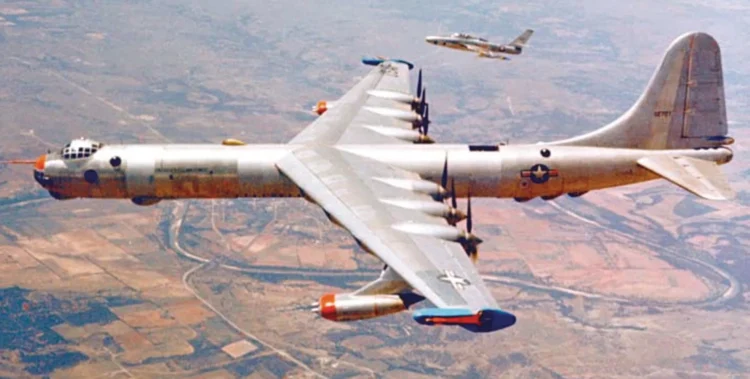
To appreciate the quantum leap the B-52 represented, one must first examine the aircraft it was built to replace. The Convair B-36 Peacemaker was a Cold War colossus — the largest mass-produced piston-engine aircraft in aviation history, boasting a gargantuan 230-foot wingspan and an unprecedented 86,000-pound payload capacity. Initially powered by six Pratt & Whitney R-4360 Wasp Major radial pusher-engines, later variants beginning with the B-36D added four General Electric J47 turbojets in underwing pods, prompting the famous crew slogan: “Six turning and four burning.” The Peacemaker provided the Strategic Air Command with its first true intercontinental reach, capable of remaining airborne for up to 32 hours without refueling.
This immense endurance was not without consequence, however. The B-36’s cruising speed of merely 230 mph and maximum dash speed of 435 mph made it agonizingly slow despite its 45,700-foot service ceiling. The combat debut of the Soviet MiG-15 swept-wing jet fighter during the Korean War confirmed SAC’s worst fears: a piston-engine bomber, regardless of its defensive armament, was hopelessly vulnerable to modern jet interceptors. The aircraft was further plagued by engine overheating and in-flight fires, earning the derisive nickname “Magnesium Overcast” for its extensive magnesium alloy skin. Ground crews endured what could charitably be called “ramp picnics” — endless open-air repair sessions beneath the massive wings.
The B-36 was entirely retired by February 1959, never having dropped a bomb in anger. Its failure provided the first critical lesson in Cold War bomber design: immense range and endurance are essential virtues, but they cannot come at the absolute expense of speed and survivability against contemporary interceptors. The B-52 absorbed that lesson, mating the strategic reach of the Peacemaker with the swept-wing jet technology required to survive in hostile airspace.
Competitor No. 2: The B-47 Stratojet — The Transitional Bomber That LeMay Outgrew

Where the B-36 provided range without speed, Boeing’s B-47 Stratojet provided speed without range. Introduced into operational service in 1951, the B-47 was an aerodynamic revelation that forever changed the trajectory of large aircraft design. Drawing heavily upon captured German swept-wing research, the B-47 was the first large military aircraft to successfully integrate a 35-degree swept wing and pod-mounted turbojet engines, achieving high-subsonic speeds of around 600 mph that could comfortably outpace many early jet fighters.
With 2,042 units manufactured, the B-47 became the numerical backbone of SAC during the 1950s and served as the primary vehicle for early airborne alert and reconnaissance missions, including 146 long-range flights by RB-47EHs from Thule, Greenland, between March and May 1956. Yet the Stratojet was fundamentally flawed by its classification as a “medium” bomber. Its unrefueled combat radius was limited to roughly 4,000 miles. To strike deep into the Soviet heartland from the continental United States, the B-47 required multiple complex aerial refuelings or total reliance on vulnerable forward-operating bases in Europe and North Africa.
General LeMay recognized that depending on overseas bases subjected American nuclear assets to the political whims of allies and the immediate threat of preemptive Soviet strikes. He mercilessly leveraged the B-47’s range limitations in Washington to justify the massive funding required for the intercontinental B-52 program.
The Stratojet’s aerodynamic elegance also masked severe structural liabilities. It was notoriously difficult to fly, featuring an unforgiving “coffin corner” at altitude where the margin between a high-speed aerodynamic stall and a low-speed stall was merely five knots. The ultra-thin, highly flexible wing that granted the B-47 its speed was acutely susceptible to structural fatigue; in flight, the wings could deflect up to 17 feet, and above 489 mph, aileron reversal became a fatal hazard, where control inputs would twist the wing rather than induce a bank. When evolving Soviet surface-to-air missiles forced bombers to transition to low-altitude profiles, the denser air induced catastrophic fatigue stresses across the B-47 fleet, accelerating the retirement of all bomber variants by 1965, with the last specialized RB-47 reconnaissance aircraft following by 1967.
The B-52 inherited the Stratojet’s swept-wing and podded-engine layout but scaled it massively upward, trading a fraction of aerodynamic purity for the structural strength and internal fuel capacity required for genuinely global reach.
Competitor No. 3: The B-58 Hustler — America’s Most Dangerous Bomber

If the B-47 represented a compromise on range, the Convair B-58 Hustler represented the total sacrifice of all other variables at the altar of pure, unadulterated speed. Entering service in March 1960, the B-58 was America’s first operational supersonic strategic bomber — a magnificent, gleaming delta-wing dart capable of sustained Mach 2 flight, powered by four General Electric J79 afterburning turbojets. The Hustler was designed to streak into Soviet airspace at high altitudes, outrunning enemy interceptors and delivering a single nuclear payload housed in a massive, jettisonable combination bomb-and-fuel pod slung beneath its fuselage.
The pursuit of Mach 2 necessitated a compact, highly swept delta wing and a slender, tightly packed fuselage that severely restricted internal fuel capacity. Consequently, the B-58 possessed even shorter legs than the B-47 it was meant to replace, demanding heavy and frequent aerial refueling from KC-135 Stratotankers just to reach intercontinental targets. Then there was the matter of safety. The Hustler was notoriously unforgiving, featuring eccentric takeoff, landing, and stall characteristics that overwhelmed even highly experienced pilots; the loss of an engine at supersonic speeds induced violent, often irrecoverable yaw dynamics. Over its brief operational lifespan of ten years, 26 of the 116 B-58s produced were destroyed in accidents — a staggering attrition rate of 22.4%. Unit acquisition costs skyrocketed to between $12.5 million and $14 million, nearly triple the cost of a B-47, while the complex air-conditioning requirements of its advanced, heat-generating vacuum-tube avionics made maintenance an endless and expensive burden.
The final death knell arrived with the deployment of Soviet high-altitude surface-to-air missiles. Forced down into dense, turbulent low-altitude air to evade radar detection, the B-58’s aerodynamic advantages vanished and its fuel consumption became astronomic. The philosophy of “speed over all else” had failed spectacularly. The Hustler was completely retired by January 1970.
Competitor No. 4: The XB-70 Valkyrie — Mach 3 and Nowhere to Go

If the B-58 was an ambitious gamble, the North American XB-70 Valkyrie was the absolute zenith of Cold War aeronautical ambition. Designed in the late 1950s, the B-70 program sought to create an intercontinental, deep-penetration strategic bomber that would cruise at Mach 3 — more than 2,000 mph — at altitudes exceeding 70,000 feet. The Valkyrie was a genuine engineering masterpiece, utilizing six General Electric YJ93 turbojets, titanium honeycomb construction, and a revolutionary aerodynamic phenomenon known as “compression lift,” where the aircraft’s folding wingtips trapped their own supersonic shockwave to generate extra lift at extreme velocities.
Military planners theorized that at Mach 3, the Valkyrie would be entirely immune to interception, streaking across Soviet radar screens too rapidly for enemy controllers to vector any available interceptor into a workable geometry. The B-70 was fully intended to relegate the B-52 to the scrapyard by the mid-1960s.
Technology on the ground, however, evolved faster than technology in the air. On May 1, 1960, a Soviet SA-2 Guideline surface-to-air missile shot down Francis Gary Powers in his high-flying Lockheed U-2 spy plane. The strategic paradigm shattered overnight. The SA-2 proved conclusively that extreme altitude and speed no longer provided sanctuary; a radar-guided missile could easily out-climb and out-turn any heavy bomber, including one traveling at Mach 3. The only tactical response was low-level penetration — flying beneath the radar horizon — but the XB-70’s massive delta wing and exotic heat-resistant airframe were explicitly optimized for high-altitude, thin-air environments. At low altitudes, the Valkyrie offered no performance advantages over the B-52, yet it cost exponentially more to build and operate.
Faced with staggering development costs, the rise of the ICBM as the primary nuclear deterrent, and the cancellation of both the “zip fuel” high-energy propellant program and the shared-cost F-108 Rapier interceptor, President John F. Kennedy and Secretary of Defense Robert McNamara canceled the B-70 as a frontline bomber in 1961. Only two XB-70 prototypes were ever completed, relegated to aerodynamic research for NASA. The program ended in tragedy on June 8, 1966, when the second prototype — designated AV-2 — was destroyed in a mid-air collision with an F-104 Starfighter during a publicity photo shoot. The Valkyrie proved that designing an aircraft around a singular extreme performance metric left it wholly incapable of adapting when the enemy changed the rules of engagement.
Competitor No. 5: The FB-111 — When “Good Enough” Wasn’t

With the B-70 canceled and both the B-58 and aging B-47s headed for retirement, the Strategic Air Command faced a looming shortfall in penetrating bombers. Secretary of Defense Robert McNamara, determined to impose cost-cutting and joint-service procurement commonality on the military, forced a controversial solution upon the Air Force: the General Dynamics FB-111A. Derived from the TFX program that produced the tactical F-111 Aardvark strike fighter, the FB-111 was a swing-wing, medium-range bomber procured in 1965 as an interim stopgap. McNamara envisioned it as a low-cost modular solution that could fulfill SAC’s nuclear strike requirement without the astronomical expense of a clean-sheet heavy bomber program. The aircraft featured highly advanced terrain-following radar, allowing it to autonomously hug the earth at supersonic speeds in zero visibility — a direct counter to the Soviet high-altitude SAM threat.
The FB-111 suffered from the same fatal flaw as the B-47 and B-58 before it: it simply lacked the range. Even with a 3.5-foot wingtip extension and reinforced landing gear to accommodate a maximum gross weight of 114,000 pounds, the FB-111 was fundamentally a tactical fighter airframe masquerading as a strategic bomber. Its combat radius of roughly 2,920 miles unrefueled meant it could not reach the Soviet Union from the continental United States without a highly vulnerable chain of aerial refuelings. Because of its compact physical dimensions, it also lacked the internal volume necessary to accommodate the large electronic warfare suites and quantities of standoff cruise missiles that would become essential to bomber survivability. Planned procurement was slashed from 210 aircraft to a mere 76.
While the F-111 platform later demonstrated genuine effectiveness as a tactical interdictor — performing precision “tank plinking” strikes during Operation Desert Storm — it was woefully inadequate as a strategic intercontinental threat. By failing to provide a credible B-52 replacement, the FB-111 inadvertently solidified the Stratofortress’s monopoly on the heavy bomber mission, extending its operational life by default.
The Philosophy That Outlasted Its Rivals: Range, Payload, and Adaptability
Why did the B-52 survive while a parade of vastly more advanced challengers marched to the boneyard? The answer lies in a foundational design philosophy that never sacrificed a balanced triad — massive range, overwhelming payload, and unparalleled structural adaptability — in pursuit of a single performance extreme.
The B-52 was, in essence, a cavernous, over-engineered flying warehouse. When the Soviet SA-2 missile threat forced the USAF to abandon high-altitude bombing in the early 1960s, the Stratofortress did not become obsolete as the XB-70 had. Instead, Boeing and the Air Force initiated the massive “Big Four” (Mod 1000) modification program between 1959 and 1963. Because the B-52 possessed vast internal volume and excess lift capacity, engineers were able to structurally reinforce the fuselage bulkheads and wing splices, allowing the aircraft to absorb the brutal aerodynamic fatigue of low-level, high-speed penetration flights. The Stratofortress also carried sprawling, heavy Electronic Countermeasure suites, terrain-avoidance radars, and decoys such as the ADM-20 Quail, which replicated the bomber’s radar signature to confuse enemy operators.
The aircraft evolved through eight major variants — A through H — continually morphing to fit the geopolitical necessity of the day. During the height of the Cold War, the B-52 was the linchpin of Operation Chrome Dome (1960–1968), maintaining continuous 24-hour airborne nuclear alert missions to guarantee Mutually Assured Destruction. When the conflict in Vietnam demanded conventional firepower over nuclear deterrence, the B-52 adapted again. Under the “Big Belly” program and Arc Light operations, B-52Ds were modified to carry up to 108 conventional bombs, devastating enemy logistics and famously bringing North Vietnam back to the negotiating table during the Linebacker II raids of 1972. In the 1980s and ’90s, as penetrating enemy airspace grew too hazardous even at low altitudes, the B-52’s massive payload capacity allowed it to transition seamlessly into a standoff cruise missile carrier, launching AGM-86B Air-Launched Cruise Missiles from safely outside enemy air defense networks.
General Curtis LeMay, defending the relevance of the manned bomber long after his retirement, perfectly encapsulated the aircraft’s enduring value when he observed in 1988 that unlike an ICBM, a bomber can be launched, loiter, demonstrate resolve, and — critically — be recalled by human judgment. The B-52’s unglamorous but unmatched combination of range and payload allowed it to project that human judgment anywhere on the globe, carrying whatever weapon system the current era demanded.
Into the 2050s: The BUFF’s Unfinished Story
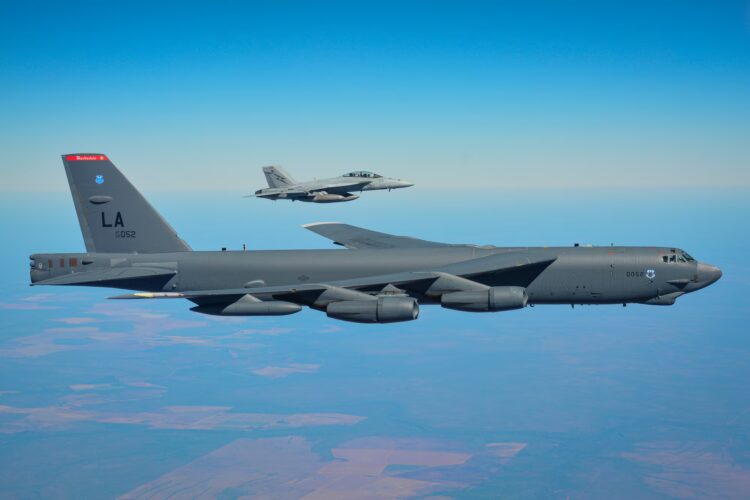
Today, the B-52H fleet — 76 active and reserve airframes based primarily at Barksdale AFB, Louisiana, and Minot AFB, North Dakota — remains the highly visible, highly active backbone of the Air Force Global Strike Command. Rather than planning its retirement, the Department of Defense is currently executing one of the most comprehensive aircraft modernization efforts in the history of military aviation.
At the heart of this revitalization is the Commercial Engine Replacement Program (CERP). The Air Force is finally shedding the 1960s-era Pratt & Whitney TF33 turbofans, replacing them with modern Rolls-Royce F130 engines. The $2 billion program will install eight F130 engines per aircraft in a dual-pod configuration, yielding a 30% improvement in fuel efficiency, drastically increasing unrefueled range, and effectively eliminating engine overhauls for the remainder of the aircraft’s lifespan.
Simultaneously, the Radar Modernization Program (RMP) is replacing the obsolete, mechanically scanned AN/APQ-166 analog radar with the Raytheon AN/APQ-188 — a system derived from the advanced Active Electronically Scanned Array radar used in the F/A-18 Super Hornet. This upgrade will provide the bomber with fighter-like situational awareness, high-resolution ground mapping, and vastly improved targeting for hypersonic and precision-guided weapons. The first B-52 equipped with the new radar arrived at Edwards Air Force Base in December 2025 to begin flight testing. These modifications are so extensive that the upgraded aircraft will receive a new designation: the B-52J.
As the B-21 Raider enters production to replace the fragile B-2 Spirit and the maintenance-intensive B-1B Lancer, the Air Force has finalized its future two-bomber fleet: the stealthy, penetrating B-21 taking down advanced air defenses, and the B-52J serving as the ultimate standoff missile truck and conventional weapons platform in permissive environments. The youngest B-52 airframe was built in 1962. When it finally retires, it will likely be 90 to 100 years old.
The Bomber That History Could Not Kill
In October 1948, George Schairer carved a tiny, swept-wing fuselage out of balsa wood in a Dayton hotel room. He could not have known that he was carving the physical architecture of American airpower for the next century. The B-52 Stratofortress was born from a sudden, radical pivot in propulsion technology, yet the design that emerged was so fundamentally sound — so structurally generous and aerodynamically balanced — that it proved entirely immune to obsolescence.
The aviation industry spent billions of dollars over seven decades attempting to build a bomber decisively superior to the B-52. They built bombers that were faster. They built bombers that flew higher. They built bombers with wings that swept. Time and again, military planners discovered that altitude is compromised by missiles, that speed is negated by catastrophic fuel consumption, and that extreme mechanical complexity is the enemy of readiness. The B-36 was outpaced by jets, the B-47 by geography, the B-58 by its own attrition rate, the XB-70 by a single Soviet missile, and the FB-111 by basic arithmetic.
The B-52 survived them all — from the Peacemaker to the Valkyrie — not because it was the fastest or the most spectacular design in that era’s portfolio, but because it was right in the ways that proved most durable: range, payload, and the structural generosity to absorb whatever new mission the next decade demanded. In the entire century of powered flight, no other combat aircraft has outlasted this many purpose-built successors. That is not luck. That is engineering philosophy.

Key Takeaways
- Triumph of Adaptability: The B-52 outlasted every challenger by optimizing a triad of range, payload, and internal volume — while rivals that chased single performance variables like Mach 3 speed or 80,000-foot service ceilings proved strategically brittle.
- Fallen Rivals: The two predecessors the B-52 replaced — the B-36 and B-47 — were undone by speed vulnerability and range limitations. The three purpose-built successors meant to replace it — the B-58, XB-70, and FB-111 — were retired prematurely due to exorbitant maintenance costs, SAM obsolescence, or inadequate intercontinental range.
- Mission Versatility: The aircraft’s physical capacity enabled seamless transitions from Chrome Dome nuclear alert (1960–1968) to low-level conventional bombing, Linebacker II strikes, and standoff cruise missile operations.
- A Century of Service: Equipped with Rolls-Royce F130 engines and a new Raytheon AESA radar, the redesignated B-52J will fly alongside the B-21 Raider into the 2050s — approaching a full century of continuous frontline service.