


The Boeing B-29 cost more to build than the atomic bomb it eventually carried — and proved to be the only aircraft in history to force a nation’s surrender through air power alone.

The object of their anguished attention was the Boeing B-29 Superfortress. Of the 97 Superfortresses that had theoretically rolled off the assembly lines, only 16 were physically capable of flight. Not one was certified combat-ready for overseas deployment. Every bomber parked on those Kansas tarmacs required exactly 54 mandatory modifications before it could be deemed airworthy: modifying engine cowl flaps, replacing thousands of electrical cannon plugs, installing distortion-free Plexiglas in the nose, improving blister seals to maintain cabin pressure, and swapping out main landing gear tires that were failing under the aircraft’s immense weight.
Mechanics operated outdoors in sub-zero conditions, allowed just 20 minutes of exposure to the wintry gale before retreating inside to warm hands too numb to grip a wrench. Because the hangars were too small to accommodate the massive bombers, most of the work was done on the open ramp — crouched under wing roots and sprawled across fuselage spines with the sleet still falling. General Henry “Hap” Arnold, Commander of the United States Army Air Forces, had ordered the bombers overseas. He had been told that none were available.
The frantic sprint that followed, compressed into 26 grueling days and christened the “Battle of Kansas” throughout the military, underscored a paradox that popular history has largely overlooked. The B-29 Superfortress was the single most expensive weapons development program of World War II — at a total cost exceeding $3 billion in wartime dollars, it eclipsed even the Manhattan Project, the highly classified effort that produced the atomic bomb it was ultimately built to carry, which consumed approximately $1.9 to $2 billion.
More than a long-range bomber, the Superfortress was a sweeping technological revolution: the first combat aircraft designed from the ground up for full pressurization, armed with an analog-computerized remote-controlled gun system, and equipped with high-resolution ground-mapping radar capable of blind bombing through overcast skies and darkness. With a 3,200-mile combat radius, it was built to reach the Japanese home islands from the Marianas — and in doing so, it would prove that an entire nation could be brought to surrender through air power alone, before a single Allied soldier set foot on Japanese soil.
A BOMBER BEYOND ITS TIME: ORIGINS AND AMBITION
The Doctrine That Demanded a Revolution
The theoretical foundation underpinning the B-29’s existence had been laid decades before a single rivet was driven. In 1921, Italian General Giulio Douhet published Il dominio dell’aria — The Command of the Air — advancing the radical argument that future wars would be decided not by armies in the field but by fleets of bombers obliterating an enemy’s governmental centers, industrial hubs, and transportation networks. In November 1932, British Lord President of the Council — and soon-to-be Prime Minister — Stanley Baldwin infamously distilled the doctrine into its most memorable formulation: “The bomber will always get through.”

The United States Army Air Corps embraced Douhet’s philosophy with particular conviction. When the nation entered World War II, its primary strategic bombers — the Boeing B-17 Flying Fortress, which first flew in 1935, and the Consolidated B-24 Liberator — were formidable weapons in the European theater, within range of forward operating bases in England. The Pacific presented an entirely different problem. Striking the Japanese home islands from available Allied territory demanded a minimum combat radius of 3,200 miles — a distance 50 percent beyond the operational reach of even the B-24.
The 1939 Super-Bomber Requirement
On December 2, 1939, anticipating this fundamental gap, the War Department issued a formal request for a “super-bomber” capable of transcontinental ranges and unprecedented operational altitudes. Boeing, which had already initiated preliminary internal studies under its Model 333 designation in January 1939, refined the concept and submitted the Model 345 design on May 11, 1940. The Army Air Corps approved the design, recognizing the aircraft not as a tool for theater commanders but as a sovereign strategic asset — one organized under a unique command structure, the Twentieth Air Force, that reported directly to General Arnold and the Joint Chiefs of Staff in Washington, D.C.
Two Philosophies: Dominator vs. Superfortress
Aware of the extraordinary technological risk embedded in Boeing’s concept, the Army Air Corps commissioned Consolidated Aircraft in June 1940 to develop a backup design — a precaution that produced the B-32 Dominator. Where the B-29 was radical — designed for 30,000-ft operations with full pressurization and computerized gunnery — the B-32 was deliberately conservative: a scaled-up B-24 optimized for altitudes between 10,000 and 20,000 ft, omitting the complex systems delaying its competitor. The B-32 ultimately vindicated Boeing’s gamble. Only 118 Dominators were built, and the type saw minimal combat action; the entire weight of the Pacific air campaign would fall on the Superfortress.
ENGINEERING THE IMPOSSIBLE: FIVE BREAKTHROUGHS THAT REDEFINED THE BOMBER
-
Pressurization: Flying in Shirtsleeve Conditions at 30,000 Feet
Before the B-29, heavy bomber crews endured brutal operational conditions at high altitude — tethered to bulky oxygen masks, wrapped in electrically heated flight suits against temperatures that caused routine frostbite and hypoxia, with human performance degrading steadily across the course of long missions. The Superfortress became the first combat aircraft designed from the outset for full cabin pressurization.
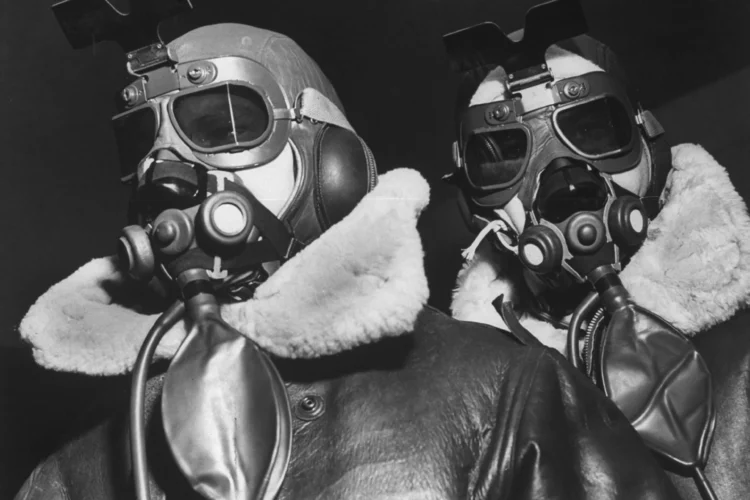 The engineering demands of maintaining pressure at 30,000 ft dictated the B-29’s distinctive profile: a sleek cylindrical fuselage and an ovaloid nose deliberately designed without a conventional stepped windshield to preserve structural integrity under pressure loads. Because pressurizing the massive bomb bays was structurally impossible, Boeing solved the problem with a dual-compartment system, connecting the forward cockpit and aft gunner stations via a 35-ft pressurized crawl tube spanning above the unpressurized bays. The result allowed an 11-man crew to operate in what the Army Air Forces described as “shirtsleeve conditions” across thousands of miles of operational flying — dramatically reducing physiological fatigue and sustaining combat effectiveness over missions that no previous bomber crew could have completed.
-
Remote-Controlled Computerized Gun Turrets
Because a fully pressurized hull could not accommodate traditional open-air manned gun positions without compromising the pressure seal, Boeing integrated the General Electric Central Fire Control system, model 2CFR55B1: four remote turrets — two dorsal and two ventral — armed with twin .50-caliber Browning M2 machine guns, alongside a manned tail position.
Control was routed through an analog electromechanical computer network built by IBM. Five gunners at sighting blisters across the aircraft tracked enemy fighters with optical sights; differential selsyn generators transmitted their azimuth and elevation data to the computers, which used relays and potentiometers to calculate precise firing solutions, correcting simultaneously for three variables: ballistics (gravity drop and aerodynamic drag on rounds fired from an aircraft traveling at 250 mph), lead (target velocity computed by twin gyroscopes in the sight), and parallax (the physical offset between a gunner’s line of sight and the distant turret barrels). The system doubled the B-29’s effective defensive engagement range to 900 yards and pointed directly toward the automated battlefields of the Cold War.
-
Ground-Mapping Radar and Electronic Warfare
For a bomber operating over the featureless Pacific, navigational precision and all-weather strike capability were as operationally critical as raw firepower. The B-29 was fitted with the AN/APQ-13 radar — an X-band system operating at 9,375 MHz, with a partially retractable radome between the bomb bays — enabling ground-mapping and blind-bombing capability to instrumented ranges of up to 100 nautical miles. Complementing the radar were active jamming transmitters, known to crews as “guardian angels,” designed to blind Japanese searchlight-control and antiaircraft-gun-direction radar. This integration transformed the B-29 into a 24-hour, all-weather instrument of total war — a combination of capabilities unprecedented in 1944.
-
Performance Envelope
The B-29’s specifications defined a new category of combat aircraft. Its 141-ft 3-in wingspan used a high-wing-loading configuration supplemented by massive Fowler flaps for essential lift during heavy-load takeoffs. Four Wright R-3350 Duplex-Cyclone 18-cylinder, twin-row air-cooled radials — each generating 2,200 hp and fitted with twin turbo-superchargers to maintain manifold pressure in the stratosphere — drove the aircraft to a maximum true airspeed of 357 mph, a service ceiling exceeding 31,850 ft, and a combat radius of 3,200 miles. That range figure was the strategic key to the entire Pacific campaign.
-
Payload Flexibility
The B-29’s twin unpressurized bomb bays were engineered for maximum mission flexibility: a maximum internal payload of up to 22,000 lb, configurable for high-explosive general-purpose bombs, clustered M-69 and M-74 napalm and phosphorus incendiary munitions, or 1,000- and 2,000-lb naval influence mines. Most critically, the cavernous bays provided the sheer physical architecture to accommodate the massive ballistic casings of the first atomic weapons. While the Royal Air Force’s Avro Lancaster required external modifications to carry outsized payloads, the B-29’s internal capacity made it the only Allied aircraft capable of executing the nuclear delivery missions that ended the war.
“The B-29 program consumed over $3 billion — against the Manhattan Project’s $1.9 to $2 billion. The delivery system had outpriced the apocalyptic weapon it was designed to drop.”
THE PRICE OF REVOLUTION: DEVELOPMENT HELL AND THE BATTLE OF KANSAS
Engine Fires and the Fatal Prototype Crash
The B-29 program’s gravest liability was the Wright R-3350 Duplex-Cyclone engine. Generating enormous power from a tightly packed twin-row cylinder arrangement, the R-3350 suffered from chronic overheating, particularly in the rear cylinder banks where cooling airflow consistently fell short. Poorly designed carburetor fuel-air mixtures exacerbated the problem, generating catastrophic exhaust valve failures at the worst possible moments.

A persistent myth holds that the R-3350’s crankcase was forged from flammable magnesium. Archival engineering records and surviving engine teardowns tell a different story: the three-section wartime crankcase was forged steel, chosen specifically to withstand the 30,000 lb of combustion force generated at each power stroke. The actual fire hazard came from the supercharger housing and various accessory components, cast from magnesium alloys to save weight. When chronic overheating ignited those accessories, they burned at core temperatures approaching 5,600°F (3,090°C) — sufficient to cut through the aircraft’s main wing spar within seconds.
The consequences of that failure mode were made public with terrible clarity in February 1943, when a highly publicized XB-29 prototype crashed into a Seattle meatpacking plant following an in-flight engine fire. The accident killed legendary Boeing test pilot Eddie Allen, his entire crew, and dozens of civilians on the ground. The program nearly died with them.
The Production Complexity Problem
The Army Air Forces compounded the engineering challenge by ordering mass production before prototype testing was complete. The manufacturing effort was dispersed across four facilities: Boeing plants in Seattle/Renton, Washington, and Wichita, Kansas; the Bell Aircraft plant in Atlanta, Georgia; and the Glenn L. Martin plant in Omaha, Nebraska. Assembling a machine with more than 40,000 individual parts, 14 miles of electrical wiring, and 600,000 rivets strained American industrial capacity to its limits. Boeing production engineer Oliver West pioneered a “multi-line” assembly approach — dividing the bomber into discrete sub-assemblies built concurrently — to accelerate output. But the decentralized system introduced severe quality-control inconsistencies across plants, and as the design changed continuously in response to test findings, aircraft were rolling off assembly floors in configurations already out of date.
The Battle of Kansas
The crisis erupted in early 1944. When General Arnold discovered that not one Superfortress was combat-ready for overseas deployment, he appointed Brigadier General Bennett E. Meyers and Colonel Clarence S. Irvine to take draconian control of the modification effort. Meyers and Irvine wielded Arnold’s authority to commandeer resources nationally — diverting subcontractor materials exclusively to the B-29 program and putting 600 Boeing factory workers onto the frozen tarmacs of the four Kansas bases in punishing wintry conditions. Working 12-hour overnight shifts, the teams rewired electrical systems, replaced entire landing gear assemblies, installed upgraded Plexiglas, and fitted the modified R-3350-23A engines. By March 26, the first combat-ready Superfortresses lifted off for the 12,500-mile journey to the Asian theater.
The Financial Cost
The financial toll of the B-29 revolution was without precedent in the history of warfare. The initial production contract for the first 3,943 aircraft was estimated at $3.7 billion; individual prototypes cost upward of $3.39 million before mass production drove the unit cost to approximately $639,188. The program’s total development and production expenditure exceeded $3 billion in wartime dollars — against the Manhattan Project’s $1.9 to $2 billion. The delivery system had outpriced the apocalyptic weapon it was designed to drop.
| WWII Military Program | Cost (1940s Dollars) |
| Boeing B-29 Superfortress Program | $3.0 Billion |
| Manhattan Project (Atomic Bomb) | $1.9–$2.0 Billion |
| Total U.S. WWII Heavy Field Artillery | $4.0 Billion |
| Total U.S. WWII Small Arms Materiel | $24.0 Billion |
Source: Historical wartime expenditure records and project audits.
FROM LIABILITY TO WAR-WINNER: HOW THE B-29’S TECHNOLOGY DECIDED THE PACIFIC WAR
The China Phase: A Logistics Nightmare
The B-29’s combat debut, under Operation Matterhorn, sent the XX Bomber Command to forward staging bases near Chengdu, China. The first tactical mission flew on June 5, 1944; the first raid on Japan — targeting the Yawata steel mills — followed on June 15. But China-based operations exposed a flaw the B-29’s extraordinary range could not overcome: supply. Because Japanese forces controlled land and sea routes, every gallon of aviation fuel and every bomb had to be airlifted over the Himalayan mountains — the infamous “Hump” — from India. B-29s were compelled to act as their own flying tankers, burning enormous quantities of fuel simply to position supplies for the bombing runs. Sustained strategic bombardment was mathematically impossible.

The Marianas Pivot
The breakthrough arrived in the summer of 1944, when U.S. forces captured Saipan, Tinian, and Guam. Located approximately 1,500 miles from Tokyo, the Marianas sat precisely within the B-29’s combat radius, and the islands could be supplied directly by deep-water cargo ships, bypassing the lethal Himalayan airlift entirely. Army engineers and Navy Seabees rapidly carved 8,500-ft paved runways into the coral of all three islands, providing the sprawling infrastructure necessary to launch hundreds of fully loaded Superfortresses simultaneously. For the first time, the B-29 had a platform that matched its capabilities.
The Incendiary Campaign
Early Marianas operations adhered to the traditional USAAF doctrine of high-altitude daylight precision bombing. The results were frustratingly poor: at 30,000 ft, the B-29s flew directly into the jet stream, encountering winds exceeding 150 mph that scattered ordnance and rendered precision targeting ineffective. In January 1945, Major General Curtis LeMay assumed command of the XXI Bomber Command and initiated one of the most consequential tactical pivots in the history of strategic air power. Recognizing that Japanese industry was heavily decentralized — spread across thousands of small feeder factories interspersed within densely built, highly flammable wooden residential districts — LeMay abandoned high-altitude precision doctrine entirely.
He ordered his B-29s down to between 5,000 and 10,000 ft — and up to 14,000 ft on subsequent missions — to conduct nighttime area bombardment using M-69 and M-74 napalm and phosphorus incendiary clusters, loading each aircraft to 16,000 lb of incendiaries by controversially stripping away most defensive ammunition — a decision crews viewed as suicidal — and relying on the cover of darkness and the aircraft’s speed. The B-29’s ground-mapping radar made blind bombing at those altitudes accurate; its range made the round trip to Japan survivable. Beginning with the devastating Operation Meetinghouse raid on Tokyo in March 1945, the fire campaign methodically burned out the industrial heart of the Japanese empire.
Operation Starvation: Blockade from the Sky
While the incendiary campaign dismantled Japan’s land-based industry, at Admiral Chester Nimitz’s urgent request, the B-29’s AN/APQ-13 radar and massive payload capacity enabled a parallel campaign against Japan’s maritime supply lines. Under Operation Starvation, the 313th Bombardment Wing flew at night, using ground-mapping radar to accurately drop parachute-retarded acoustic, magnetic, and pressure influence mines into shipping lanes targeting the vital Shimonoseki Strait. The numbers are striking: 1,529 sorties; approximately 12,135 mines deployed; 670 enemy ships sunk or damaged; more than 1,250,000 tons of shipping destroyed or immobilized; and only 15 B-29s lost — just 5.7 percent of XXI Bomber Command’s total operational effort. The campaign sank more ship tonnage in the final months of the war than U.S. submarines and surface fleets combined, executing a total naval blockade from the sky.
| Operation Starvation Maritime Impact (Mar.–Aug. 1945) | Statistics |
| Total B-29 Sorties Flown | 1,529 |
| Percentage of XXI Bomber Command Effort | 5.7% |
| Naval Mines Deployed | ~12,135 |
| Enemy Ships Sunk or Damaged | 670 |
| Total Japanese Tonnage Destroyed/Immobilized | >1,250,000 tons |
| B-29 Aircraft Lost | 15 |
Source: USAAF Operational Records and Post-War Strategic Bombing Surveys.
The Atomic Delivery: Project Silverplate
The final validation of the entire B-29 program came with Project Silverplate — a classified modification effort that stripped all defensive turrets except the tail guns, installed specialized H-frame hoists and pneumatic bomb bay doors, fitted fuel-injected engines, and added Curtiss electric reversible-pitch propellers, all to accommodate the massive ballistic casings of the first nuclear weapons. In August 1945, the Silverplate B-29s Enola Gay and Bockscar, flying from North Field on Tinian with the 509th Composite Group, delivered the atomic payloads to Hiroshima and Nagasaki, bringing a definitive end to the Second World War.

LEGACY: WHAT THE SUPERFORTRESS PROVED AND WHAT IT LEFT BEHIND
The B-29 Superfortress confirmed, with brutal finality, the foundational theories on strategic air power that Douhet had outlined more than two decades earlier. It became the only aircraft in history to force the capitulation of a sovereign nation through air power alone — deliberately averting an amphibious invasion of the Japanese home islands that military planners estimated would have cost hundreds of thousands of American lives and likely millions of Japanese.
The Superfortress continued in service deep into the Cold War, flying thousands of combat sorties during the Korean War before being phased out in favor of the structurally reinforced, Pratt & Whitney R-4360-equipped B-50 Superfortress — a direct derivative — and eventually the jet-powered B-47 and B-52.
Its most unusual legacy, however, was written behind the Iron Curtain. Lacking a strategic bomber capable of reaching the continental United States, Soviet Premier Stalin ordered the Tupolev Design Bureau to reverse-engineer three B-29s that had made emergency landings in Vladivostok after raids over Japanese-held Manchuria: Ramp Tramp, Ding Hao, and the General H.H. Arnold Special. Soviet engineers faced formidable obstacles — converting American imperial measurements to the metric system forced the use of slightly thicker aluminum gauges, producing a heavier aircraft with reduced range; the Wright engines required Soviet ASh-73TK substitutes. Despite these challenges, the resulting Tupolev Tu-4 “Bull” flew in May 1947. Western observers at the Tushino air show were stunned to see a virtual carbon copy of the B-29, replicated down to the placement of equipment mounts and the color of the interior paint. The Tu-4 gave the Soviet Union its first nuclear-capable strategic delivery platform, permanently altered the geopolitical balance of power, and helped launch the Cold War arms race in earnest.
WHERE TO FIND A SURVIVING B-29 TODAY
Of the 3,970 Superfortresses originally constructed across four American assembly plants, only 26 survive in complete, recognizable form. The vast majority were scrapped in post-war drawdowns, expended as weapons test targets at Naval Air Weapons Station China Lake, or subjected to destructive survivability studies at Aberdeen Proving Ground. Today, only two remain fully airworthy.
| Aircraft | Status | Location |
| “Doc” (S/N 44-69972) | Airworthy / Tours | Doc’s Friends, Wichita, KS |
| “Fifi” (S/N 44-62070) | Airworthy / Tours | Commemorative Air Force, Dallas, TX |
| “Enola Gay” (S/N 44-86292) | Static Display | Udvar-Hazy Center, Chantilly, VA |
| “Bockscar” (S/N 44-27297) | Static Display | NMUSAF, Dayton, OH |
| “It’s Hawg Wild” (S/N 44-61748) | Static Display | IWM Duxford, United Kingdom |
Source: Current B-29 survivor registries.
EPILOGUE
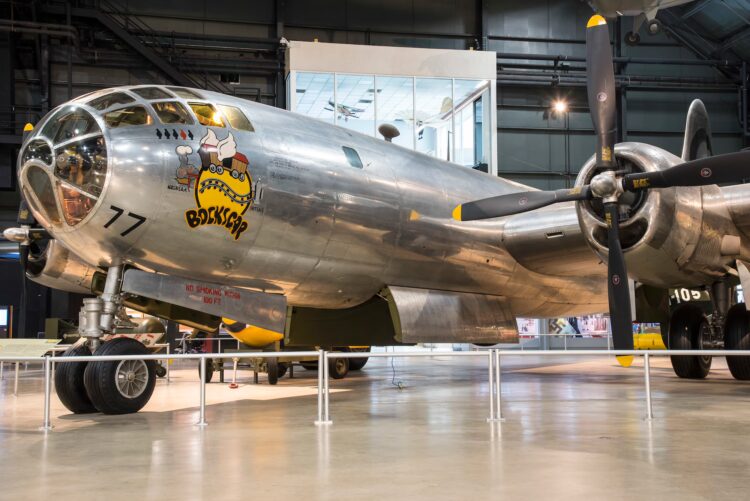
On September 2, 1945, as the formal instruments of surrender were signed on the wooden deck of the USS Missouri in Tokyo Bay, formations of B-29 Superfortresses flew overhead in an overwhelming display of unchallenged air supremacy. The sight was a striking contrast to the scene eighteen months earlier at the frozen Kansas tarmacs, where mechanics battled sleet and sub-zero temperatures to coax a crisis-ridden prototype into something that could reach the Pacific and fight.
The Boeing B-29 Superfortress was built to be impossible. It demanded more capital than any weapons program in American history, required the reinvention of industrial mass production on a national scale, and pushed aerospace engineering into capabilities — pressurized flight, computerized fire control, radar-guided bombing through clouds and darkness — that were closer to science fiction than to anything the U.S. Army Air Forces had previously fielded. The program consumed billions, claimed the lives of test pilots and combat crews who fought the aircraft as much as they fought the enemy, and nearly collapsed under the weight of its own ambitions.
In the end, the Superfortress won the war. That fact, and the engineering revolution that made it possible, is its permanent legacy.

Key Takeaways
- The Financial Paradox: The B-29 program exceeded $3 billion — outspending the Manhattan Project’s $1.9–$2 billion and establishing a precedent that delivery systems could, and would, outprice their payloads.
- Five Technologies: Full pressurization, analog-computerized remote gun turrets (900-yd effective range), high-resolution ground-mapping radar (AN/APQ-13), a 3,200-mile combat radius, and a 22,000-lb payload made the B-29 categorically unlike any previous bomber.
- Near-Disaster: Fatal engine fires, a dispersed four-plant production network, and 54 mandatory modifications per aircraft nearly cancelled the program before combat; the 26-day Battle of Kansas saved it.
- Strategic Victory: Through LeMay’s incendiary campaign, Operation Starvation (670 ships sunk or disabled; 5.7% of bomber effort), and the atomic delivery missions, the B-29 became the only aircraft in history to force a national surrender through air power alone.