


A handful of hand-built targeting devices decided the fate of an entire air campaign, rendering the massive, inaccurate bombing armadas of Rolling Thunder obsolete overnight and rewriting the rules of aerial warfare.
In the predawn darkness of May 11, 1972, the atmosphere over the Laotian border was a deafening, highly choreographed theater of war. The sky was thick with the oily smell of aviation fuel and the roaring exhaust of hundreds of jet engines. A massive aerial armada was assembling, drawing combat aircraft from across Southeast Asia into a singular, complex formation. High above the dense, gray overcast layer, Boeing KC-135 Stratotankers orbited at designated refueling anchors — color-coded Purple, Tan, Red, White, and Blue — feeding thousands of pounds of fuel to waves of thirsty tactical fighters. Below them, EB-66 Destroyers howled through the thin air, projecting invisible cones of electronic jamming to blind the North Vietnamese early warning radar network.
F-105G Wild Weasels from the 388th Tactical Fighter Wing prowled the lethal edges of the formation, aggressively hunting the radar emissions of the deadly SA-2 Guideline surface-to-air missile (SAM) batteries that dotted the Red River Delta. Simultaneously, specialized F-4 Phantoms equipped with highly classified Combat Tree transponder-interrogators established a dedicated MiG Combat Air Patrol (MiGCAP), scanning the horizon to intercept incoming MiG-21s beyond visual range. Ahead of the main strike force, a vanguard of Phantoms flew in a precise, staggered line, dispensing thousands of radar-reflective metallic chaff strips. Every twenty seconds, an M-129 chaff bomb burst open, weaving a protective corridor five to six miles wide and thirty-two miles long directly into Route Package VI — the most heavily defended airspace on the planet.
Yet this vast, multi-million-dollar ecosystem of men, machines, and logistics existed to support just four aircraft.
Flying in the protective shadow of the chaff corridor were four F-4D Phantoms belonging to the 8th Tactical Fighter Wing (TFW), the legendary “Wolfpack,” stationed at Ubon Royal Thai Air Base. Slung beneath their wings were massive, 2,000-pound and 3,000-pound bombs fitted with bulbous seeker heads and oversized canard fins. Bolted to the underbelly of the lead Phantom, flown by Captain Thomas Messett of the 435th Tactical Fighter Squadron, was a banana-shaped, 1,200-pound piece of experimental hardware: the AN/AVQ-10 Pave Knife laser designator pod.

Their target was the Paul Doumer Bridge, an 8,437-foot-long steel and concrete leviathan spanning the Red River in the heart of Hanoi. For years during Operation Rolling Thunder, the United States military had hurled hundreds of aircraft and thousands of unguided bombs at this very structure, losing pilots and planes to a dense curtain of anti-aircraft artillery, only to see the bridge quickly repaired and put back into service. But on this morning, the calculus of aerial warfare was about to permanently shift. The bridge that had survived an era of mass-saturation bombing was about to be severed in a single pass by four jets, guided by a single beam of light.
The successful strike on the Paul Doumer Bridge on May 11, 1972, marked a definitive technological watershed in military history. It was the precise moment the “dumb-bomb” doctrine of the Rolling Thunder era was rendered obsolete overnight. The operational introduction of the Paveway Laser-Guided Bomb (LGB) and the Pave Knife targeting pod established the birth of precision air power, proving definitively that the destruction of a hardened target no longer required sheer volume, but rather surgical accuracy.
The paradox of this revolution was its scale. The future of American air power rested on an absurdly fragile logistical foundation: there were never more than six handmade Pave Knife pods operational in the entire Southeast Asian theater. Yet this tiny inventory of experimental hardware forced the United States Air Force to completely redesign its strike package architecture, abandoning the industrial web theory of mass bombardment in favor of specialized, precision-centric task forces. The tactical innovations engineered to protect those six pods over the skies of North Vietnam in 1972 laid the foundational doctrine for the stealth and precision air campaigns of Operation Desert Storm in 1991, fundamentally rewriting the rules of aerial warfare for every conflict that followed.
A Thousand Feet and a Prayer
To understand the magnitude of the precision revolution, one must first examine the benchmark of failure that preceded it. During Operation Rolling Thunder (1965–1968), the United States attempted to coerce North Vietnam through a gradual, sustained campaign of aerial bombardment. The tactical execution of that campaign, however, was fundamentally constrained by the physics of unguided munitions.
In the era of “dumb bombing,” accuracy was dictated by a complex, unforgiving mathematical equation involving airspeed, dive angle, release altitude, wind shear, and ballistics. To achieve a high probability of a hit, a fighter-bomber pilot had to enter a steep dive, establish a stabilized platform, manually calculate the release point through an optical gunsight, and drop the ordnance at a specific altitude. Over the heavily defended skies of North Vietnam, executing this textbook maneuver was a near-suicidal endeavor. Pilots were forced to fly through concentrated barrages of 37mm, 57mm, and 85mm anti-aircraft artillery (AAA), all while evading supersonic SA-2 SAMs.
The resulting accuracy was dismal. While peacetime training could yield a Circular Error Probable (CEP) — the radius of a circle within which 50 percent of bombs dropped will fall — of roughly 420 feet, combat conditions altered the reality entirely. A USAF study analyzing bombing efficacy revealed that in high-threat environments, the best expected CEP for unguided bombs expanded to approximately 1,000 feet. Hitting a narrow, linear target like a bridge truss under these conditions was largely a matter of statistical luck.
“An internal Air Force study revealed that in high-threat environments, the best expected CEP for unguided bombs expanded to approximately 1,000 feet. Hitting a bridge truss was largely a matter of statistical luck.”
This dynamic forced military planners to rely on the principle of mass. If individual accuracy was impossible, the solution was to flood the target area with high explosives. The historical precedent was bleak; during the Combined Bomber Offensive of World War II, the legendary Norden bombsight failed to live up to its peacetime promises. Under the friction of combat, it required an average of 3,024 aircraft dropping 9,000 bombs to achieve a 3,300-foot CEP. In Vietnam, the continued reliance on mass led to thousands of sorties, immense collateral damage, and horrific aircraft losses, with little strategic disruption to the enemy’s logistics.
No target embodied the futility of the dumb-bomb era more than the Thanh Hoa Bridge. Located 70 miles south of Hanoi and spanning the Song Ma river, the 540-foot steel truss structure rested on a massive central concrete pier measuring 16 feet in diameter, supported by concrete abutments at each end. Nicknamed the “Dragon’s Jaw” (Hàm Rồng) by the North Vietnamese, it was the critical choke point for the rail and highway network funneling supplies to the Viet Cong in the South. Originally built by the French during the colonial era, the bridge was destroyed by the Viet Minh in 1945 by colliding two TNT-laden locomotives in its center. Rebuilt heavily and inaugurated by Ho Chi Minh himself in 1964, the new structure was designed to be virtually indestructible.
Between 1965 and 1968, the U.S. Air Force and Navy threw everything in their conventional arsenals at the Dragon’s Jaw. The campaign began on April 3, 1965, with a massive strike package of 79 aircraft. Over the next three years, an astounding 871 sorties peppered the bridge and its surrounding landscape. Aircraft dropped 750-pound and 3,000-pound general-purpose bombs, fired AGM-12 Bullpup missiles — which possessed 250-pound warheads too small to damage the concrete abutments — and even dropped massive floating mines from C-130 transport planes in the ill-fated Operation Carolina Moon.
The bridge absorbed the punishment. North Vietnamese air defense regiments surrounding the gorge claimed 11 American aircraft. While the bridge’s approaches were repeatedly cratered and traffic temporarily halted, the central span never fell. The Dragon’s Jaw stood defiant, an immovable monument to the limitations of unguided air power and the “thousand feet and a prayer” reality of the Rolling Thunder campaign.
The Laser in the Pod
The solution to the 1,000-foot CEP problem was incubated not in a high-profile Pentagon initiative, but in a streamlined, fast-track research program led by a small team of civilian engineers. In 1965, Colonel Joe Davis Jr. at the Air Proving Ground at Eglin Air Force Base sought a weapon capable of striking within 30 feet of a target. He partnered with Weldon Word, an engineer at Texas Instruments, who proposed adapting Army laser-guidance concepts into an add-on kit for standard “iron” bombs.
The resulting technology, the Paveway I Laser-Guided Bomb (LGB), was mechanically elegant. It did not require a complex internal guidance computer or propulsion system. Instead, a standard Mk.84 2,000-pound general-purpose bomb was retrofitted with a specialized nose section and oversized rear fins to prevent rolling. The nose housed a gimbal-mounted laser seeker head that tracked laser energy reflected off the target. The guidance mechanism utilized a simple, highly cost-effective “bang-bang” control system; rather than making proportional aerodynamic adjustments, the computer control group deflected the front canard fins to their physical limits, causing the bomb to fly a sinusoidal, correcting trajectory down the laser beam into the “basket” of the target.
However, the bomb itself was only half the equation. The munition required an external source to paint the target with a laser beam coded with a specific Pulse Repetition Frequency (PRF). Early attempts at laser designation were crude. The Airborne Laser Designator (ALD) was essentially a handheld device pointed out the window by a Weapon Systems Officer (WSO) in the rear seat of an F-4. This required the designating aircraft to fly a highly predictable, steady 6,000-foot pylon turn around the target, making the jet an easy mark for SAMs and AAA. In the dense threat environment of North Vietnam, this was a death sentence.
Simultaneously, the Air Force experimented with the GBU-8 HOBOS (Homing Bomb System), an Electro-Optically Guided Bomb (EOGB). The HOBOS utilized a television camera in the nose to lock onto a target’s high-contrast edge, allowing the pilot to release the weapon and immediately egress. While this “fire-and-forget” capability was highly desirable, the television seeker was severely limited by the environmental realities of Southeast Asia. The GBU-8 frequently lost its lock due to smoke, cloud cover, or the long, obscuring shadows cast during morning and evening strikes.
The technological breakthrough that unlocked the true potential of the LGB was the AN/AVQ-10 Pave Knife pod. Developed by Ford Aerospace (then Philco-Ford, Aeronutronics Division) in Newport Beach, California, the Pave Knife was procured under a quick-reaction, fixed-price contract and delivered in an astonishing six months.
The Pave Knife was a 1,200-pound, banana-shaped external pod containing a steerable laser boresighted to a Low-Light Level Television (LLLTV) camera. Crucially, the camera and laser were mounted on a stabilized gimbal system capable of rotating 360 degrees longitudinally and pivoting from -160 to +15 degrees in pitch. This stabilization was the game-changer. The WSO in the rear cockpit monitored the camera feed on a small Sony TV screen and steered the laser onto the target using a hand controller. Because the gimbal could track independently of the aircraft’s flight path, the pilot was free to roll in, drop the LGB, and immediately execute aggressive, high-G evasive maneuvers to defeat SAMs while the WSO kept the laser crosshairs fixed on the target.
Despite its revolutionary capability, the Pave Knife program was highly experimental. The pods were essentially handmade prototypes. Of the twelve units built for the testing program, only six were deployed to the 8th TFW “Wolfpack” at Ubon Royal Thai Air Base for combat operations in early 1972. Operating these delicate electro-optical systems in the austere, high-tempo combat environment of Thailand proved immensely difficult. With only two civilian technical representatives on-site and no formal technical data or maintenance checklists, the maintenance crews of the 8th TFW had to keep the hardware functioning using sheer ingenuity, sometimes holding the pods together with the metaphorical equivalent of “bailing wire.”
The scarcity of the Pave Knife pods made them the most valuable tactical assets in the theater. After two pods were sidelined early in the campaign — rendered substandard by acute parts shortages and the relentless operational tempo — the inventory of fully mission-capable units dropped to just four. General John W. Vogt Jr., the commander of the Seventh Air Force, famously conveyed the strategic value of the hardware to the Wolfpack crews, reportedly stating:
“Don’t come back if you don’t have that pod with you when you return!”
Table 1: Precision-Guided Munitions and Targeting Systems Deployed in Operation Linebacker I
| Munition / System | Guidance Mechanism | Warhead Weight | Technical Limitation | Operational Impact in 1972 |
| Unguided Mk.84 | Free-fall (Ballistic) | 2,000 lbs | CEP of ~1,000 ft in combat. | Required mass sortie waves; high aircraft loss rates. |
| GBU-8 HOBOS | Electro-Optical (TV) | 2,000 lbs | Required high visual contrast; foiled by smoke/shadows. | Provided “fire-and-forget” capability, but unreliable in hazy conditions. |
| Paveway I (LGB) | Laser Seeker (Bang-Bang) | 2,000 lbs | Required continuous external laser illumination. | Highly accurate; required Pave Knife integration to survive AAA/SAMs. |
| GBU-11 “Fat Albert” | Laser Seeker (Bang-Bang) | 3,000 lbs | Extremely heavy; limited aircraft range and maneuverability. | Designed specifically to shatter heavy concrete bridge abutments. |
| Pave Knife Pod | LLLTV + Laser Designator | N/A (Targeting Pod) | Scarce (only 6 in theater), fragile, experimental. | Allowed evasive maneuvers during bomb fall; revolutionized targeting. |
Data synthesized from USAF operational records as presented in Michel, Linebacker I 1972, Osprey Publishing, 2019.
Six Pods, A Hundred Aircraft
The introduction of precision-guided munitions fundamentally inverted the logic of the tactical air campaign. During Rolling Thunder, the doctrine relied on sending dozens of bombers to saturate a single coordinate. In Operation Linebacker, the explosive payload could be delivered by a single flight of four F-4Ds. However, because the Pave Knife pods were both indispensable for accuracy and utterly irreplaceable, the U.S. Air Force was forced to construct an unprecedented, multi-layered defensive architecture specifically to shepherd those six pods to the target and back.
The constraint built a new Air Force. Planners at the Seventh Air Force could no longer afford to launch generic, multi-role strike packages. Instead, the bases in Thailand were strictly segregated by specialized mission roles to support the PGM strikes:
- Ubon RTAFB — home of the 8th TFW “Wolfpack,” specializing in LGB delivery, Pave Knife operations, and chaff dropping.
- Udorn RTAFB — housed the 432nd Tactical Reconnaissance Wing (TRW), operating the Combat Tree-equipped F-4Ds dedicated to air-to-air MiGCAP missions.
- Korat RTAFB — hosted the 388th TFW, dedicated to electronic warfare and F-105G Wild Weasel Suppression of Enemy Air Defenses (SEAD).
- Takhli RTAFB — provided general-purpose ground attack and escort forces.
A standard Linebacker Route Package VI mission into the Hanoi-Haiphong area was a marvel of synchronized logistics. Before the strike fighters even crossed into North Vietnamese airspace, an armada of KC-135 Stratotankers had to establish holding patterns over Laos and the Gulf of Tonkin to refuel the thirsty Phantoms.

The infiltration sequence was meticulously timed. First, the 388th TFW Wild Weasels crossed the border to force the North Vietnamese SA-2 radar operators to shut down or face destruction by AGM-45 Shrike anti-radiation missiles. Next came the MiGCAP flights from Udorn. Flying ahead of the strike force, these F-4Ds utilized their highly classified Combat Tree systems to read the IFF (Identification Friend or Foe) transponders of North Vietnamese MiG-21s, allowing them to track and engage the interceptors beyond visual range.
The most critical defensive layer was the chaff corridor. Because the Pave Knife-equipped strike fighters had to maintain a relatively stable ingress heading to acquire the target on the Sony TV monitor, they were highly vulnerable to radar-laid AAA and SAMs. To counter this, flights of F-4s from Ubon, each carrying six to nine M-129 chaff bombs, flew in wide formations deploying clouds of aluminum dipole strips to create a radar-opaque corridor in the sky. The strike flight, often delayed to allow the chaff to fully bloom, would then thread their way through this artificial sanctuary.
Once over the target area, the escort fighters faced a brutal tactical dilemma. While the Pave Knife allowed the designating pilot to maneuver, the bomb’s time of fall still required the strike flight to linger in the target area much longer than a conventional dive-bomber. The egress CAP and close escorts had to loiter in the hostile flak environment, acting as bait to keep MiGs away from the invaluable Pave Knife aircraft.
This architecture created a striking paradox of efficiency. The support package required to drop a bridge had ballooned to nearly a hundred aircraft, yet the actual destructive work was accomplished by just four jets.
The statistical shift validating this approach was staggering. A comparison of sortie volumes highlights the sheer disparity in operational methodology between the dumb-bomb era and the precision era.
Table 2: Rolling Thunder vs. Linebacker I — Strike Sortie Comparison, Peak Interdiction Months
| Campaign Era | Month/Year | Target Priority | Total Strike Sorties | Munition Type | Outcome |
| Rolling Thunder | June 1967 | Bridges / Logistics | 1,564 | Unguided Mk.84 / Bullpup | Minimal strategic disruption; bridges quickly repaired. |
| Linebacker I | June 1972 | Bridges / Logistics | 278 | Paveway LGB / GBU-8 | Decisive infrastructure destruction; rail lines severed. |
Data synthesized from USAF operational reports comparing peak interdiction months.
In June 1967, during the height of Rolling Thunder, the U.S. flew 1,564 strike sorties against North Vietnam. In June 1972, under Linebacker I, the U.S. flew just 278 PGM strike sorties. Yet those 278 sorties inflicted exponentially more catastrophic damage to North Vietnam’s infrastructure than the thousands of dumb bombs dropped years prior.
“Rolling Thunder flew 1,564 strike sorties into Route Package VI in June 1967. Linebacker flew 278 in June 1972 — and those 278 sorties inflicted exponentially more catastrophic damage.”
The Bridge That Couldn’t Be Broken
The ultimate test of this new strike architecture — and the technological promise of the Pave Knife pod — arrived on May 10, 1972, the opening day of Operation Linebacker. President Richard Nixon, facing a massive conventional invasion of South Vietnam by the PAVN (the Nguyen Hue Offensive), authorized the resumption of sustained bombing north of the 20th Parallel. The primary objective was to sever the logistical arteries supplying the invasion force. At the absolute top of the target list was the Paul Doumer Bridge.
Spanning the Red River on the northern outskirts of Hanoi, the 19-span, 8,437-foot Paul Doumer Bridge handled both rail and road traffic converging from the Chinese border and the port of Haiphong. It was the geographical and logistical heart of North Vietnam.
The May 10 assault was the largest and bloodiest air battle of the war. A total of 414 sorties were flown — 120 by the Air Force and 294 by the Navy. The skies over Hanoi degenerated into a swirling melee of F-4s, MiG-17s, MiG-19s, and MiG-21s. While U.S. forces shot down 11 MiGs, claiming the highest single-day total of the war, the strike on the Doumer Bridge itself was a failure. During the chaos, Major Robert Lodge and Captain Roger Locher — call sign Oyster 1 — shot down a MiG-21, but moments later their F-4D was hit in the tail by cannon fire from a MiG-19. Lodge was killed in action, while Locher successfully ejected and evaded capture in one of the most remarkable survival stories of the war.
Amidst this ferocious aerial combat, the initial strike package relied heavily on the GBU-8 HOBOS TV-guided bombs. As the Phantoms rolled in, the WSOs struggled to lock the electro-optical seekers onto the bridge’s trusses. The combination of dense smoke from defensive fires, the hazy morning air, and the dark shadows cast by the bridge onto the muddy waters of the Red River provided insufficient contrast. The TV seekers broke lock, tracking shadows or drifting aimlessly into the water. Despite a few conventional hits from supporting aircraft, the spans held.
Unwilling to accept failure, Seventh Air Force commander General Vogt ordered an immediate restrike for the following morning, May 11. This time, the 8th TFW would rely exclusively on the Pave Knife and laser-guided munitions.
The May 11 mission was a stark contrast to the massive armada of the previous day. Due to rapid planning and the scarcity of the Pave Knife, the strike force was stripped down to a razor’s edge. Only four F-4D Phantoms, led by Captain Thomas Messett of the 435th Tactical Fighter Squadron, were tasked with the actual bombing. Messett’s aircraft carried the solitary Pave Knife pod, while the trailing Phantoms were loaded with Mk.84 2,000-pound LGBs and the devastating GBU-11 “Fat Albert” bombs — massive 3,000-pound M118 demolition bombs fitted with Paveway fins, explicitly designed to crack concrete abutments.
As Messett’s flight approached Hanoi, the North Vietnamese air defenses, assuming this small formation was merely a reconnaissance or diversionary flight following the previous day’s massive raid, initially held their fire. Rolling in from altitude, Messett’s WSO acquired the Doumer Bridge on the Sony TV monitor and squeezed the hand controller trigger, firing a pulsed laser beam at the structure’s western span.
“Bomb gone!”
The Phantoms released their ordnance. Because they were free from the restrictive pylon turn required by earlier systems, the F-4Ds immediately banked into violent evasive maneuvers, pulling heavy Gs to defeat the SAMs that were now erupting from the ground. In the rear cockpit, the WSO fought the G-forces, manipulating the thumb-stick to keep the crosshairs perfectly centered on the bridge as the pod’s gimbal compensated for the aircraft’s wild maneuvering.
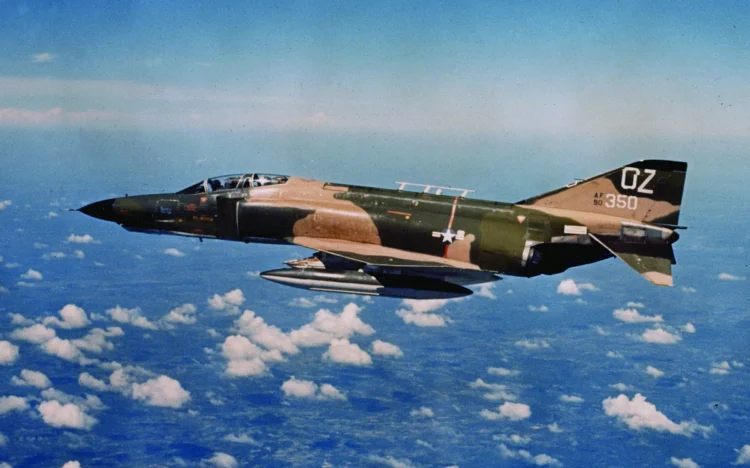 The result was flawless. All eight laser-guided bombs rode the energy beam down, scoring direct hits on the designated aim points. The massive 3,000-pound Fat Alberts detonated with catastrophic force, shattering the reinforced concrete and dropping the entire Hanoi-side span of the Paul Doumer Bridge cleanly into the Red River.
In a matter of minutes, four aircraft and one handmade pod had achieved what thousands of tons of high explosives had failed to do in the preceding years. The bridge that couldn’t be broken was finally severed. It would remain impassable for a year.
The Bridge That Rolling Thunder Never Broke
The validation of the Pave Knife architecture on May 11 triggered an immediate shift in targeting priority. Just two days later, on May 13, 1972, the 8th TFW turned its attention back to the ultimate symbol of American frustration: the Thanh Hoa Bridge.
The Dragon’s Jaw had survived 871 sorties during Operation Rolling Thunder, absorbing hundreds of direct hits from unguided bombs that merely chipped its concrete or dented its steel. It was universally considered the toughest target in North Vietnam.
On the morning of May 13, a strike force of 14 Phantoms from the 8th TFW, equipped with Pave Knife pods, arrived over the Song Ma river. The aircraft carried a mixed payload: fifteen 2,000-pound LGBs, forty-eight 500-pound conventional bombs, and nine 3,000-pound GBU-11 Fat Alberts. Braving an intense wall of 37mm and 57mm flak, the Phantoms designated the target.
The results mirrored the Doumer strike. The precision guidance allowed the massive kinetic energy of the 3,000-pound warheads to be applied directly to the structural weak points of the bridge. The western span of the Dragon’s Jaw was blown completely off its massive concrete abutment, crashing into the river below. In three days, Linebacker’s precision munitions had accomplished what three years of Rolling Thunder mass bombardment could not.
The success at Doumer and Thanh Hoa immediately unchained the strategic planners of the Seventh Air Force. Because LGBs possessed a CEP measured in feet rather than thousands of feet, the rigid targeting constraints imposed to prevent civilian casualties were suddenly lifted. Targets previously off-limits because they resided in heavily populated urban areas or near foreign shipping facilities were now viable. On May 18, F-4s utilized LGBs to surgically dismantle the Uong Bi electric power plant near Haiphong without causing widespread collateral damage. On May 25, the 8th TFW struck the Lang Giai Railroad Bridge deep within the previously restricted Chinese Buffer Zone, dropping the span with zero collateral incidents. The era of precision had fundamentally altered the political and strategic calculus of the air war.
| Fat Albert and the Paveway Family
The precision revolution of 1972 relied on a family of distinct, hastily developed munitions, each attempting to solve the 1,000-foot CEP problem. Paveway I (LGB) The workhorse of the campaign. The Paveway I was not a bomb itself, but a guidance kit retrofitted to standard Mk.84 2,000-pound unguided bombs. It featured a gimbaled laser seeker head and large canard fins that snapped to their maximum deflections (bang-bang guidance) to steer the weapon into the laser reflection. GBU-11 “Fat Albert” Designed specifically for heavy infrastructure like the Thanh Hoa Bridge abutments, the GBU-11 mated the Paveway laser guidance kit to the massive M118 3,000-pound demolition bomb. It was affectionately named “Fat Albert,” with crews known to yell “Fat Albert’s on the way!” upon release. GBU-8 HOBOS (EOGB) An Electro-Optically Guided Bomb that utilized a television camera to lock onto the high-contrast edge of a target, allowing for “fire-and-forget” delivery. While theoretically superior as it did not require continuous laser designation, the HOBOS frequently failed in combat, as the TV seeker regularly lost lock due to North Vietnam’s persistent haze, smoke, and shifting shadows. |
Cutting the Lifeline
The destruction of the Doumer and Thanh Hoa bridges was not merely a symbolic triumph; it yielded immediate, devastating strategic consequences for the North Vietnamese military.
In the spring of 1972, the PAVN was entirely dependent on a massive logistical tether to sustain its mechanized Easter Offensive in South Vietnam. The invasion force required vast quantities of fuel, ammunition, and spare parts for its Soviet-supplied T-54 tanks and 130mm artillery pieces. This materiel arrived via Soviet and neutral shipping in Haiphong harbor, or via rail from the Chinese border, converging at the Hanoi rail yards before traveling south.
Linebacker I severed this tether. With Haiphong harbor choked by the aerial mines of Operation Pocket Money — executed on May 9 by A-6 Intruders and A-7 Corsair IIs — North Vietnam was forced to rely exclusively on its rail network. By dropping the major bridges at Doumer and Thanh Hoa, the U.S. Air Force surgically cut the North Vietnamese rail system into three isolated segments: from the Chinese border to Hanoi, from Hanoi to Thanh Hoa, and from Thanh Hoa to Vinh.
Goods could no longer move in continuous, efficient rail runs. Instead, the North Vietnamese were forced to offload supplies at shattered bridge abutments, load them onto trucks or hand-pushed bicycles, ferry them across the rivers under the cover of darkness using vulnerable pontoon bridges, and reload them onto trains on the opposite bank. This laborious transshipment process created massive logistical bottlenecks, leaving stockpiles exposed to subsequent Alpha strikes.
The strategic effect cascaded down to the battlefields in the south. Starved of fuel and heavy munitions, the momentum of the PAVN invasion ground to a halt. Unable to sustain their mechanized tempo, the North Vietnamese forces were pounded by continuous close air support and B-52 Arc Light strikes. By September 15, 1972, the resupplied Army of the Republic of Vietnam (ARVN) successfully retook the critical city of Quang Tri, effectively breaking the back of the Easter Offensive and forcing Hanoi back to the negotiating table in Paris.
A Revolution With Roots
The legacy of Operation Linebacker I extends far beyond the borders of Vietnam. The tactical necessities birthed by the scarcity of the Pave Knife pods established the foundational doctrine of modern American air power.
Prior to 1972, the prevailing doctrine of the Tactical Air Command centered on multi-role aircraft performing massed, low-altitude unguided deliveries. Linebacker proved that the future belonged to precision and specialization. The complex strike package architecture developed to protect the Pave Knife — integrating dedicated Suppression of Enemy Air Defenses (SEAD) with Wild Weasels, specialized electronic jamming, standoff MiGCAP, and precision strike elements — became the blueprint for the modern Air Expeditionary Wing.
Furthermore, the undeniable success of the LGBs shattered institutional resistance to guided munitions. The empirical data was impossible to ignore: a single aircraft dropping a single guided bomb could achieve the massing effect of dozens of aircraft. This realization validated massive post-war investments in electro-optics, laser targeting, and eventually GPS guidance.
When the United States Air Force deployed to the Middle East in 1991 for Operation Desert Storm, the tactics on display — stealth aircraft dropping laser-guided bombs down the ventilation shafts of Iraqi command bunkers, supported by integrated SEAD and jamming packages — were not born in the Iraqi desert. They were the direct, evolutionary descendants of the desperate, improvised tactics engineered by the 8th Tactical Fighter Wing over the Red River Delta in 1972.
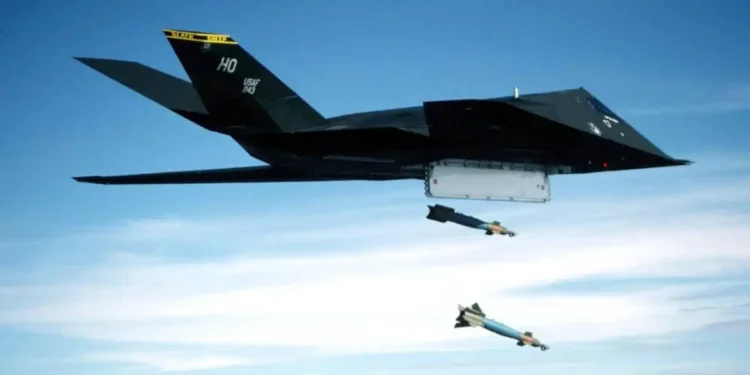 That continuity of doctrine is the truest measure of what happened over Hanoi in the spring of 1972. The enormous support package the pods required was itself a constraint, and the full doctrinal integration of precision strike took years after Linebacker. But the evidence had been gathered, the proof was written in post-strike photography, and no institutional inertia could unsee it.
On the morning of May 11, 1972, as the smoke cleared over the Red River, the twisted steel of the Paul Doumer Bridge lay submerged in the muddy water, a monument to a defunct military doctrine. The destruction of the bridge was not achieved by the sheer weight of industrial might, nor by sending thousands of men into the teeth of enemy anti-aircraft fire. It was achieved by four aircraft, carrying eight bombs, guided by a single, fragile, hand-built pod. In that fleeting moment, the paradigm of modern warfare irreversibly shifted. The era of dumb bombing was dead, buried under the waters of the Red River, and the future of air power had arrived on a beam of laser light.

Key Takeaways
- The Catalyst of Scarcity: A tiny inventory of experimental, handmade Pave Knife targeting pods — never exceeding six in-theater — forced a complete redesign of USAF strike doctrine.
- The Strike Package Paradox: To protect these fragile pods, the USAF built massive, specialized support armadas (jammers, SAM-hunters, chaffers), allowing 278 Linebacker PGM sorties to achieve more than 1,564 unguided Rolling Thunder sorties.
- Proof of Concept: The surgical destruction of the heavily defended Paul Doumer and Thanh Hoa bridges in May 1972 validated laser-guided bomb (LGB) technology after years of costly failures with unguided munitions.
- Strategic Strangulation: Precision bridge kills severed the North Vietnamese rail system into three isolated segments, crippling the logistics of the 1972 Easter Offensive.
- Doctrinal Legacy: The specialized strike architectures and precision prioritization born in Linebacker I laid the direct foundational blueprint for the 1991 Gulf War.