


A decade after its debut, Eduard’s Mk.IXe still outperforms newer competitors through superior engineering and dimensional accuracy.
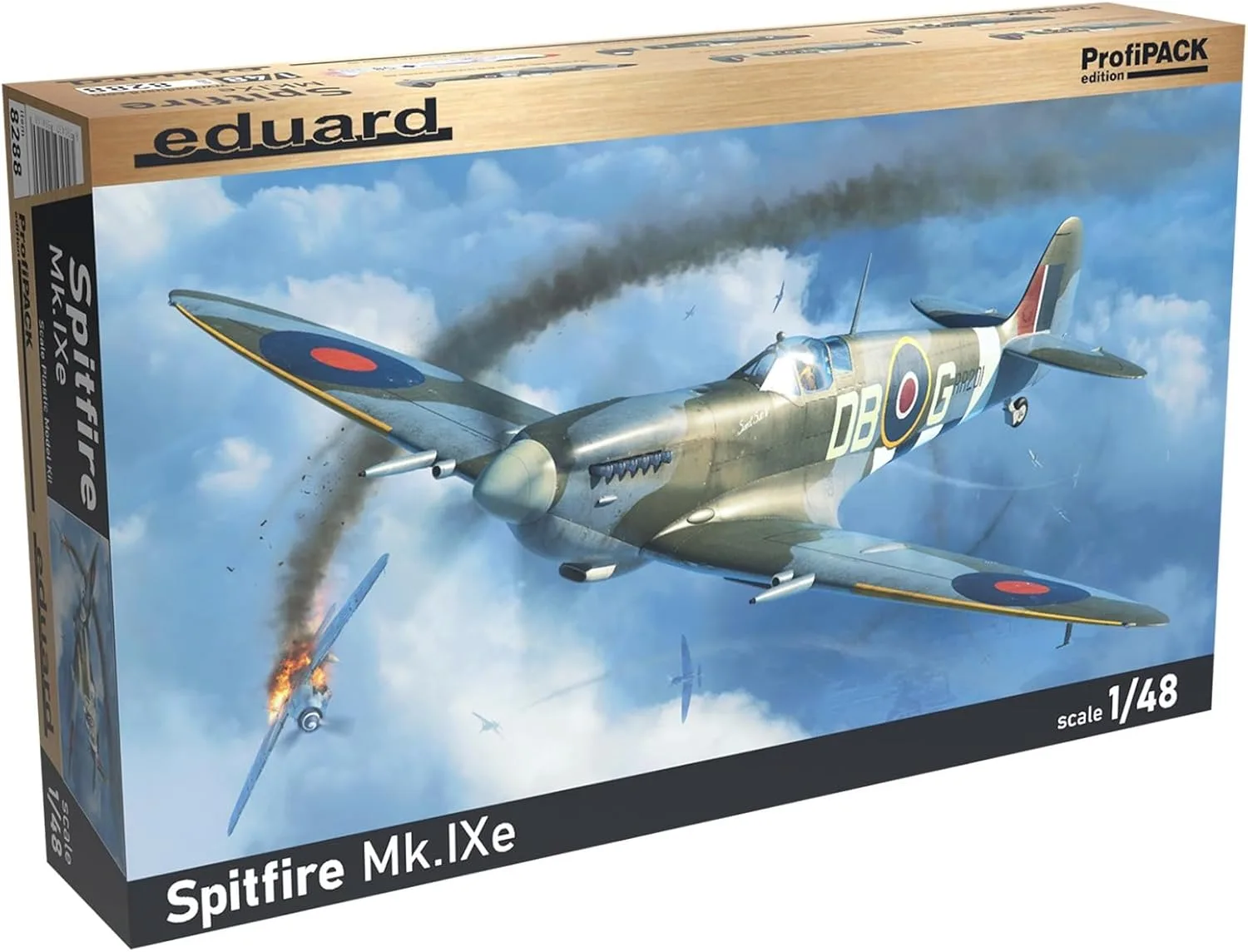
Kit Specifications
- Kit number: 8288
- Manufacturer: Eduard
- Scale: 1/48
- Contents: 193 grey plastic parts; 14 clear parts; color photo-etched fret; self-adhesive die-cut masking sheet
- Skill Level: Intermediate to Advanced
The Spitfire Mk.IX remains one of aviation history’s most significant fighters. Born from tactical necessity when the Focke-Wulf Fw 190 appeared over the Channel Front in September 1941, the Mk.IX mated the Merlin 61 engine to the existing Mk.V airframe. What started as an interim solution became the most numerous Spitfire variant, with more than 7,000 delivered to Allied air forces.
The Mk.IXe arrived in late 1944 with a strengthened wing and revised armament that replaced four .303 machine guns with two .50 caliber heavy machine guns, while standardizing two 20mm cannon in the outboard bays. Eduard’s 2025 reissue consistently earns its place among the best model airplane kits in the 1/48 scale category—and for good reason: the original 2013 release set benchmarks for accurate dimensions, outstanding surface detail, and thoughtful engineering that anticipated builder needs before problems arose.
The defining feature here is the insert-free “e” wing. Unlike earlier variants that required separate gun bay blisters, Eduard molds the outboard narrow gun bulges directly into the top wing halves, with appropriate shell ejector ports similarly integrated on the bottom surfaces. This eliminates fit issues and preserves the crisp panel lines that characterize Eduard’s tooling.
Pros & Cons
Pros:
- Accurate fuselage and wing dimensions verified against historical documentation
- Outstanding surface features, including crisply recessed panels and subtle rivet lines where appropriate
- Color photo-etched parts reduce cockpit painting workload
- Seven comprehensive marking options versus competitors’ typical two or three schemes
- Proven production quality maintained across more than ten years
- Useful options for alternative armament and rudders
Cons:
- Premium pricing compared to basic Airfix or Hasegawa releases
- Photo-etch components increase complexity for builders uncomfortable with brass parts
- No significant engineering updates since 2013 tooling
- Reissue offers no new content beyond updated marking options
Why You’ll Simply Love This Kit
Eduard engineered this kit to eliminate the frustrations that plague other 1/48 scale Spitfires. The fuselage halves align precisely without the shimming or filling that characterized the Hasegawa kit’s notoriously short fuselage. Unlike Airfix’s thick moldings and slab-like cannon bulges, Eduard’s surface detail remains sharp and to scale. Parts only fit one way, guided by positive locators that prevent assembly errors.
The color photo-etched instrument panel transforms cockpit construction. Instead of hand-painting dozens of tiny gauge faces, you’re applying pre-colored brass that settles into the raised detail with a touch of canopy glue. The effect rivals resin cockpit sets costing half the kit’s price. Similarly, the molded gun bulges on the “e” wing mean you’re not wrestling with separate inserts that never quite sit flush—a problem that plagued ICM’s over-engineered approach.
Seven marking schemes open remarkable possibilities. Build Richard Audet’s RR201 from No. 411 Squadron—the aircraft he flew during his legendary five-kill mission over Germany in December 1944. Or tackle Wing Commander Rolf Berg’s PV181 with its distinctive Norwegian national markings that caused such controversy with RAF Supreme Command. Group Captain Douglas Bader’s unusual Medium Sea Grey and Dark Green scheme offers a rare night fighter-style finish, while the Israeli 105 Tayeset aircraft provides an overall silver alternative. Each scheme tells a compelling story and offers unique visual appeal.
Construction Experience Analysis
Cockpit and Interior
The 193 grey plastic parts begin with a well-detailed cockpit that shows through the generous clear canopy. The color photo-etched instrument panel requires careful handling—anneal the brass with brief heat exposure to make it more pliable, then attach it with PVA-based canopy glue to avoid the fogging that cyanoacrylate vapors can cause. The sidewall details and seat construction follow logically, with parts keyed to fit only in their correct positions. The completed cockpit settles into the fuselage halves without drama, though you’ll want to test-fit before cementing to ensure the sidewalls don’t bind.
Fuselage Assembly
This is where Eduard’s engineering superiority becomes evident. Unlike Hasegawa’s dimensionally short fuselage or ICM’s skinny cross-section, Eduard’s halves scale out perfectly to the 31-foot, 1-inch original. The kit avoids ICM’s multi-piece nose complexity by molding engine panels into the fuselage halves. Alignment is positive, guided by substantial locating pins. Panel lines meet across the centerline seam without offset. I needed minimal filler along the spine—a small bead of liquid cement drawn along the joint handled it. This stands in stark contrast to the extensive putty work required on the Airfix kit’s thick moldings.
Wing Construction
The insert-free “e” wing is this kit’s technical highlight. The outboard gun bulges flow naturally from the wing surface, eliminating the fit gaps and alignment headaches that separate inserts create. Shell ejector ports are crisply molded on the lower surfaces. The wing-to-fuselage join proved tight—so tight that some builders report minor gaps at the wing root. A professional solution involves inserting a small spreader bar of scrap sprue inside the fuselage between the cockpit and firewall, pushing the walls outward fractionally for a flush fit without obscuring rivet detail with putty.
Control surfaces are separate, though you’ll need to modify them if you want to pose flaps or ailerons deflected. The kit includes separate wingtips, allowing both standard elliptical and clipped configurations depending on your chosen scheme.
Surface Detail Quality
Eduard’s panel lines remain the 1/48 scale benchmark. They’re crisp without being trench-like, subtle enough to look correct under paint but deep enough to accept pin washes effectively. Rivet detail appears where appropriate—around access panels and stressed areas—without the overdone “golf ball” effect that mars some kits. The plastic is firm enough to hold detail through repeated handling without the soft, mushy feel of some Eastern European manufacturers. Ejector pin marks are intelligently placed on non-visible surfaces or designed to be trapped between assembled parts.
Configuration Options and Value Analysis
Parts Options Breakdown
Eduard supplies both pointed and rounded rudders. The pointed version appeared mid-production as an aerodynamic modification to counter the Merlin engine’s increased torque, so verify which type your chosen aircraft carried. Bomb loadout parts allow operational configuration, while a blank cannon fairing accommodates the Danish marking option that lacked outboard cannons.
These options align intelligently with the seven marking schemes. Richard Audet’s RR201 requires the rounded rudder and standard wingtips for the December 1944 timeframe, while Rolf Berg’s PV181 needs the pointed rudder. The engineering allows easy modification for variants not explicitly covered—the modular approach means you’re not locked into a single configuration.
Marking Schemes Value
Seven schemes deliver exceptional variety:
- RR201, F/Lt Richard Audet/John Boyle, No. 411 Squadron (Netherlands, December 1944) – Day Fighter Scheme
- RR201, F/Lt John Boyle, No. 411 Squadron (Netherlands, February-April 1945) – Same aircraft, later timeframe
- PV181, W/Cdr Rolf Berg, No. 132 Wing (Netherlands, winter 1944) – Norwegian livery with pointed rudder
- RK889, S/Ldr Otmar Kučera, No. 313 Squadron (RAF Manston, May-July 1945) – Czech livery, pointed rudder
- TE517, S/Ldr Kučera, No. 313 Squadron (RAF Manston, August 1945) – Day Fighter Scheme
- RK917, G/Cpt Douglas Bader (RAF North Weald, September 1945) – Medium Sea Grey overall with Dark Green disruption, pointed rudder
- 2003 (ex TE531), 105 Tayeset (Ramat David AB, Israel, September 1953) – Overall silver, pointed rudder
A second decal sheet supplies comprehensive stenciling. This variety justifies the premium price when competitors typically offer two or three schemes and charge separately for aftermarket decal sets.
Who Should Buy It
This kit rewards intermediate to advanced modelers comfortable with photo-etched components and seeking dimensional accuracy. If you’re building your definitive 1/48 scale Spitfire Mk.IXe and want engineering that eliminates common fit problems, Eduard delivers. Spitfire enthusiasts building multiple variants will appreciate the scheme variety, while modelers valuing proven engineering over latest releases will find the decade-old tooling still outperforms newer competitors.
Consider alternatives if you’re a first-time builder—the photo-etch components and premium detail level may frustrate beginners better served by Airfix’s simpler approach. Budget-conscious modelers might opt for Hasegawa despite its dimensional shortcomings, accepting the shorter fuselage as a trade-off for lower cost. If you specifically need features not covered in the Mk.IXe variant or prefer the latest tooling innovations regardless of accuracy, other options exist.

Key Takeaways
- Eduard’s 1/48 scale Spitfire Mk.IXe remains the dimensional accuracy benchmark more than a decade after release.
- Insert-free “e” wing eliminates common fit problems while preserving exceptional surface detail.
- Seven comprehensive marking schemes deliver better value than purchasing multiple single-option kits.
- Photo-etched components and premium engineering suit intermediate to advanced builders seeking accuracy.
- Still highly recommended for anyone building the definitive 1/48 scale Mk.IXe.