

We skipped the spec sheet and took it to the field. The SAFE tech is real. The 5 mph wind ceiling is also real. Here’s the honest verdict.
Learning to fly RC aircraft used to require one of two things: a veteran pilot connected to your transmitter via a buddy-box cable, or the willingness to demolish your first airplane on the maiden flight and rebuild from the wreckage. For generations of potential hobbyists, the second outcome happened far more often than the first — and many of them never came back to the flight line.
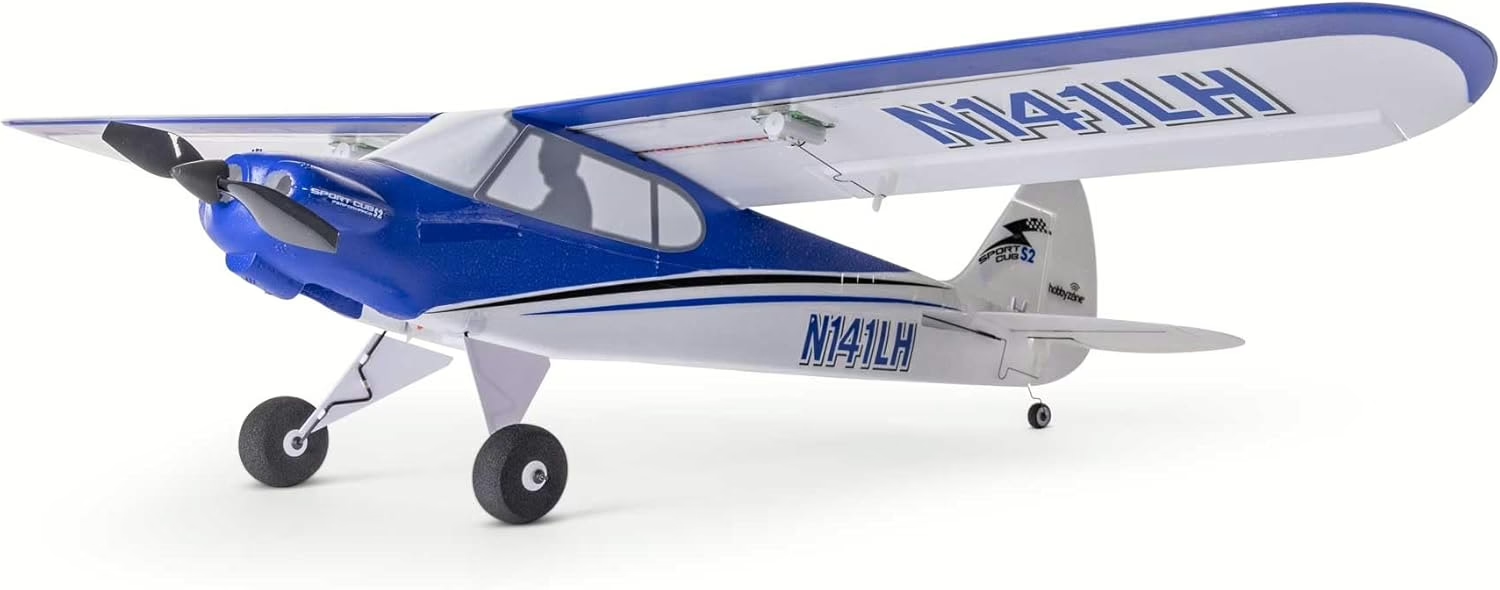
The HobbyZone Sport Cub S 2 RTF (HBZ444000) is Horizon Hobby’s most direct answer to that problem. This Skill Level 1 micro trainer combines progressive electronic stabilization with a genuine all-in-one ready-to-fly package, targeting first-time pilots who want to learn in structured stages without betting hundreds of dollars on a learning curve that has historically eaten beginners alive. We ran it through a thorough real-world utility test to find out whether the engineering actually delivers.
Brief Overview
What It Is
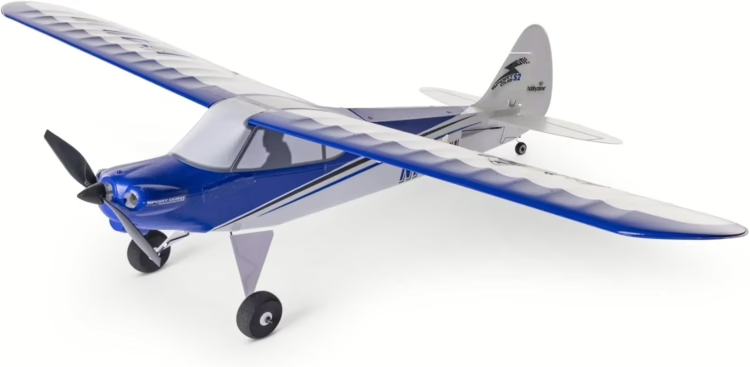
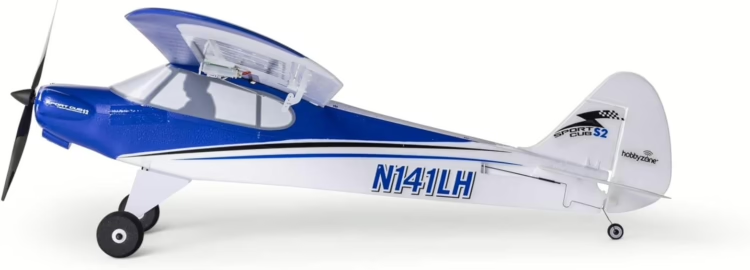
The Sport Cub S 2 is a Skill Level 1 RTF aircraft from HobbyZone, a brand under the Horizon Hobby umbrella. Item number HBZ444000. It ships as a 100% factory-assembled ultra-micro model: EPS foam airframe, motor installed, control surfaces hinged, pushrods connected, electronics bound and ready. Wingspan is 24.3 inches (617mm); total fuselage length is 16.3 inches (414mm). Nothing requires glue, soldering, or mechanical adjustment before the first flight.
Target Audience
This is a first-RC-airplane purchase. The RTF designation means the Spektrum MLP6DSM 6-channel 2.4GHz DSMX transmitter — four AA batteries included — an E-flite 150mAh 1S LiPo flight battery, and a USB charger are all inside the box. Day 1 flying is entirely achievable for someone who has never held an RC transmitter before.
Key Features
Three features define the Sport Cub S 2’s value to a beginner. Horizon Hobby’s SAFE (Sensor Assisted Flight Envelope) technology imposes hard pitch and roll angle limits in Beginner Mode and activates automatic self-leveling the moment the pilot releases the control sticks — the plane rights itself without any input. The Panic Recovery trigger, mounted on the transmitter’s right shoulder button, overrides all stick inputs instantaneously and returns the aircraft to stable, level flight from any attitude, including fully inverted. Spektrum Smart Telemetry streams real-time battery voltage to a multi-color LED on the transmitter face: solid green (healthy), solid yellow (prepare to land), solid red (critically low), and flashing red paired with an audible alarm when Low Voltage Cutoff is imminent — cutting motor power while keeping the servos live for a controlled emergency landing.
Quick Specs
| Spec | Detail |
| Wingspan | 24.3 in. (617mm) |
| Length | 16.3 in. (414mm) |
| Flying Weight | 2.1 oz. (61g) |
| Motor | 8mm brushed |
| Battery | 1S 150mAh LiPo |
| Flight Time | 6–9 min. (stock) |
| Radio | Spektrum MLP6DSM 6-ch 2.4GHz DSMX |
| Skill Level | 1 (Beginner) |
Pros & Cons
Pros
- SAFE self-leveling and AS3X stabilization genuinely work. In Beginner Mode, releasing the sticks returns the aircraft to wings-level automatically. The overcorrection spiral that destroys most first flights simply cannot happen.
- True RTF value, simulator included. Transmitter, flight battery, USB charger, and a RealFlight Trainer Edition trial key offering up to 100 minutes of virtual flight on accurate physics models are all in the box.
- No FAA registration required. At 61 grams of flying weight, the Sport Cub S 2 falls well under the federal 250-gram threshold — no paperwork, no annual fee.
- Panic Recovery button works from any attitude. Including fully inverted, regardless of what the pilot’s sticks are doing at the time.
- Three-stage flight mode progression. Beginner, Intermediate, and Experienced modes build a structured curriculum rather than a single, unadjusted flight profile.
Cons
- Hard 5 mph wind ceiling. Above that threshold, the 61-gram airframe cannot hold position. Calm air is not a preference — it’s a hard operational requirement.
- Six to nine minutes of stock flight time. A frustratingly narrow practice window for building the muscle memory that learning to fly demands.
- Brushed motor and gearbox have a finite lifespan. Repeated nose strikes will eventually require propeller shaft and gearbox replacement.
- Tail-dragger wheels snag on rough grass. For most beginners operating at public parks, hand-launches are the only practical alternative.
Performance & Real-World Flight Experience
First Flight
The Sport Cub S 2’s maiden flight is categorically different from what this hobby delivered even five years ago. With the mode switch in Beginner, the SAFE system’s hard angle limits physically prevent the aircraft from rolling past a safe bank or pushing into a steep dive. Pilots who panic and spike a stick — historically the single most common cause of first-flight wreckage — find that the plane will not comply with the destructive input. Release the sticks entirely and the SAFE system’s self-leveling kicks in, restoring stable, wings-level flight within seconds. That autonomous recovery, witnessed for the first time by a complete novice, is exactly what holds beginners in the hobby.
One pre-flight ritual the manual undersells: when connecting the battery, the aircraft must sit perfectly level and completely motionless on a flat surface for five seconds while the gyroscopes calibrate to gravity. Holding the plane at an angle or letting wind jostle it during this initialization window causes erratic flight behavior or binding failures. Community users have traced puzzling bind failures directly to this single overlooked step.
Flight Characteristics
In dead-calm air, the Sport Cub S 2 is a composed, forgiving aircraft. Its high-wing configuration and heavily cambered airfoil generate substantial lift at slow airspeeds, keeping the flight pace comfortable and reaction times manageable. Moving to Intermediate Mode — which expands the allowable bank and pitch limits to approximately 45 degrees while deactivating self-leveling — forces the pilot to manually recover from banks and dives without electronic assistance. That friction is intentional: the coordination habits built here transfer directly to any larger aircraft in the pilot’s future. Experienced Mode removes all envelope restrictions, opening up loops, barrel rolls, and sustained inverted flight, though the cambered wing demands significant forward elevator pressure and higher airspeed to hold altitude upside down.
Wind remains the defining operational constraint. At 61 grams, the airframe carries virtually no momentum to push through moving air. Real-world testing confirms that anything above 5 mph effectively reduces the Sport Cub S 2 to a weather vane — a strong gust can push it backward faster than the motor can counter it. Early morning, pre-wind conditions are not optional.
Durability & Build Quality
Ultra-low mass is the primary crash-survival mechanism. At 61 grams, low-speed collisions with trees, fences, or thick grass generate so little kinetic energy that the airframe frequently bounces off undamaged. Field repairs are straightforward with foam-safe CA glue or clear packing tape. The mechanical weak points are the 8mm brushed motor, plastic propeller shaft, and nylon reduction gears — all of which wear down from repeated nose-first ground strikes.
One maintenance note that bears emphasis: the motor connector has three pin holes but only uses two pins. If seated with the vacant hole on the right instead of the left, the motor spins to full RPM the instant the battery connects — a genuine laceration hazard. Check connector orientation every single time after performing any maintenance work on the airframe. Horizon Hobby maintains an online replacement parts supply chain for the necessary components, though local hobby shop stock for these specific micro parts can vary.
Learning Curve & Training Value
The RealFlight Trainer Edition trial bundled in the box — accessed by connecting the included Spektrum transmitter to a Windows PC via USB-C cable — provides up to 100 minutes of virtual flight on accurate physics models, including the exact Sport Cub S 2 airframe. Built-in Virtual Flight Instructor lessons walk users through takeoff, basic circuits, and landing procedures. That risk-free practice time, combined with Beginner Mode’s self-leveling, meaningfully compresses the path from unboxing to a confident solo circuit. Pilots who want longer uninterrupted sessions can install a community-standard 500mAh 1S battery using widely available 3D-printed brackets, stretching flight time from 6–9 minutes to 20–25 minutes. The modification requires careful battery positioning to maintain the original CG balance point — shift the pack without checking the balance and the plane goes nose-heavy.
Why You’ll Simply Love This Plane
There’s a specific moment every Sport Cub S 2 pilot eventually reaches, usually around the third or fourth session. You’re in Beginner Mode, making slow, deliberate circuits over a quiet field in the early morning. The AS3X system is making hundreds of invisible micro-corrections per second. SAFE is holding the angle limits in the background. The telemetry LED glows solid green. And for the first time in this hobby, the controls feel intuitive rather than threatening — you’re steering, not reacting.
The progression from that first composed Beginner Mode circuit to unlocking Intermediate Mode carries a genuine sense of earned skill. You start flying your own recoveries, reading the wind, managing throttle through turns. When you eventually switch to Experienced Mode and nail a clean loop — the wing arcing overhead before the nose settles back to level — the payoff is real. Getting there without destroying the airframe and without a veteran holding a buddy-box cable on the field makes the Sport Cub S 2 feel like it genuinely delivered on what it promised.
Who Should Buy It
- The absolute first-timer with zero RC experience who wants to self-teach. The financial exposure is manageable, and SAFE’s self-leveling electronically performs the protective role that historically required a veteran pilot and a buddy-box cable on the field.
- The space-constrained hobbyist limited to a suburban backyard, cul-de-sac, or indoor gymnasium. The Sport Cub S 2’s 24.3-inch wingspan operates comfortably in spaces where a 1.1m trainer would create genuine safety concerns.
- The budget-conscious buyer who wants everything in one box — transmitter, battery, charger, and simulator trial — without navigating the piecemeal purchase landscape.
Who should look elsewhere: If your local conditions regularly exceed 5 mph of wind, the extra money buys the AeroScout S 2 — a 3S brushless, pusher-prop trainer with tricycle landing gear and the mass to handle those conditions with authority. Pilots flying exclusively from rough, uncut grass fields will find the tail-dragger setup a constant source of frustration; a tricycle-gear model is the better operational fit. Intermediate pilots expecting brushless power response or serious aerobatic capability will hit the Sport Cub S 2’s ceiling quickly. Those drawn to a scale bush-plane experience with real wind penetration should look to the Carbon Cub S 2 — but treat it as a second aircraft rather than a first.

Key Takeaways
- The Sport Cub S 2 RTF is a complete Skill Level 1 trainer with SAFE technology, AS3X stabilization, and a Panic Recovery trigger that functionally replaces the buddy-box mentor historically required for safe first flights.
- At 61 grams, it falls below the FAA’s 250g registration threshold and survives low-speed impacts well — but anything above 5 mph wind grounds it. Calm conditions are mandatory.
- Stock flight time runs just 6–9 minutes; the community 500mAh upgrade extends sessions to 20–25 minutes but demands careful CG management.
- Space-constrained, budget-conscious beginners get the strongest return on investment here. Pilots flying in consistent wind should put some extra dollars into the AeroScout S 2 instead.