


At its price point, the Revell Corsair lets you drill out gun barrels, scribe panel lines, and botch your first canopy install without a shred of guilt. Here’s why that matters.

The Vought F4U-4 Corsair is one of the most recognizable silhouettes in naval aviation history, and it continues to hold a powerful grip on the imagination of U.S. scale modelers. For newcomers navigating the crowded landscape of the best model airplane kits, choosing the right Corsair can mean the difference between a rewarding weekend project and a frustrating remediation marathon. The Revell 1/48 Corsair F4U-4 (kit no. 85-5248) sits squarely in that dilemma. Originally tooled in 1963, it banks on nostalgia, affordability, and a genuinely impressive decal sheet to compete in a segment where modern engineering increasingly sets the bar. Before a beginner commits to this kit, the honest question isn’t whether the box art looks good—it’s whether the plastic inside can realistically support a satisfying build. That’s exactly what this review examines.
Brief Overview
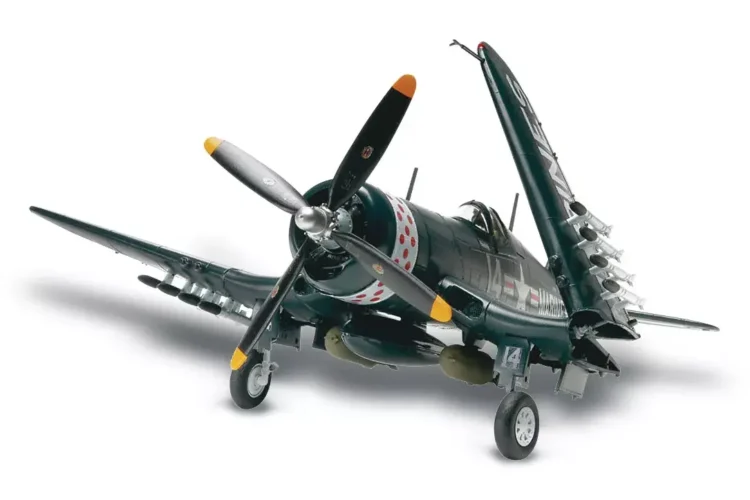
Revell’s kit 85-5248 packages 75 light gray and clear injection-molded parts into a box that builds a 1/48 scale Corsair measuring 8 inches in length with a 10.5-inch wingspan. Ordnance options are generous for the price tier: three external drop tanks, two 1,000-pound bombs, and eight High Velocity Aircraft Rockets (HVARs) are included. The kit’s “interactive” features—folding wings and retractable landing gear—were engineering novelties in 1963 and remain the source of most of the kit’s structural headaches today.
The plastic quality reflects its age honestly. Thick runner attachment gates, prominent flash, and raised panel lines characterize the sprues. The instruction manual is vague on the articulating mechanisms, leaving builders to work out alignment through trial, error, and intuition. Where the kit truly rises above its limitations is the decal sheet: premium waterslide markings for two storied Korean War Marine Corps units—VMF-214 “Black Sheep” aboard the USS Sicily (1951) and VMA-332 “Polka Dots” aboard the USS Bairoko (1953)—are included, and they perform exceptionally well. This is the kit’s single most compelling selling point, and for builders specifically hunting those markings, it shifts the value calculation considerably.
👉 Check the current price and availability on Amazon
The Build Experience: A Beginner’s Reality Check
Strap in. The Revell F4U-4 does not hide what it is at the workbench, and beginners expecting the intuitive, peg-and-slot confidence of a modern kit will hit a wall early.
The fundamental problem stems from the kit’s legacy “action features.” Those folding wings and retractable landing gear mechanisms—designed for playability in an era when plastic models doubled as toys—gut the structural integrity of the finished model. Building the wings in the extended, flight-ready position exposes massive gaps at the fold joints that demand aggressive application of putty, extensive sanding, and re-scribing of panel detail. For most builders, the practical solution is to commit early: flood the hinge joints with thin cyanoacrylate (CA) glue, let capillary action pull the adhesive deep into the joint, and permanently lock the wings flat. This transforms a structural liability into a manageable gap-filling exercise.
The fuselage halves compound the frustration. Unlike modern injection-molded kits with precise locating pins, these halves rely on the builder’s eye and patience for alignment. Once the wing assembly is mated to the lower fuselage, a noticeable step appears at the wing root that requires heavy filler and careful reshaping to preserve the aerodynamic profile. The one-piece clear canopy doesn’t sit flush against the fuselage spine either, creating a visible ledge that needs deliberate remediation—whether through a gloss acrylic dip to improve clarity and seal the joint, or replacement with a vac-form alternative.
Other nuisances accumulate. Landing gear doors and wheel wells lack scale depth. Ejector pin marks dot the interior surfaces and must be scraped clean with a hobby knife. Perhaps most tellingly, a molded-in 1963 copyright stamp on the underside of the port wing must be sanded completely flat before painting. The low part count—75 pieces—implies a quick build, but the reality is the opposite: achieving a clean, seamless finish here is genuinely more labor-intensive than assembling a well-engineered modern kit with twice the parts.
This is not a shake-and-bake project. It is a workbench skills course disguised as a model kit.
Where the Revell 1/48 Corsair F4U-4 Really Shines
Despite its age, this kit earns its keep in two areas that matter: finishing options and historical character.
The decal sheet is the headline act. Both the VMF-214 “Black Sheep” and VMA-332 “Polka Dots” markings are high-quality waterslide transfers that respond flawlessly to setting solutions—Micro Set and Micro Sol perform exactly as intended, chemically bonding the decal film over the kit’s raised surface details without silvering. In the context of the 1/48 F4U-4 market, where truly definitive markings for these specific Korean War squadrons are scarce, the decal sheet alone justifies serious consideration of this kit.
Visually, the Corsair’s defining character also translates well despite the 1963 engineering. When painted in the correct overall Glossy Sea Blue (FS 15042) finish and fitted with the VMA-332 polka-dot cowl or the VMF-214 “Black Sheep” markings, the finished model carries genuine shelf presence. The inverted gull-wing silhouette—the Corsair’s most recognizable feature, born from the need to clear that massive 13-foot, 4-inch Hydromatic propeller—is captured with a degree of accuracy that rewards the builder’s investment of remediation time.
For modelers approaching this kit as a practice canvas for seam filling, puttying, and panel line scribing, there is also a secondary satisfaction: the skills developed on this inexpensive platform transfer directly to more demanding projects. It is a low-stakes classroom with a high-impact subject.

👉 Check the current price and availability on Amazon
The Value-to-Performance Ratio
The Revell F4U-4 occupies a uniquely defensible position in the 1/48 Corsair market—not because it is the best kit, but because no one has produced a definitively better F4U-4 variant at any price point.
Tamiya’s celebrated 1/48 Corsair series covers the F4U-1, F4U-1A, and F4U-1D with their trademark precision, but Tamiya has never released a dedicated F4U-4 variant. Builders seeking that specific subtype using a Tamiya base must source expensive aftermarket resin conversion sets from suppliers like CMK or Missing Link Models, and those conversions are notoriously difficult to fit around the cowling and flap areas. The Hasegawa (ex-Mania) F4U-4 offers accurate overall shape but shares the Revell kit’s raised panel lines and adds a complex multi-piece cowling assembly that creates its own alignment headaches. HobbyBoss’s 2012 tooling brought recessed panel lines and a detailed R-2800 engine, but severe proportional inaccuracies around the cowling and wing roots—the result of a shared core mold stretched across ten Corsair variants—compromise the final result. The Academy F4U-4B is largely dismissed by experienced modelers due to a fuselage that’s molded noticeably too wide from the cockpit forward, distorting the frontal profile beyond practical correction.
Against that competitive landscape, the Revell kit’s affordability and superior decal options make it a rational, if demanding, choice for builders specifically targeting a Korean War F4U-4 build.
Pros & Cons
Pros
- Exceptional decals: Premium waterslide markings for VMF-214 “Black Sheep” and VMA-332 “Polka Dots” are the best available for this subject at this price point.
- Accurate silhouette: The inverted gull-wing profile and overall shape are captured with solid fidelity.
- Highly affordable: One of the least expensive entry points into 1/48 scale Korean War fighter aircraft.
- Skills canvas: Ideal low-cost platform for practicing seam filling, puttying, and surface scribing.
Cons
- Legacy action features are structural liabilities: Folding wings and retractable gear create massive gaps that require permanent bonding and extensive gap-filling.
- Outdated surface detail: Raised panel lines, a thick canopy with poor fit, and prominent ejector pin marks demand significant remediation.
- Not beginner-friendly in practice: Despite the low part count, achieving a clean finish requires intermediate-to-advanced skills.
- 1963 copyright stamp: A molded copyright mark on the port wing underside must be sanded flat—a dispiriting discovery.
Who Should Buy It
This kit has a clear and specific audience—and an equally clear list of buyers who should look elsewhere.
Buy it if: You are specifically building a 1/48 Korean War F4U-4 and want the VMF-214 or VMA-332 markings without sourcing expensive aftermarket sheets. Buy it if you are a beginner willing to treat the build as a workbench education—an affordable platform where gap-filling mistakes and scribing errors cost little. Buy it if you have a nostalgic attachment to this classic 1963 Monogram tooling and want to see what patient, disciplined remediation can achieve.
Skip it if: You are a true beginner expecting a relaxed weekend assembly. Skip it if your goal is a competition-standard replica without the time or interest to invest in surface correction. For those priorities, no perfect F4U-4 solution currently exists at any price, but a Tamiya F4U-1D with an aftermarket resin conversion—despite its challenges—will yield a superior engineering baseline.
Final Verdict
Should you buy the Revell 1/48 Corsair F4U-4? For beginners chasing a specific Korean War subject on a tight budget, the answer is a qualified yes—with eyes fully open. This kit will not fall together. It demands gap-filling around the wing fold joints, filler at the wing root step, canopy remediation, and the patience to sand away a 63-year-old copyright stamp before the first coat of Glossy Sea Blue goes down. But for a builder willing to commit that effort—or for anyone specifically seeking VMF-214 “Black Sheep” or VMA-332 “Polka Dots” markings—the Revell F4U-4 remains a surprisingly viable canvas. It is a historical artifact of the hobby that rewards skill and punishes impatience. Know which you bring to the bench before you buy.

Key Takeaways
- Mandatory remediation: The 1963 tooling requires extensive gap-filling at the wing fold joints, wing root step, and canopy line—this is not a quick build.
- Outstanding decals: VMF-214 “Black Sheep” and VMA-332 “Polka Dots” waterslide markings are the kit’s strongest asset and perform flawlessly with setting solutions.
- Budget entry point: One of the most affordable 1/48 Korean War fighter kits available, with genuine shelf presence once finished.
- No modern F4U-4 rival: No manufacturer currently produces a definitively better, correctly shaped F4U-4 at any price—keeping this kit relevant despite its age.
- Skills, not shelf ease: Best suited to intermediate builders or beginners specifically seeking a practice canvas for fundamental modeling techniques.