


Ready to fly? Not quite. You still need a battery, a charger and at least 1,300 feet of clear space. Here’s what the manual and the flight-test record say before you buy.
Quick Verdict
The HobbyZone Carbon Cub S 2 1.3m RTF is a strong choice for a new pilot who has a large open field, wants a scale bush plane and will use its training aids. Three SAFE (Sensor Assisted Flight Envelope) modes and Panic Recovery let one airframe grow with you, from self-leveled training to unrestricted pitch and bank. That progression earns it a look among the best RC planes for scale-minded learners.
- The box is incomplete. The battery and charger cost extra.
- The field is big. Horizon’s manual calls for at least 1,300 feet of clear space in every direction.
- It’s a taildragger. Ground handling can ask more of a beginner than a tricycle-gear trainer does.
Choose the E-flite Apprentice STS if simple ground steering matters more than scale looks. The closest named flight test covers the older S+, not this package, so read on to see which promises are documented and which remain promises.
Brief Overview
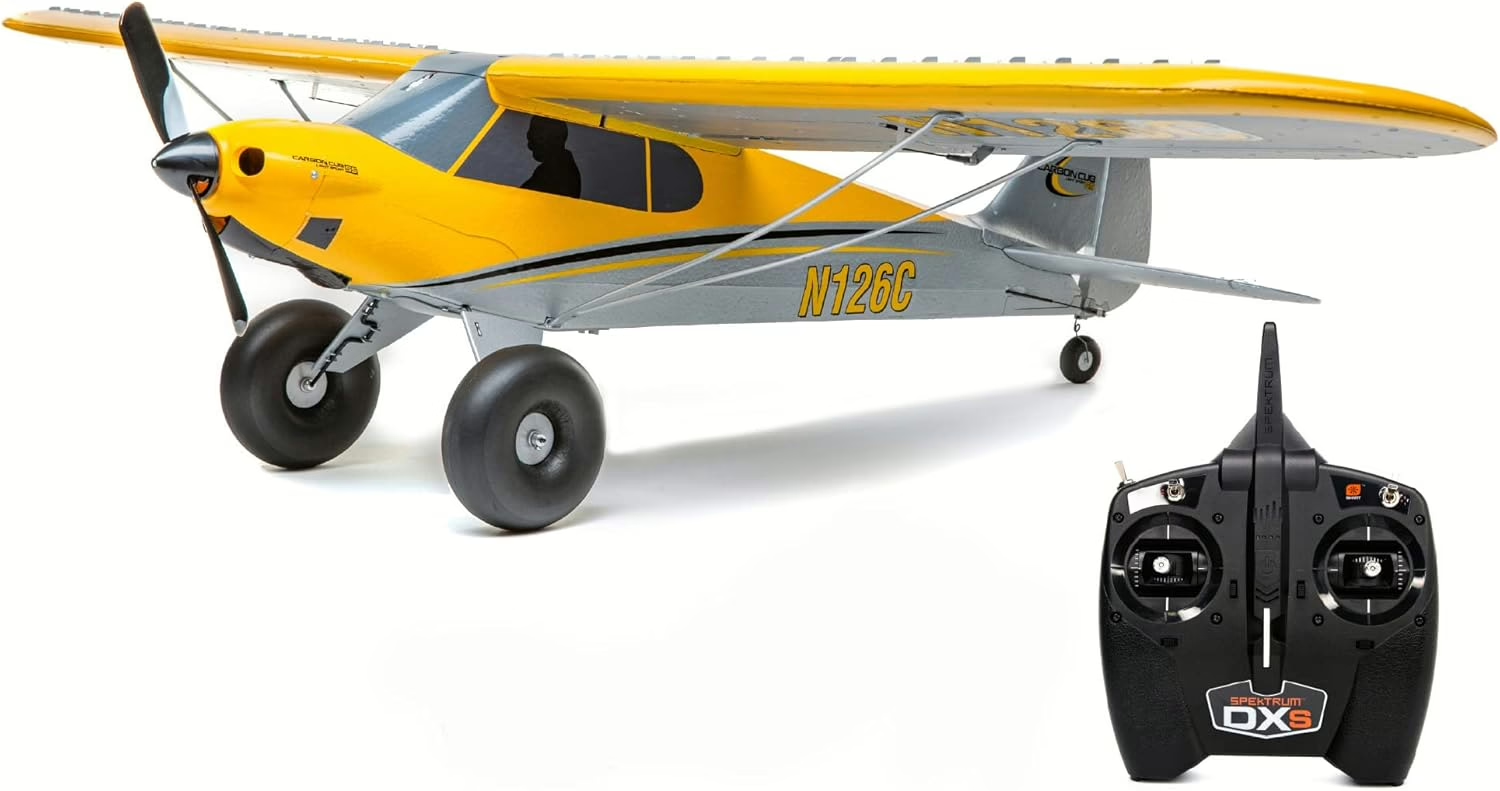
What it is. Horizon Hobby’s HobbyZone Carbon Cub S 2 1.3m RTF Basic (HBZ320001) is a 51-inch electric scale trainer in EPO (expanded polyolefin) foam, based on the full-size CubCrafters Carbon Cub. “Basic” is the word to watch. The radio and electronics come in the box; the flight battery and charger don’t.
Horizon lists the older complete RTF (HBZ32000), which included a 2200mAh battery and S120 charger, as discontinued. The BNF (Bind-N-Fly) Basic (HBZ32500) also needs a transmitter.
Who it’s for. Horizon rates it Skill Level 1. It suits first-time pilots, returning pilots and park flyers moving up to a club field, and it belongs among the best RC planes for beginners only if you can reach a suitable site.
Cool features
- SAFE and Panic Recovery: Beginner mode limits pitch and bank and self-levels when you release the sticks, a direct answer to over-control. Panic Recovery helps when you lose orientation, given enough height and a clear path.
- Tundra tires and steerable tailwheel: These widen your surface options, though results depend on the surface.
- DXS battery LEDs: Four LEDs give an approximate flight-pack reading with compatible Smart electronics, a second cue beside your timer.
- Upgrade path: Optional GPS, a Landing Assist Sensor (LAS) and floats add capability at added cost.
AT A GLANCE
| Spec | Detail |
| Model | Carbon Cub S 2 1.3m RTF Basic (HBZ320001) |
| Manufacturer | HobbyZone (Horizon Hobby, LLC) |
| Wingspan / length | 51 in. / 34 in. |
| Flying weight | 2.8 lb. (1,285 g) with 3S 2200mAh pack, per manual; retail specs list 32.2 oz. (913 g) without battery |
| Motor | E-flite 480 brushless outrunner, 960Kv (EFLM480BL) |
| ESC | E-flite 30A telemetry-capable (EFLA1030FB) |
| Prop | E-flite 9 x 6 (EFLP09060) |
| Power req’d | 3S 11.1V 2200mAh IC3 LiPo, compatible charger |
| Radio | Spektrum DXS 2.4GHz DSMX (included) |
| Pilot skill level | Skill Level 1 |
| Flight timer | 6–8 minutes (manual’s initial setting) |
If a big field and a separate battery fit your plans, check current pricing and availability of the HobbyZone Carbon Cub S 2 1.3m RTF on Amazon.
Pros & Cons
Pros
- Three SAFE modes plus Panic Recovery give you a staged learning path.
- Horizon pitches the oversize tires at varied surfaces. Greg Gimlick’s Model Aviation flight review of the earlier S+ describes it as capable of operating from grass, dirt or pavement, though that doesn’t establish a test on each surface.
- Basic assembly needs only PH0 and PH1 Phillips screwdrivers.
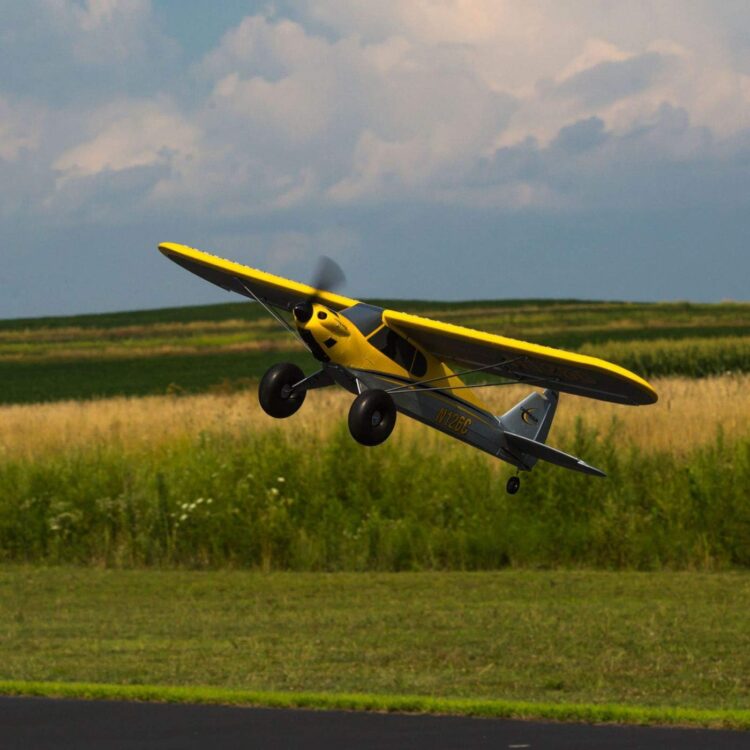
- Experienced mode removes pitch and bank limits. Horizon lists loops, rolls and inverted flight, and Gimlick flew loops, rolls and inverted on the S+.
- The manual catalogs replacement fuselage, wing, tail set, landing gear and strut parts.
Cons
- The purchase excludes the battery and charger.
- The field requirement rules out many neighborhood parks.
- Taildragger gear can be harder to maneuver on the ground than tricycle gear.
- The manual’s 6–8 minute timer means longer sessions take more batteries.
What You’ll Actually Spend
Price the complete setup, not the airplane alone. Horizon’s U.S. listing calls for a 3S 11.1V LiPo of 1300–2200mAh with an EC3 or IC3 connector. The manual specifies 2200mAh IC3 and sets 2200mAh as the minimum for substitutes, even though its optional-parts table lists a 1300mAh Smart pack. Both sources support 2200mAh IC3, so we’d buy that and skip the disputed low end.
| Spending tier | Items |
| Required | Compatible 3S LiPo and charger. Horizon’s Spektrum Smart Powerstage Air Bundle (SPMXPSA200) pairs a 2200mAh 3S 30C IC3 pack with an S120 USB-C charger, which needs a compatible USB power source. The manual lists four AA alkalines as included; verify on used or open-box buys. |
| Smart beginner buys | Spare prop (EFLP09060), spare pack, Dynamite charge protection bag (DYN1405), foam-safe adhesive |
| Optional | RealFlight Trainer Edition (RFL1205) and WS2000 dongle (SPMWS2000), GPS module (SPMA3173), LAS (SPMA3180), Super Cub LP floats (HBZ7390), flap servo (SPMSA382) plus a programmable transmitter |
| Site-dependent | Club or site access, plus any Remote ID module your operation requires |
Expected Experience with HobbyZone Carbon Cub S 2 1.3m RTF
Horizon’s manual is the basis for what follows, with Gimlick’s S+ review as the closest flight evidence. His airplane flew a stock 1300mAh 3S 20C E-flite LiPo, a Spektrum DXe radio, an 18A ESC and GPS-equipped electronics, and his table lists 35.6 oz. The current package lists 2.8 lb. with its recommended pack. No independent test documenting HBZ320001’s stock performance has been verified.
Assembly: simple, but not instant
The manual’s steps cover the tail surfaces, main landing gear, vortex generators and wing, with the struts fitted as the wing goes on. No verified build time is available.
Tighten the rudder hinge screw, then back it off half a turn so the rudder moves freely; Gimlick warned that excess tension on the S+ risked binding. Keep the wing wiring from getting pinched.
Radio and preflight setup
The DXS arrives factory-bound, so routine pairing is done. The checks aren’t.
- Balance the airplane at 62–68mm (about 2.4–2.7 in.) behind the leading edge at the wing root, with the flight battery installed and before you power the ESC.
- Run the range check in reduced-power mode at about 30 paces.
- Run the control direction test in Experienced mode with throttle cut active.
Warning: Treat throttle cut as a safety device. It blocks throttle stick input while active, and a stick above minimum can start the motor when you release it. Lower the throttle first, stay clear of the prop and disconnect the flight pack before any prop work.
First flights: stable, but not self-flying
SAFE doesn’t fly the airplane for you. The manual recommends instructor assistance and Beginner mode for first flights, with gradual throttle into the wind and small rudder corrections on the ground roll.
On the S+, Gimlick reported good tracking on the ground and in the air and generally uneventful intentional stalls. One wind-disturbed stall rolled inverted before he recovered. Treat that as predecessor evidence, not a promise for this package.
David Boddington, in Building and Flying Radio Controlled Model Aircraft, describes tricycle gear as tracking straighter on takeoff and generally easier to land, a general observation rather than a test of this airplane. RC Airplane World makes the narrower point that conventional tailwheel models can be harder to maneuver on the ground.
Wind: the documents don’t settle it
Gimlick flew the S+ at 45°F in 10–15 mph wind gusting to 25 mph, and he changed modes along the way. “I wanted more control authority in these conditions than Beginner Mode allowed” was his reason for moving to Intermediate. He also used considerable power on final and preferred Experienced mode’s extra elevator on a later landing.
The manual sets no general wind ceiling. It limits hand launches to wind below 5–7 mph, and its GPS section sets a wind limit of 12 mph (16 km/h), unequal values since 16 km/h is about 10 mph. We’d save your first flights for calm days.
Landings, durability and repairs
The manual describes a manually flown approach into the wind, a gradual descent and an elevator flare. No verified test of this package ranks landing difficulty for novices or measures tail-set strength or repair frequency.
The manual allows hot glue, CA or epoxy on foam, warns that CA accelerator can damage paint, and requires a secure, correctly oriented flight controller after impact. Order by part number, such as HBZ3222 for the tail set, because several service entries carry older S+ names. Part numbers don’t guarantee stock.
Quirks and limits
- Flaps: The manual’s procedure needs a programmable transmitter with an assignable AUX2 channel and three-position switch. It doesn’t recommend the stock DXS, which lacks the needed mixing.
- LAS: It works in Beginner and Intermediate, sits inactive in Experienced, and can read poorly over dark surfaces or water.
- GPS: It adds calibration and home-position steps, needs a satellite lock before normal control response, and doesn’t detect obstacles.
- Intermediate mode: It reverts to Beginner below 50 feet. Beginner and Intermediate list a 400-foot altitude limit.
Fleet reliability and typical customer-service outcomes remain undocumented in verified tests.
How It Compares
No verified head-to-head flight test covers this group, so compare layout, equipment and training role.
| Factor | HobbyZone Carbon Cub S 2 1.3m (HBZ320001) | E-flite Apprentice STS 1.5m (EFL370001) | HobbyZone Apprentice S 2 1.2m (HBZ310001) | E-flite T-28 Trojan 1.1m (EFL08250) |
| Role | Scale trainer | Large club trainer | Smaller traditional trainer | Skill Level 2 sport scale |
| Package | RTF Basic | RTF Basic | RTF Basic | BNF Basic |
| Wingspan | 51 in. | 59 in. | 48 in. | 44 in. |
| Ground setup | Steerable tailwheel | Steerable nosewheel | Steerable nosewheel | Steerable nosewheel |
| Battery needed | 3S 2200mAh IC3 | 3S 3200–4000mAh EC3/IC3 | 3S 1300–2200mAh EC3/IC3 | 3S/4S 1800–2200mAh EC3/IC3 |
| Radio | DXS included | DXS included | DXS included | Full-range DSMX/DSM2, 5+ channels, not included |
| Choose it if | You want Cub character and one airplane to grow with | You want a larger nosewheel layout | You want a smaller trainer and can find one; Horizon lists it as discontinued | You’ve finished basic training |
All four need a separate battery and charger, so compare complete carts, including gear you already own. We’d say the Cub justifies its cost for buyers who value scale character and staged progression. Buyers seeking the most straightforward ground handling should look to the Apprentice STS first.
Where the HobbyZone Carbon Cub S 2 1.3m RTF Really Shines
Losing track of which way the airplane is pointing can rattle any first-time pilot. Panic Recovery offers a second chance: hold the momentary Panic control with enough height and a clear path, and the manual describes the airplane leveling with the sticks centered. Release it and you resume control. Gimlick saw related self-leveling on the S+, recovering from an intentional spin by switching to Beginner and releasing the controls. That wasn’t a Panic test, and no verified test measures Panic success on this package.
The bigger payoff is staying power. You can start in Beginner, loosen the limits in Intermediate and remove them in Experienced without changing airframes. The tires widen where you might fly, the DXS can move on to compatible BNF aircraft after you check channel mapping and setup, and cataloged parts give you options after a bad landing.
[Amazon Product Display Box]
HobbyZone Carbon Cub S 2 1.3m RTF Basic (HBZ320001)
Battery and charger not included.
Compare current pricing and availability
Who Should Buy It
Best for
- The first-time pilot with space: You have a suitable field or a nearby club. The Academy of Model Aeronautics (AMA) offers an introductory ground school and a club-finding link.
- The returning modeler: You want modern assistance without a long build.
- The Cub enthusiast: Scale character and tundra tires matter to you.
Skip it if
- A small park or backyard is your only site.
- Nosewheel steering is your priority.
- You want long sessions without extra batteries.
- You expect GPS or SAFE to replace learning.
FAQ
Q: Is the HobbyZone Carbon Cub S 2 1.3m RTF a good first RC plane if I’ve never flown before?
A: The HobbyZone Carbon Cub S 2 1.3m RTF is a good first RC plane for a beginner with enough space and help.
- Confirm your field and find an instructor.
- Practice on a simulator; the RealFlight software and dongle are separate purchases.
- Fly first in Beginner mode.
Q: What do I need to buy to get the HobbyZone Carbon Cub S 2 1.3m RTF in the air?
A: The HobbyZone Carbon Cub S 2 1.3m RTF needs a compatible 3S LiPo and charger.
- Choose 3S 2200mAh IC3, the configuration Horizon’s listing and manual share.
Q: How much space do I need to fly the HobbyZone Carbon Cub S 2 safely?
A: The HobbyZone Carbon Cub S 2 needs at least 1,300 feet of clear space in every direction, according to the manual.
- Stay clear of people and obstacles.
- Confirm site permission and airspace before you fly.
Q: How long will the HobbyZone Carbon Cub S 2 fly on one battery?
A: The HobbyZone Carbon Cub S 2 manual advises setting a 6–8 minute timer for early flights.
- Use that as a planning figure, not a guarantee.
- Watch the DXS LEDs, which are approximate.
- Expect no measured figure; no verified test defines endurance for this package.
Q: Should I add the GPS module and Landing Assist Sensor to my Carbon Cub S 2?
A: The GPS module and Landing Assist Sensor are best left until you’ve learned on stock SAFE.
- GPS adds Virtual Fence, Holding Pattern and AutoLand, plus setup steps.
- LAS helps near touchdown, but you still fly and align the approach.
- Neither has a verified side-by-side test on this package.
Q: What FAA rules do I need to follow before flying the HobbyZone Carbon Cub S 2 in the United States?
A: FAA rules for recreational flyers require registration, TRUST and a Remote ID solution for the HobbyZone Carbon Cub S 2.
- Register and mark it through FAA DroneZone; its listed weight exceeds the 250 g threshold.
- Pass The Recreational UAS Safety Test (TRUST) and carry proof.
- Use Standard Remote ID or an FAA-accepted broadcast module, or fly inside an FAA-Recognized Identification Area (FRIA). You and the airplane must stay inside its boundaries, within visual line of sight, and you need permission to access the site. The package documentation doesn’t establish factory Remote ID capability.
- Follow the safety guidelines of an FAA-recognized community-based organization, and carry proof of registration.
- Keep the airplane in visual line of sight, give way to other aircraft and stay generally at or below 400 feet in Class G airspace.
- Get FAA authorization before flying in controlled airspace.

Key Takeaways
- Best for beginners with a large field who want a scale trainer.
- The battery and charger cost extra; choose 3S 2200mAh IC3.
- SAFE helps, but it doesn’t replace stick time or instruction.
- Taildragger ground handling demands attention, and independent evidence for this exact package remains thin.
- Long-term value depends on using its mode progression and cataloged parts.