


A barometer, a 2.4GHz radio, and a coaxial rotor head walk into a living room. What could go wrong? Everything the manufacturer isn’t telling you—revealed.
The entry-level RC helicopter market in 2026 is a noisy, overcrowded space. For a beginner trying to find a reliable first aircraft, the signal-to-noise ratio is brutal: exaggerated specification sheets, vague stability claims, and machines that promise drone-like precision but deliver chaotic living-room crashes. The fundamental dilemma is real—how do you identify a platform that bridges the gap between a disposable toy and a mechanically complex hobby-grade machine?
Sorting out the best RC helicopters demands an objective, hands-on methodology that holds manufacturer claims directly against real-world performance data. That is exactly the standard we applied here. Rather than reciting what is printed on the retail packaging, this evaluation approaches the Syma S107H-E strictly from the perspective of the target consumer—breaking down the engineering integrity, the validity of its altitude-hold system, the aerodynamic learning curve, and the cold reality of long-term maintenance. The goal is a single, definitive answer to the question every prospective buyer actually needs answered: does this aircraft solve the beginner’s problem of achieving stable, controlled flight without immediate, costly destruction?
Brief Overview
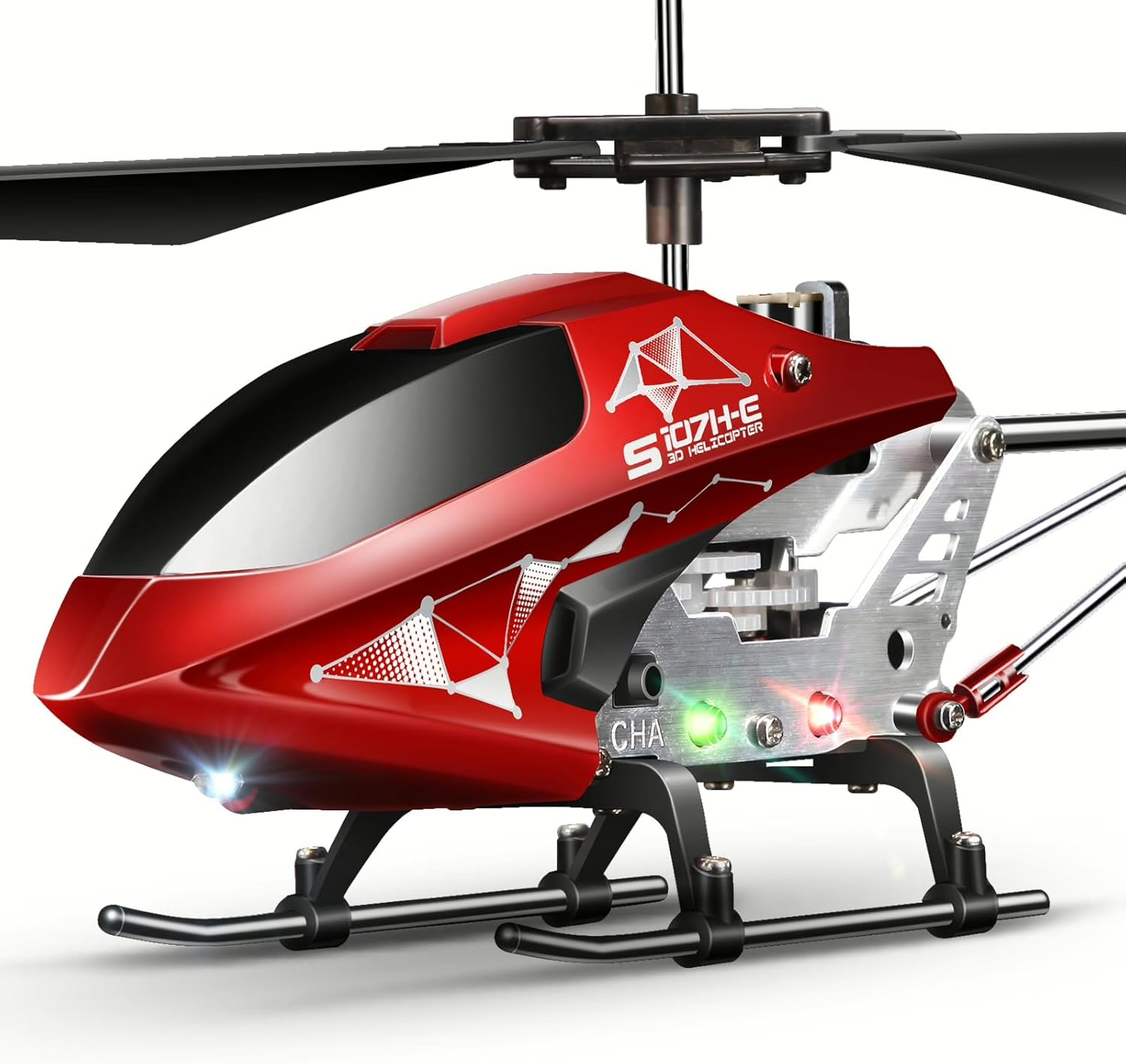
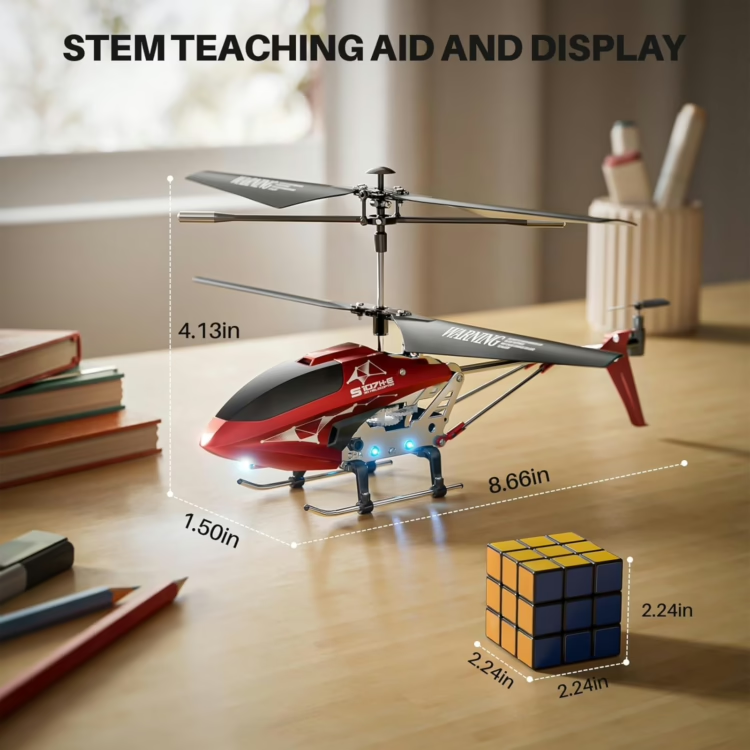
The Syma S107H-E is the evolutionary successor to one of the most commercially successful micro-helicopters in the hobby’s history—the legacy infrared-controlled Syma S107G. Out of the box, its core purpose is to deliver a highly stabilized, indoor-specific flight experience that requires zero prior aviation knowledge to operate. It measures 220mm by 105mm and weighs approximately 42 grams. That makes it a 3.5-channel coaxial helicopter designed explicitly to eliminate the steep learning curve traditionally associated with rotary-wing aircraft.
The ideal buyer is a beginner RC helicopter enthusiast—someone entering the consideration phase of their purchase cycle who needs a platform that forgives erratic control inputs, survives collisions with domestic obstacles, and functions as a reliable foundational training tool.
Three critical upgrades separate the S107H-E from older models in this lineage. First, an integrated barometric altitude hold sensor automates throttle/hover control, locking the aircraft at a fixed height when the pilot releases the throttle stick. Second, a built-in gyro stabilization system actively counters unwanted yaw and tail drift, keeping the aircraft planted in a stable hover. Third, the shift from legacy infrared to a 2.4GHz radio frequency protocol eliminates the line-of-sight dropouts and signal interference that made earlier S107-series models frustrating in rooms with multiple pilots or bright lighting. Taken together, these three features do meaningful work—and that distinction matters when evaluating the helicopter’s real-world value.
Check Current Price & Availability on Amazon
Unboxing, Setup, and Build Quality
Engineering, Fit, and Detail
The Syma S107H-E ships fully assembled, accompanied by a 2.4GHz transmitter, a USB charging cable, a spare tail rotor blade, and a detailed instruction manual. Nothing is left ambiguous for the new owner.
The helicopter’s most significant engineering achievement is structural durability. Where many entry-level competitors rely entirely on brittle injection-molded plastic, the S107H-E uses a whole alloy metal body frame. That alloy metal chassis provides meaningful rigidity, protecting the internal PCB, the Ø7 coreless brushed motors, and the pinion gears from the direct impact forces that are inevitable during the learning phase. The main rotor blades and flybar assembly are manufactured from impact-resistant polymers specifically engineered to flex on impact rather than fracture. The result is an energy-absorbing structure that routinely survives high-velocity encounters with walls, ceilings, and furniture without catastrophic damage.
Close inspection does reveal the compromises expected at this price point. The micro-gearing that drives the coaxial shafts remains partially exposed, leaving it vulnerable to domestic debris—carpet fibers, pet hair, dust. The landing skids, while metallic and solid, are rigid and lack any shock-absorbing dampening. Heavy vertical landings transfer kinetic energy directly into the main frame rather than dissipating it. These are not dealbreakers, but they are maintenance realities every buyer should understand before purchase.
The Learning Curve
A common pre-purchase fear among newcomers is a complex, tool-dependent setup that requires technical software or lengthy binding procedures. The S107H-E dismantles that concern with a genuine Ready-to-Fly (RTF) configuration. The only meaningful time investment before first flight is charging the internal 3.7V 200mAh lithium-polymer battery via the included USB cable—a 50 to 60 minute process. The transmitter requires four AA alkaline batteries. Once charged, the binding between the helicopter and the 2.4GHz transmitter is automatic the moment both devices are powered on.
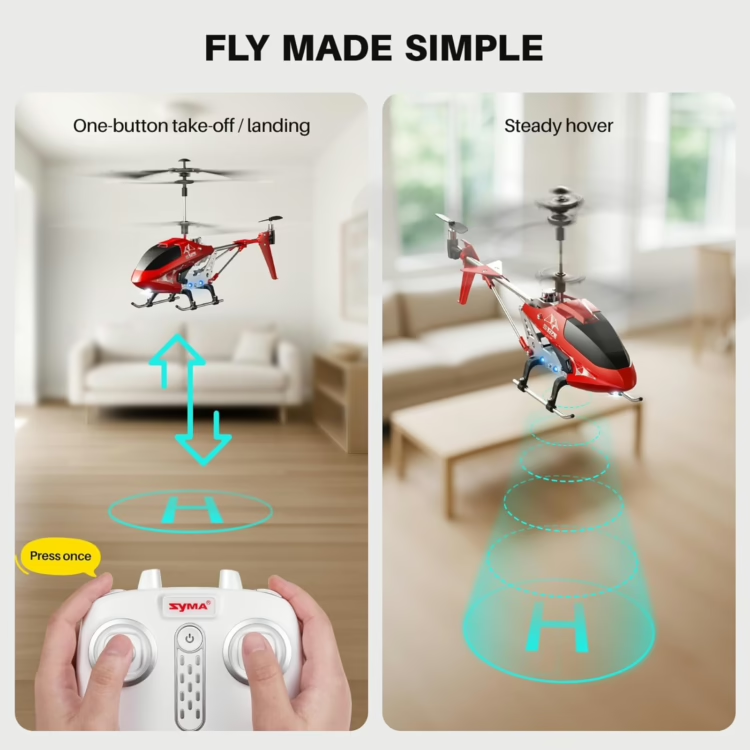
The transmitter itself features an ergonomic gamepad-style layout that feels immediately familiar to anyone who has handled a modern video game controller. The One Key Take-Off/Landing button is the real equalizer: pressing it commands the flight controller to spin up the rotors, lift the aircraft to a safe predetermined height, and establish a stable hover—all without the pilot touching the throttle stick. For a beginner, this removes the two most technically demanding phases of flight at a single press. The learning curve flattens considerably.
Flight Performance: Taking to the Skies
Hands-On Daily-Use Scenarios
In confined domestic environments—living rooms, garages, basements—the S107H-E performs well above its price class. The 3.5-channel coaxial rotor design physically cancels torque at the source: the top and bottom rotors spin in opposite directions, preventing the chassis from rotating uncontrollably. The aircraft never demands the constant anti-torque pedal work that makes single-rotor helicopters so difficult for beginners.
The barometric altitude hold sensor is where the upgrade over legacy models becomes tangible. Older RC helicopters required the pilot to continuously feather the throttle stick to hold altitude—a mentally exhausting task that left no cognitive bandwidth for navigation. The S107H-E’s flight controller reads atmospheric pressure changes and adjusts motor RPM in real time to maintain a stable horizontal plane. Release the left stick and the aircraft simply parks itself in the air. That capability frees the pilot to focus entirely on directional navigation—forward, backward, left, right—using the right stick. Navigating around furniture, ascending a staircase, and executing precision landings on a coffee table become achievable goals in the first session.
Two speed modes (High and Low) allow the flight envelope to scale with the pilot’s developing skill level. The ultra-bright LED navigation lights provide reliable orientation cues for night flying in darkened rooms.
Challenges, Quirks, and Deal-Breakers
Despite its strengths, the S107H-E carries specific aerodynamic limitations and mechanical vulnerabilities that buyers must understand before committing.
Wind Sensitivity. At 42 grams, the aircraft has near-zero wind resistance. The slight draft from an HVAC vent or a ceiling fan can meaningfully alter its flight path. Taking this helicopter outdoors is a high-risk proposition—even a gentle breeze can overpower the tail rotor’s horizontal thrust, carrying the aircraft away. It must be treated as a strictly indoor machine, or reserved for outdoor conditions with absolutely dead-calm air.
The Pendulum Effect. The heavy metallic chassis hangs below the rotor disk like a pendulum, and the aircraft naturally wants to return to a flat, stationary hover. When the tail rotor pitches the helicopter forward, it fights against gravity and this pendulum effect, resulting in slow, sluggish forward flight speed. Some pilots find this frustrating enough that they resort to aftermarket modifications—removing the cosmetic tail fin or landing gear to shed weight and shift the center of gravity forward.
The Toilet Bowl Effect (TBE). During extended hovering, the S107H-E can occasionally develop what pilots call the Toilet Bowl Effect: the aircraft begins orbiting in an ever-widening horizontal circle, resembling water draining from a bowl. This is not a software glitch but a mechanical friction problem—it occurs when the upper flybar mechanism binds, or when the plastic linkage connecting the flybar to the upper rotor blades stiffens, breaks slightly, or bends after a crash impact. Diagnosing and freeing this mechanical binding is a necessary troubleshooting skill for any long-term owner.
Long-Term Durability & Maintenance Realities
The alloy frame absorbs impacts impressively, but the powertrain operates under the harsh physical constraints of brushed micro-motor technology.
Brushed Motor Wear. The S107H-E uses coreless brushed motors. Unlike brushless variants, these rely on physical friction—brushes rubbing against a commutator—to pass current. That friction generates heat. Over time, the brushes wear down and lifting power diminishes. The critical risk: if a beginner crashes the helicopter and fails to cut the throttle immediately, the motors stall while drawing maximum current and cook the internal components. Motor lifespan on toy-grade platforms is measured in hours of flight time, and eventual motor replacement—which requires basic micro-soldering skills—is an inevitability, not a possibility.
Debris Hazard. The exposed pinion gears act as magnets for carpet fibers and pet hair. When hair wraps around the main shaft, it introduces severe mechanical drag, causing the counter-rotating rotors to spin at mismatched RPMs and destroying gyroscopic balance. The aircraft will spin out of control. Routine maintenance using tweezers to extract debris from the gear mesh is not optional—it is a prerequisite for sustained operational reliability.
Battery Degradation. The onboard LiPo battery delivers a realistic 6 to 8 minutes of flight time per charge. LiPo cells are highly sensitive to over-discharging. Flying the aircraft until the blades stop spinning, or storing it in a depleted state for weeks, degrades the internal chemistry rapidly. Many users report flight times collapsing from eight minutes down to 30 seconds after months of improper charging habits. Maintaining battery health requires discharging to 40%–50% capacity before long-term storage.
Pros & Cons
Pros:
- Automated Stability: The barometric altitude hold and built-in gyro stabilization fully automate throttle management, enabling absolute novices to achieve a rock-solid hover instantly—no active stick feathering required.
- Exceptional Crash Durability: The whole alloy metal airframe and flexible polymer rotor blades absorb high-velocity impacts with indoor obstacles, dramatically reducing part breakage and crash anxiety.
- Interference-Free Control: The 2.4GHz transmitter delivers a robust, reliable connection that supports flying multiple helicopters simultaneously in the same room without signal crossover or line-of-sight dropouts.
- Zero-Friction Setup: The RTF configuration combined with one-key takeoff and landing requires no technical assembly, no software binding, and no specialized tools—delivering immediate first-flight gratification.
Cons:
- Zero Wind Tolerance: The 42-gram coaxial design restricts operation to strictly indoor or perfectly calm environments; any moderate breeze will overpower the weak tail rotor.
- Sluggish Forward Speed: The pendulum effect of the metallic chassis severely restricts forward flight agility, which will quickly frustrate pilots seeking aggressive aerodynamic maneuvers.
- Maintenance-Intensive Powertrain: The exposed pinion gears are highly susceptible to jamming from carpet fibers and pet hair, demanding frequent hands-on cleaning to maintain synchronized rotor speeds.
- LiPo Degradation Risk: The internal battery requires strict charging discipline; storing it in a fully depleted state will permanently damage the cells, cutting usable flight time to a matter of seconds.
The Value-to-Performance Ratio & Competitor Comparison
Assessing the true ROI on the S107H-E requires moving past static price points—which fluctuate constantly with retail algorithms—and focusing instead on the metrics that define value in the sub-250-gram toy-grade market: flight time per dollar and durability per crash.
On crash survivability, the S107H-E delivers an exceptionally high return. Where all-plastic competitors fracture on their first encounter with a ceiling or drywall, the Syma’s alloy frame preserves the buyer’s financial investment across dozens of impacts. Altitude hold further protects this investment by preventing the high-speed vertical plummets that typically destroy internal electronics in unassisted platforms. However, long-term ROI is constrained by the inherent wear of brushed motors and the sealed internal battery bay, which makes field-swapping batteries impossible without third-party modifications.
The Competition
| Feature / Specification | Syma S107H-E | DEERC DE51 | Cheerwing U12S | Blade Nano S3 |
| Rotor Design | Coaxial (Dual Rotor) | Coaxial (Dual Rotor) | Coaxial (Dual Rotor) | Single Rotor (Collective Pitch) |
| Primary Stabilization | Barometer / built-in gyro stabilization | Barometer / Gyro | Barometer / Gyro | SAFE Technology / AS3X |
| Aircraft Weight | ~42g | ~57g | ~71g | 32g |
| Flight Time (Per Battery) | 6–8 minutes | 8–10 minutes | 5–6 minutes | 4–5 minutes |
| Batteries Included | 1 (Internal) | 2 (Modular) | 1 (Modular) | 1 (Removable) |
| Camera Integration | None | None | 640×480p Wi-Fi FPV | None |
| Ideal Environment | Indoor | Indoor | Indoor | Indoor / Light Outdoor |
| Target Pilot Level | Absolute Beginner | Absolute Beginner | Beginner | Intermediate / 3D Training |
Syma S107H-E vs. DEERC DE51. The DE51 is Syma’s most direct coaxial rival, and it holds a meaningful advantage in continuous utility: it frequently ships with two modular batteries, offering up to 20 minutes of total flight time per session. Compared to the Syma’s 8-minute flight followed by a 60-minute USB recharge with no swap capability, that difference is real. However, community consensus and long-term testing consistently point to the Syma S107 legacy platform having superior, more readily available replacement parts across online marketplaces—making it cheaper and easier to keep flying over the long haul.
Syma S107H-E vs. Cheerwing U12S. The U12S adds a 640×480p Wi-Fi camera for FPV video streaming to a smartphone. It is a novelty that comes at a cost: the camera drains the battery faster, yielding only 5 to 6 minutes of flight time, and the extra mass reduces the aircraft’s agility and crash resilience. For pilots focused purely on mastering flight fundamentals, the Syma delivers a purer, more mechanically durable experience.
Syma S107H-E vs. Blade Nano S3. The Nano S3 represents a leap into true hobby-grade mechanics—a 32-gram, single-rotor, collective-pitch machine capable of inverted flight and full 3D aerobatics, equipped with SAFE (Sensor Assisted Flight Envelope) technology. It is also vastly more complex, fragile, and unforgiving than the Syma. The Blade targets intermediate pilots training for larger outdoor machines. The Syma remains the definitive tool for the absolute novice who simply wants sustained, upright hovering without immediate destruction.
Where the Syma S107H-E Really Shines
The real triumph of the S107H-E is not found in high-speed aerobatics—it was never designed for them. It is found in the psychological victory it hands a first-time pilot.
Learning to navigate three-dimensional space via a dual-stick transmitter is an inherently unnatural skill. The typical learning curve is stressful, expensive, and discouraging. The S107H-E systematically neutralizes that anxiety. Unbox the aircraft, power it on, press the One Key Take-Off button, and within five minutes, a beginner can achieve a perfectly stable, hands-free hover in the center of the living room. That is not a small thing. It transforms what is traditionally a frustrating first experience into a genuinely rewarding one.
Once airborne, the platform opens up an entire world of accessible indoor aviation. Threading the helicopter through a self-made obstacle course of dining room chairs. Executing a precise landing on a coaster. Watching the LED navigation lights paint light across a darkened hallway at night. These are low-stakes, high-reward scenarios that build genuine stick-skill habits without punishing every mistake with a pile of broken plastic.
The alloy frame ensures that the inevitable wall encounter or ceiling tap produces a gentle bounce—not a catastrophic failure. The fun continues. That resilience, combined with the altitude-hold automation that keeps the aircraft from plummeting or surging into the ceiling, makes the S107H-E a uniquely low-friction entry point into RC aviation mechanics.
See the Syma S107H-E on Amazon
Who Should Buy It
Identifying the right buyer for this aircraft is critical to preventing the kind of disappointment that comes from mismatched expectations.
The Ideal User Profiles:
- The Absolute Beginner. Individuals with zero prior RC flight experience who require a platform that guarantees a successful first flight. The altitude hold and built-in gyro stabilization make it the most capable teaching tool available at this price point for basic transmitter orientation—without the penalty of immediate destruction.
- The Indoor Enthusiast. Pilots living in apartments or facing harsh winter climates who need a slow-moving, reliably controllable aircraft that can be flown in confined domestic spaces without damaging walls, furniture, or pets.
- Parents and STEM Educators. Adults seeking a mechanically durable gift for younger pilots (typically ages 8 and up, under supervision). The coaxial rotor system and exposed gear train offer a practical, hands-on demonstration of aerodynamic principles and gyroscopic physics.
Who Should Avoid It:
- Outdoor Pilots. Anyone planning to fly in a park, backyard, or open field must look elsewhere. The S107H-E’s extreme wind sensitivity will result in immediate loss of control and flyaways in anything beyond dead-calm conditions.
- Advanced and 3D Pilots. Enthusiasts seeking flips, rolls, fast forward passes, or any form of aggressive aerobatics will find this aircraft heavily restrictive. The coaxial design physically prevents aggressive banking maneuvers, making it entirely unsuitable for pilots transitioning toward collective-pitch mechanics.

Key Takeaways
- Unmatched Beginner Stability: Barometric altitude hold and built-in gyro stabilization automation allow absolute novices to achieve a rock-solid hover on the first flight—no feathering, no guesswork.
- Exceptional Structural Durability: The alloy metal frame, combined with flexible polymer rotor blades, absorbs severe domestic impacts routinely, protecting both the aircraft and the buyer’s investment.
- Strictly an Indoor Machine: At 42 grams with a coaxial rotor head, the S107H-E has near-zero wind resistance and must not be flown outdoors in any breezy conditions.
- Maintenance Awareness Is Non-Negotiable: Exposed brushed motors and pinion gears require diligent cleaning to prevent hair and debris buildup from causing mechanical drag and premature motor burnout.
- Strong Value-to-Friction Ratio: Despite a 6–8 minute flight time per charge, the instant 2.4GHz connectivity, RTF configuration, and zero-assembly setup make it an outstanding foundational training platform for the right pilot.