


Precision fit, a detailed cockpit, and polycap-mounted stores — without the fragility of ultra-premium releases. This kit is designed for the transition builder.
Kit No. 61098 | Scale: 1/48 | Subject: F-16CJ Block 50 Fighting Falcon | Manufacturer: Tamiya
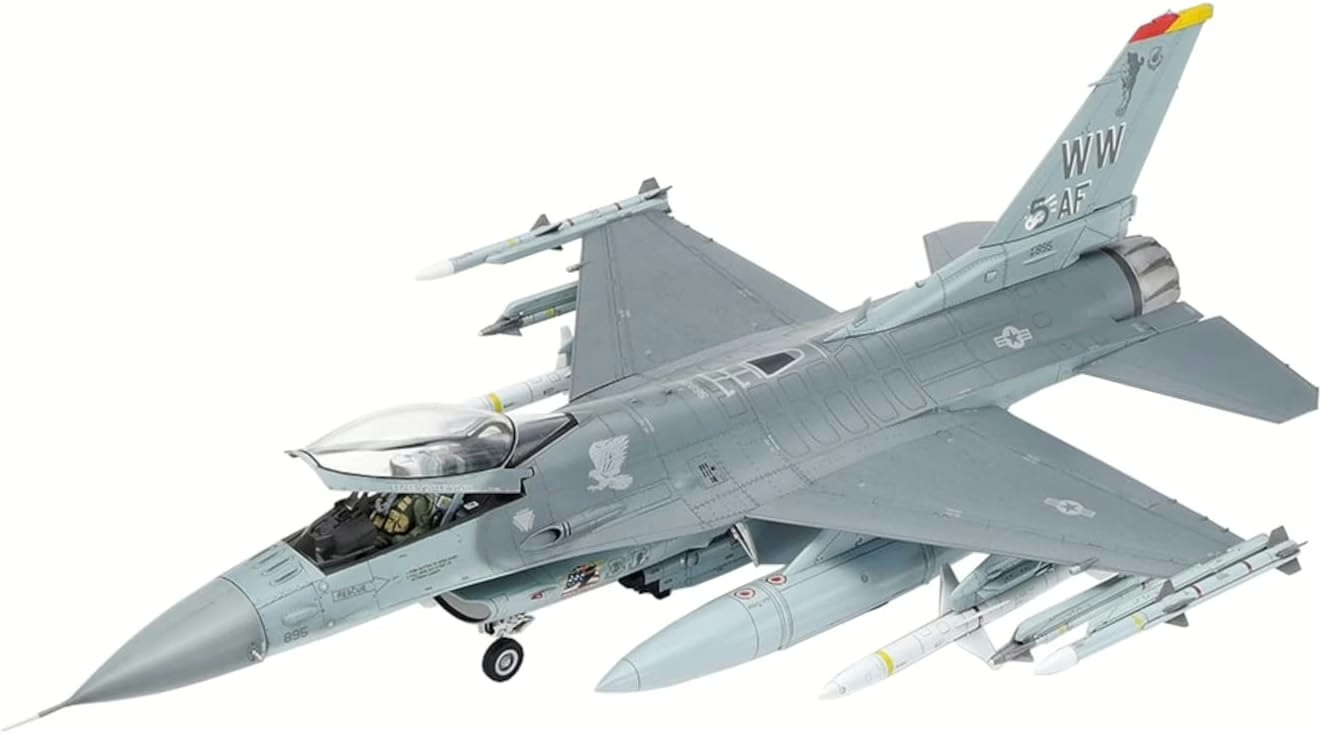
The 1/48 modern jet market has never been noisier. Between freshly tooled releases from Kinetic and Great Wall Hobby and a flood of re-boxed vintage toolings, builders who are just stepping up from entry-level kits face a genuinely difficult purchasing decision — one that can cost them dozens of hours and real money if they get it wrong. The central question on forums and in hobby shops right now is a fair one: does the Tamiya 1/48 Lockheed Martin F-16CJ (Block 50) still justify its reputation and its price tag, or has the market moved on?
For builders researching their next project, finding the best model airplane kits demands exactly this kind of evidence-based approach — cutting through the promotional hype to focus on what the kit actually does at arm’s length, in real building conditions.
The F-16CJ (Kit No. 61098) is a replica of one of the most operationally significant aircraft in recent U.S. Air Force history. Born from the early 1970s Lightweight Fighter program as a simple, highly agile daylight dogfighter intended to complement the F-15 Eagle, the airframe evolved over decades into a sophisticated multirole platform. The Block 50 F-16CJ represents the apex of that evolution — the dedicated Suppression of Enemy Air Defenses (SEAD) machine that replaced the aging F-4G Wild Weasels. That heritage deserves an accurate replica. The question is whether Tamiya delivers one.
Brief Overview
The Tamiya 1/48 Lockheed Martin F-16CJ (Block 50) Fighting Falcon, Kit No. 61098, is a premium injection-molded styrene kit replicating the U.S. Air Force’s dedicated “Wild Weasel” anti-radiation platform. Originally released in 2007 as a companion to Tamiya’s acclaimed 1/32 Viper tooling, it is engineered to deliver aerodynamic accuracy alongside a modular, builder-friendly assembly sequence.
Who it’s for: The kit sits squarely in the ambitious beginner-to-intermediate bracket — builders who are done wrestling with vintage toolings and want a structurally sound, highly detailed airframe that rewards clean technique rather than demanding heroic gap-filling sessions. It is not a shake-and-bake kit, but it is designed to let the builder spend their workbench time on painting, masking, and weathering rather than structural correction.
The features that matter most:
Modular CCIP Engineering. A modular nose section and “bird cutter” Advanced Identification Friend or Foe (AIFF) antennas allow the builder to accurately construct either a pre- or post-Common Configuration Implementation Program (CCIP) Block 50 aircraft. That degree of variant flexibility usually requires sourcing expensive aftermarket resin conversions — here, it comes in the box.
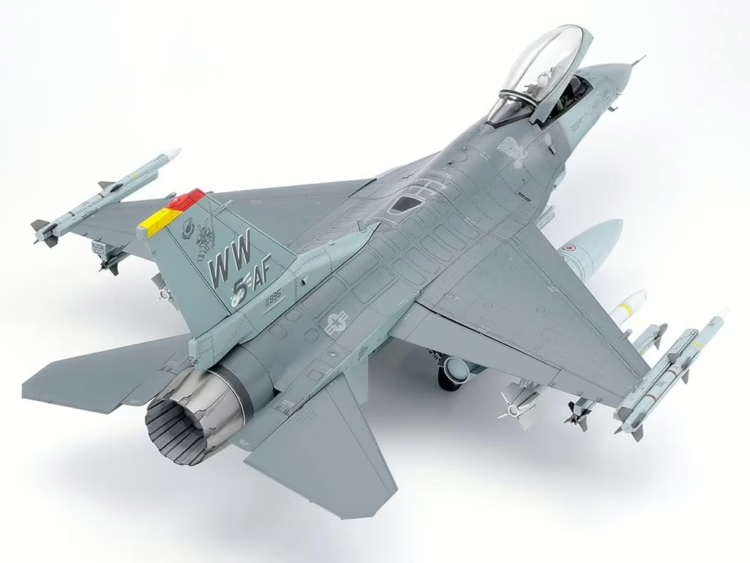
Comprehensive SEAD Ordnance. The kit includes the HARM Targeting System (HTS) pod, AGM-88 HARM anti-radiation missiles, AIM-120C AMRAAMs, and the AIM-9M/X Sidewinder. That is a purpose-built SEAD weapons loadout that older kits cannot match without supplementary purchases.
Polycap Integration. Tamiya routes hidden polycaps through the horizontal stabilizers, centerline pylon and inner wing pylons, and external fuel tanks. The result: stores and stabilizers friction-fit and detach cleanly, solving the perennial problem of transporting a finished model to a show without snapping off a pylon in the case.
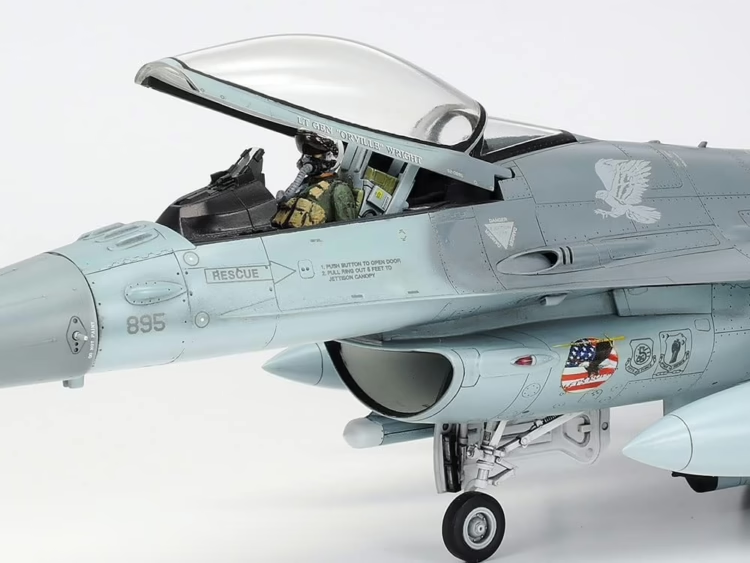
Pilot Figure with Dual Helmet Options. A pilot figure is included with two helmet choices — a standard lightweight helmet and the Joint Helmet-Mounted Cueing System (JHMCS) — adding scale reference and immediate realism to an open-cockpit display.
Check the current price and availability of the Tamiya 1/48 F-16CJ on Amazon
The Real-World Utility Test: Buildability & Value
Evaluating a kit by its box art tells you nothing. Evaluating it by how the polystyrene behaves under cement and how the sub-assemblies reward — or punish — the builder’s effort tells you everything.
Aerodynamic Design Translated to Plastic
Capturing the F-16’s blended wing-body profile in injection-molded plastic is not a simple engineering task. The continuous, organic curves that define the Viper’s fuselage have plagued older toolings with prominent, unnatural seam lines. Tamiya addresses this by breaking the upper fuselage into strategic sections to prevent the warpage common in single-piece upper fuselage designs. The fit between the upper wing sections and the forward fuselage is close to perfect, requiring only minimal capillary-action liquid cement — Tenax or Plast-I-Weld being the standard choices — to produce a seamless join.
Surface detail is where this tooling continues to impress. Tamiya collaborated directly with Lockheed Martin to capture the geometric data of the actual aircraft, producing recessed panel lines and rivet details at a depth and width that effortlessly accepts clay-based or enamel weathering washes. Unlike older toolings where surface detail softens and disappears under primer, these recesses remain crisp throughout the painting process — a significant practical advantage for any builder pursuing a realistic, combat-worn finish.
Cockpit and Instrumentation
The cockpit tub achieves a well-judged balance between visual fidelity and buildability. Side consoles feature separate, raised pieces for the throttle and control stick, producing the kind of three-dimensional switchgear detail that typically requires aftermarket resin intervention. The instrument panel has genuine depth and responds convincingly to dry-brushing to highlight the multi-function displays (MFDs). Builders who prefer a closed-canopy display will find the out-of-the-box styrene cockpit entirely sufficient. Those building with the canopy open may still want to replace the provided decal ejection seat harnesses with photo-etch equivalents, as the decals lack three-dimensional convincingness.
The Intake Trunking Challenge
The intake is the most demanding structural element in the build — and the most important to understand before purchase. The F-16’s fixed pitot-type intake is a prominent visual feature, and Tamiya engineered a full-length trunking using four separate longitudinal pieces to accurately capture the complex internal geometry that leads to the engine compressor face.
That design decision produces accurate depth but creates four internal seam lines that are notoriously difficult to access once the sub-assembly is closed. For beginner builders, this is a genuine frustration. Experienced modelers typically address it by pouring liquid primer — Mr. Surfacer 1000 is the standard choice — into the sealed intake, rolling it to fill the seams, and immediately pouring off the excess. It is a multi-day process that disrupts an otherwise fluid build, and one where Tamiya clearly prioritized scale accuracy over ease of assembly.
The Undercarriage Painting Trap
A less-discussed but equally important engineering constraint involves the landing gear sequence. Tamiya’s instructions require the main undercarriage legs to be installed and trapped within the gear bay before the lower fuselage panels can be fully sealed. The main landing gear bay wraps around the underside of the intake ducting and involves multiple structural bulkheads crossing the bay.
This sequencing means the builder must mask around fragile, already-installed gear legs during all external airbrushing phases — a genuine risk of snapping delicate struts during routine handling. Experienced builders sometimes attempt to modify the mounting tabs to allow post-painting gear installation, but doing so compromises the structural integrity of the heavy-duty Block 50 landing gear doors.
The Canopy Seam Reality
The prominent mold seam running down the longitudinal center of the bubble canopy is a known discussion point and worth addressing clearly: it is not a manufacturing defect. The F-16’s complex, bulbous canopy — featuring an “omega” cross-section that provides the pilot with unobstructed forward visibility — cannot be extracted from a two-piece steel mold without leaving a seam line. The fix involves wet-sanding the clear part through progressively finer polishing compounds, followed by a dip in Future floor wax to restore optical clarity. It is an achievable process for any builder willing to approach clear parts methodically.
Decal Performance
Three aircraft markings are provided, including the 5th Air Force Commander’s aircraft at Misawa AB, Japan, and the 52nd Fighter Wing Commander’s aircraft at Spangdahlem AB, Germany. The decals themselves present a documented limitation: Tamiya’s stock decals are somewhat thicker than the current industry benchmark and prone to silvering — the reflective micro-bubbling caused by air trapped beneath the carrier film over panel line recesses. Mitigation requires a smooth gloss clear coat pre-application and strong setting solutions such as MicroSol and MicroSet to force the thick film into recessed detail.
Competitive Context
| Feature | Tamiya F-16CJ (Block 50) | Kinetic Gold Series (2022) | Hasegawa (Vintage Tooling) | Great Wall Hobby (2026) |
| Fit & Engineering | Class-leading; minimal filler required | Highly detailed; prone to tricky nose and canopy assemblies | Shows significant age; needs aftermarket upgrades | Extreme complexity; high parts count |
| Intake Trunking | Full-length (4 pieces); accurate but difficult seams | Full-length; similar complex assembly | Truncated/shallow; lacks compressor face depth | Full-length; numerous fragile sub-assemblies |
| Ordnance Included | Excellent (AIM-9X, HARM, AIM-120C, HTS pod) | Massive variety of stores and targeting pods | Very sparse; requires separate weapons sets | Comprehensive but complex sub-assemblies |
| Variants | Focused on C-models (Block 50) | High modularity; A/B/C/D models depending on sprues | Vast array of boxes across all production blocks | Highly specific variants (e.g., F-16I Sufa) |
| Cockpit Detail | Excellent 3D relief; detailed pilot figure included | Good; slightly softer molding on fine detail | Simplistic flat panels requiring decals or resin | Museum-grade detail; photo-etch often native |
The competitive picture is clear. The Tamiya kit delivers dramatically superior detail compared to the budget Hasegawa toolings without demanding the exhausting build time and fragility risk that define the Great Wall Hobby ultra-premium releases. Kinetic’s 2022 tooling is a credible competitor on ordnance variety, but its nose and canopy assemblies introduce fit challenges that undercut the out-of-box experience. The Tamiya F-16CJ earns its position in the premium bracket through foundational engineering quality — a forgiving, stable airframe that absorbs a beginner’s learning curve rather than punishing it.
Pros & Cons
| Pros | Cons |
| Impeccable Parts Fit. Precision engineering keeps filler and sanding to a minimum, protecting the builder’s time and maintaining forward momentum through the build. | Intake Trunking Seams. The four-piece intake design produces difficult-to-reach internal seam lines requiring advanced filling techniques — a documented frustration for beginner builders. |
| Superior Surface Detail. Tamiya’s Lockheed Martin-sourced geometric data produces recessed panel lines that accept weathering washes by capillary action, eliminating the need to rescribe lost detail. | Landing Gear Sequencing. Installing main undercarriage legs before fuselage closure complicates exterior painting and creates unnecessary risk to fragile gear struts during handling. |
| Premium SEAD Ordnance Included. AIM-9M/X Sidewinder, AGM-88 HARMs, AIM-120C AMRAAMs, and the HTS pod are all in the box — a loadout that older kits cannot replicate without aftermarket purchases. | Thick Decals. Stock decals are notably thick and prone to silvering, requiring gloss pre-coats and strong setting solutions — or prompt aftermarket replacement — to achieve a flat, film-free finish. |
| Polycap Modularity. Friction-fit stabilizers, pylons, and external tanks allow the finished model to survive show transportation and enable interchangeable display configurations. | Prominent Canopy Seam. The mold-line center seam on the clear canopy is an engineering inevitability, but it requires wet-sanding and polishing to eliminate — a process that intimidates newcomers to clear-part work. |
| Dual-Helmet Pilot Figure. Inclusion of standard and JHMCS helmet options adds authentic scale reference and dynamic display possibilities without extra cost. |
Where the Tamiya 1/48 Lockheed Martin F-16CJ Really Shines
The kit’s strengths are most apparent not when it’s being unboxed, but once the airframe is painted and the first wash hits the wings.
Because Tamiya’s engineers worked from Lockheed Martin’s actual geometric data, the recessed panel lines and rivet detail respond to a dark clay-based or enamel wash with an immediacy that genuinely surprises first-time Tamiya builders. Capillary action pulls the pigment cleanly and consistently across the wing blend and fuselage sides. What you get is a convincing three-dimensional depth that transforms the model from a piece of molded plastic into something that reads, at scale, like a heavy, worn combat machine — without any heroic weathering technique required. The flat, toy-like look that plagues lesser toolings simply does not occur here.
The kit also captures the specific aggressive character of the Block 50 SEAD mission with precision. The F-16CJ was designed to deliberately provoke enemy radar systems and fire AGM-88 HARMs directly down active radar beams — a mission so dangerous its practitioners adopted “YGBSM” (You Gotta Be Shitting Me) as an unofficial motto. Tamiya’s accurate molding of the HARM Targeting System pod and the distinctive bulged heavy-duty landing gear doors of the Block 50 translate that operational identity into plastic with fidelity that generic Viper kits simply cannot match.
Hanging the ordnance is one of the build’s genuine pleasures. The polycap system provides a tactile mechanical feedback — a satisfying, positive lock as fuel tanks and stabilizers seat into place — that is uncommon in static-model construction. It rewards the builder physically at the moment of assembly completion, which matters more than it might sound on a build that has run across multiple weekends.
Structurally, the kit actively protects the builder from the kind of late-stage catastrophes — a wing mounted at the wrong angle, a tail plane that won’t sit flush — that characterize less carefully engineered kits. The robust attachment geometry ensures the wings assume the correct anhedral without complex jigs or reference tools. It is a kit that works with the builder, not against them: converting what could be a filler-heavy structural marathon into a focused, technically demanding, but ultimately rewarding creative project.
That is the core value of the Tamiya F-16CJ at the workbench: it removes the friction between the builder and the result. The outcome reflects the builder’s skill and attention, not their ability to compensate for manufacturing shortcomings.
Order the Tamiya 1/48 F-16CJ on Amazon and put the Viper on your shelf
Who Should Buy It
The Tamiya 1/48 F-16CJ is the right kit for builders who are genuinely ready to step away from vintage toolings — who have tried to make an older Hasegawa Viper sing and run into the wall of soft surface detail, sparse ordnance, and extensive filler work that defines that generation of kit engineering. If you value your time at the bench and want the confidence that comes from starting a project on a structurally sound, precision-molded airframe, this kit delivers that foundation.
It is equally well-suited to modern military aviation enthusiasts who want a historically accurate SEAD replica. The accurate CCIP-era “bird cutter” AIFF antennas, the Block 50’s distinctive heavy-duty gear doors, and the full SEAD weapons loadout — HTS pod, AGM-88 HARMs, AIM-9M/X Sidewinder, AIM-120C AMRAAMs — combine to produce a model that represents the aircraft as it actually flew over Iraq and in other global theaters during the Block 50’s operational career.
Addressing the common pre-purchase objections: The intake seams and the canopy mold line are the two issues that generate the most forum discussion, and both deserve a clear-eyed assessment. Neither is a structural failure. The canopy seam is an engineering inevitability of the F-16’s omega-section polycarbonate, and it can be fully eliminated with wet-sanding through progressive polishing compounds and a dip in acrylic floor polish. For a builder at the beginner-to-intermediate transition, it is an excellent low-risk introduction to clear-part finishing technique. The intake seams require a multi-step filling process that demands patience, but the technique is straightforward once understood.
On the financial question: the kit commands a premium over vintage Hasegawa offerings, but it includes a detailed cockpit, a pilot figure, full-length intake trunking, and a comprehensive SEAD ordnance suite. Reaching an equivalent level of fidelity with an older tooling requires purchasing aftermarket resin seats, photo-etch, and separate weapons sprues — costs that quickly exceed the price differential. The initial investment here buys a project that builds efficiently and finishes well.
Builders who should look elsewhere: those who need maximum variant flexibility across the entire F-16 production spectrum, or who are specifically chasing an A- or B-model, should investigate Kinetic’s modular offerings. Builders who want factory-included photo-etch and museum-grade cockpit detail from the box should evaluate the Great Wall Hobby ultra-premium releases — with the understanding that complexity and fragility increase proportionally.

Key Takeaways
- Exceptional fit: Precision-matched parts reduce filler and sanding to near-zero, delivering a faster, cleaner build with a structurally sound airframe from the first join.
- Complete SEAD loadout: The AIM-9X, AGM-88 HARM, AIM-120C, and HTS pod are all included — a purpose-accurate weapons suite that eliminates costly aftermarket purchases.
- Superb surface detail: Tamiya’s Lockheed Martin-sourced recessed panel lines accept weathering washes by capillary action, producing a convincing, professional finish without rescribing.
- Known build challenges: Four-piece intake trunking seams, mandatory pre-painting gear installation, thick stock decals, and a canopy mold line all require specific techniques to resolve.
- Smart polycap system: Friction-fit stabilizers and external stores make the finished model safely transportable and display-configurable — a practical engineering decision that pays off at the show table.