


The SYMA CH-47 RC Chinook packs military-scale authenticity, near-indestructible construction, and one-key simplicity into a 47-gram micro-heli—but its 3-channel fixed-pitch design sets a hard ceiling on where this aircraft can take you.
The entry-level RC helicopter market has never been more crowded, and separating genuine utility from polished packaging takes more than a five-minute hover over a workbench. The hobby has undergone a fundamental technical shift over the past decade, migrating away from flybar-stabilized rotor heads toward software-driven electronic systems built around Microelectromechanical Systems (MEMS) Inertial Measurement Units (IMUs)—multi-axis gyroscopes and accelerometers that allow micro-scale platforms to fly with near-robotic precision. In this landscape, identifying the best RC helicopters requires cutting through manufacturer hyperbole to find authentic aerodynamic capability.
The SYMA CH-47 RC Chinook (Model S52H) enters the 2026 market targeting absolute novices and scale aviation enthusiasts with a promise of stress-free, crash-resistant flight. To put those claims to the test, our evaluation applied the Buyer’s Investment Matrix—a framework that weighs not just acquisition cost, but the long-term investment of time, maintenance demands, and what we call “daily friction”: the real-world effort required to get the aircraft from storage into stable flight. A helicopter that stays grounded because of confusing binding procedures or fragile components delivers zero return on investment. Alongside that, a Feature-to-Function Reality Check subjected the S52H to indoor precision tests, outdoor variable-wind trials, and repeated simulated crash scenarios to determine what the machine actually delivers in the field.
Brief Overview
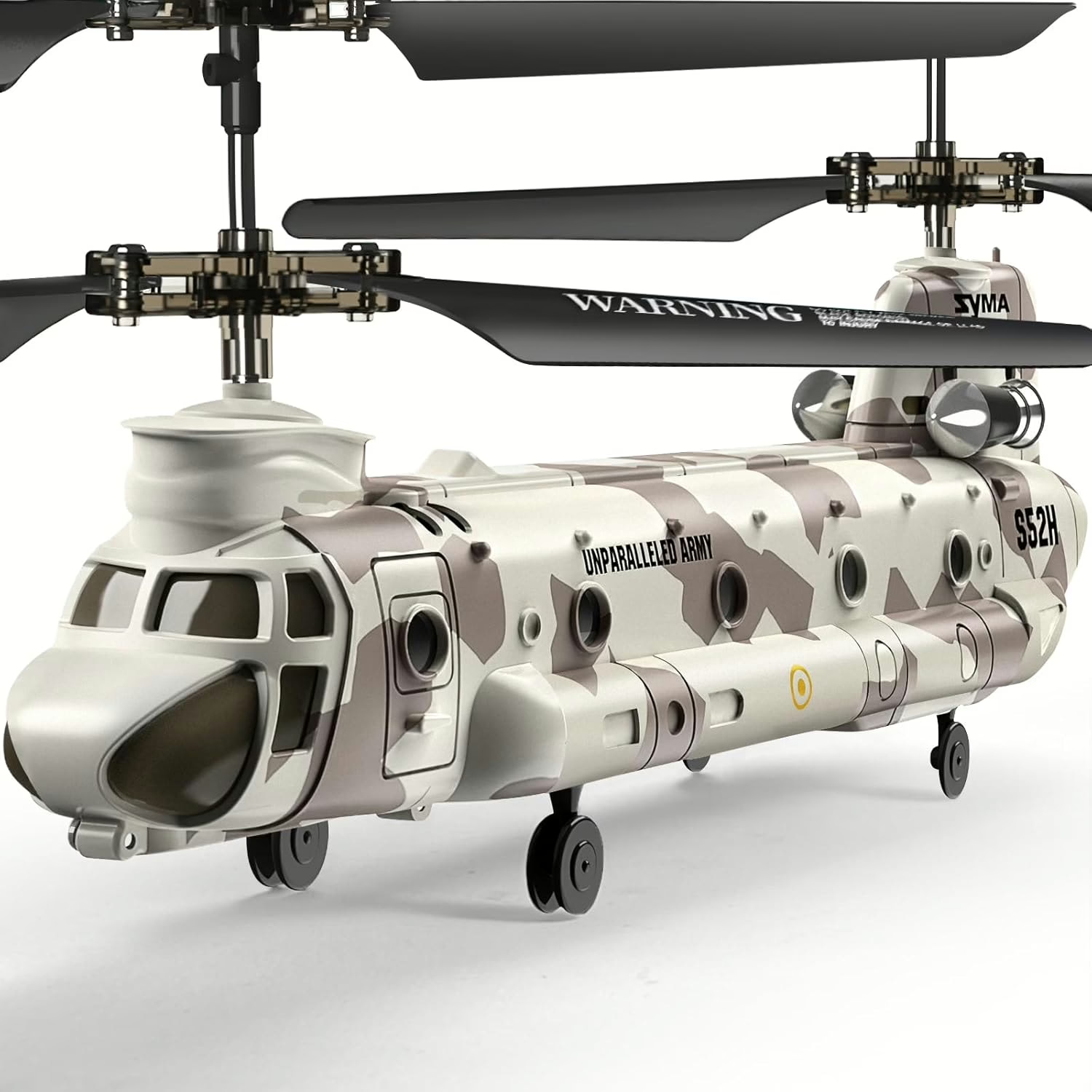
The S52H is a three-channel, fixed-pitch micro-helicopter built around the visual identity of the heavy-lift Boeing CH-47 Chinook. Measuring 10 x 1.45 x 4 inches and tipping the scale at just 47 grams, it’s engineered for confined indoor spaces, featuring a twin tandem-rotor layout, desert camouflage detailing, integrated LED navigation lights for spatial orientation, and an alloy-reinforced chassis wrapped in impact-resistant DuPont plastics.
The target audience is clearly defined: absolute beginners, younger hobbyists, and aviation history enthusiasts who want the visual payoff of military-scale rotary flight without the mechanical complexity of a collective pitch trainer. Because the S52H uses a fixed-pitch rotor mechanism rather than a Cyclic/Collective Pitch Mixing (CCPM) swashplate, it is built for relaxed indoor flight, not 3D aerobatics.
Four core design features define its value for that audience:
- 6-Axis Gyroscopic Stabilization continuously monitors pitch, roll, and yaw, countering un-commanded deviations before the pilot registers them.
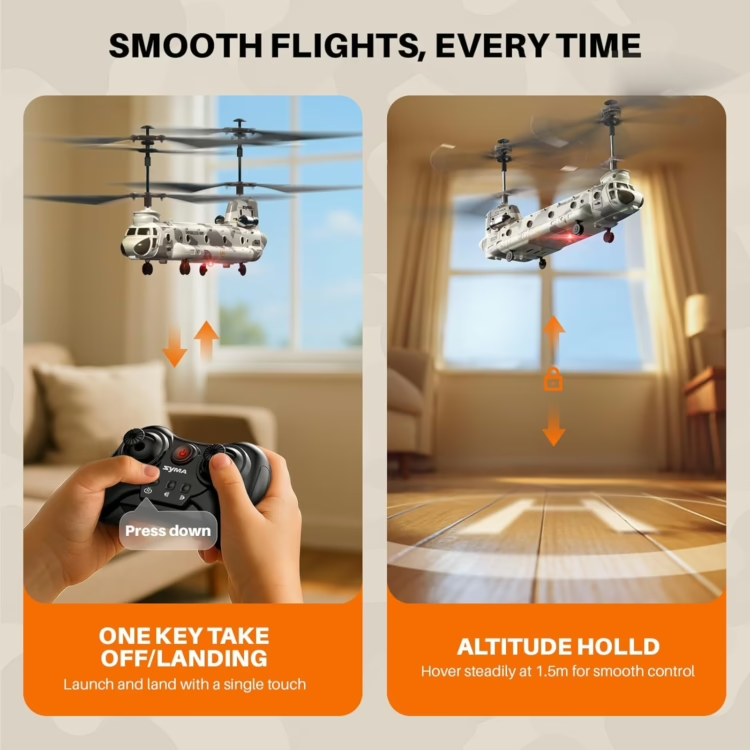
- Barometric Altitude Hold uses onboard air pressure sensing to lock the helicopter at a set height the moment the throttle returns to neutral—eliminating what is typically the most difficult skill for any beginner to master: constant, precise throttle management.
- One-Key Takeoff/Landing automates the most crash-prone phases of beginner flight through a dedicated transmitter button, smoothly lifting the aircraft to a stable hover altitude and returning it to the ground on command.
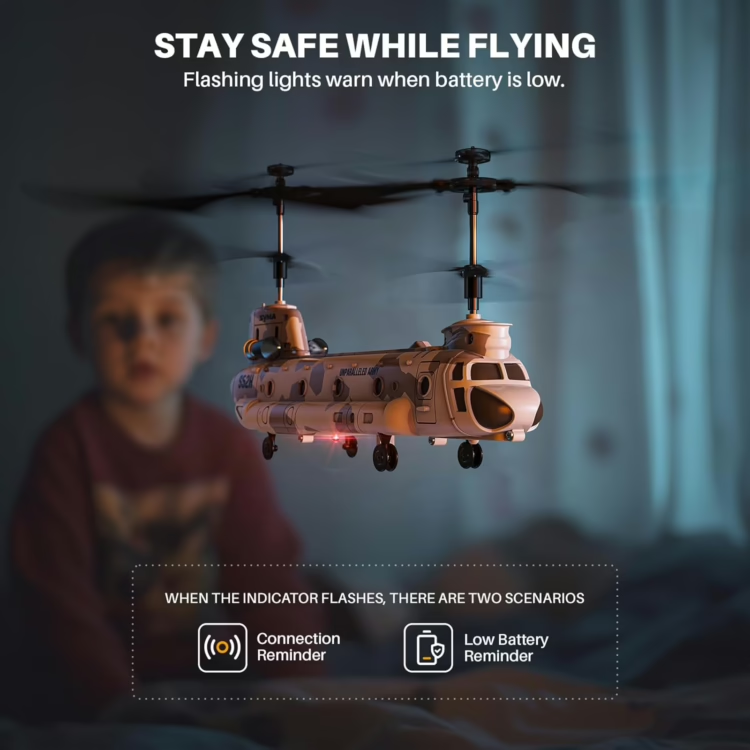
- Failsafe Double Protection instantly cuts motor current if the blades detect a physical obstruction, preventing ESC burnout and gear stripping, while a low-voltage LED alert signals the pilot before the battery hits critical depletion.
Check Current Price & Availability on Amazon
Together, these systems reduce the required skill level to near zero at the moment of first flight—which is precisely the design intent.
Pros & Cons
Pros
- Exceptional Structural Survivability: The alloy-reinforced chassis, DuPont plastics, and flexible folding blades absorb high-velocity impacts without dents, cracks, or drivetrain damage. Repeated crash testing produced no structural degradation and required no replacement parts.
- Zero-Friction First Flight: Barometric altitude hold combined with one-key auto-takeoff reduces required pilot skill to near zero. Beginners achieve a stable, controlled hover within seconds of arming the aircraft.
- Electronic Failsafe Architecture: The proprietary double-protection system cuts motor current on blade contact, dramatically extending brushed motor and ESC lifespan and protecting the drivetrain through an abusive learning phase.
- Scale Authenticity: The tandem-rotor layout, military camouflage finish, and LED navigation lights deliver visual presence that standard pod-and-boom micro-helis can’t match.
Cons
- Severe Wind Susceptibility: At 47 grams with no cyclic roll authority, the aircraft is entirely unsuitable for outdoor flight. Breezes under 5 mph cause uncontrollable translational wind drift.
- Non-Swappable Battery: The internal 3.7V 150mAh LiPo cannot be hot-swapped. Six to eight minutes of flight requires a 30-minute tethered USB recharge, preventing back-to-back sessions.
- Asymmetric Flight Dynamics: The simplified pitch mechanism drives the aircraft backward noticeably faster than it moves forward, requiring pilots to anticipate asymmetric braking distances at all times.
- Limited Control Envelope: The 3-channel architecture lacks cyclic roll (aileron) input, forcing robotic stop-yaw-go turns and establishing a low ceiling for aerodynamic skill progression.
The Real-World Utility Test
Out-of-the-Box Setup and RF Binding
The S52H arrives in RTF (Ready-To-Fly) configuration—zero mechanical assembly required before the maiden flight. The retail package includes the helicopter, a proprietary USB charging cable, a small Phillips-head screwdriver, four replacement rotor blades, a miniature cardboard landing pad, and the 2.4GHz transmitter. One friction point surfaces immediately: the transmitter requires four AAA batteries, which are not included. Anyone expecting to fly straight out of the box will need to make a quick detour.
The transmitter itself is compact, deliberately sized for smaller hands, and features digital trim buttons, a mode selection switch, and a shoulder-mounted auto-takeoff/landing button. The RF binding sequence is manual and specific: power on the helicopter, wait for the LED to flash, power on the transmitter, then cycle the left throttle stick fully up, fully down, and back to center. A solid LED confirms the 2.4GHz link is secured and the flight controller is armed. Unlike advanced protocols such as DSMX or ExpressLRS (ELRS)—which use Frequency Hopping Spread Spectrum (FHSS) and Direct Sequence Spread Spectrum (DSSS) to manage high-density RF environments with microsecond latency—the Syma protocol is a closed-loop short-range system. Within typical indoor environments, the signal holds reliably with no perceptible latency during basic hovering maneuvers.
Tandem Aerodynamics vs. 3-Channel Toy Mechanics
Understanding what the S52H actually does in the air requires some context on what it doesn’t do. In a full-scale Boeing CH-47, forward flight is achieved through differential collective pitch: increasing pitch on the aft rotor while simultaneously reducing it on the forward rotor tilts the net aerodynamic thrust vector forward without physically changing the rotor mast angle. The S52H operates on a fundamentally different principle. Its tandem rotors are fixed-pitch, so altitude is governed entirely by modulating brushed motor RPM. Forward and backward translation is driven by a horizontally mounted tail motor that physically raises or lowers the tail section, tilting the entire airframe to redirect thrust. This eliminates CCPM swashplate complexity entirely—but it also eliminates the fourth channel: cyclic roll, which would allow the aircraft to bank laterally and strafe.
In practice, changing direction requires stopping forward momentum, yawing the nose to the new heading, and pushing forward again. The flight path is deliberate and angular rather than fluid. For a beginner focused on basic spatial orientation and nose-in flying, this is a workable constraint. For a pilot hoping to build muscle memory transferable to a 3D collective pitch machine, it’s a genuine developmental problem.
The Barometric Dipping Phenomenon and Asymmetric Control
Two specific aerodynamic quirks emerge during the indoor flights that prospective buyers need to understand. The first is the barometric dipping phenomenon. The altitude hold system reads ambient static air pressure to maintain height, and it performs consistently well in still air. In rooms with active HVAC systems, ceiling fans, or open windows, localized pressure gradients can momentarily fool the sensor, causing the flight controller to reduce motor RPM and drop several inches without pilot input. Passing through these pressure zones requires brief manual throttle correction to maintain a smooth flight path.
The second issue is directional asymmetry. The S52H accelerates backward measurably faster than it translates forward—a byproduct of the simplified pitch mechanism. Navigating tight indoor spaces requires anticipating different braking distances depending on direction of travel. Precision landing on the included cardboard “H” pad proved consistently challenging, further complicated by Ground Effect turbulence when the rotors operate within a few inches of a hard surface.
Outdoor Operation
Despite manufacturer suggestions that windless outdoor conditions are viable, empirical testing strongly contradicts this. In breezes under 5 mph, the aircraft demonstrated complete loss of directional authority. As horizontal wind passes over the rotor disc, Translational Lift causes the helicopter to balloon upward and backward; because the S52H lacks the cyclic authority to punch its nose down and penetrate the oncoming air, it acts as a sail. Outdoor deployment in any realistic backyard or park environment is not advisable—in meaningful wind, the aircraft will simply be carried away.
Where the SYMA CH-47 RC Chinook Really Shines
Unprecedented Structural Survivability
The most striking characteristic of the S52H is its crash resilience. Conventional single-rotor trainers carry an inherent Achilles’ heel: the long, exposed tail boom that fails when main blades flex downward on a hard impact—the classic “boom strike” that ends flight sessions and opens wallets. The S52H has no exposed tail boom to strike. The tandem-rotor layout places both lifting rotors directly over a dense alloy-and-DuPont-plastic fuselage, distributing impact forces across a far more robust structure.
During evaluation, the aircraft was intentionally flown into walls, dropped from maximum indoor altitudes, and driven into heavy furniture. In every instance, the folding rotor blades absorbed kinetic energy elastically, and the jamming protection system cut motor current before gears could strip or ESCs burn out. Post-impact, the chassis showed no dents, cracks, or mechanical degradation whatsoever. The pilot simply repositioned the aircraft upright and initiated another auto-takeoff—no tools, no parts, no downtime. Traditional single-rotor micro-helis in the same price bracket would not survive this treatment.
The Democratization of Rotary Flight
The deeper value of the S52H is less mechanical than psychological. For children and first-time pilots, the fear of destroying an expensive item frequently paralyzes the learning process before it ever really begins. The integrated 6-axis gyro and barometric altitude hold function as a permanent, invisible safety net: release the sticks in a moment of panic, and the aircraft simply brakes, stabilizes, and holds position, waiting for the next command.
This frees beginners to focus entirely on spatial orientation—particularly the cognitive challenge of nose-in flying, where directional inputs reverse in the pilot’s mind as the aircraft faces them—without simultaneously managing throttle to prevent a descent. Paired with the authentic tandem-rotor silhouette and bright LED navigation lights, the S52H functions as a genuinely engaging educational tool that builds aviation intuition, spatial geometry awareness, and an appreciation for rotary mechanics. The absence of 3D capability is entirely irrelevant to the father and son flying on a rainy Saturday afternoon; what matters is the controlled landing on the coffee table and the grin that follows.
Check Current Price & Availability on Amazon
The Value-to-Performance Ratio
Comparative Market Analysis
The following table contextualizes the S52H against its most relevant beginner-oriented competitors in the 2026 market.
| Aircraft | Stabilization | Control Scheme | Environment | Primary Advantage / Limitation |
| SYMA S52H Chinook | 6-Axis Gyro + Barometer | 3-Channel (No Roll) | Strictly Indoor | Advantage: Supreme crash durability and unique tandem scale aesthetic. Limitation: Cannot fly outdoors; no lateral cyclic control. |
| Blade Nano S3 | AS3X + SAFE Auto-Level | 6-Channel eCCPM | Indoor / Backyard | Advantage: True 3D mechanics; skill progression transfers to professional 700-class machines. Limitation: Higher fragility and cost; requires Spektrum DSMX transmitter. |
| RC ERA C032 Huey | Optical Flow + TOF Laser | 4-Channel (With Roll) | Indoor / Light Wind | Advantage: TOF obstacle detection prevents wall strikes; superior 3D position-holding. Limitation: Proprietary charging; struggles in moderate outdoor wind. |
| WLtoys K170 | 6G Electronic Gyro | 4-Channel FBL | Light Outdoor | Advantage: Brushless main motor provides long lifespan and high top speed. Limitation: Higher rotational mass increases damage potential during crashes. |
The S52H occupies a tightly defined niche at the most accessible end of the beginner tier. The Blade Nano S3 is the stronger choice for pilots committed to long-term aerodynamic progression—its 6-channel eCCPM setup with AS3X stabilization builds muscle memory that transfers directly to professional 700-class 3D machines. But the Nano S3 is significantly more fragile, more mechanically complex, and represents a considerably higher financial risk for an absolute beginner. The RC ERA C032 Huey goes further with 4-channel control (introducing cyclic roll) and optical flow sensors that lock the aircraft in a 3-dimensional position grid by reading floor texture—a capability the S52H lacks entirely, meaning it will drift laterally over time and requires minor continuous pilot input to hold a static position. The S52H’s 3-channel constraint is its most defining aerodynamic limitation; without aileron control, every directional change is a stop-yaw-go sequence rather than a fluid banking turn.
Electrical Efficiency and Component Lifespan
The S52H relies on traditional brushed micro-motors—inexpensive to manufacture, but dependent on physical carbon brush-to-commutator contact that generates heat and progressive mechanical wear over sustained flight hours. Premium competitors like the WLtoys K170 employ brushless main motors that operate through magnetic induction without physical contact, delivering substantially longer service life.
Power comes from an internal 3.7V (1S) 150mAh LiPo, calculating to approximately 0.555 Watt-hours of total energy capacity. The conservative power draw keeps operation inherently safe for younger users, but the non-modular battery design is the S52H’s most disruptive daily friction point. Verified flight time falls between 6 and 8 minutes per charge; the aircraft then requires approximately 30 minutes of tethered USB recharging before the next session. That 4:1 ratio of charge time to flight time interrupts the learning momentum in a way that modular smart battery systems—standard equipment across many 2026 competitors—eliminate by allowing pilots to swap pre-charged packs from their pocket in seconds.
Final Verdict on Value
Despite the non-swappable battery and the aerodynamic ceiling imposed by 3-channel operation, the S52H delivers genuine value for its intended use case. It strips away every complex variable—ATV tuning, ESC soft-start programming, blade angle balancing—and provides a zero-maintenance, economical introduction to basic aviation principles. It is not a platform that will take a pilot toward 3D aerobatics. It is a platform engineered with precise singular intent: to ensure that the first experience with radio-controlled flight is defined by excitement and success, not mechanical frustration and broken parts.
Who Should Buy It
Buy the SYMA CH-47 RC Chinook if you are:
- An absolute beginner or parent buying for a child (ages 8 and up) who needs a highly forgiving, effectively unbreakable platform for learning basic spatial orientation, yaw control, and throttle management. The financial risk of an early crash is negligible; the structural risk to the aircraft is nearly nonexistent.
- An indoor aviation enthusiast living in an apartment, a densely populated urban area, or a cold-climate region who wants a quiet, furniture-safe aircraft for living room operation.
- A military scale collector who values the functioning twin-rotor aesthetic of the Boeing CH-47 Chinook and wants a durable, working model rather than a high-performance aerobatic machine.
Avoid the SYMA CH-47 RC Chinook if you are:
- A pilot targeting 3D aerobatic progression. The 3-channel architecture with no aileron control builds no transferable muscle memory and will actively hinder advancement toward collective pitch flying. Look instead at the Blade Nano S3 or Blade Infusion 120—both offer 6-channel eCCPM platforms with AS3X or SAFE technology built for progression.
- An outdoor operator. The sub-50g airframe and absence of cyclic roll authority render the S52H incapable of fighting outdoor wind. Breezes under 5 mph will carry it, and anything stronger will guarantee a loss.

Key Takeaways
- Near-indestructible build quality: The alloy chassis, DuPont plastics, and folding blades absorb repeated hard crashes without structural damage, eliminating repair costs through the entire beginner learning phase.
- Instant, stress-free hover: Barometric altitude hold, and one-key auto-takeoff deliver a stable hover within seconds of arming—no prior stick time required.
- Strictly indoor operation: At 47 grams with no cyclic roll, the aircraft cannot penetrate outdoor wind; even breezes under 5 mph cause complete loss of directional control.
- Battery limits session continuity: The integrated 150mAh LiPo provides 6–8 minutes of flight but demands a 30-minute tethered USB recharge between sessions.
- 3-channel ceiling: The absence of aileron control limits aerodynamic progression; pilots targeting 3D mechanics should step up to a 6-channel eCCPM trainer from the outset.