
Three B-29s landed on Soviet soil in 1944 and a fourth crashed. Here’s how the Tu-4 matched the Superfortress outside, broke from it inside, and helped push North America to guard the Arctic
On July 29, 1944, U.S. Army Air Forces (USAAF) Capt. Howard R. Jarrell turned the Boeing B-29 Superfortress Ramp Tramp, serial 42-6256, toward the Vladivostok area on the way back from a raid in Manchuria. Smithsonian aviation historian Von Hardesty reports that the bomber had electrical trouble and a radio that could receive but not transmit. In Hardesty’s account, Jarrell expected to be repaired, refueled and sent on his way. Instead, the Soviets interned the crew and kept the airplane. By November 21, 1944, three B-29s had landed intact in the Soviet Far East. A fourth had crashed after its crew bailed out, and Soviet teams recovered parts from the wreck.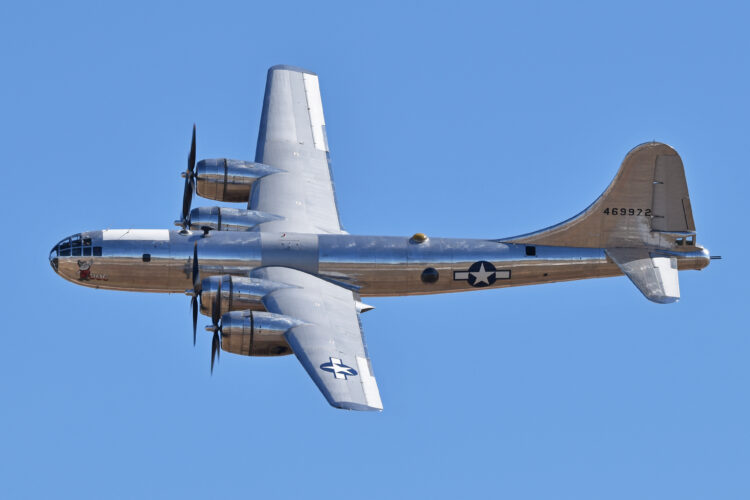
What happened next is the heart of any B-29 vs. Tu-4 comparison. Under a two-year deadline set by Joseph Stalin, Andrei Tupolev’s design bureau and about 900 factories, institutes and other organizations turned the American bomber into the B-4, later called the Tu-4. It first flew on May 19, 1947. From the outside it was nearly a twin of the B-29: 99 ft (30.18 m) long with a 141 ft 3 in (43.05 m) wingspan. Inside it had Soviet Shvetsov ASh-73TK engines, metric-gauge aluminum, Soviet Kobalt radar and, on later aircraft, 23 mm cannons.
The consequences went well beyond engineering. On October 18, 1951, a Tu-4 made the first Soviet air-dropped atomic test, and the bomber’s appearance added to the pressure that led North America to build northern radar lines and eventually the North American Air Defense Command (NORAD). Here is how the copy was made, where it departed from Boeing’s design, and which famous stories don’t hold up.
Why Stalin Needed America’s $3 Billion Bomber
The B-29 was the most ambitious bomber program of its era. Its documented origins go back to December 2, 1939, when Gen. Henry H. Arnold notified industry of a new bomber requirement. Boeing submitted its design on May 1, 1940, and the XB-29 prototype first flew on September 21, 1942. Boeing’s company history lists 2,766 aircraft built by Boeing in Wichita, Kansas, and Renton, Washington, 668 by Bell Aircraft in Georgia, and 536 by Glenn L. Martin in Nebraska. That is 3,970 in total, and production ended in 1946. The National WWII Museum puts the B-29 program at approximately $3 billion in wartime dollars, compared with about $2 billion for the Manhattan Engineer District’s atomic bomb effort.
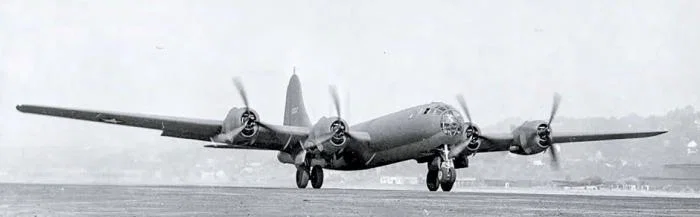
The money paid for a combination no other bomber had at the time: pressurized crew cabins, powerful engines, radar and centralized defensive fire control, all needed for high-altitude operations. The type flew its first combat mission on June 5, 1944, against railway workshops at Bangkok, Thailand. That mission was part of Operation Matterhorn, a campaign flown from bases in the Calcutta and Chengdu regions that placed heavy demands on transport and construction.
Moscow had nothing like it. Soviet air power existed mainly to support the land war. The only modern Soviet four-engine heavy bomber, the Petlyakov Pe-8, was available in modest numbers. Hardesty cites an estimate of just 32 serviceable Pe-8s around spring 1945. Older Tupolev four-engine designs, including the TB-3, were from an earlier generation.
Historians disagree about when Moscow first learned of the B-29. Air historian Walter J. Boyne, in his Air & Space Forces Magazine feature “Carbon Copy Bomber,” ties Soviet awareness to a visit by World War I ace Eddie Rickenbacker in June 1943. In his Air & Space account “Made in the U.S.S.R.,” Hardesty dates the visit to 1942 and says Soviet intelligence already knew about the bomber. The Associated Press reported Rickenbacker in Moscow on June 23, 1943, and U.S. Ambassador William H. Standley’s July 5 telegram describes how he was received. Neither record shows what, if anything, he said about the B-29. What is clear is that Washington refused to supply B-29s under Lend-Lease. Boyne gives 120 as the number of aircraft in one Soviet request.
Tupolev had a long-range bomber of his own on the drawing board, called Samolet 64 (samolet is Russian for aircraft). The Tupolev design encyclopedia by Anatoly Zatuchny, Vladimir Rigmant and Pyotr Sineoky records a September 1943 proposal, a preliminary design finished in August 1944, and a mock-up approved in April 1945. The project still lacked compatible bombing and navigation equipment. A flyable B-29 offered a complete, proven system that Soviet engineers could study.
Four Stranded Superfortresses: How America’s B-29s Fell Into Soviet Hands
Diplomacy explains why the bombers never went home. The USSR and Japan had signed a neutrality pact in Moscow on April 13, 1941. Its Article Two required each side to stay neutral if the other became the object of hostilities by a third power. There was already a precedent. After the April 1942 Doolittle Raid, Capt. Edward York landed his North American B-25 Mitchell in the Vladivostok area, and Soviet authorities interned his crew.
The 1944 arrivals all came from the USAAF’s China-based B-29 campaign, which flew from a network of airfields around Chengdu. The table below follows Boyne’s printed airframe ledger and shows how each aircraft was used.
| Date (1944) | Serial and name | Commander and unit | What happened and Soviet use |
| July 29 | 42-6256, Ramp Tramp | Capt. Howard R. Jarrell, 770th Bombardment Squadron, 462nd Bombardment Group | Forced landing in the Vladivostok area; kept as the flying example for evaluation and later experiments |
| August 20 | 42-93829, Cait Paomat II | Maj. R. McGlinn, 395th Bombardment Squadron, 40th Bombardment Group | Crashed after the crew bailed out; parts recovered from the wreck |
| November 11 | 42-6365, General H. H. Arnold Special | Capt. W. H. Price, 794th Bombardment Squadron, 468th Bombardment Group | Landed in the Vladivostok area; taken apart in Moscow to document its structure and systems |
| November 21 | 42-6358, Ding Hao! | 1st Lt. W. Micklish, 794th Bombardment Squadron, 468th Bombardment Group | Landed in the Vladivostok area; kept on the ground as the intact reference aircraft |
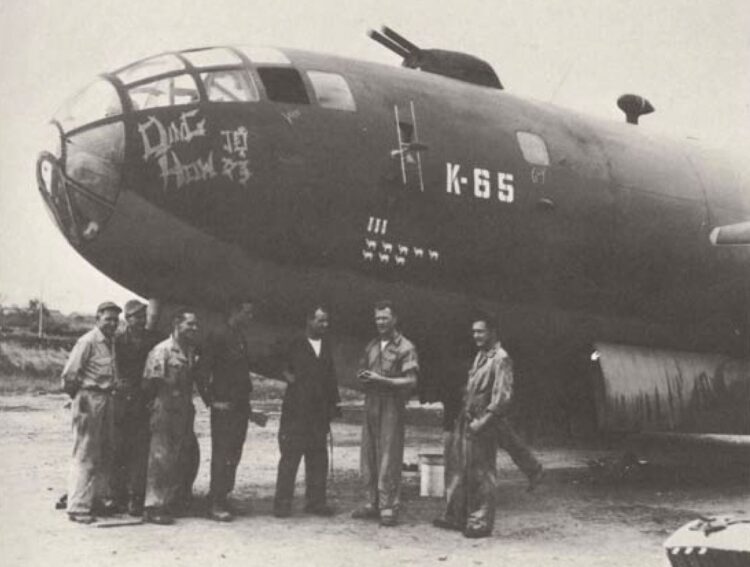
Each airframe gave the Soviets a different kind of evidence. Ramp Tramp showed how the whole machine behaved in the air. Ding Hao! (written Ding How in Hardesty’s account) preserved how the systems and fittings related to each other. The General H. H. Arnold Special supplied measurements and material samples, and the wreck added spare material. That is why accounts mention both three interned bombers and four airframes.
Soviet bomber pilot and memoirist Vasiliy Reshetnikov, in Hardesty’s English rendering, called the arrival of the intact B-29s a “gift from God” (dar Bozhii in Russian).
The crews had a longer and quieter ordeal. Boyne puts the number of American airmen held in Soviet custody during the war at nearly 300, a figure that includes many crews besides the B-29 men. The U.S. side of the U.S.–Russia Joint Commission on Prisoners of War and Missing in Action counted 291 American fliers from 37 crews between April 1942 and September 1945, including five B-29 crews in 1944–45. The commission recorded five release operations, among them January 30 and May 27, 1945, and named the Soviet foreign affairs and internal affairs commissariats as participants. Boyne describes released airmen passing through Uzbekistan and Turkmenistan toward a secret transfer into Iran, and says they were asked to avoid publicity. Neither government published a crew-by-crew account of the B-29 releases.
Meanwhile, the Soviet Navy began evaluating the bombers. Hardesty credits Adm. Nikolai Gerasimovich Kuznetsov, the naval commissar, and Lt. Col. Semyon Borisovich Reidel, a naval flight-test officer, with the first work. Reidel flew Ramp Tramp to a base near Romanovka on January 9, 1945, and his team relied on manuals that came with the aircraft. Boyne describes a January–July 1945 program, after which the three flyable bombers went to Izmailovo and the 65th Special Mission Air Regiment under Air Marshal Alexander Golovanov’s authority.
Stalin’s Two-Year Deadline: Inside Tupolev’s 900-Factory Copying Program
The decision came in June 1945. The Tupolev encyclopedia records a June 6, 1945 State Defense Committee decision, No. 8934, to organize production at Plant No. 22 in Kazan. On June 22, an order from the aviation industry commissariat directed B-4 production at that plant. A certified copy is held in the National Archive of the Republic of Tatarstan. Hardesty treats June 22 as the formal program launch and says Samolet 64 was canceled at the same time. Tupolev had estimated the job would take three years. Stalin gave him two.
The political climate was dangerous. Boyne notes that Tupolev had been arrested in 1937, worked from 1939 in a sharashka (a prison design bureau), was released in 1941 and was not formally pardoned until 1955. Leonid Kerber, Tupolev’s radio and navigation specialist, later wrote a memoir published in English as Stalin’s Aviation Gulag. Hardesty, who interviewed Kerber in 1991, says Kerber recalled that Tupolev preferred his own long-range design and that the state assigned him the copy anyway. The aviation industry was also in turmoil. Russia’s Central Air Force Museum dates the removal and arrest of air force commander Alexander Alexandrovich Novikov to April 22, 1946. It describes his forced confession and prison sentence, and names wartime aviation commissar Alexei Ivanovich Shakhurin among those convicted in the same aviation case. Novikov was rehabilitated in 1953 after the proceedings were closed for lack of a crime.
Hardesty dates Tupolev’s inspection of the B-29 to July 10, 1945. The teardown took place at Moscow’s Central Airfield, in a hangar big enough to hold the General H. H. Arnold Special. Boyne describes teams documenting each assembly, weighing and photographing parts, and identifying their materials, from the airframe to instruments, wiring, fasteners, and nonmetallic items. In a CBS News report on a 2001 panel at the Russian Embassy in Washington, D.C., Hardesty summed up the process:
“They took it apart component by component, panel by panel, almost rivet by rivet,” he said.
The scale was enormous. CBS and Hardesty both report about 105,000 parts examined and about 40,000 drawings produced, and the two numbers should not be confused. The Tupolev encyclopedia separately records around 40,000 drawings, completed in March 1946. The encyclopedia puts the number of participating factories, institutes and other organizations at around 900. Published histories describe 12–14-hour days and seven-day weeks during the most intense periods, and Hardesty describes stretches with one day off a month.
Running a program that size took its own system. Tupolev divided specialties across his bureau. Project lead Dmitriy Markov and team leaders turned measurements into drawings and parts orders for outside factories. Hardesty describes a progress display, direct calls to factories, named managers for each ministry, and an escalation route through Lavrentiy Pavlovich Beria’s security apparatus. Industries well beyond aircraft plants had to supply unfamiliar parts or equivalents, including metallurgy, electrical equipment, rubber, plastics and instruments. Production went to Plant No. 22 in Kazan, and later Plant No. 18 in Kuibyshev (today’s Samara) and Plant No. 23 at Fili in Moscow joined. Kerber described the result as an “analog” of the B-29.
B-29 Vs Tu-4: Why The “Exact Copy” Was Really A Soviet Re-Engineering Feat
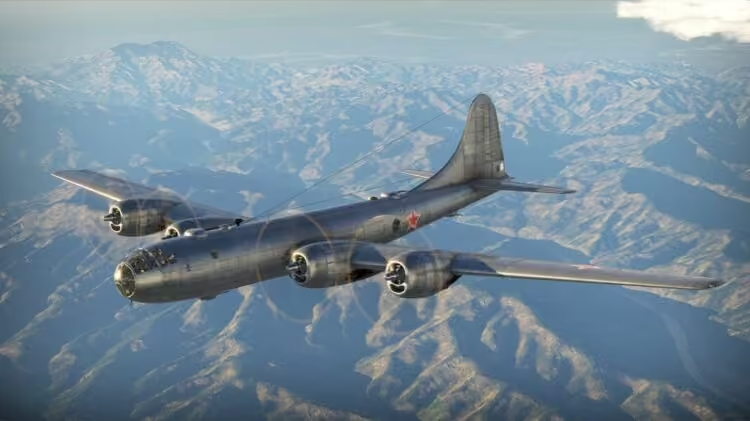
From the outside, the Boeing B-29 Superfortress and Tupolev Tu-4 are almost indistinguishable. Their span and length are nearly identical, their heights are within a few inches, both have pressurized crew sections joined by a tunnel over the bomb bays, and both use remotely controlled defensive gun stations. The tunnel mattered because crew members could move through the aircraft without the whole fuselage being pressurized. Underneath that shared shape, Soviet engineers had to change four major things.
Metal. American stock sizes had no direct Soviet equivalent. Hardesty uses a 1/16 in panel (1.5875 mm) as an example: engineers had to test domestic sheets of different thicknesses against each part’s strength and weight requirements. Boyne reports that the result came within 1% of its intended design weight. Hardesty’s separate 1% figure compares the finished aircraft with the B-29, so the two percentages measure different things.
Engines. The Tu-4 did not copy the Wright R-3350 as a whole. It used Arkady Shvetsov’s ASh-73TK, a domestic radial engine from a line influenced by earlier licensed Wright designs and rated at about 2,300 hp in Hardesty’s and Boyne’s accounts. According to the Tupolev encyclopedia, some accessories were copied, including turbocharger equipment, magnetos and heat-resistant bearings. Neither engine was trouble-free in early service. Hardesty documents engine overheating, propeller problems and landing-gear failures on early Tu-4s. At the 2001 embassy panel, Tupolev Museum director Vladimir Rigmant told the audience, “Our engines caught on fire as well as the American ones.” His remark shows that both programs had problems. It does not show that they had them at the same rate.
Guns. The Soviets kept the B-29’s central remote fire-control principle but changed the weapons. The Tupolev encyclopedia says early aircraft carried 20 mm B-20 cannons and later ones 23 mm NR-23s. Hardesty and a Russian museum catalog document NS-23 cannons. Later descriptions give ten 23 mm guns in five remote turrets. Boyne emphasizes how hard it was to reproduce the analog fire-control system.
Electronics. Documented Tu-4s carried the Soviet Kobalt bombing radar in place of the AN/APQ-13, and later or alternate fits included Kobalt-M and Rubidiy. Whether the entire system directly duplicated the American set has not been established. A peer-reviewed study of Soviet aviation technology transfer documents later Soviet radio and instrument substitutions, some of which drew on features learned from U.S. equipment.
Hardesty’s verdict sums up the mix: “the dominant genes were Boeing’s, and the recessive genes were Tupolev’s.”
The table below compares published figures. Each number belongs to a specific source and configuration, and the two aircraft were never flown under a common test program. Range and ceiling depend on load, altitude and how each source defines the mission, so treat the rows as approximate rather than as a direct contest.
| Metric | Boeing B-29 Superfortress | Tupolev Tu-4 |
| First flight | XB-29, Sept. 21, 1942 | B-4, May 19, 1947 (Nikolai Rybko) |
| Engines | 4 × Wright R-3350 Duplex Cyclone, 2,200 hp each (Boeing) | 4 × Shvetsov ASh-73TK, about 2,300 hp each (Hardesty, Boyne) |
| Length | 99 ft | 99 ft (30.179 m) |
| Wingspan | 141 ft 3 in | 141 ft 3 in (43.047 m) |
| Height | 28 ft (Museum of Flight aircraft) | 27 ft 9 in (8.46 m) |
| Takeoff weight | 105,000 lb gross (Boeing); 133,500 lb maximum (museum profiles) | 105,490 lb (47,850 kg) normal takeoff mass |
| Maximum speed | 357 mph (museum profiles); 365 mph (Boeing) | 347 mph (558 km/h) at about 33,630 ft (10,250 m) |
| Service ceiling | 33,600 ft (museum profiles); 31,850 ft (Boeing) | About 36,745 ft (11,200 m) practical ceiling |
| Published range | 5,830 statute miles (Boeing; bombload not stated) | 3,915 statute miles (6,300 km) with 6,614 lb (3,000 kg) of bombs |
| Maximum bombload | 20,000 lb (Boeing) | About 17,637 lb (8,000 kg) (Tupolev encyclopedia) |
| Defensive guns | .50-caliber machine guns plus a 20 mm cannon (Boeing profile) | 20 mm B-20s on early aircraft; ten 23 mm cannons in five turrets on later ones |
| Bombing radar | AN/APQ-13 or AN/APQ-7, depending on mission | Kobalt |
| Crew | 10 (Boeing table) to 11–13, depending on mission | 11 |
| Number built | 3,970 | Disputed (see below) |
Fact Vs Folklore: The Drill Hole, The Flak Patch, And The Missing Production Count
The strict copying rule had a practical reason. With scores of design bureaus and many factories involved, any local change could ripple through interfaces, weights and assembly. Kerber also recalled that a deviation could be read as disobedience, with personal or police consequences. Both pressures were real, and together they produced a culture that discouraged improvisation. That culture is also where the best-known legends started.
The most famous is the drill hole. Author Viktor Suvorov put it in print in his Russian-language book Osvoboditel (The Liberator). In translation, his line reads: “Thus a tiny hole, drilled with the thinnest bit, appeared in the left wing of every Tu-4 strategic bomber.” The 2006 edition describes the book as a novel, and no evidence has confirmed that any such hole was copied across the fleet.
The damage-patch story has some basis. Citing his 1991 interview with Kerber, Hardesty describes a fuselage repair patch that was replicated, along with copied interior paint colors. He calls stories about reproducing wing flak damage exaggerated. A single reported fuselage patch is far narrower than battle damage reproduced on every production airframe, and no inspection of production aircraft has shown a fleet-wide pattern. Other stories have no confirmation at all. No surviving part or contemporary report confirms “Boeing” markings on rudder pedals. No evidence ties a two-color tunnel to a Boeing paint shortage. No owner, artifact or inventory order supports the tale of a crewman’s Leica camera becoming standard equipment.
The real safeguard was Ding Hao!, kept intact on the ground so engineers could check the dismantled aircraft against a complete original instead of relying on memory.
The production count is harder to settle. The figures below come from different sources and count different things. Some are factory totals, some are estimates of aircraft in operational units, and some are intelligence projections.
| Figure | What it represents |
| 845 | Korean War-era fleet figure cited by Hardesty from newly uncovered archives |
| 847 | Estimate attributed to Russian aviation historian Ivnamin Sultanov |
| 850 | Total reported in CBS’s 2001 coverage |
| About 1,000 | Approximate estimate attributed to project chief Dmitriy Markov |
| 1,296 | 1948–1953 series attributed to aviation writer Nikolay V. Yakubovich and Russian State Archive of the Economy materials |
| 1,672 | CIA estimate of total production since 1947, dated June 4, 1953 |
| About 1,100 | 1954 U.S. intelligence estimate of aircraft in operational units as of July 1, 1954 |
The CIA’s 1953 paper also estimated 900–1,000 operational Tu-4s. None of these intelligence figures came from Soviet factory returns. Nuclear Companion’s transcription of the archival plant figures gives the year-by-year breakdown below, which peaks at 421 aircraft in 1951.
| Plant | 1948 | 1949 | 1950 | 1951 | 1952 | 1953 | Total |
| No. 22, Kazan | 17 | 120 | 177 | 191 | 150 | — | 655 |
| No. 18, Kuibyshev | — | 41 | 108 | 150 | 166 | 16 | 481 |
| No. 23, Fili | — | — | 27 | 80 | 52 | 1 | 160 |
| Total | 17 | 161 | 312 | 421 | 368 | 17 | 1,296 |
The same summary gives a Kazan Aircraft Production Association figure of 644 for Plant No. 22. It is also unclear whether the table includes the earliest aircraft. A Polytechnic Museum catalog records 20 early series aircraft by the end of 1947, while the Tupolev encyclopedia places 20 series aircraft at the end of 1948. Because the figures count different things, 847 and 1,296 should not be read as the low and high ends of a known total. Each is a separate published count that only makes sense alongside its source and scope.
The Tushino Shock, The First Soviet Atomic Airdrop, And America’s Arctic Shield
The Soviet copy moved quickly from drawings to hardware. The Tu-70 passenger prototype, which used parts and systems from the B-29/B-4 family, first flew on November 27, 1946. Boyne dates the first B-4 rollout at Kazan to February 28, 1947, and test pilot Nikolai Stepanovich Rybko flew it on May 19, 1947. That was about 23 months after the June 1945 launch.
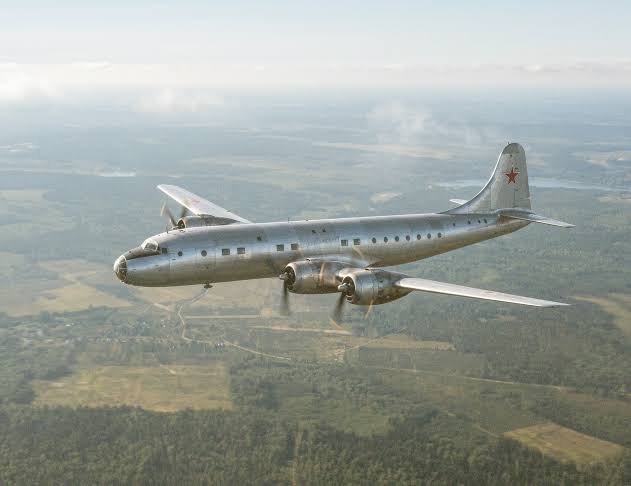
The West saw it on August 3, 1947, at the Tushino Aviation Day display in Moscow. Three B-4/Tu-4 bombers flew over, one of them flown by Air Marshal Alexander Yevgenyevich Golovanov, followed by the Tu-70. Hardesty and Boyne both describe Western observers first guessing that the trio were the interned American aircraft, and realizing otherwise when the unfamiliar airliner appeared. A declassified June 4, 1953 CIA assessment put it plainly: “The TU-4 was a surprise to intelligence when first seen by Western observers at Tushino Airport, Moscow, on Soviet Aviation Day, 3 August 1947.”
The Tu-4, called “Bull” by the North Atlantic Treaty Organization (NATO), was formally accepted into Soviet service on May 11, 1949, according to the Tupolev encyclopedia. Boyne reports that more than 270 were assigned to Long-Range Aviation regiments by 1950. A specialized nuclear-capable version, the Tu-4A, received changes that included a heated bomb bay. On October 18, 1951, a Tu-4 dropped the RDS-3 device over the Semipalatinsk test site in the Kazakh Soviet Socialist Republic, now Kazakhstan. It was the first Soviet air-dropped atomic test and came after the first Soviet nuclear test in August 1949. The Atomic Archive’s RDS-3 record gives a yield of 42 kilotons, matching the 0.042 megatons listed by the United Nations Scientific Committee on the Effects of Atomic Radiation (UNSCEAR).
U.S. intelligence took the threat seriously but also saw its limits. The 1954 Special National Intelligence Estimate (SNIE 11-7-54) described the Tu-4 as “the only bomber available to the Soviets in large numbers and capable of carrying nuclear weapons to distant targets.” The same estimate treated limited in-flight refueling and the state of Soviet bases as constraints. It assessed one-way missions or other ways of extending range as the means of reaching much of the continental U.S. Alaska and Canada were much closer to Soviet bases.
North America’s response came in stages. In a Ted Stevens Center for Arctic Security Studies history of the DEW Line, historian Kristi Swain links the Tushino appearance to growing Arctic-defense concern and a faster radar and interceptor buildup, including Alaska’s Aircraft Control and Warning (AC&W) network. Swain dates to September 1949 the U.S. Air Force study group that led to Project Charles, and MIT Lincoln Laboratory dates Project Charles itself to February–August 1951. MIT’s 1952 Summer Study recommended radar warning across northern North America, and the initial Distant Early Warning (DEW) Line became operational in 1957. The Semi-Automatic Ground Environment (SAGE) used computers to combine radar data for air-defense coordination. NORAD’s own history dates the command’s operational start at Ent Air Force Base in Colorado Springs, Colorado, to September 12, 1957, and the formal U.S.–Canadian agreement to May 12, 1958. Hardesty also links the Tu-4 and its jet successors to Nike missiles and radar-guided antiaircraft guns.
The Tu-4 was one cause among several. NORAD’s history also credits binational negotiations, earlier radar-line cooperation and joint defense planning, and newer Soviet bombers kept the pressure on. Swain notes that the U.S. had more than 1,000 bombers in 1955, and that Soviet security agencies’ custody of nuclear weapons limited operational readiness. The Central Air Force Museum calls the Tu-4 a step toward strategic parity. The 1954 U.S. assessment emphasized serious geographic and readiness limits.
Legacy Of The Bull: Soviet Industry, China’s Combat Tu-4s, And Three Survivors
The Tu-4’s biggest effect was on Soviet industry. The Polytechnic Museum catalog credits the program with upgrading Soviet aviation materials, onboard systems and industrial practice. Hardesty traces Tupolev’s system of cross-ministry accountability to Sergei Pavlovich Korolev’s later rocket and space programs. Boyne, a former director of the Smithsonian’s National Air and Space Museum and a retired U.S. Air Force colonel, wrote that “The Bull brought the entire Soviet aircraft industry, from its design bureaus to its most insignificant parts supplier, into the modern airpower age.”
The airframe also produced a family of variants. The Tu-4A was the limited nuclear-delivery version, the Tu-4K an anti-ship conversion for Soviet naval aviation, and the Tu-4D and Tu-4T troop and airborne-transport adaptations. The Tu-70 airliner never entered airline service, and the Tu-75 was a dedicated military transport. The Tu-80 enlarged the design, and the Tu-85 long-range piston bomber first flew on January 9, 1951, but planned production at the three Tu-4 plants never happened. The twin-jet Tu-16 and four-turboprop Tu-95 replaced the type in front-line service. The Federation of American Scientists dates the start of those replacements to 1954 and 1956, and some converted Tu-4s stayed in other roles into the 1960s.
China gave the Bull a second career. The People’s Liberation Army Air Force (PLAAF) received former Soviet Tu-4s. Writing for Vintage Aviation News, Grant Trevor Newman reports that the first 10 bombers arrived on February 28, 1953, as a gift connected with Mao Zedong’s 60th birthday, and that 25 entered Chinese service. No original transfer list or complete PLAAF roster has been published. Newman also reports bombing against Kuomintang positions and later night interception of reconnaissance aircraft, and he dates final retirement to 1991. Some secondary profiles give 1988.
The best-documented Chinese mission is in Tibet. Historian Jianglin Li, in When the Iron Bird Flies, dates an attack by two Tu-4s on Lithang Monastery in Kham, in today’s Sichuan, to March 29, 1956. Li writes that the official published history by China’s Academy of Military Science describes the suppression of an armed rebellion in general terms and does not detail the Lithang attack. No contemporary PLAAF statement on the raid has been found. Newman reports civilian casualties, but Li cautions that casualty records are incomplete, and no reliable death toll has been established. Interviews in the Library of Congress’s Tibet Oral History Archive add other perspectives. They include a 1994 interview with Dündül of Litang about local resistance and a 1996 interview with Jambey Gyatso, a former People’s Liberation Army troupe member who was in Litang before the bombardment.
None of the four original B-29s is known to survive. Hardesty records that Ramp Tramp was scrapped by 1954. Three Tu-4s survive. Red 01 is at the Central Air Force Museum in Monino, outside Moscow. The museum calls it the only survivor in Russia and began a first phase of restoration in 2024. Newman identifies it as serial 2805103, while a Polytechnic Museum catalog lists it as 225103. The China Aviation Museum near Beijing displays the other two. One is red 4114, construction number 2806501, the KJ-1 airborne early warning (AEW) prototype with a dorsal radar fairing. The other is red 4134, construction number 225008, which Newman photographed as the WZ-5 reconnaissance-drone carrier fitted with WJ-6 turboprops.
The Tu-4 looked like a copy from the outside, but inside it was largely a Soviet aircraft. Its most lasting effects were on Soviet industry and on the air defenses North America built in response.
Key Takeaways
- Three B-29s landed intact in Soviet territory in 1944, and a fourth crashed and supplied parts.
- Under Stalin’s two-year deadline, Tupolev’s team flew the first B-4 on May 19, 1947, with about 900 organizations involved.
- The Tu-4 kept Boeing’s layout but used Soviet engines, metric-gauge metal, Soviet radar and revised armament.
- Published production totals disagree, and the copied-battle-damage legends go beyond the single documented repair patch.
- A Tu-4 made the first Soviet atomic airdrop in 1951, and its appearance contributed to North American air-defense efforts.