

A rocket plane hit 4,520 mph, yet a 1976 spy-jet run is still the official record. Here’s how America’s fastest military aircraft really rank, and why the numbers online so often clash.
The fastest crewed U.S. military aircraft ever flown is the North American X-15A-2. On October 3, 1967, U.S. Air Force (USAF) test pilot Maj. William J. “Pete” Knight flew it to Mach 6.70, or 4,520 mph (7,274 km/h). A modified Boeing NB-52 mothership released the X-15A-2, and it then accelerated under its own rocket power. The National Aeronautics and Space Administration (NASA) describes that speed as unofficial.
The official record belongs to a different aircraft. On July 28, 1976, USAF pilot Capt. Eldon W. Joersz and reconnaissance systems officer Maj. George Morgan flew a Lockheed SR-71A Blackbird to 2,193.167 mph (3,529.56 km/h) over a straight measured course. The Fédération Aéronautique Internationale (FAI), the world air sports federation that ratifies aviation records, still lists that performance as the absolute speed record for powered airplanes. The Central Intelligence Agency’s (CIA) A-12 OXCART, the Blackbird’s single-seat predecessor, flew in the same Mach 3 class, but its 1965 Mach 3.29 test peak was never timed under FAI rules, and published conversions range from 2,171 mph to the CIA’s 2,208 mph.
Fighters sit well behind both. The F-15 Eagle family has a published rating of Mach 2.5-plus, while the F-22 Raptor’s true top speed has never been made public. Here is how America’s fastest military aircraft rank, and what each number actually measures.
What Counts As “Fastest”: Records, Rocket Planes, And Fine Print
Online rankings of the fastest U.S. military aircraft often disagree because they compare figures that measure different things. A 4,520-mph test peak and a 2,193-mph course average are not the same type of number, and putting them side by side without explanation is how most of the confusion starts.
Official Records Vs Test-Flight Peaks
Five kinds of speed claim tend to get mixed together:
- FAI straight-course records. These are averages over a measured course, such as the 15/25 km pass the SR-71 flew in 1976. The FAI’s current sporting code requires runs in opposite directions for the relevant 15-kilometer task.
- FAI closed-circuit averages. These measure speed around a fixed loop, such as the 500 km (311-mile) circuit flown by a Soviet MiG-25 derivative in 1967.
- Flight-test peaks. These are the highest speeds recorded on a single test flight, such as the X-15A-2’s Mach 6.70.
- Published operating limits and specifications. These include flight-manual cruise limits and museum or fact-sheet maximums.
- Pilot recollections. These are first-person accounts with no independently timed speed attached.
Each type has its own value. A ratified course average can be repeated under published rules. A test can legitimately record a higher single-flight peak under a different measurement method. Importantly, the lowest headline number can still be the strongest evidence for a tightly defined comparison.
The FAI database itself can look contradictory. It gives the same Blackbird performance two entries: file 8865 in the Class C-1 straight-course category (landplanes, turbojet group), which is now retired because of changes to the sporting code, and file 8879 in the absolute category, which remains current. The two statuses describe one flight.
This ranking covers publicly documented, crewed airplanes flown by or for the U.S. military and intelligence services. Joint NASA, USAF and U.S. Navy sponsorship makes the X-15 eligible, and CIA operation qualifies the A-12. Prototypes such as the XB-70 and YF-12A count because they flew and produced public results. Each entry is labeled with how its figure was measured. Projects that are unflown or not publicly verified receive no rank.
Why Mach 2.5 Can Mean 1,650 Or 1,875 MPH
Mach number is an aircraft’s speed divided by the local speed of sound, and the speed of sound depends on air temperature. Altitude matters because temperature changes with height. Near sea level on a standard day, Mach 1 is about 761 mph (1,225 km/h). At typical temperatures in the lower stratosphere, it is about 660 mph (1,062 km/h).
A June 2017 Department of the Air Force environmental assessment for Nellis Air Force Base, Nevada, gives a real-world example. It pairs an F-16C figure of Mach 1.89 with 1,247 mph at 40,000 feet above mean sea level, which works out to about 660 mph per Mach unit.
The consequence is easy to see. Mach 2.5 comes to about 1,903 mph using the sea-level value and about 1,650 mph (2,655 km/h) using the stratospheric value. That explains why Air Combat Command’s archival F-15 Eagle profile lists 1,875 mph (3,018 km/h) alongside Mach 2.5-plus, while a Hawaii Air National Guard release pairs Mach 2.5 with more than 1,600 mph (2,575 km/h). Both describe the same jet. Neither publication explains how its conversion was done, so the gap is best read as an illustration of the physics, not of the arithmetic behind either figure.
Why The X-43A And X-51A Don’t Make This List
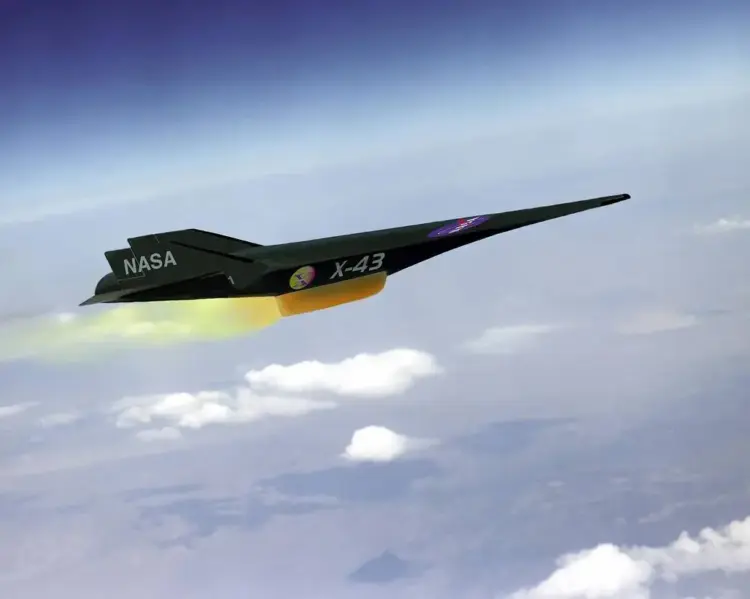
NASA’s X-43A Hyper-X reached about Mach 9.6, nearly 7,000 mph (roughly 11,300 km/h), on November 16, 2004. It was robotic and expendable, powered by a supersonic-combustion ramjet, or scramjet, after a rocket booster brought it to test conditions. NASA’s flight report reproduces Guinness World Records’ description of that flight at Mach 9.68 with an engine burn of around 10 seconds. An earlier X-43A flight on March 27, 2004, reached Mach 6.83.
The USAF’s uncrewed X-51A Waverider reached Mach 5.1 over the Pacific on its fourth and final flight on May 1, 2013, after a B-52 carried it aloft and a rocket boosted it. The USAF reports more than six minutes of flight over more than 230 nautical miles, including 210 seconds of air-breathing hypersonic flight. “It was a full mission success,” program manager Charlie Brink of the Air Force Research Laboratory said in the Air Force’s report on the final flight.
Neither vehicle carried a pilot. They show how much the crewed-airplane boundary changes the answer: the X-43A beat the X-15’s Mach number, and the X-51A beat the SR-71’s Mach range.
America’s Fastest Military Aircraft At A Glance
The ranking below orders crewed U.S. aircraft by the best documented primary-source figure for each. The “Measured How” column matters as much as the speed, because the list mixes test peaks, course records and published specifications. The A-12, F-15 and X-1A positions are provisional, since their figures were not measured under comparable conditions.
| Rank | Aircraft | Propulsion | Top Speed | Measured How |
| 1 | North American X-15A-2 | Reaction Motors XLR99 rocket | 4,520 mph (7,274 km/h), Mach 6.70 | Unofficial flight-test peak, 1967 |
| 2 | Lockheed SR-71A Blackbird | 2 × Pratt & Whitney J58 turbojets | 2,193.167 mph (3,529.56 km/h), about Mach 3.3 | FAI absolute speed record, 1976 |
| 3 (provisional) | Lockheed A-12 OXCART | 2 × Pratt & Whitney J58 turbojets | Mach 3.29; 2,171–2,208 mph (3,494–3,553 km/h) reported | 1965 CIA-documented test peak; not FAI-timed |
| 4 | Bell X-2 Starbuster | Rocket | 2,094 mph (3,370 km/h), Mach 3.2 | Flight-test peak, 1956 |
| 5 | Lockheed YF-12A | 2 × Pratt & Whitney J58 turbojets | 2,070.101 mph (3,331.505 km/h) | Official speed record, 1965 |
| 6 | North American XB-70A Valkyrie | 6 × General Electric YJ93 turbojets | 2,056 mph (3,309 km/h), Mach 3.1 | Museum specification; NASA records Mach 3.08 peak, 1966 |
| 7 (provisional) | McDonnell Douglas F-15 Eagle | 2 × Pratt & Whitney F100-series turbofans | Mach 2.5-plus | Published capability; no comparable speed run |
| 8 (provisional) | Bell X-1A | Rocket | 1,612–1,650 mph (2,594–2,655 km/h), Mach 2.44 | NASA-documented test peak |
| 9 | McDonnell F4H Phantom II (Skyburner) | General Electric J79 turbojets | 1,606.51 mph (2,585.425 km/h) | FAI straight-course record, 1961 |
| 10 | Grumman F-14D Tomcat | 2 × General Electric F110-GE-400 turbofans | 1,544 mph (2,485 km/h), about Mach 2.34 | Published maximum at 40,000 feet |
| 11 | Convair F-106A Delta Dart | Pratt & Whitney J75 turbojet | 1,525.92 mph (2,455.736 km/h) | FAI straight-course record, 1959 |
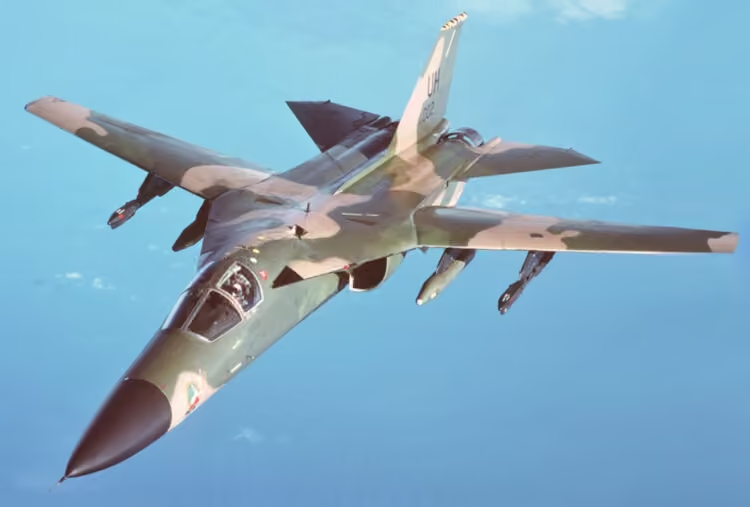
| Also fast | General Dynamics F-111A/F Aardvark | Pratt & Whitney TF30 turbofans | 1,452 mph (2,337 km/h) | Museum specification |
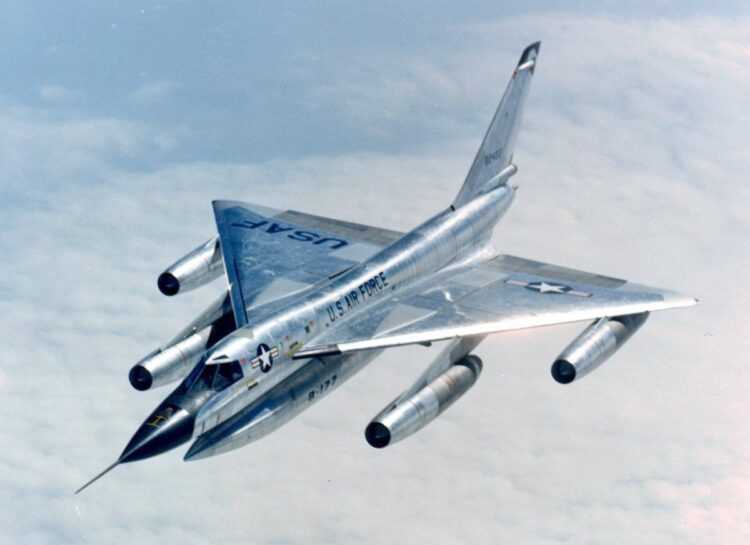
| Also fast | Convair B-58A Hustler | 4 × General Electric J79 turbojets | 1,325 mph (2,132 km/h) | Museum specification |
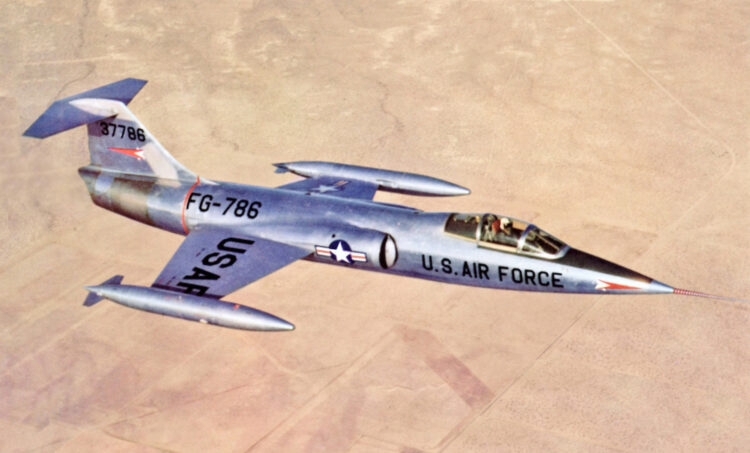
| Also fast | Lockheed F-104C Starfighter | General Electric J79 turbojet | 1,320 mph (2,124 km/h) | Museum specification |
Today’s frontline jets, the F-22A, F/A-18E/F, F-35A and B-1B, are deliberately left out of the numbered ranking and covered in their own section below.
The Rocket Planes: Faster Than Anything With A Jet Engine
Among crewed airplanes, rocket power produced the highest speeds. The X-15A-2’s 4,520 mph is more than double the SR-71’s certified figure. Air launch does not disqualify these aircraft: the carrier and the research plane were separate airplanes, and the X-15 reached its maximum under its own power after release.
A third rocket plane deserves a place on the list. NASA documents the Bell X-1A at Mach 2.44, with two NASA sources giving 1,612 mph (2,594 km/h) and 1,650 mph (2,655 km/h) respectively. Both figures exceed the F-4 Phantom II’s certified course average. That puts the X-1A in the same range as the F-15’s published capability, which is why its position relative to the Eagle remains provisional.
1. North American X-15A-2 — “Mach 6.70 On Rocket Power”
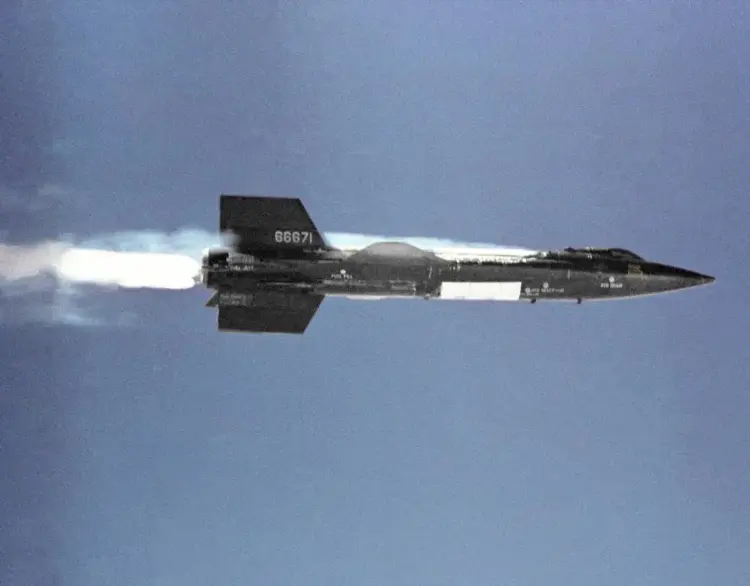
The X-15A-2 was a rebuilt and extended version of the second X-15. North American Aviation lengthened its fuselage and fitted jettisonable external propellant tanks to extend its powered flight. A Reaction Motors XLR99 liquid-propellant rocket engine powered it. For the record flight, the aircraft also wore an ablative coating, a protective layer that sheds material as it absorbs heat.
On October 3, 1967, with the external tanks fueled, Knight reached Mach 6.70 and 4,520 mph. NASA’s historical monograph on hypersonics identifies radar as the measurement source and places the maximum at 102,700 feet (31,303 m). NASA calls the result an unofficial speed record for a piloted winged vehicle at the time. The speed came at a cost. A NASA retrospective records that heating around a model scramjet carried on the flight penetrated the protective coating and caused significant damage, and the aircraft did not fly again.
According to the NASA X-15 program poster, the program’s one ratified world mark was for altitude: USAF test pilot Robert M. White reached 314,750 feet (95,936 m) on July 17, 1962. NASA research pilot Joseph A. Walker later flew an unofficial program maximum of 354,200 feet (107,960 m) in 1963.
Knight had already survived a serious emergency that year. On June 29, 1967, while climbing through 107,000 feet (32,614 m) at Mach 4.17, he suffered a complete electrical failure, and NASA’s biography credits him with a safe glide landing. The program that began with Albert Scott Crossfield’s first glide flight on June 8, 1959, ended when NASA research pilot William H. Dana flew the final X-15 flight on October 24, 1968.
The X-15 also bridged two eras. Joe H. Engle, a USAF X-15 pilot who later commanded the Space Shuttle, compared the landings in NASA’s 2023 retrospective: “You fly roughly the same glide speed and the same glide slope angle.” NASA notes that Columbia’s 1981 orbital reentry later exceeded the X-15’s speed, which is why this list is limited to atmospheric airplanes.
4. Bell X-2 Starbuster — “First Past Mach 3”
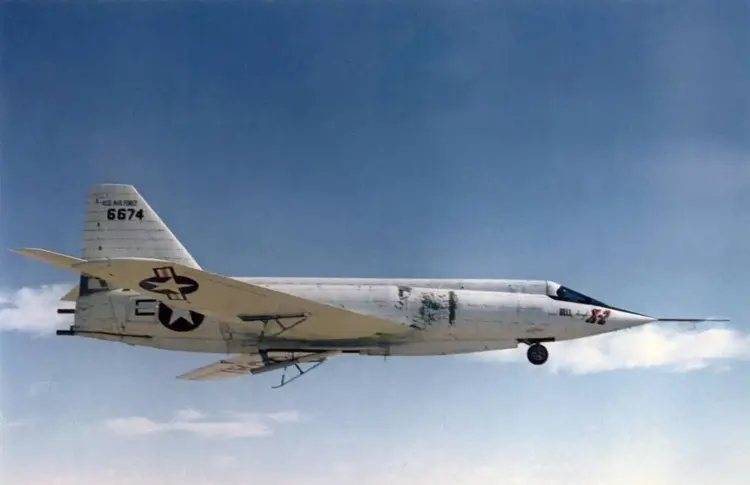 On September 27, 1956, USAF test pilot Capt. Milburn G. Apt took the Bell X-2 to Mach 3.2, or 2,094 mph (3,370 km/h). NASA identifies it as the first piloted airplane to reach Mach 3. The X-2 was lost and Apt died on the same flight. The joint USAF/National Advisory Committee for Aeronautics (NACA) flight-behavior report documents the program’s measured data and the loss.
The X-2 was a swept-wing rocket research aircraft launched from a modified B-50. NASA’s detailed program history places its top Mach number at around 65,500 feet (19,964 m). Earlier that month, on September 7, 1956, USAF test pilot Capt. Iven C. Kincheloe Jr. had taken it to 126,200 feet (38,466 m).
The X-2 capped a decade in which speed barriers fell rapidly. As NASA’s Six Decades of Flight Research chronology records, Capt. Charles E. “Chuck” Yeager reached approximately Mach 1.06 in the Bell X-1 in 1947. NACA research pilot Scott Crossfield then reached Mach 2.005 in the Douglas D-558-2 Skyrocket on November 20, 1953, during a U.S. Navy/NACA research program. Less than three years later, the X-2 passed Mach 3.
The Mach 3 Club: America’s Fastest Jets
Four air-breathing U.S. designs flew in the Mach 3 class. The SR-71A, A-12 and YF-12A all used twin Pratt & Whitney J58 turbojets. North American’s XB-70A used six General Electric YJ93 afterburning turbojets. They served very different roles: strategic reconnaissance, an experimental interceptor and an experimental bomber.
2. Lockheed SR-71A Blackbird — “The Record Nobody Has Broken”
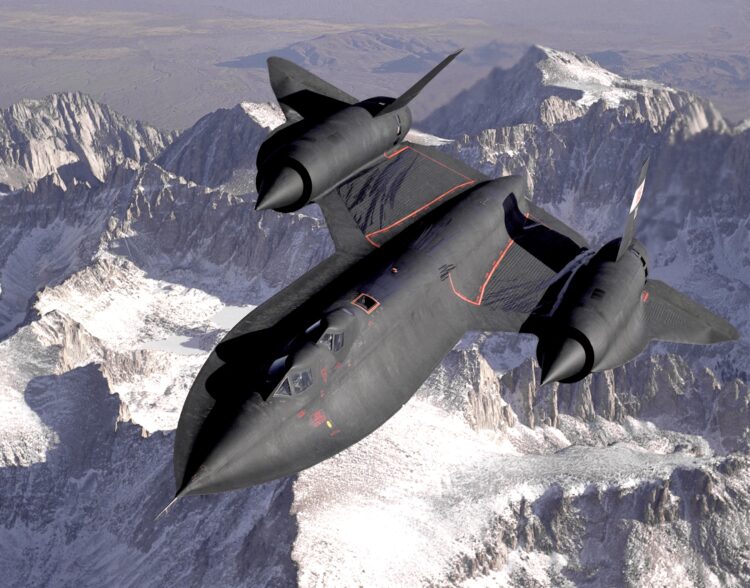
SR-71A 61-7958 flew the 1976 record sortie from Beale Air Force Base, California, with Joersz at the controls and Morgan as reconnaissance systems officer. The FAI’s metric figure of 3,529.56 km/h converts to 2,193.167 mph. During the same July 1976 campaign, another SR-71A crew, pilot Capt. Robert C. Helt and reconnaissance systems officer Maj. Larry A. Elliott, held a sustained horizontal altitude of about 85,069 feet (25,929 m). The FAI’s retrospective describes that altitude mark as retired after sporting-code changes, and notes that both crews wore pressure suits.
The jet’s limits were published, but they were conditional. NASA-published historian Peter W. Merlin, in his technical history of the Blackbird, gives Mach 3.2 as the family’s maximum design cruise and Mach 3.17 as the maximum recommended normal cruise in the SR-71 pilot’s handbook. Mach 3.3 was allowed only if engine compressor inlet temperature (CIT), the temperature of air arriving at the engine’s compressor, stayed at or below 427°C (800°F). Merlin records Mach 3.32 for the 1976 run and reports that speeds above Mach 3.3 were occasionally recorded in tests. “Maximum speed was limited by structural temperature restrictions,” he wrote.
Claims of Mach 3.4 in testing, and of a Mach 3.5-plus peak over Libya, have not been independently confirmed. Retired USAF Maj. Brian Shul’s account of a Libya mission describes the Mach meter easing to 3.5, but it is a first-person recollection with no independently timed speed attached.
The National Museum of the United States Air Force describes the SR-71A as an unarmed, two-seat strategic reconnaissance aircraft that first flew on December 22, 1964, and joined the USAF in January 1966. On its March 1990 retirement flight, according to Merlin, a Blackbird averaged about 2,144 mph (3,450 km/h) between Los Angeles and Washington, D.C. NASA continued to fly Blackbirds for research into 1999.
3. Lockheed A-12 OXCART — “The CIA’s Mach 3 Predecessor”
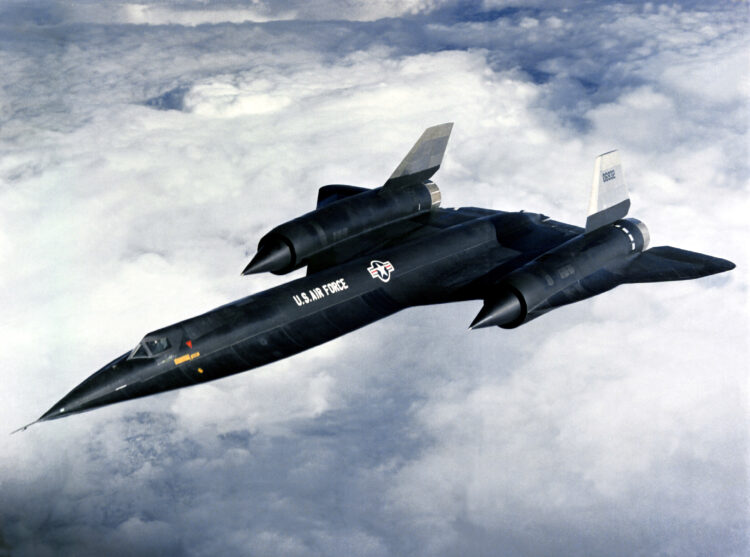
The A-12 was designed as a single-seat CIA reconnaissance aircraft and was the forerunner of the two-seat USAF SR-71. The CIA authorized Lockheed’s design in 1959 and tested it at the Nevada site commonly called Area 51. CIA Chief Historian David Robarge’s history, Archangel, documents 15 airframes, including a two-seat trainer, and a titanium-intensive structure.
The A-12’s speed is where accounts diverge. The CIA’s public history, OXCART vs Blackbird, describes a 1965 milestone of “attaining a sustained speed of Mach 3.2 (just over 2,200 miles per hour) at 90,000 feet altitude,” and presents the aircraft’s performance as an unbroken record for piloted jets. The same CIA account gives a documented 1965 test maximum of 2,208 mph at 90,000 feet, and Robarge’s history puts the Mach 3.29 peak at over 2,200 mph. Merlin, by contrast, records the same Mach 3.29 test at 2,171 mph (3,494 km/h).
Those figures straddle the SR-71’s timed 2,193.167 mph, so the published record cannot settle which jet was faster. The A-12 ranks third here, provisionally, because only the Blackbird’s speed was independently timed. The two aircraft clearly flew in the same Mach class. No FAI-certified A-12 performance exists, and no single, documented explanation for the lack of certification has been confirmed.
Operationally, A-12 missions under the BLACK SHIELD name began from Kadena Air Base on Okinawa in 1967. The aircraft photographed North Korea after the January 1968 seizure of USS Pueblo, and the program ended that year.
5. Lockheed YF-12A — “The Interceptor That Got There First”
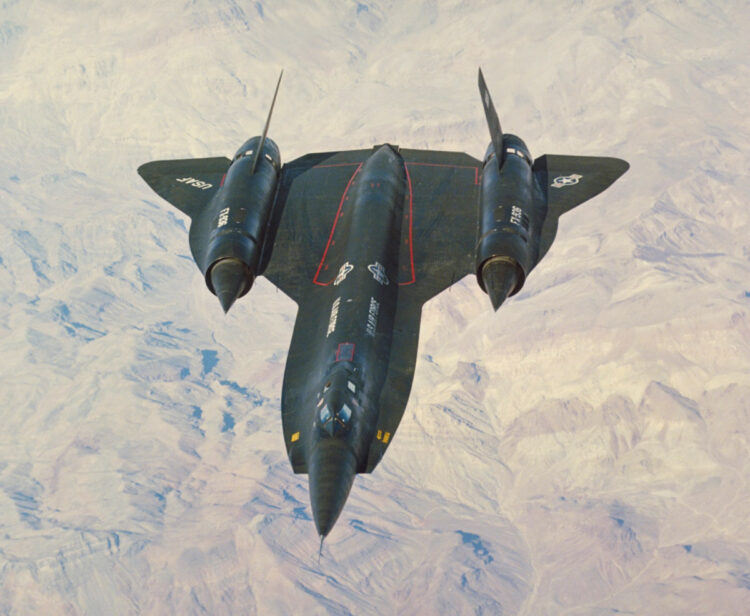
The YF-12A was an A-12-derived interceptor prototype that never entered operational service. On May 1, 1965, it set an official speed record of 2,070.101 mph (3,331.505 km/h), which NASA documents along with an altitude of 80,257.65 feet (approximately 24,463 m) on the same day. The USAF identifies the speed as an FAI Class C-1 Group 3 record, and the Air Force Test Center honors Col. Robert L. Stephens and Lt. Col. Daniel Andre of the YF-12 test force for the achievement. Sources differ on whether the course was straight or closed, but they agree on the speed.
The SR-71 surpassed the figure in 1976. Between 1969 and 1979, NASA and the USAF used YF-12-family aircraft to study the thermal, structural, aerodynamic and propulsion effects of sustained Mach 3 flight.
6. North American XB-70A Valkyrie — “The Mach 3 Bomber”
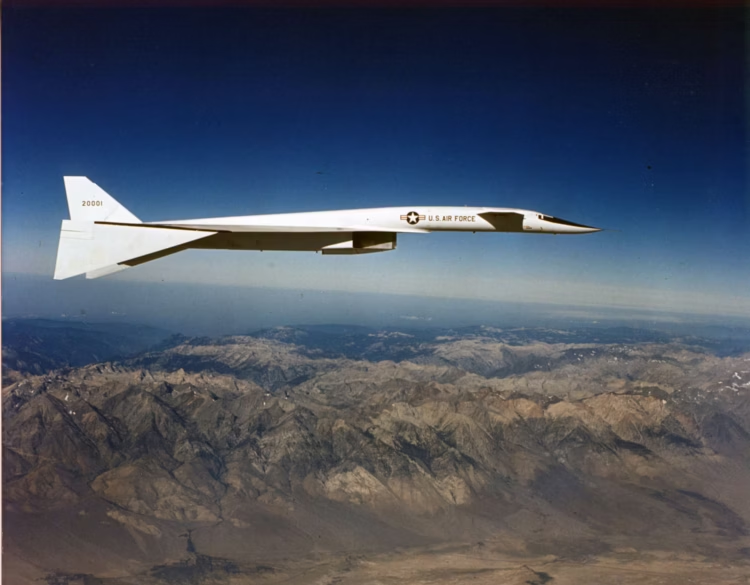
The XB-70 was the prototype of a planned high-altitude, supersonic USAF bomber. The operational B-70 was canceled, and the two XB-70A airplanes flew research and test sorties instead. The USAF museum lists 2,056 mph (3,309 km/h), Mach 3.1, at 73,000 feet (22,250 m). NASA’s mishap-history volume records the program maximum as Mach 3.08 on April 12, 1966, in Air Vehicle 2 (AV-2).
The two airframes performed differently. NASA’s Armstrong history reports poor directional stability above Mach 2.5 in AV-1, which flew above Mach 3 only once. AV-2 incorporated five degrees of wing dihedral, an upward tilt of the wings, and handled better. It first reached Mach 3 on January 3, 1966, and on May 19, 1966, it sustained Mach 3 for 32 minutes, according to the USAF museum, or 33 minutes in North American Rockwell’s program chronology. AV-1 flew 83 times and AV-2 46 times, for a total of 129 flights.
On June 8, 1966, NASA’s F-104N collided with AV-2 during a photo formation. NASA chief research pilot Joseph A. Walker and USAF copilot Maj. Carl S. Cross died. North American Aviation test pilot Alvin S. White escaped with serious injuries. The final XB-70 research flight on February 4, 1969, ended with a ferry flight to Wright-Patterson Air Force Base, Ohio.
Reality Check: Was The Soviet MiG-25 As Fast As The SR-71?
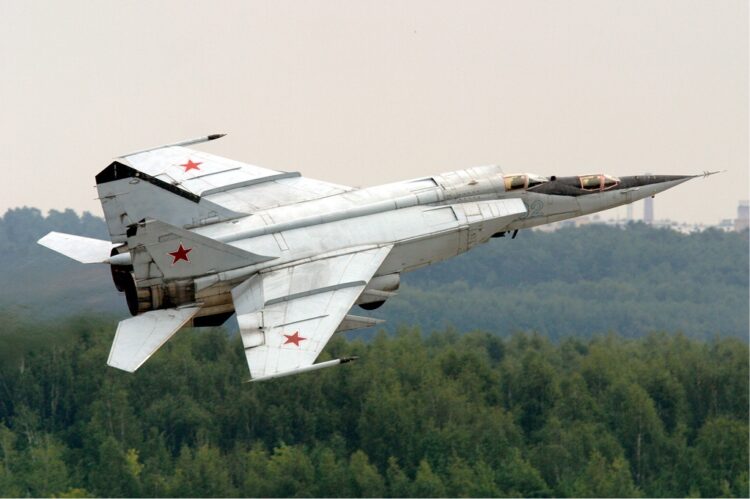
The Mikoyan-Gurevich MiG-25, known by the North Atlantic Treaty Organization (NATO) reporting name Foxbat, is outside the U.S. ranking, but it is the most common comparison. Early Western estimates were generous: Air Force Magazine‘s March 1979 Soviet Aerospace Almanac printed Mach 3.2 at altitude. Later coverage in the same magazine in October 1994, along with the USAF museum, gives Mach 2.83 for the type. That is roughly 1,864–1,868 mph (about 3,000 km/h), depending on atmospheric conditions.
A widely repeated story describes a MiG-25 tracked at Mach 3.2 over the Sinai and returning with damaged engines. That account has not been independently confirmed. Contemporaneous Aviation Week reporting, archived by the CIA, does document Western observations of Soviet-crewed Foxbats operating from Egypt.
The MiG-25 family does hold genuine records. FAI file 8856 credits Soviet pilot Mikhail Komarov with 2,981.5 km/h (1,852.62 mph) around a 500 km closed circuit without payload on October 5, 1967, in an aircraft the FAI lists as the E-266M (E-155M). The record is ratified and now retired under the sporting code.
The verdict depends on the question. The Komarov result shows a high course average in record configuration. On routine speed, the MiG-25’s published Mach 2.83 sits below the SR-71’s recommended normal cruise of Mach 3.17. The Foxbat was an exceptional interceptor, but the published evidence does not make it an SR-71 equal at sustained speed.
The Mach 2 Era: Cold War Fighters And Bombers
Below the Mach 3 club, U.S. fighters and bombers have figures measured in very different ways. The F-15 has a published Mach rating, the modified F-4 has a ratified course record and the F-14D has a museum maximum at a specified altitude. Variants and configurations matter at every step.
7. McDonnell Douglas F-15 Eagle — “Mach 2.5-Plus On The Public Record”
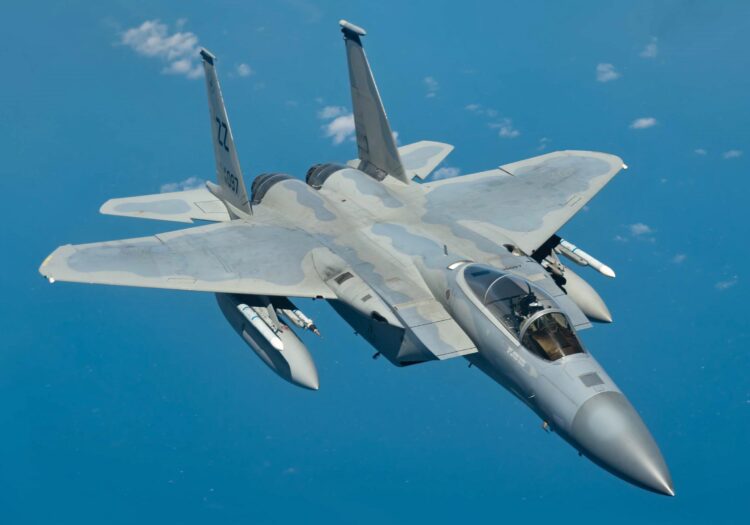
The Air Force Test Center documents Mach 2.5-plus for the F-15 family, which places the Eagle among the fastest U.S. production fighters. The USAF fact sheet lists twin Pratt & Whitney F100-series afterburning turbofans, with -100, -220 and -229 versions across the Eagle and F-15E Strike Eagle. The 1,875-mph and “more than 1,600 mph” figures explained above both come from the same Mach rating. Using the Nellis 40,000-foot ratio, Mach 2.5 is about 1,650 mph (2,655 km/h). No same-condition comparison proves the Eagle is uniquely the fastest U.S. fighter across every type and configuration.
The famous Streak Eagle often gets misremembered. According to the USAF museum, the stripped F-15A set eight time-to-climb records between January 16 and February 1, 1975, reaching 98,425 feet (30,000 m) in 3 minutes 27.8 seconds from brake release. Those records measured time to altitude, not top speed. The F-15 first flew in July 1972 and joined the USAF inventory in November 1974. Boeing separately lists Mach 2.5 for the newer F-15EX.
9. McDonnell F4H Phantom II — “Operation Skyburner”
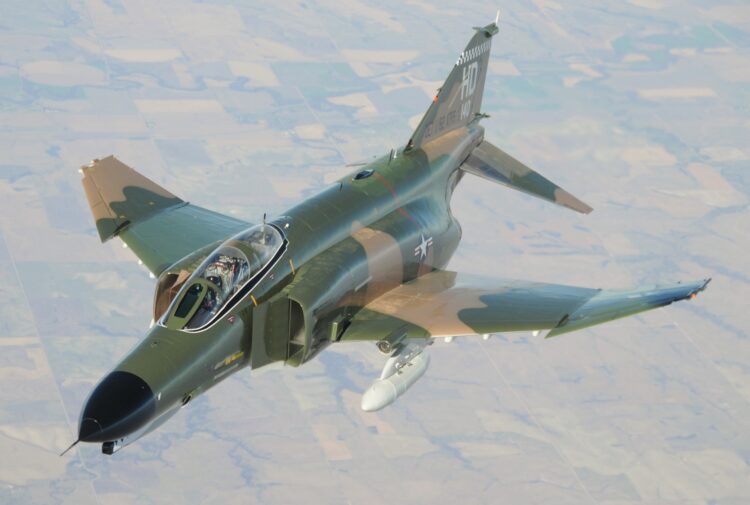
On November 22, 1961, Lt. Col. Robert B. Robinson of the U.S. Marine Corps flew a specially prepared Navy F4H Phantom to 1,606.51 mph (2,585.425 km/h) over a straight 15/25 km course. FAI file 9060 records the performance as ratified and now retired under the sporting code. The Marine Corps newspaper Windward Marine reported the run in December 1961 as Project Skyburner, printing a 1,606.342-mph average and a separate peak of about 1,650 mph (2,655 km/h) at about 45,000 feet (13,716 m).
The Skyburner aircraft used General Electric J79 turbojets, though its exact engine subvariant and modifications have not been confirmed. This was a record configuration, not a typical combat jet. By comparison, the USAF museum gives the later production F-4C a 1,400 mph (2,253 km/h) maximum.
10. Grumman F-14 Tomcat
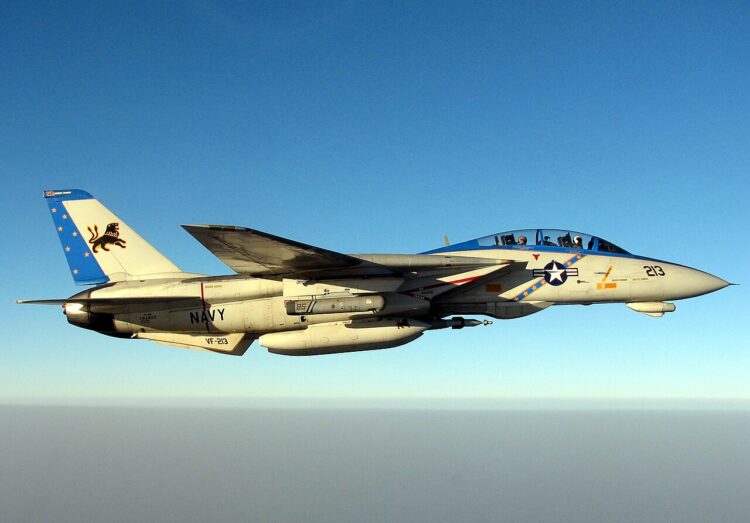
The National Naval Aviation Museum lists 1,544 mph (2,485 km/h) at 40,000 feet (12,192 m) for the F-14D, about Mach 2.34 using the Nellis ratio for that altitude. Smithsonian’s Air & Space magazine records a wing-sweep range of 20° to 68° in flight, which helped the design meet both carrier and high-speed requirements.
The original F-14A used two Pratt & Whitney TF30 afterburning turbofans. The F-14A Plus, later redesignated F-14B, and the F-14D switched to General Electric F110-GE-400s. The two-seat Tomcat, crewed by a pilot and a radar intercept officer, entered Navy deliveries in June 1972 and was retired in 2006.
11. Convair F-106A Delta Dart
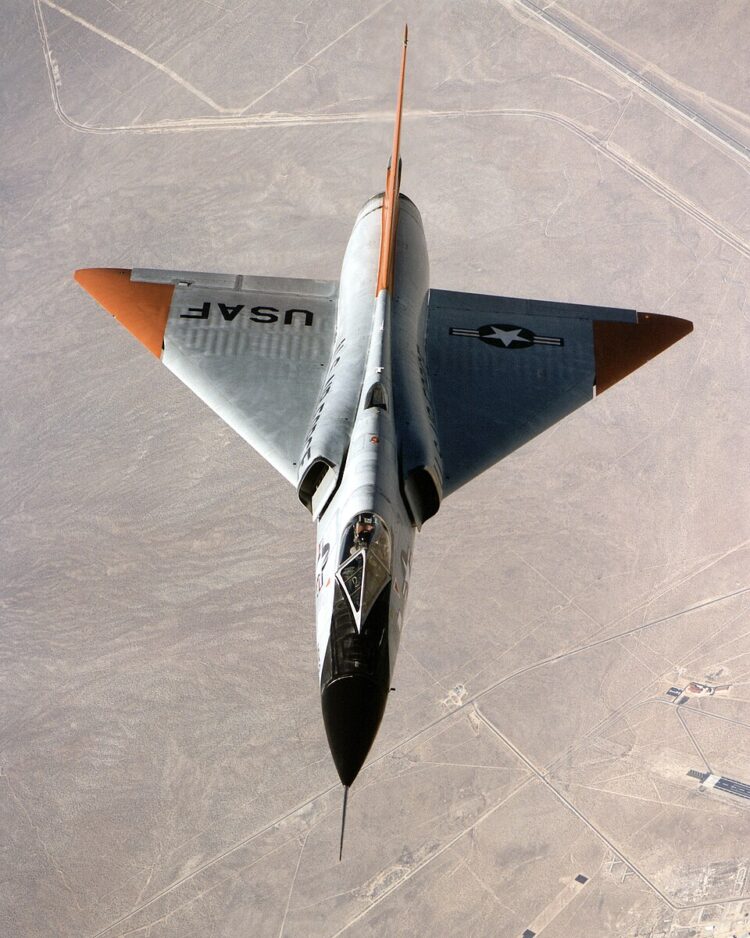
The USAF museum gives the Convair F-106A Delta Dart interceptor a maximum of 1,525 mph (2,454 km/h) on a single Pratt & Whitney J75 turbojet. The FAI index records USAF pilot Maj. Joseph W. Rogers at 1,525.92 mph (2,455.736 km/h) over a straight 15/25 km course on December 15, 1959, a record that is ratified and now retired. It was an early benchmark that the Skyburner Phantom surpassed in 1961 and the YF-12A in 1965.
Also Fast: F-111, B-58 Hustler, And F-104 Starfighter
The USAF museum lists 1,452 mph (2,337 km/h) for both the General Dynamics F-111A and F-111F Aardvark, which used different Pratt & Whitney TF30 versions. Some references, including an aviation directory and a NASA-cataloged period source, cite a higher design figure of about Mach 2.5. No common test condition reconciles the two figures.
The Convair B-58A Hustler, powered by four General Electric J79s, has a 1,325 mph (2,132 km/h) museum maximum. On March 5, 1962, according to the USAF museum’s Bendix Trophy exhibit, pilot Capt. Robert G. Sowers, navigator Capt. Robert MacDonald and defensive systems operator Capt. John T. Walton flew from Los Angeles to New York City at an average of 1,214.17 mph (1,954.02 km/h). That leg was part of a round trip that produced three speed records.
The single-J79 Lockheed F-104C Starfighter has a 1,320 mph (2,124 km/h) museum maximum. An earlier F-104A, flown by USAF Capt. Walter W. Irwin, set an FAI straight-course record of 1,404.01 mph (2,259.538 km/h) on May 16, 1958, and that record cannot be credited to the C model.
Why Today’s Frontline Jets Are Slower, And Better For It
Today’s frontline jets are not designed to top speed rankings, and their published figures show it. The USAF describes the Lockheed Martin F-22A Raptor as Mach 2 class, with two Pratt & Whitney F119-PW-100 turbofans and supercruise, meaning sustained flight above Mach 1.5 without afterburner. “Its unclassified top speed is Mach 2.0,” F-22 instructor pilot Maj. Brock Lange told Tech. Sgt. Matthew Bates for an Airman Magazine profile. Bates’s article calls the true top speed “a guarded secret.” A Mach 2.25 figure that circulates online has not been confirmed.
The rest of the current fleet follows the same pattern:
- The U.S. Navy lists the Boeing F/A-18E/F Super Hornet at Mach 1.8-plus, on two General Electric F414-GE-400 turbofans.
- The USAF lists the Lockheed Martin F-35A Lightning II at Mach 1.6, about 1,200 mph (1,930 km/h), on a single Pratt & Whitney F135-PW-100.
- Air Force Global Strike Command lists the Rockwell B-1B Lancer at 900-plus mph (more than 1,448 km/h), Mach 1.2 at sea level, on four General Electric F101-GE-102 turbofans. It was designed for low-level penetration.
These numbers reflect different priorities, not lost ability. Supercruise lets the F-22 operate supersonically again and again without the fuel cost of an afterburning dash, and the USAF pairs it with stealth, internal weapons carriage and integrated avionics. The F-35A’s documentation similarly presents speed alongside sensors and survivability. The SR-71, by contrast, carried no weapons and relied on speed and altitude. A 1998 Congressional Research Service analysis treated satellites, crewed aircraft and uncrewed aerial vehicles as platforms with different coverage, endurance and access trade-offs, and recorded disagreement over the SR-71’s retirement and replacement.
Why Crewed Speed Peaked In The 1960s
Heat, more than thrust alone, set the limits. Merlin’s history identifies structural temperatures and the 427°C compressor-inlet ceiling as the Blackbird’s speed limits, with thrust, fuel and inlet design as parts of the larger problem. Inlet temperature rises with speed and depends on atmospheric conditions, so the ceiling shapes the usable flight envelope.
“Dealing with the extreme temperatures of Mach 3+ flight was the most formidable challenge,” Robarge wrote in Archangel. His history describes the engineering responses: a titanium-intensive airframe and specially developed fuel, lubricants and sealants. Because no sealant could withstand both the fuel and the heating cycles, the tanks leaked on the ground until the metal expanded at operating altitude and closed the gaps.
Rocket planes did not escape the problem. A rocket carries its own oxidizer and needs no compressor inlet, but structural heating still applies. At Mach 6.70, the X-15A-2 was damaged despite its ablative protection.
The human cost was real. The X-2 claimed Milburn Apt in 1956. Joseph Walker and Carl Cross died in the 1966 XB-70 collision, although that accident happened during a formation flight, not a speed demonstration. The record chronology extends into the 1970s: the SR-71’s 1976 run is the last entry in this ranking.
The Real Legacy Of America’s Fastest Aircraft
The fastest U.S. aircraft were mostly research tools and spy planes, not frontline fighters. Their lasting value lies in what they taught. NASA directly ties X-15 research to the Mercury, Gemini, Apollo and Space Shuttle programs. The YF-12 and SR-71 supported NASA work on high-temperature structures and propulsion, and the XB-70 flew research into sonic booms and supersonic transport flight profiles.
Hypersonic research continued with uncrewed vehicles. An Air Force Test Center retrospective places the X-51A in the line of U.S. hypersonic experiments that followed the X-15. No single explanation for why the crewed records have lasted so long has been established, and no direct component lineage from the X-15 to the X-43A or X-51A has been documented. The Blackbird’s own retirement involved defense budgets and high operating costs as well as changes in reconnaissance technology.
The most useful lesson is simple. Any claim of “fastest” needs a footnote explaining how the speed was measured, by whom, and under what conditions.
Key Takeaways
- The X-15A-2 reached Mach 6.70 (4,520 mph) in 1967, the fastest crewed U.S. flight, but the mark is unofficial.
- The SR-71A’s 2,193.167 mph from 1976 is still the FAI absolute speed record. The CIA’s A-12 reached Mach 3.29 in 1965 tests but was never FAI-timed.
- Converting Mach to mph depends on air temperature, which explains many conflicting figures.
- The MiG-25’s published Mach 2.83 falls below the SR-71’s Mach 3.17 normal cruise.
- The F-22 and F-35 trade top speed for stealth, sensors and survivability.