


They’re ice, not secret spray. Here’s the jet-engine physics behind why some trails vanish in seconds while others spread for hours, what scientists found when they tested chemtrail claims, and the real climate science.
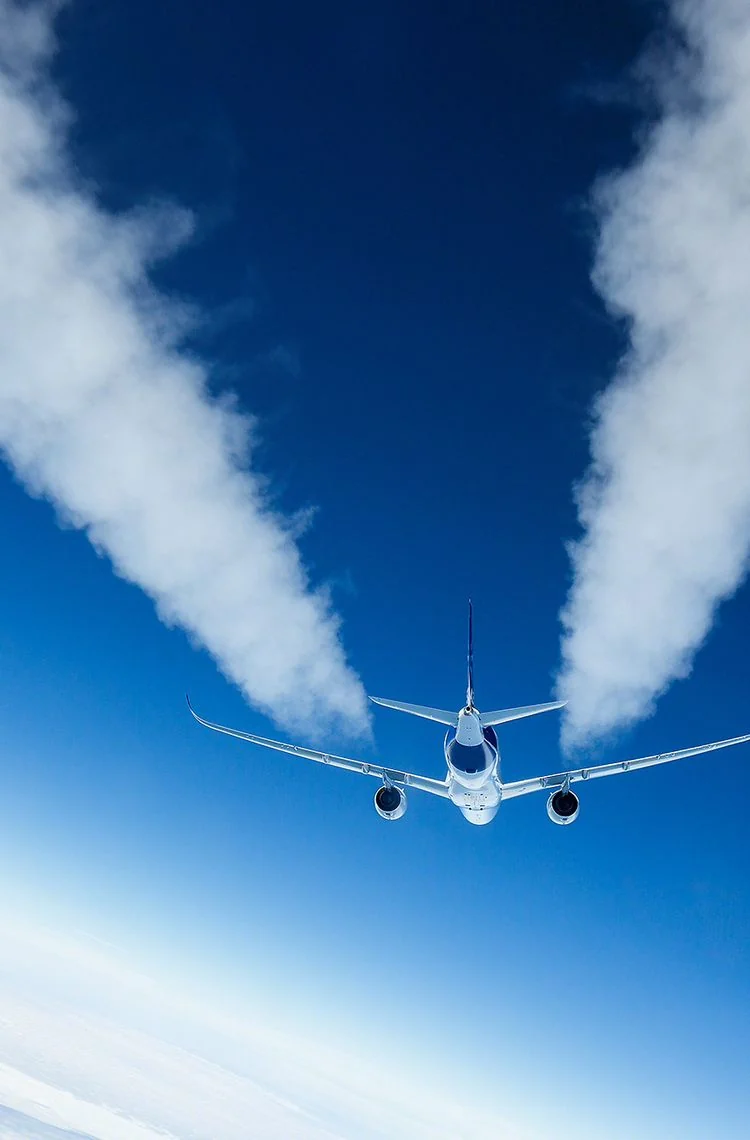
In the chemtrails vs contrails debate, the evidence points clearly one way. The white lines behind high-flying jets are contrails, short for condensation trails. They are thin clouds of ice that form when hot, moist engine exhaust mixes with very cold air at altitude. No substantiated evidence supports the claim that those lines are part of a secret, large-scale spraying program.
The case against the chemtrail theory rests on solid ground. In a peer-reviewed survey published in August 2016, 76 of 77 specialists in contrails and atmospheric deposition, or 98.7%, said they had never encountered evidence of a secret, large-scale atmospheric spraying program. In July 2025, the U.S. Environmental Protection Agency (EPA), the Federal Aviation Administration (FAA) and the National Oceanic and Atmospheric Administration (NOAA) restated the physics in a joint Contrails Fact Sheet. It describes contrails as ice clouds and notes that standard aviation turbine fuel contains no metal-based compounds as additives.
There is a twist, though. Air traffic has grown, modern high-efficiency engines can form trails across a wider range of conditions, and scientists really are working to reduce contrails. The reasons are physics and climate, not secret additives. Here is what those white lines actually are, and why they behave so differently from one day to the next.
 Why The Chemtrail Debate Moved From Forums To Statehouses
The chemtrail claim used to live mostly on late-night radio and internet forums. It now shows up in state law and federal policy, which is why the science behind it matters more than ever.

The Claim As Believers State It
In its most common form, the claim holds that long-lasting aircraft trails are deliberate chemical or geoengineering spraying. Believers often point to reports of unusual aluminum, barium and strontium levels, the same elements the 2016 expert study examined. The idea has real reach. In a 2011 online survey of 3,105 people in the U.S., Canada and the UK, 2.6% called a statement about a secret government program using airplanes to put harmful chemicals into the air “completely true,” and 14% called it “partly true.” That makes nearly 17% combined.
Why The Question Is Now Policy, Not Just Online Talk
In July 2025, the EPA launched new public resources on contrails and geoengineering. Administrator Lee Zeldin framed the effort this way in the EPA release: “Americans have legitimate questions about contrails and geoengineering, and they deserve straight answers.”
State legislatures have also acted:
- Tennessee: Public Chapter 709, which took effect July 1, 2024, addresses intentional atmospheric modification.
- Florida: Senate Bill 56, whose main provisions took effect July 1, 2025, makes specified intentional atmospheric releases a third-degree felony. It also requires public-use airports to file monthly reports to the Florida Department of Transportation (FDOT) starting October 1, 2025.
- Louisiana: Act No. 95, effective August 1, 2025, covers specified releases made with the express purpose of affecting temperature, weather, climate or sunlight intensity.
The U.S. Government Accountability Office (GAO) reported that, as of July 2025, more than 30 states had some form of proposed or enacted weather-modification ban. That count mixes bills with laws, so it is not a tally of enacted statewide bans. The policy organization SRM360 runs its own tracker of state proposals.
The early results have been unremarkable. In March 2026, E&E News reported that Florida had received more than 20,000 weather-modification claims since the law passed, but no evidence of weather-modification activity. Bills, complaints and filings record political activity. They do not show that ordinary jet trails are spraying, and explaining the physics tends to persuade better than ridicule does.
How Jet Exhaust Becomes A Contrail
Forming a contrail and keeping one are two separate tests. Both depend on conditions where the airplane is, not where the observer is standing.
What Actually Comes Out Of A Jet Engine
Burning kerosene-type jet fuel mainly produces carbon dioxide (CO₂) and water vapor. Smaller amounts of sulfur oxides (SOₓ), nitrogen oxides (NOₓ), carbon monoxide (CO), unburned hydrocarbons and particles such as soot come out too. In the EPA and FAA’s simplified breakdown of combustion products, those products are about 71% carbon dioxide, 28% water vapor and less than 1% everything else.
That water vapor is the key ingredient. Burning hydrocarbon fuel always produces it, and it supplies the moisture for the initial trail. The federal resources also explain that dissolved metals in fuel would make the engine run less stably. As the FAA’s contrails portal notes, the white cloud is a separate matter from ground-level exhaust pollutants, which can raise health concerns of their own.
The Schmidt-Appleman Criterion, Explained In Plain English
The rule scientists use is called the Schmidt-Appleman criterion. In plain English, it predicts whether hot, humid exhaust mixing with colder surrounding air will briefly become saturated with liquid water. If it does, water condenses on tiny particles such as soot, and the droplets freeze almost at once.
- Appleman of the U.S. Air Force’s Air Weather Service published a forecasting method in 1953, building on earlier work by Schmidt. Ulrich Schumann, an atmospheric physicist at the German Aerospace Center (DLR), later extended the analysis to account for engine efficiency.
A useful rule of thumb is cruise altitudes near or above about 25,000 feet (7,600 m), where air temperatures are often around −40°F (−40°C) or colder. That is context rather than a fixed threshold. The actual cutoff depends on temperature, pressure, humidity and the combination of engine and fuel. Federal illustrations show the visible trail often starting within roughly one wingspan behind the aircraft.
Three Kinds Of Contrail, And Why Humidity At Cruise Altitude Decides Which You Get
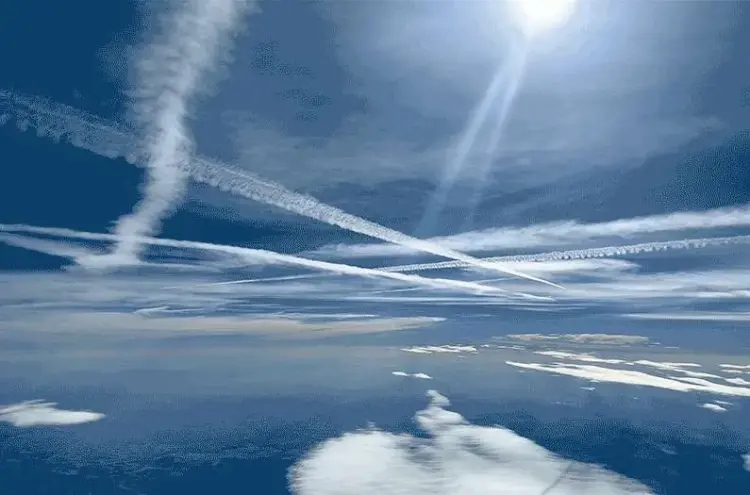
Whether a trail survives depends on the surrounding air. The key concept is the ice-supersaturated region (ISSR), a layer where relative humidity with respect to ice is above 100%. In such a layer, ice crystals can keep growing even though the air is not saturated enough to form liquid droplets. The table below follows the federal visual classification.
| Type | Upper-air condition | Typical lifespan | What you see |
| Short-lived | Dry air (below ice saturation) outside the plume | Seconds to minutes; a 2025 NASA technical paper puts most trails under 10 minutes | A narrow line that fades quickly as the ice turns back into vapor |
| Persistent, non-spreading | Enough moisture to sustain the ice, with little widening | Can last hours; no fixed duration | A fairly narrow line that drifts with the wind |
| Persistent, spreading | An ISSR plus wind shear or turbulence | Hours; NASA says persistent trails may last up to 18 hours, and agencies describe hours to days | The line widens and can merge into cirrus |
Wind shear is a change in wind speed or direction with height, and it pulls a long-lived trail into a sheet. Scientists group these spreading trails and the cirrus they become under the label aviation-induced cloudiness. Older trails can lose their line shape entirely and become hard to tell apart from natural cirrus.
The most useful point for anyone watching from the ground is that conditions at cruise altitude can differ sharply from the weather at the surface. A clear sky over your backyard says little about the moisture at the flight level overhead.
The Paradox: Why Efficient Turbofans Leave More Contrails
 Here is the counterintuitive part. Better engines can make contrails form more easily.
Schumann’s analysis in Aerospace Science and Technology, available through the DLR repository, works through the mechanism. A more efficient engine turns a larger share of the fuel’s energy into thrust. That leaves less heat in the exhaust for the same amount of water vapor. The cooler plume reaches saturation more easily, so trails can form at warmer outside temperatures and across a wider band of conditions.
Schumann and colleagues later tested the effect by flying two four-engine jets with different engines wing by wing. Their worked example in a standard atmosphere compared overall efficiencies of 0.3 and 0.5 and found that the more efficient engine’s formation threshold sat roughly 2,300 feet (700 m) lower in altitude. That is a modeled example tied to its stated assumptions.
The irony is hard to miss. The high-efficiency engineering that cut fuel burn also widened the range of conditions in which contrails can form. Traffic growth adds more opportunities.
However, this is one factor among several. A modeling study led by Roger Teoh estimated that global contrail coverage grew by an average of 0.7% per year from 2006 to 2019, while total flight distance grew 3.6% per year. Geography, falling soot emissions and fuel use also shape the net trend. A wider formation envelope gives a route more chances to make a trail. Whether that trail lasts still depends on humidity.
Reading The Sky: What Each “Chemtrail” Clue Really Shows
The most common clues in chemtrail posts each have a documented weather, aerodynamic or flight-test explanation. A single photo from the ground also usually lacks the time, altitude, wind and aircraft data needed to prove anything either way.
| Observation | What is actually happening |
| One jet trails and a nearby jet doesn’t | The two may be at different altitudes, temperature and humidity can change across thin layers, and engine efficiency shifts the formation threshold |
| Trails switch on and off | The aircraft moves into moister or drier air, or crosses a weather boundary; warmer air can also cause a gap |
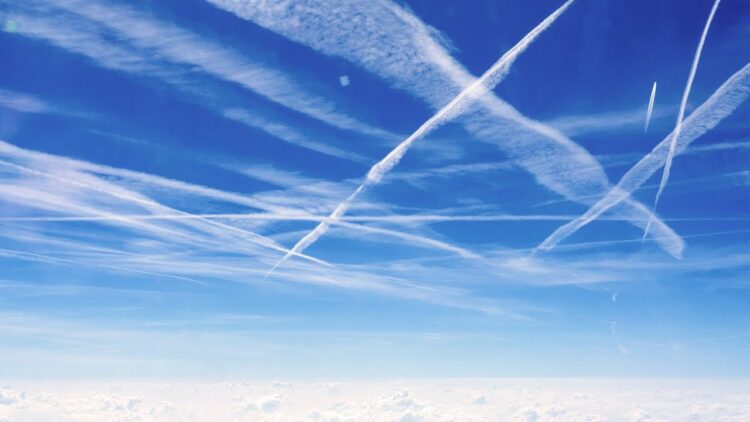
| Grids, X patterns, loops | Crossing routes and drifting older lines create intersections; an aircraft in a holding pattern draws a loop |
| No matching plane on a flight tracker | Strong upper-level winds move old trails while the aircraft that made them keep flying |
| Odd colors near sunrise or sunset | Sunlight hits ice crystals at a low angle and can tint them orange or red, an optical effect rather than a chemical one |
| Ribbons from the wings or wingtips | Aerodynamic contrails, formed when pressure drops and cooling around the wing condense moisture from the air |
| Cabins full of plumbed barrels | Water ballast on flight-test aircraft, moved to shift the center of gravity (CG) |
| Plumes during an unplanned return | Fuel jettison to reduce weight before landing, on aircraft equipped for it |
Several of these clues deserve a closer look. The MOST Policy Initiative explains that aerodynamic contrails can appear away from the engine exhausts entirely. On ballast, Aviation Week documented plumbed water-ballast tanks aboard a Boeing 777-9 test aircraft, where the test crew transfers water to vary the CG. That does not identify every barrel image circulating online.
Fuel jettison is also more limited than many posts suggest. Boeing’s own capability matrix lists the 737 series without a jettison system. When an equipped aircraft does dump fuel, FAA Order JO 7110.65 directs controllers in instrument flight rules (IFR) conditions to assign it an altitude at least 2,000 feet above the highest obstacle within 5 miles of its route or pattern.
Finally, dark smoke is a different phenomenon. Federal materials distinguish soot and other particles from the white ice cloud of a contrail.
Where The Myth Began, And What Happened When Scientists Tested It
The history shows how documents that really exist were stitched into a claim they never supported.
From An Air Force Thought Piece To Late-Night Radio
In August 1996, a paper titled Weather as a Force Multiplier: Owning the Weather in 2025 was prepared for Air Force 2025, a future-oriented study. The Air Force later described it as a thesis outlining a possible future strategy and said it did not reflect current military policy, practice or capability. Separately, U.S. Patent 5,003,186, assigned to Hughes Aircraft Company, had been issued on March 26, 1991.
Legal scholar Charles R. Corbett, writing in the Missouri Law Review, attributes the link between the paper and the patent to William Thomas. Archives of Coast to Coast AM record host Art Bell and Thomas discussing the claim on March 17, 1999. A Time profile of Bell that August identified contrail enthusiasts among his audience. A speculative paper shows that someone considered a scenario, and a patent shows that someone described an invention. Neither shows what any aircraft actually carried.
Militaries Spent Decades Trying To Avoid Contrails
Long before the myth, contrails were a military headache. Historical accounts describe high-altitude trails marking bomber formations in World War II, including formations of propeller aircraft. Appleman’s 1953 work gave forecasters a way to judge when exhaust trails would form, according to a NASA contrails guide. For a military planner, a conspicuous trail is a liability, not a delivery system.
The Federal Answer And The 77-Expert Test
In September 2000, the EPA, FAA, NASA and NOAA issued the Aircraft Contrails Factsheet, which explained how trails form, why they fade in dry air and how persistent ones spread. An Air Force fact sheet, preserved in an EPA archive, put it bluntly: “There is no such thing as a “Chemtrail”. Contrails are safe and are a natural phenomenon. They pose no health hazard of any kind.” The current EPA and FAA materials limit their health statement to the high-altitude ice cloud itself.
The most direct test came on August 10, 2016, in Environmental Research Letters. The authors were Christine Shearer and Steven J. Davis of the University of California, Irvine and Near Zero, Mick West of Metabunk.org and Ken Caldeira of the Carnegie Institution for Science. They surveyed 49 contrail specialists and 28 experts in atmospheric deposition, the settling of particles out of the air. Those totals reflect response rates of about 29% and 15% among eligible researchers. The experts assessed four photos and chemistry results that believers had circulated. The study did not track aircraft or collect new samples.
The results were lopsided. All 49 contrail specialists rejected a secret program as the simplest explanation for each photo. The one “yes” on the evidence question cited high atmospheric barium in a remote area compared with local soil, without establishing where the barium came from. Respondents pointed to known contrail physics and to samples that were contaminated or not representative. “The experts we surveyed resoundingly rejected contrail photographs and test results as evidence of a large-scale atmospheric conspiracy,” Davis said in a Carnegie Science release. According to the release, the authors aimed to put a scientific benchmark on record for people who had not yet made up their minds, not to convert committed believers.
Cloud Seeding And Geoengineering: The Real Programs Behind The Confusion
 Some aircraft really do release materials into the air. The difference lies in the purpose, the target, the paperwork and the evidence.
| Operation | Altitude and platform | Materials and purpose | Oversight and reality |
| Exhaust contrails | Jets cruising in the cold upper troposphere | Ice formed from exhaust water vapor; no purpose | Ordinary engine operation |
| Agricultural and firefighting drops | Low-flying aircraft near a ground target | Crop products, water or retardant for a defined job | FAA governs the flying; EPA regulates pesticides |
| Cloud seeding | Aircraft or ground generators serving suitable clouds | Silver iodide to encourage ice formation and more rain or snow | Federal reporting rules and, in some states, restrictions |
| Solar geoengineering | Stratospheric aerosol injection (SAI); marine cloud brightening (MCB) over the ocean | Proposed reflective aerosols for SAI; sea-salt particles for MCB | EPA says no U.S. government outdoor testing or deployment |
Cloud Seeding Is Real, Overt And Local
Cold-cloud seeding commonly uses silver iodide, which only helps ice form in clouds that already exist. As of July 2024, the GAO identified active programs in at least nine states: California, Colorado, Idaho, Nevada, New Mexico, North Dakota, Texas, Utah and Wyoming. GAO’s 2026 audit added that state and local agencies in nine states spent or planned to spend at least $20 million on cloud seeding in 2024.
The studies GAO reviewed estimated anywhere from zero to 20% more precipitation. They also suggested that silver iodide at current localized levels poses no significant health or environmental concern, though GAO flagged gaps for wider use. Under 15 CFR Part 908, operators must ordinarily report a covered activity to NOAA at least 10 days before it begins. The EPA’s geoengineering FAQ explains how these activities differ.
Real History, Real Paperwork Gaps
The U.S. did experiment with the weather. Project Cirrus included a hurricane-seeding test in October 1947. During the Vietnam War, Project Popeye aimed to increase rainfall. Project Stormfury ran from 1962 into the early 1980s and ended after natural hurricane behavior undercut its claims of success. In an October 2024 fact check, NOAA stated that no technology can create, strengthen, destroy or steer hurricanes.
The record-keeping has real flaws. A February 2026 GAO audit counted 1,084 reports in NOAA’s public database as of February 2025, only four of which described solar geoengineering. GAO estimated that more than half of all reports filed with NOAA likely had errors, such as missing required maps. It also faulted NOAA’s process, including scanned records that couldn’t be searched and vague reporting instructions. NOAA agreed with GAO’s three recommendations and asked that the report make clear its role is to collect reports, not to authorize projects. GAO accepted that clarification. Weak paperwork is a governance problem. It is not evidence of secret spraying.
Why Airliners Couldn’t Secretly Do SAI
A 2018 engineering study by Wake Smith and Gernot Wagner, available in a Harvard-hosted copy, modeled deployment at about 65,600 feet (20 km). It concluded that the existing aircraft it examined were unsuitable for that mission, which sits far above the cruise band of airliners. Nature supplied a reference point when Mount Pinatubo erupted in 1991. The U.S. Geological Survey puts the temporary global cooling that followed at approximately 1°F (0.5°C) over 1991–1993.
The EPA states that the U.S. government is not engaged in outdoor solar geoengineering testing or deployment. The few real episodes have been small and non-federal. Harvard’s Stratospheric Controlled Perturbation Experiment (SCoPEx) stopped pursuing its experiment in 2024. On June 4, 2024, the City of Alameda voted against continuing a small sea-salt study by the University of Washington and its partners aboard USS Hornet. In April 2025, the EPA sought information from Make Sunsets, a private company that reports releasing sulfur dioxide from balloons.
The Real Reason Scientists Track Contrails: Climate Warming
The legitimate science on contrails is about climate, not chemistry.
How An Ice Cloud Warms The Planet
During the day, a contrail reflects some sunlight back to space, which cools. Day and night, it also traps outgoing infrared heat, which warms. A single trail can come out warming, cooling or roughly neutral depending on the sun angle, what lies beneath it and how long it lasts. Across the fleet, however, global studies find that the net effect is warming.
The Numbers
Scientists measure this with effective radiative forcing (ERF), the change in Earth’s energy balance at the top of the atmosphere after the atmosphere’s fast adjustments. It is expressed in milliwatts per square meter (mW/m²), and it is not a temperature reading. The Lee et al. assessment, published in 2021, estimated aviation’s ERF for 2018 as follows.
| 2018 estimate | Central ERF (mW/m²) | Range |
| Net aviation total | 100.9 | 55–145 |
| Contrail cirrus | 57.4 (about 57% of the total) | 17–98 |
| Aviation CO₂ (accumulated over time) | 34.3 | — |
| Net NOₓ effects | 17.5 | — |
The National Academies put a different frame on the same question. Their 2025 report places contrails and related aviation-induced cloudiness at about 1.5% of all human-caused forcing. Both figures can be right because they divide by different totals.
The warming is also highly concentrated, according to modeling estimates. Teoh and colleagues estimated that 2.2% of flights caused 80% of modeled contrail forcing in six weeks of Japanese airspace data, and that about 12% did so over the North Atlantic from 2016 to 2020. Their 2019 global model found that about 2% of all flights accounted for 80% of annual net contrail forcing. That concentration is why targeted avoidance looks promising.
Two Fixes Being Tested
AI-guided avoidance. In a pilot reported in 2023, American Airlines and Google Research said 70 test flights produced 54% less contrail formation than control flights. Google’s initial account noted 2% extra fuel on flights that attempted avoidance. A larger trial followed, covering about 2,400 American Airlines Boeing 777 and 787 flights between January 15 and May 13, 2025. Avoidance forecasts were built into the Flightkeys dispatch software, and satellites measured the results. Google announced the results on March 19, 2026. A peer-reviewed paper led by Tharun Sankar followed on November 19, 2026.
On the 112 flights that flew the optimized plan, observable contrail formation fell 62.0% compared with controls, with no statistically significant difference in fuel burn. Across the broader group of 1,232 flights, the reduction was 11.6%. The paper reports that only 7.8% of candidate flights actually flew an avoidance plan. Dispatchers cited voluntary participation, preferred track structures, software and interface limits, workload, turbulence and reluctance to add climbs or descents mid-flight, alongside weather and air traffic management. The trial measured trails visible to the GOES-East satellite, which can miss young or narrow ones, so the reduction in trails is not a direct measure of reduced warming.
Cleaner fuel. In the ECLIF3 study, a DLR Falcon flew in the exhaust wake of an Airbus A350-941 with Rolls-Royce Trent XWB-84 engines. Burning 100% sustainable aviation fuel (SAF) instead of conventional Jet A-1, the engines produced 56% fewer ice crystals and 35% fewer soot particles per kilogram of fuel. An earlier NASA-DLR campaign beginning in 2018 reported a range of 50–70%. “This research shows we have an opportunity using alternative fuels to make immediate changes that could help the planet,” NASA Langley scientist Richard Moore said in the NASA-DLR release.
What Science Still Hasn’t Settled
Some of this science is still uncertain, and it is worth saying so plainly.
- The size of the effect. Lee’s 17–98 mW/m² range amounts to roughly ±70% around the central estimate. A 2025 Nature Communications paper by Andreas Petzold and colleagues found that about 90% of the conditions that support long-lived contrails over the Northern Hemisphere midlatitudes, and almost 100% in the Southeast Asian subtropics, occur inside existing cirrus. Trails formed there may add little warming and could even cool in some conditions.
- The avoidance trade-off. A detour that burns extra fuel adds CO₂, part of which affects the climate for centuries, to prevent contrail warming that lasts hours and is itself uncertain. R&D World reported that atmospheric scientist David S. Lee considers that trade-off unresolved.
- Cloud seeding at scale. The long-term effects of much wider silver iodide use remain uncertain on the evidence GAO reviewed.
- Governance. The EPA reported that, as of July 2025, no dedicated international framework governed solar geoengineering research or deployment. Existing instruments still apply in places, such as the International Maritime Organization’s 2013 amendment to the London Protocol on marine geoengineering.
None of these open questions supports the chemtrail claim. They are about ice clouds, fuel and governance.
How To Read The Next Trail You See
The next time you look up, three questions will tell you more than any viral post:
- Is it lingering? The air at cruise altitude is probably humid enough to sustain the ice.
- Is it spreading? Wind shear or turbulence aloft is likely stretching it.
- Does it stop abruptly? The aircraft has likely crossed into drier or warmer air, possibly the edge of an ISSR.
These clues describe conditions aloft. Pinning down a specific flight or boundary takes flight-track and upper-air data. The real story is more interesting than the myth: efficient engines, invisible humidity layers and an industry starting to steer around its own clouds. The better question isn’t “What are they spraying?” It’s “Why is the air up there so humid today?”

Key Takeaways
- White jet trails are contrails: ice clouds that form when water vapor in engine exhaust freezes in very cold air, often around −40°F.
- Humidity and wind shear at cruise altitude, not chemicals, decide whether a trail vanishes in seconds or spreads for hours.
- Expert surveys and federal agencies have found no evidence of secret spraying. Cloud seeding is real, but it is overt, local and reported.
- Persistent contrails warm the climate overall, so airlines and researchers are testing AI routing and sustainable fuel, though uncertainty remains.