

Pan Am launched the Boeing 747 and flew the globe, yet it had almost no domestic network to feed it. Here’s how fuel shocks, a costly merger, asset sales, Lockerbie, and the Gulf crisis brought down a legend.
The Short Answer
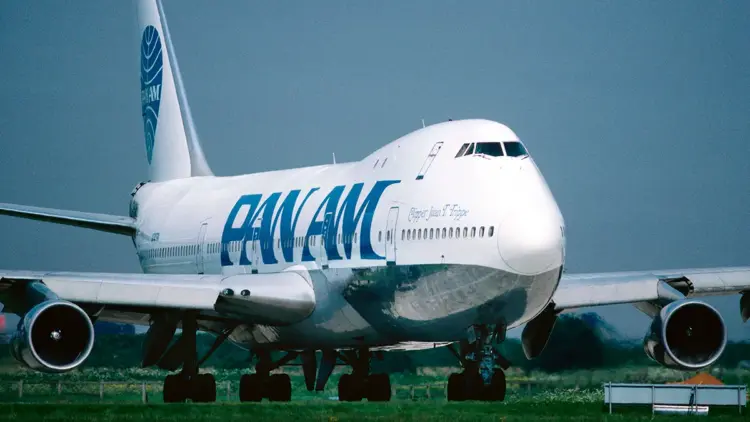 Pan American World Airways stopped flying on December 4, 1991, nearly 11 months after it filed for Chapter 11 bankruptcy protection. The trigger was money. Pan Am’s lawyer told the bankruptcy court the airline needed roughly $25 million in additional funding to keep going, and Delta Air Lines declined to provide it. The Associated Press put the number of Pan Am employees out of work at about 7,500. That same day, Captain Mark Pyle flew Boeing 727-221ADV N368PA, Clipper Goodwill, from Grantley Adams International Airport (BGI) in Bridgetown, Barbados, to Miami International Airport (MIA) as Flight 436. It was Pan Am’s last scheduled service.
So what happened to the airline Pan Am? Many readers assume the 1988 Lockerbie bombing or the 1978 deregulation of U.S. airlines destroyed a healthy giant almost overnight. That view is partly true, but it is far from the full picture. In material later printed by Congress, Pan Am itself dated its financial turning point to 1969, nine years before deregulation and 19 years before Lockerbie.
The short version runs like this. Pan Am had only a very limited U.S. domestic network, so it had little traffic of its own to feed its long-haul flights. It took delivery of a huge new 747 fleet just as its finances turned down, and then the 1973–74 oil shock hit. It bought National Airlines to get domestic routes quickly, sold off its most valuable assets to cover recurring losses, and had nothing left to absorb Lockerbie, a recession and the Gulf crisis. Here is how it unraveled, decision by decision.
Why Pan Am’s Collapse Still Matters
Pan Am was not just another airline that failed. In October 1955, Juan Terry Trippe’s company ordered 20 Boeing 707s and 25 Douglas DC-8s. That dual order helped shape two competing families of jetliners. In 1966 Pan Am became the launch customer for the Boeing 747, which means it placed the first order and so made the program possible.
Much of today’s U.S. airline map also carries Pan Am’s DNA. United Airlines bought Pan Am’s Pacific Division and, in a separate deal, its London Heathrow Airport (LHR) route rights. Delta began flying Pan Am’s transatlantic routes on November 1, 1991, which took it into a much larger Atlantic operation in one step. The routes Pan Am sold gave its domestic rivals an opportunity to grow overseas.
That points to the central lesson of this story. Prestige and a worldwide route map could not make up for weak domestic feed, meaning the connecting passengers an airline brings from other U.S. cities onto its international flights. The timeline below shows how the decline played out over 22 years, from the first losses to the final shutdown.
Table 1: Pan Am’s 22-Year Decline at a Glance
| Year | Milestone |
| 1969 | Pan Am identified 1969 as its financial turning point and reported a net loss |
| 1970 | The Boeing 747 entered commercial service in January |
| 1973–74 | The Arab oil embargo disrupted energy markets and Pan Am’s fuel costs rose sharply |
| 1978 | President Jimmy Carter signed the Airline Deregulation Act on October 24 |
| 1980 | The National Airlines merger was completed in early January |
| 1980–81 | Pan Am sold its Manhattan headquarters and the InterContinental hotel chain |
| 1985–86 | The Pacific Division was sold to United, which took it over in February 1986 |
| 1988 | Flight 103 was destroyed over Lockerbie, Scotland, on December 21 |
| 1990–91 | Iraq invaded Kuwait, Lufthansa took over Berlin service, and the Heathrow sale closed in two phases |
| January 1991 | Pan Am filed for Chapter 11 on January 8 |
| December 1991 | The original airline stopped flying on December 4 |
Juan Trippe Builds An Empire (1927–1968)
From Key West To Six Continents
Pan American Airways was incorporated on March 14, 1927. According to the Pan Am Historical Foundation, the incorporators were John K. Montgomery, Richard Bevier, G. Grant Mason Jr. and S. S. Colt. Juan Trippe built that paper company into an operating airline. Scheduled airmail between Key West, Florida, and Havana, Cuba, began on October 28, 1927, and fare-paying passenger service followed on January 16, 1928. Charles Lindbergh joined as a technical adviser and helped open new routes. He became technical director in 1929 and later served as a longtime adviser to the board.
The flying boats came next. Pan Am opened scheduled transpacific mail service in 1935, carried its first paying passengers across the Pacific in 1936 and started Atlantic flying-boat routes in 1939. On June 17, 1947, it began scheduled round-the-world service.
Pan Am was never officially America’s “flag carrier,” the term for an airline that represents its country on international routes. U.S. officials used “U.S. flag carrier” to mean any qualifying American airline. Abroad, though, Pan Am was so prominent that it served as the country’s de facto representative in the sky.
It was also profitable for a long time. An annual report cited by the Pan Am Historical Foundation put 1966 operating revenue at $841 million and profit at $83.7 million.
Opening The Jet Age
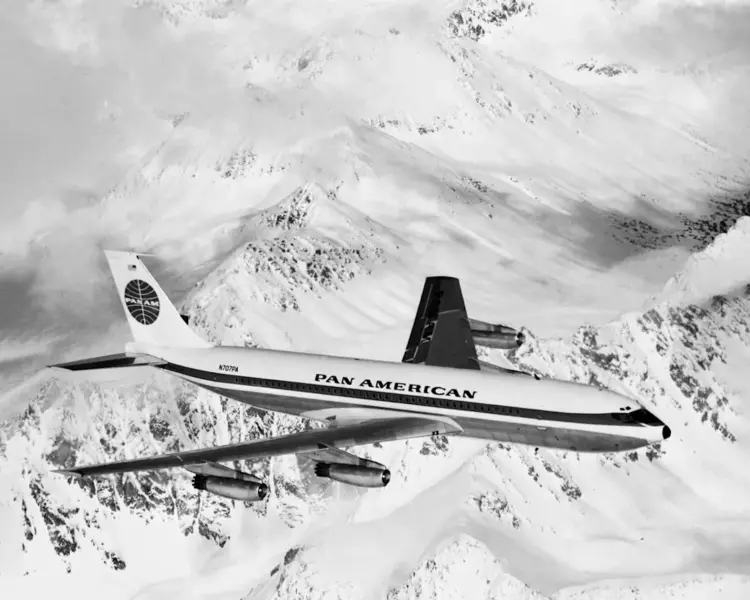
The 1955 order for 707s and DC-8s pushed U.S. international airline service into the jet age. The foundation links the two rival designs to Pan Am’s negotiations over long-range economics and six-abreast seating. On October 26, 1958, Boeing 707-121 Clipper America left New York International Airport, then known as Idlewild and later renamed John F. Kennedy International Airport (JFK), for Paris via Gander, Newfoundland. British Overseas Airways Corporation (BOAC) had beaten Pan Am to transatlantic jet service by three weeks, starting on October 4. Pan Am eventually received 19 of the 25 DC-8s it had ordered, and DC-8 service began in 1960.
In 1963 the airline opened its corporate monument, the Pan Am Building at 200 Park Avenue in Manhattan, which stands above the rail approaches to Grand Central Terminal. It would later be one of the first assets the company sold.
The Berlin Franchise
After World War II, the Western occupying powers controlled air access to West Berlin. As a result, U.S., British and French airlines had a special role there. Pan Am built Internal German Services (IGS), which linked West Berlin with cities in West Germany. Pan Am carried Berlin traffic in the early postwar years, and the Pan Am Historical Foundation dates the formal IGS unit to April 1954. Berlin was its hub and Frankfurt its technical base. Photographs from the foundation show Douglas DC-4s and Boeing 727-100s at Berlin Tempelhof Airport (THF).
The business depended entirely on a legal arrangement that limited which airlines could fly there. When German reunification ended those restrictions in 1990, Deutsche Lufthansa AG moved in. An often-repeated estimate that Pan Am carried about 60% of West Berlin’s civilian air traffic has not been independently confirmed.
The Hidden Flaw: An Airline With No Home Market
The Civil Aeronautics Act of 1938 set up federal economic regulation of airlines. From the 1940 reorganization onward, the Civil Aeronautics Board (CAB) controlled market entry, routes and fares. It awarded routes under a “public convenience and necessity” standard, meaning an airline had to show a route served a public need before it could fly it.
Pan Am was built to fly overseas, and it never had a broad domestic network. That mattered because of domestic feed: passengers who start in other U.S. cities and connect onto a long-haul departure. An airline with its own domestic flights can collect those travelers on its own aircraft and spread the cost of a long international flight across many origin cities. Pan Am had far fewer chances to do that.
A common belief is that Pan Am had no domestic flying except Hawaii and Alaska. The record is more nuanced. A September 1978 Washington Post report quoted the CAB describing Pan Am’s domestic system as very limited. Before the October 1978 law, the board had authorized Pan Am to carry local passengers on several continental segments of its international flights, including Washington–New York, San Francisco–Los Angeles and Seattle–Portland. The CAB said changing international competition had placed an unusual burden on Pan Am. However, those authorizations covered only traffic tied to international schedules.
Pan Am’s overseas position was not an untouched monopoly either. On April 11, 1969, President Richard Nixon wrote to CAB Chairman John H. Crooker Jr. revising the Transpacific Route Investigation, which split Pacific routes among several U.S. airlines. That decision discussed Pan Am, Trans World Airlines (TWA) and other U.S. competitors. By the early 1970s, Pan Am also faced TWA head-on across the North Atlantic, along with growing competition from foreign airlines and charter operators. Pan Am told Congress that around 1969, U.S. rivals with large domestic networks were getting more chances to compete internationally.
Pan Am got the worst of both arrangements. Its overseas advantage was shrinking, and it had almost no domestic flying to feed its gateways.
The $525 Million Jumbo Bet Meets The Oil Shock
Launching The Queen Of The Skies
Juan Trippe wanted an airplane much bigger than the 707. Boeing’s 747 team, led by Joseph F. Sutter, designed a widebody with the flight deck above the main deck. This left the nose free to swing open for loading on freighter versions. Boeing gave the freighter role weight because the industry expected supersonic transports to take over passenger flying, so the 747’s future as a cargo jet mattered. Pan Am’s passenger 747s used the upper-deck space behind the cockpit for passenger amenities.
A newsreel archived by the U.S. National Archives reported the April 1966 launch order as 25 747s for $525 million, with a design capacity of 490 passengers. That $525 million was a purchase commitment, not debt. Pan Am’s employee publication at the time said the airline expected to pay for the jets with a mix of internally generated cash, credit and convertible debt.
Development was not smooth. The Pan Am Historical Foundation records early surge and installation problems with the Pratt & Whitney JT9D engines. A compressor stall, also called a surge, happens when the smooth flow of air through an engine’s compressor breaks down. It can cut thrust. The 747 first flew in February 1969.
Too Many Seats, Too Few Passengers
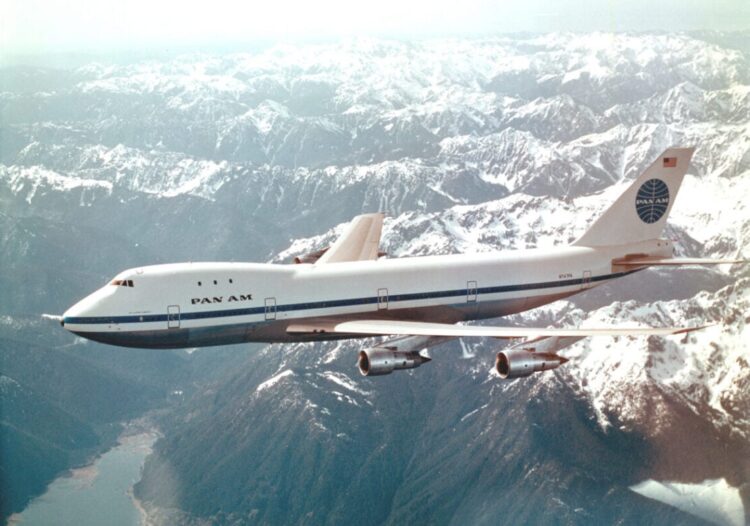 The first commercial 747 flight went from JFK to Heathrow and was scheduled for January 21, 1970. According to the Pan Am Historical Foundation’s reconstruction, it was delayed, a substitute aircraft was used, and it finally departed New York after midnight on January 22. The Pan Am Museum Foundation reports 335 passengers and 20 crew members on board.
The timing could hardly have been worse. Pan Am had already recorded its first loss in 1969, before the first revenue 747 flight. In its statement to Congress, Pan Am put that loss at almost $34 million, while a 1971 TIME report put it at $26 million. The reason for the difference is not clear, but both sources agree there was a loss and when it happened. Pan Am said its aggregate losses for 1969 through 1971 exceeded $125 million.
The 747 promised a lower cost per seat, but only if the seats were filled. Pan Am described a squeeze from foreign airlines, charter operators and established U.S. carriers, along with weak international fares. Meanwhile, more widebody types soon entered the market.
The 1973 Oil Shock And Washington’s “No”
The U.S. State Department’s Office of the Historian links the 1973–74 Arab oil embargo to a sharp jump in oil prices. For an international airline that was already losing money, it changed the economics of every flight. Testifying to the U.S. Senate in 1974, Pan Am chairman William T. Seawell estimated the airline’s 1974 fuel bill at $339 million, compared with roughly $170 million paid in 1973. That figure was a forecast from an interested party, not an audited result.
Pan Am asked Washington for help. TIME reported in September 1974 that Pan Am sought a $10.1 million monthly subsidy and owed roughly $700 million to banks and insurance companies. The Ford administration said no to cash. Describing President Gerald R. Ford’s policy, Transportation Secretary Claude S. Brinegar said “it is not now fair to the nation’s taxpayers to ask them to support our U.S. international flag carriers with direct cash subsidy payments.”
Washington offered other measures instead. They included pursuing better scheduling and competition arrangements, examining whether foreign airlines followed bilateral agreements, encouraging the use of U.S. carriers, considering mail compensation and talking to Pan Am’s creditors. The CAB considered the subsidy application separately. TIME reported that Seawell welcomed the steps while still hoping for direct assistance. The package aimed at longer-term competitive conditions, but Pan Am’s operating losses needed money immediately.
Seawell’s Temporary Rescue
Pan Am changed management in March 1972 and cut its fleet and operations. The cuts reduced the losses. According to Pan Am’s account in a congressional print, its net loss fell from $45.3 million in 1971 to $28.2 million in 1972. Before interest costs, the 1972 operating result was roughly break-even.
That gap between operating results and net results matters throughout the Pan Am story. Shrinking an airline can delay a cash crisis without fixing the underlying business. Widely repeated figures on the later Seawell years have not been independently confirmed. They include about $364 million in ten-year losses by 1976, debt near $1 billion, cuts of 25% in routes and 30% in staff, and a 1977 profit helped by tax-loss credits. What the record shows is that the 1972 management change came before the 1973–74 fuel shock and before the National acquisition that Seawell would lead.
Deregulation: Freedom That Came Too Late
On October 24, 1978, President Jimmy Carter signed the Airline Deregulation Act, Public Law 95-504. According to the Law Library of Congress, the act phased out federal control of domestic market entry and fares and set the CAB to close at the end of 1984. Alfred E. Kahn had already started reforms as CAB chairman before the law passed.
For Pan Am, the new freedom came with a catch. It could finally build a domestic network, but the incumbent domestic airlines already had their hubs in place. In a hub-and-spoke network, flights from many cities converge on one hub airport, where passengers connect to onward flights. Before deregulation, a traveler from a mid-sized U.S. city often flew a domestic airline to a coastal gateway and connected there to Pan Am. Under a hub-and-spoke system, an integrated airline can carry that passenger from home all the way to the destination and schedule its long-haul flights around the connecting flow.
Domestic deregulation did not, as is sometimes claimed, give U.S. airlines automatic access to overseas routes from their hubs. International routes still needed route-specific approvals and remained subject to bilateral restrictions, as the later Heathrow proceedings showed. Still, the domestic carriers’ growing networks made them stronger competitors for passengers headed overseas.
Fares changed as well. One measure here is the revenue passenger mile (RPM), which counts one paying passenger carried one mile. Comparing 1979 with 1988, the U.S. General Accounting Office found that inflation-adjusted fares per passenger mile at its sampled airports fell about 9% at small-community airports, 10% at medium-community airports and 5% at large-community airports. Results varied by airport and period. GAO also found that hubs expanded one-stop connections, while some markets lost nonstop service.
Pan Am needed a domestic network fast. That need drove its next decision.
The National Airlines Merger: Buying The Wrong Network
National Airlines was based in Miami and had flown since 1934. In 1971 it introduced the widebody McDonnell Douglas DC-10 on its Miami–New York route. To Pan Am, National offered an existing domestic route network.
Pan Am did not have the field to itself. National’s management signed a merger agreement with Pan Am on September 6, 1978, while Texas International Airlines competed for control. This made Pan Am the “white knight,” meaning a buyer a takeover target’s management favors over a hostile bidder. National’s shareholders approved the Pan Am merger on May 16, 1979. On July 28, 1979, Texas International sold its shares at $50 each. According to the U.S. Court of Appeals for the Fifth Circuit, it made a substantial profit on them. In that later shareholder litigation, dissenting Judge Thomas Gibbs Gee described National’s management as resisting Texas International and supporting Pan Am. Texas International argued that making it give up the profit would unfairly favor Pan Am. The majority held that the stock sale was voluntary and subject to the statute at issue.
Washington weighed in as well. On December 21, 1979, the Justice Department’s Office of Legal Counsel issued an opinion on the president’s authority over the international route portions of the CAB’s decision, such as Miami–London. Government approval followed on December 22, and the merger was completed on January 7, 1980. Airways reports that the takeover cost $437 million and that the combined airline had about 35,000 employees.
Several problems became apparent:
- Geography. National was a Miami-based network, and the Delta Flight Museum describes the deal as an attempt to build a domestic system quickly. Pan Am’s overseas flights, however, ran from several gateways. Owning a route map and getting useful connecting traffic from it are separate questions. How much each National route actually fed Pan Am’s international flights has never been measured.
- Fleet. National’s DC-10s joined Pan Am’s Boeing 747s and Lockheed L-1011 TriStars, adding another widebody type to the fleet. No published figure measures how much extra that mix cost.
- Labor. Airways reports that Pan Am agreed to raise National’s union pay to Pan Am levels, which put pressure on route profitability. The exact cost of that increase has not been confirmed.
- Timing. The merger came during the 1978–79 oil shock and just before the 1980 recession, which made a hard environment for a newly expanded airline.
Selling The Family Silver (1980–1991)
From 1980 on, Pan Am followed a pattern. It sold assets to raise cash against recurring losses, and each sale shrank the business that was supposed to earn the money back. The Foreign Claims Settlement Commission of the United States (FCSC), a federal body that later reviewed Pan Am’s finances in a former employee’s claim against Libya, described the sales as attempts to raise cash. Thomas G. Plaskett became chief executive in January 1988 and pursued route and service changes.
The table below lists the major disposals. Figures are nominal U.S. dollars, as reported at the time, and where accounts differ, both are shown.
Table 2: What Pan Am Sold, To Whom, And For How Much
| Date | Asset | Buyer | Value and notes |
| 1980–81 | Pan Am Building, Manhattan | Metropolitan Life Insurance Company | About $400 million, a record for a building sale at the time |
| 1981 | InterContinental hotel chain | Grand Metropolitan Ltd. | $500 million |
| April 1985 agreement, February 1986 handover | Pacific Division routes and related operating assets | United Airlines | $750 million announced; $715 million reported at the November 1985 regulatory clearance |
| 1990 | West Berlin operations | Deutsche Lufthansa AG | About $150 million expected, according to contemporary reports; final proceeds unconfirmed |
| October 1990 agreement, April 1991 second closing | London operations and related assets | United Airlines | $400 million in two phases: $110 million and $290 million |
| August–November 1991 | Shuttle and Atlantic asset package | Delta Air Lines, Inc. | $416 million in cash under the amended agreement |
The sales could flatter the books. According to the FCSC, Pan Am posted a $181.5 million operating loss in 1985 but a $52 million profit once the Pacific sale was included. Those are two different measures, and only one of them came from flying airplanes.
The Pacific deal drew economists’ attention. In a 1987 article in the RAND Journal of Economics, Massachusetts Institute of Technology economist Franklin M. Fisher examined the Pacific Division transfer. He warned that high entry barriers and concentrated existing service could weaken competition after the sale. “Where entry is difficult, however, detailed analysis is required,” Fisher wrote. Put simply, he argued that a route sale cannot be assumed harmless to competition when rivals cannot easily enter the market.
Pan Am also tried to buy its way out of trouble. In 1989 it was one of several bidders for Northwest Airlines. The individual $2.7 billion figure often attached to its bid has not been independently confirmed.
The last big sales hit Pan Am’s cash at the worst possible time. Lufthansa announced it would start Berlin service from Berlin Tegel Airport (TXL) on October 28, 1990, using leased Pan Am aircraft. The Heathrow sale to United went through government approvals in two phases, and the FCSC found that the delay in closing Phase II left Pan Am in a financial bind. Even after all these sales, Pan Am remained insolvent.
Lockerbie: Tragedy, Security Failures And “Wilful Misconduct”
On December 21, 1988, Pan Am Flight 103, a Boeing 747-121 registered N739PA, was destroyed by a bomb over Lockerbie, Scotland, on its way from Heathrow to JFK. The UK Air Accidents Investigation Branch (AAIB) recorded the loss at about 19:03 Coordinated Universal Time (UTC), roughly 38 minutes after takeoff. All 259 people on board and 11 people on the ground were killed. The flight connected with an earlier leg from Frankfurt Airport (FRA), which used a different aircraft.
The President’s Commission on Aviation Security and Terrorism (PCAST), chaired by Ann McLaughlin, issued its report in May 1990. It found systemic flaws in U.S. aviation security, including shortcomings at the Federal Aviation Administration (FAA). Its starkest line was: “The destruction of Flight 103 may well have been preventable.” That was the collective judgment of a presidential commission, not a claim by the victims’ lawyers.
The civil case turned on the Warsaw Convention, the international treaty that normally capped an airline’s damages for passenger deaths. The cap did not apply if the airline was found guilty of willful misconduct. On July 10, 1992, a federal jury found Pan American World Airways and its security subsidiary, Alert Management Systems, Inc., liable for willful misconduct. The U.S. Court of Appeals for the Second Circuit affirmed the judgments in 1994. In its narrative, the appeals court summarized the opinion of Rodney Wallis, an aviation-security expert who testified for the plaintiffs, as describing a “commercial rather than security priority.”
Two points are disputed in the record. First, the plaintiffs argued that the bomb began its journey as baggage from Malta and moved through Frankfurt. The appeals court described that as the plaintiffs’ theory, noted that the defense disputed it and recorded other evidence the jury heard. The verdict itself was a general finding of willful misconduct. Second, Pan Am said FAA security official Raymond Salazar, who directed the FAA Office of Civil Aviation Security at the time, had verbally approved its approach. Salazar denied giving permission. The appellate majority upheld the verdict, while the dissent challenged evidentiary exclusions and the fairness of the trial.
The criminal cases ran separately. Abdelbaset al-Megrahi was convicted in 2001 by a Scottish court sitting at Camp Zeist in the Netherlands. Abu Agila Mohammad Mas’ud, charged by U.S. prosecutors in December 2020, was taken into U.S. custody in December 2022 and has pleaded not guilty. The charges against him remain allegations. As of November 2026, an amended scheduling order set jury selection for January 19, 2027, a date that could still change.
The bombing hurt the business as well. Pan Am reported that Atlantic division revenue in 1989 fell 14.5%, or $258 million, from 1988, and attributed weaker demand partly to security fears. The FCSC also pointed to pricing and other factors. The decisive blow to the business, however, came about 20 months after the bombing.
The Gulf War, Chapter 11 And The Last Clipper
The Final External Shock
The U.S. recession began in July 1990, according to the FCSC’s chronology, and Iraq invaded Kuwait on August 2. Jet fuel rose from roughly $0.60 a gallon to more than $1.30, and passenger traffic fell. The FCSC found that much of Pan Am’s revenue growth over the previous two years had come before the invasion, after which revenue fell sharply. Pan Am’s third-quarter loss grew from $18 million in 1989 to $29.1 million in 1990, and its consolidated net loss for 1990 reached $662.9 million.
Cash was draining away. The FCSC recorded declines in cash on hand of about $85 million in 1989 and nearly $138 million in 1990. Pan Am was not alone: the Associated Press reported that Eastern Air Lines and Midway Airlines also stopped flying in 1991. Pan Am, however, had no reserves left to absorb the shock.
Bankruptcy And The Pension Hole
Pan Am Corporation and its subsidiaries filed for Chapter 11 on January 8, 1991. Chapter 11 lets a company keep operating while it tries to reorganize. The Los Angeles Times reported that Pan Am told the court its companies had combined assets of $2.1 billion and liabilities of $2.8 billion. The airline blamed fuel costs, the downturn and the Flight 103 bombing.
The pensions became a major creditor problem. In 1991, the Pension Benefit Guaranty Corporation (PBGC), the federal agency that insures private pensions, moved to terminate two of Pan Am’s three pension plans. On September 19, 1991, as recorded in In re Pan Am Corp., it filed proofs of claim, meaning formal demands for payment in the bankruptcy, of $914,489,000 in employer termination liability and $364,134,540 in unpaid minimum funding contributions. Pan Am objected. The pilots’ A plan was terminated by consent in January 1992, after the flying had stopped. These claims were amounts PBGC demanded, not its final cost.
Delta’s Rescue That Wasn’t
Delta offered a two-part deal. Under an August 11, 1991 letter agreement and an October 22 follow-up, Delta would buy Pan Am’s Atlantic routes and the Shuttle. The routes included operations at Frankfurt and JFK, and London service through London Gatwick Airport (LGW). The amended purchase price was $416 million in cash, and Delta was required to hire 6,600 Pan Am employees under the agreement. Separately, according to the federal district court’s findings, Delta proposed investing in a smaller, reorganized Pan Am based in Miami: $50 million in cash for 45% of the common equity, $155 million for senior notes and a separate $100 million working-capital facility. That investment depended on conditions and on a workable reorganization plan.
Pan Am’s reported profits gave a misleading picture. The FCSC reported that Pan Am earned $99.9 million in the second quarter of 1991, and contemporary reports said the quarter would have been a loss without a $260 million gain from the Heathrow sale.
Delta began flying the Atlantic routes on November 1, and the numbers for the smaller Pan Am then deteriorated. In mid-November, John Lewis, Pan Am’s vice president for airline planning, forecast November revenue $19.5 million, or 17.1%, below expectations and December revenue $9 million below plan. By November 25, the court found, Pan Am’s own analysis showed the proposed airline could not repay its later senior-note obligations. Estimates of the daily cash drain differed. The Associated Press reported about $2 million a day in describing Delta’s position, while the Los Angeles Times, citing industry sources, put it at about $3 million.
December 4, 1991
The end came quickly. “On December 3, 1991, Pan Am’s Chief Executive Officer Russell Ray decided not to proceed with a confirmation hearing relating to the Joint Plan,” U.S. District Judge Robert W. Sweet wrote in his 1994 findings. Without that hearing, there was no reorganized airline to fund. Pan Am stopped flying the next day, and TIME recorded that callers were greeted by a recorded closure message.
Workers found out at the door. “We came up to work and they just told us we couldn’t go in,” Harry Tomisaka, a fleet service employee with 23 years at Pan Am, told the Associated Press in San Francisco.
Out of the Caribbean, Flight 436 completed the last scheduled service. Captain Mark Pyle, First Officer Robert Knox and Flight Engineer Chuck Foreman flew Clipper Goodwill from Barbados into Miami.
The legal and financial aftermath lasted years. Pan Am and its creditors sued Delta, arguing it should have funded the reorganization. Delta said the conditions for closing had not been met. Judge Sweet held that providing further debtor-in-possession financing, meaning loans to a company in bankruptcy, was not among Delta’s obligations at that point, and he ruled for Delta on the plaintiffs’ claims. He also ruled against Delta’s counterclaim against the creditors’ committee. Former employees recovered only a fraction of what they were owed. According to the FCSC, a December 1994 distribution paid about 9.6% of their administrative claims, and the final payments in December 2006, which followed Pan Am’s settlement with Libya, amounted to roughly 5% to 6%.
Myths, Disputed Numbers And What Remains Uncertain
“Lockerbie killed Pan Am.” The bombing did real commercial damage, but no audited record separates the losses caused by Lockerbie, the recession, competition and the Gulf crisis. In its Scottish lawsuit, Pan Am claimed the bombing caused its bankruptcy, and Libya contested that claim. Reviewing a former employee’s claim, the FCSC found adverse effects after the bombing but stressed the larger fall in cash during 1990. “Events in 1991, however, were clearly intervening, and, in a legal sense, suffice to sever any possible causal link with the Lockerbie bombing,” the commission wrote. That is a legal finding about causation in one claim, not an accounting of what would have happened without the attack.
“Deregulation alone killed it.” By Pan Am’s own account, its losses began in 1969, and it faced stiff international competition long before the 1978 law. The National merger, the asset sales and the final restructuring were management decisions, each with its own timing and terms.
The disputed numbers:
- Pacific Division: $750 million was announced in April 1985, and $715 million was reported at the November 1985 clearance. Why the figures differ remains unclear.
- Heathrow: $400 million total, paid as $110 million plus $290 million, which produced a reported $260 million gain. It was not a reduced price.
- Pensions: PBGC filed claims of $914.5 million and $364.1 million. A separately cited $841 million cost estimate has not been independently confirmed.
- Daily losses: about $2 million (Associated Press) or about $3 million (Los Angeles Times).
- Jobs lost at shutdown: about 7,500. An alternative figure of nearly 8,000 has not been independently confirmed.
A few popular figures also lack independent confirmation. They include an 87-country network in 1968, cumulative domestic-division losses above $1 billion from 1980 to 1987, and an industry-wide early-1990s loss of $10.6 billion to $13 billion.
Pan Am After Pan Am: A Name That Refuses To Land
The original Pan American World Airways ended for good on December 4, 1991. Everything since then has been other companies using the name.
Table 3: Pan Am’s Brand Afterlives
| Period | Entity | What happened |
| 1996–98 | A later Pan Am and the former Carnival Airlines | According to the U.S. Department of Transportation, both companies operating under the Pan Am name filed for Chapter 11 on February 26, 1998, and stopped all scheduled flying on February 27 |
| Late 1990s–2008 | Guilford Transportation Industries and Boston-Maine Airways | Guilford bought the Pan Am name, and Boston-Maine Airways flew within the group until its airline certificate was revoked in 2008 |
| 2022 | Pan Am Railways and CSX Corporation | The Surface Transportation Board approved the acquisition with conditions in April 2022, and CSX completed the purchase on June 1, 2022 |
| 2025–26 | Pan Am Brands and AVi8 Air Capital | A June 2025 heritage charter used Icelandair Boeing 757-200 TF-FIC in Pan Am colors, a certification effort was announced on October 9, 2025, and an Amadeus distribution technology agreement was announced in February 2026 |
The newest effort needs careful reading. In its October 9, 2025 release, AVi8 Air Capital said “Pan Am® has formally initiated the certification process with the Federal Aviation Administration (FAA)”. The U.S. Department of Transportation explains that a scheduled U.S. airline needs two separate approvals: economic authority from DOT and safety certification from the FAA. A heritage charter, a technology contract and a sponsor’s statement about certification are each different steps. As of November 20, 2026, no issued scheduled-airline authority, schedule or launch date had been confirmed. October 2027 will mark 100 years since Pan Am’s first airmail flight. That anniversary is separate from any relaunch.
What Pan Am’s Fall Teaches About Airline Survival
Pan Am’s fall comes down to two lessons. First, a long-haul network is easier to fill when connections draw travelers from many cities. Pan Am had a global map and almost no domestic flying to feed it. Second, selling assets gives a company cash once. It does not fix a business that loses money flying. The 1985 Pacific sale and the 1991 Heathrow gain both turned operating losses into reported profits for a while, but neither changed the underlying trend.
Today’s network airlines are built around the connecting model Pan Am lacked. In their annual Form 10-K filings for 2025, both Delta and United describe hubs, regional flying and connections as the basis of their networks. Those are the same two airlines that bought Pan Am’s crown jewels.
In a sense, Pan Am never entirely disappeared. Its Pacific routes, Heathrow rights and Atlantic network still operate inside other airlines’ systems. Not all of its legacy survived, however. In 2013, Delta and the Port Authority of New York and New Jersey announced a redevelopment plan that included demolishing JFK Terminal 3, the former Pan Am Worldport.

Key Takeaways
- No home market: Pan Am’s very limited domestic network left it short of connecting traffic as international competition grew.
- Bad timing: The 747s from the $525 million 1966 order arrived after losses began in 1969, and the oil shocks followed. The $437 million National merger added domestic routes, but the losses continued.
- Selling the future: Selling the headquarters, hotels, Pacific Division, Berlin service and Heathrow rights raised cash, but each sale shrank the business.
- The final blows: Lockerbie, the recession and the Gulf crisis piled on. Pan Am stopped flying on December 4, 1991, when its reorganization funding fell through.