


Radio, battery, and charger come in the box. Calm air doesn’t. See how a 0–5 mph wind window can turn this tiny Cub into a smart first plane or a shelf model.
Quick Verdict
This HobbyZone Sport Cub S 2 RTF review ends in a conditional yes. We’d recommend it to a first-time adult pilot or a supervised teen who wants a complete 4-channel trainer and can wait for calm air.
The case rests on the box and the electronics. You get the radio, battery, and charger, and SAFE assistance can be dialed back as your skills grow. The catch sits in the manual, whose takeoff and landing illustrations show winds of 0–5 mph. If your field rarely gets that still, or you want more airframe for the money, start with our guide to the best RC planes instead.
One caution on the evidence: no named, independent flight test of this exact package or product-specific expert panel has surfaced, so handling, endurance, and durability remain unmeasured.
Keep reading to see where the plane stumbles and what it really costs to keep flying.
Brief Overview
What It Is
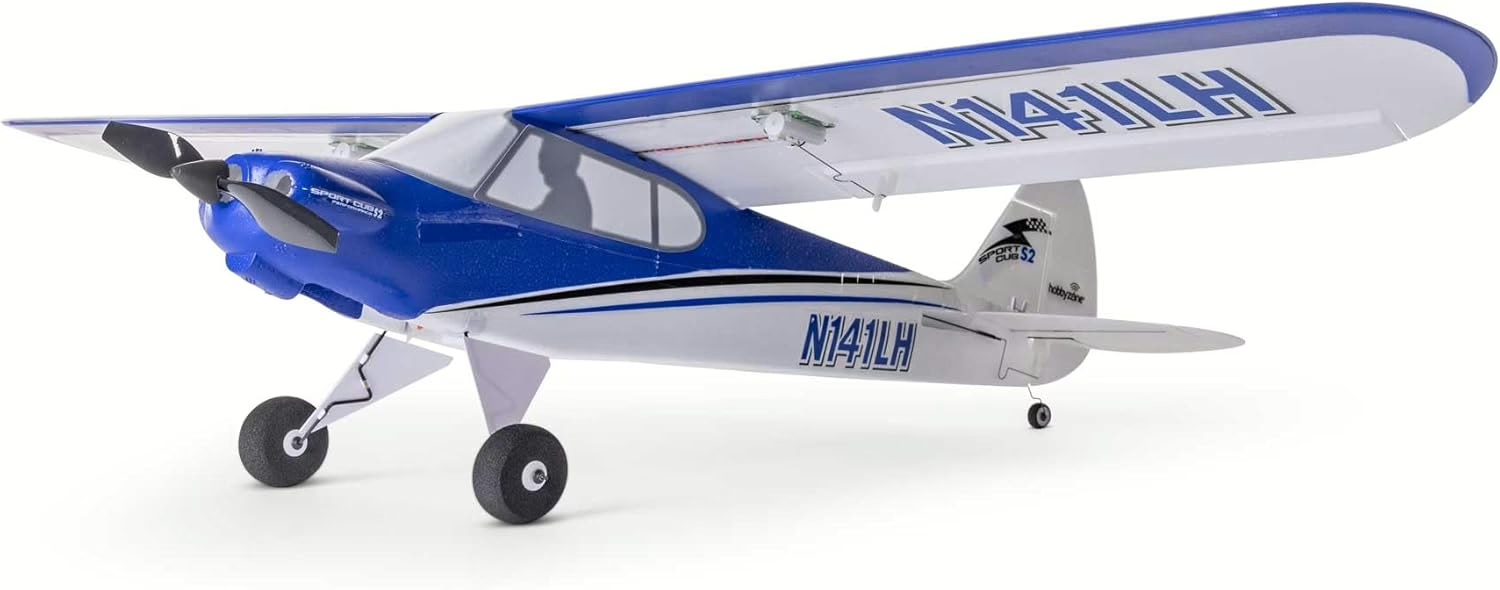
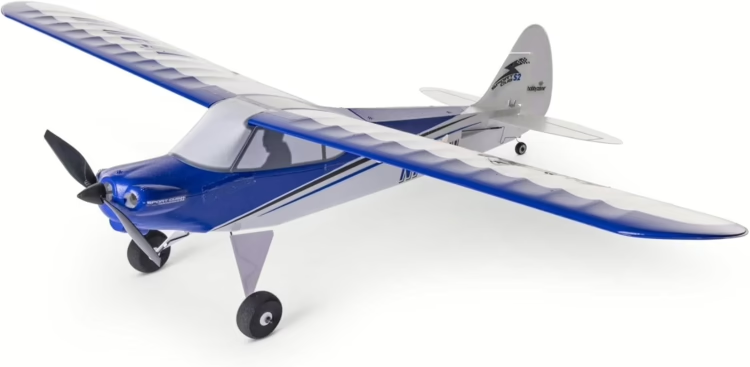
The Sport Cub S 2 RTF (HBZ444000) is a factory-assembled EPS foam trainer from HobbyZone, styled after the CubCrafters Carbon Cub. RTF means ready to fly: Horizon Hobby’s package includes the airframe and electronics, a Spektrum MLP6DSM transmitter, four AA cells, one E-flite 150mAh battery, a USB charger, and a manual.
Check the item number before you buy. The HBZ44500 is the Bind-N-Fly (BNF) version, which needs your own compatible transmitter, battery, and charger, and Tower Hobbies lists the older HBZ44000 as discontinued.
Who It’s For
Horizon pitches the plane at suitable large yards, parks, sports fields, and indoor spaces the size of a basketball court. Its natural buyers are first-time pilots, parents flying with supervised teens, and flyers short on space. The manual sets the age at 14 and up and calls for direct adult supervision of children. For a wider field of starter aircraft, see our picks for the best RC planes for beginners.
Cool Features That Matter
- Three SAFE modes. SAFE (Sensor Assisted Flight Envelope) gives you Beginner, with pitch and bank limits plus self-leveling; Intermediate, with wider limits and no automatic leveling; and Experienced, with no pitch or bank limits.
- Panic Recovery. Hold the trigger and the plane commands wings-level flight with a slight climb, though it can lose altitude first. Release it to return to your selected mode.
- Voltage telemetry. A transmitter LED shows green above 3.7V per cell, yellow from 3.3V to 3.7V, and red below 3.3V. It reports voltage, not minutes remaining.
- Replacement parts. Horizon’s list runs from the wing and tail to the motor and the receiver/electronic speed controller (ESC) unit.
AT A GLANCE
Model: Sport Cub S 2 RTF with SAFE (HBZ444000)
Manufacturer: HobbyZone (Horizon Hobby)
Wingspan: 24.3 in.
Length: 16.3 in.
Weight: 2.1 oz. with battery
Pilot skill level: Level 1 (manufacturer rating)
Assembly: None required (factory-assembled)
Power: 1S 150mAh lithium-polymer (LiPo), included
Radio: Spektrum MLP6DSM, included
If you can count on 0–5 mph air, this complete first-plane package deserves a look: check the current price on Amazon.
Pros & Cons
Pros
- Radio, battery, and charger come in the box, which means fewer first-purchase decisions.
- SAFE assistance can be reduced as your skills grow.
- Voltage telemetry gives you a running battery cue.
- Horizon lists parts down to the motor, gearbox, and receiver/ESC.
Cons
- The documented takeoff and landing wind window is narrow.
- One battery, a 5- or 6-minute manual timer, and a recharge of about 45 minutes from empty limit session length.
- Motor service means opening taped and decaled fuselage joints, and paint can lift.
- No independent test documenting endurance, wind handling, or crash survival has surfaced.
Is the Sport Cub S 2 Worth the Price?
How It Stacks Up
Price tiers below rank Horizon’s listed prices for these four packages, before taxes, shipping, and optional gear. Sales and seller bundles can change the order.
| Package | Span | Power and controls | Stabilization | Flight gear included | Price tier | Best use |
| Sport Cub S 2 RTF (HBZ444000) | 24.3 in. | Geared electric; 4-channel control | Three SAFE modes; Panic Recovery | Radio, 1S pack, USB charger, AA cells | Second lowest | Complete Cub-style 4-channel start |
| Duet S 2 RTF (HBZ05300) | 20.6 in. | Twin brushed motors; 3-channel control with differential-thrust steering | SAFE mode plus AS3X mode | Radio, 1S pack, USB charger, AA cells | Lowest | Lowest entry cost |
| Apprentice STOL S 700mm RTF (HBZ6100) | 27.56 in. | Brushless; 4-channel control | Three SAFE modes; Panic Recovery | Spektrum SLT6 radio, 2S pack, USB-C charger, AA cells | Second highest | Larger brushless micro trainer |
| AeroScout S 2 1.1m RTF Basic (HBZ380002) | 43.1 in. | Brushless pusher; 4-channel control | Three SAFE modes; Panic Recovery | DXS radio, full RealFlight; battery and charger sold separately | Highest, before battery and charger | Much larger platform |
No head-to-head trial separates these planes, and bigger doesn’t automatically buy better weather. Horizon’s own wind wording for the Apprentice also stops at 5 mph, and that model needs final wing and landing-gear installation. Horizon’s listed weights (about 5.5 oz. for the Apprentice, 30.1 oz. for the AeroScout with battery, 2.1 oz. here) don’t translate into wind tolerance either.
Astra, a distributor, lists the Sport Cub’s geared drive as brushed. Horizon’s documents confirm the gearing, so treat the brushed label as unconfirmed.
The Real Cost of Ownership
Budget beyond the box for:
- Spare E-flite 150mAh packs (EFLB1501S25) to shorten the wait between flights
- A prop and spinner (HBZ4401)
- A motor (HBZ4429), if yours needs replacing
- An optional Spektrum S44 four-port charger (SPMXC1040) or RealFlight Trainer Edition (RFL1205)
Horizon advertises a RealFlight trial of up to 100 minutes, which requires a compatible Windows PC, Steam, internet access, and a separately supplied USB-C cable. Horizon also lists a complete gearbox (HBZ4430), yet the manual prohibits removing the gearbox from the aircraft, so confirm the repair path before ordering one.
No published dataset on crash frequency, motor life, or yearly repair cost has surfaced, and part stock varies by listing. Treat spares money as a reserve, never a forecast.
The Value Call
We’d choose the Sport Cub S 2 for four separate flight controls, Cub styling, and a complete box. Pick the Duet if the lowest entry cost matters most. Look at the Apprentice for brushless power in a larger micro, or the AeroScout for a far bigger airframe, once you add its battery and charger to the budget. The Sport Cub earns its price only if your weather lets you use it.
Expected Experience with HobbyZone Sport Cub S 2 RTF
Unless noted, these expectations rest on Horizon’s manual, not a test report.
Unboxing and Setup
Horizon describes the plane as factory-assembled, and the RTF transmitter comes pre-bound. No independent build test confirms fit or setup time. The routine runs like this:
- Install the four AA cells with correct polarity.
- Charge the flight battery from a USB power source. A fully discharged pack takes about 45 minutes, and the charger’s red LED goes out when it finishes.
- Power on the transmitter and wait five seconds, then connect the battery and keep the plane upright, still, and out of the wind for five seconds.
- Restrain the plane, run the control-direction test in Experienced mode, then run the separate SAFE-response test. SAFE activates after the first throttle-stick or trim increase.
- Select Beginner mode for the first flight.
First Flights
The manual recommends a hand launch by a helper. A ground takeoff calls for a hard, level runway and rudder steering. After a ground takeoff, delay turns until the plane is high off the ground.
To land, reduce power on approach and close the throttle near the ground. Never try to catch the plane. Panic Recovery can lose altitude while it levels the wings, so it needs height, especially from inverted flight. The manual gives no recovery-height figure.
Stepping Up
Intermediate and Experienced modes hand you more responsibility. No source sets a flight count for moving up or documents how the plane feels in each mode.
In a general beginner-training article for Park Pilot, not a Sport Cub review, Jay Smith, then Model Aviation Editor-in-Chief, wrote that such technology advances “fall short of having an actual instructor available.”
Battery Life and Flight Time
The manual disagrees with itself: its preflight checklist sets a five-minute timer, and its flying section says six. Neither figure is measured endurance. We’d start at five and land sooner if power fades.
Motor pulsing means land immediately. The troubleshooting table links pulsing followed by power loss to the receiver/ESC’s low-voltage cutoff (LVC).
Where It Stumbles
- Wind. The 0–5 mph labels are the documented guidance, and no named test shows how this package behaves at or beyond them.
- Durability. No crash test, failure rate, or ranking of which parts break first has surfaced for this package. Inspect after any impact and let the damage decide the repair.
- Evidence limits. Any single owner’s story describes one airplane, not a failure rate. A U.S. Consumer Product Safety Commission recall of HobbyZone Super Cub S packages involves different item numbers and is no evidence about this plane.
Repairs
The manual specifies foam-compatible cyanoacrylate (CA) or clear tape. Unsuitable glue can harm the foam, and CA accelerant can damage paint. To correct a large trim offset, recenter the electronic trims and carefully adjust the linkage’s U-bend. Set elevator neutral right after powering on, before advancing the throttle activates SAFE.
Listed replacements include landing gear (HBZ4406), wing (HBZ4420), and tail set (HBZ4431). The gearbox must stay in the aircraft. After any repair, repeat the control and SAFE checks.
⚠️ Battery safety: Supervise every charge, use a compatible LiPo charger, and charge away from flammables. Stop using swollen or damaged packs. The manual bars minors from charging. Disconnect the flight battery before maintenance and before switching off the transmitter, and keep clear of the propeller.
💡 Find a mentor: The manual recommends experienced local pilots and AMA membership. The Academy of Model Aeronautics also describes an Introductory Pilot Program offering eligible nonmembers 90 days of supervised instruction through a certified mentor. It’s an option, not a legal requirement.
Where the HobbyZone Sport Cub S 2 RTF Really Shines
The first-flight safety net. Pitch and bank limits, self-leveling, and Panic Recovery can help a nervous beginner manage control inputs and regain orientation. That can build confidence, though no electronics guarantee a crash-free flight.
The small-field advantage. A 24.3-inch span and 2.1-oz. weight make this an easy plane to store and carry, and Horizon names sports fields and parks among suitable sites. No source gives a minimum field size, so check clearance, permission, and the manual’s rule against flying over people, roads, structures, or power lines or near airports.
The real-trainer feel. Separate throttle, rudder, aileron, and elevator controls let you practice full 4-channel flying, which the Duet’s simplified setup doesn’t offer. Picture the payoff: the first calm evening you lower the assistance and the airplane is truly yours to fly.
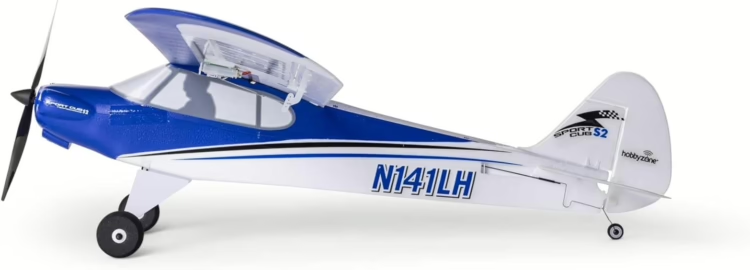
HobbyZone Sport Cub S 2 RTF (HBZ444000)
Complete, SAFE-equipped, and built for calm air. If your weather and flying site fit, see the current Amazon offer.
Who Should Buy It
Best Fit
- First-time pilots with regular access to calm conditions
- Adults flying with supervised teens 14 and up
- Learners who want to progress through SAFE modes on one plane
- Cub fans with a suitable, permitted site nearby
Who Should Skip It
- Pilots whose fields see steady wind
- Buyers who want a larger sport airframe; compare the Apprentice or AeroScout
- Unsupervised children
- Experienced pilots who already own a full-range 6+ channel Spektrum DSMX/DSM2 transmitter, who should price the BNF version, including its 1S battery and charger
FAQ
Q: Is the HobbyZone Sport Cub S 2 RTF a good first RC plane if I’ve never flown before?
A: The HobbyZone Sport Cub S 2 RTF is a sensible first plane if you can fly in calm air with suitable help.
- The package includes everything needed to fly except a USB power source.
- Beginner mode limits pitch and bank and self-levels.
- An experienced helper remains valuable, and no published novice success rate has surfaced.
Q: How windy is too windy for the HobbyZone Sport Cub S 2 RTF, and can I fly it indoors?
A: The HobbyZone Sport Cub S 2 RTF manual’s takeoff and landing illustrations show 0–5 mph, so treat anything above that as outside documented guidance.
- That range isn’t a tested limit or a promise about gusts.
- Horizon lists basketball-court-sized indoor space as suitable.
- No source validates smaller rooms.
Q: How long does one battery last, and how many should I buy?
A: One Sport Cub S 2 battery comes with a five- or six-minute manual timer, and no measured endurance figure has surfaced.
- Start with the five-minute timer.
- Land immediately if the motor pulses.
- One or two extra packs may suit a session, depending on budget and supervised charging.
Q: What else do I need to buy before my first flight with the HobbyZone Sport Cub S 2 RTF?
A: The HobbyZone Sport Cub S 2 RTF needs no extra flight equipment beyond a USB power source for its charger.
- Spare packs and parts are optional.
- The simulator trial has its own PC and cable requirements.
- A safe, legal site is essential.
Q: How do I repair the HobbyZone Sport Cub S 2 after a crash, and which parts usually break first?
A: Repair the HobbyZone Sport Cub S 2 by following the manual, because no reliable data shows which parts usually break first.
- Disconnect the flight battery.
- Inspect the airframe, linkages, and drivetrain.
- Fix foam with foam-compatible CA or clear tape, or fit the listed replacement.
- Leave the gearbox in the aircraft.
- Repeat the control and SAFE checks before flying.
Q: Do I need to register the HobbyZone Sport Cub S 2 RTF with the FAA?
A: FAA registration isn’t required when you fly the 61-gram (2.1-oz.) HobbyZone Sport Cub S 2 RTF purely for recreation.
- The exemption covers aircraft under 250 grams flown under the Exception for Limited Recreational Operations.
- You must still pass the free TRUST test, The Recreational UAS Safety Test, and carry proof.
- Follow recognized community-based organization safety guidance, keep the plane in visual line of sight, yield to other aircraft, and observe airspace rules.
- Non-recreational use or voluntary registration changes the answer, including for Remote ID.
Key Takeaways
- Buy it if you’re a beginner or supervised teen who wants a complete, SAFE-equipped 4-channel trainer.
- Check your weather first: the manual’s takeoff and landing guidance shows 0–5 mph.
- Budget for spare packs and repairs, since no data predicts crash or motor-replacement costs.
- Choose the Duet for the lowest entry cost, or the Apprentice or AeroScout for more size and brushless power.