


It looks like an easy park flyer, but its Level 3 rating, tip-stall reports, and a 250-gram FAA catch tell a different story. Here’s who should buy it and who should walk away.
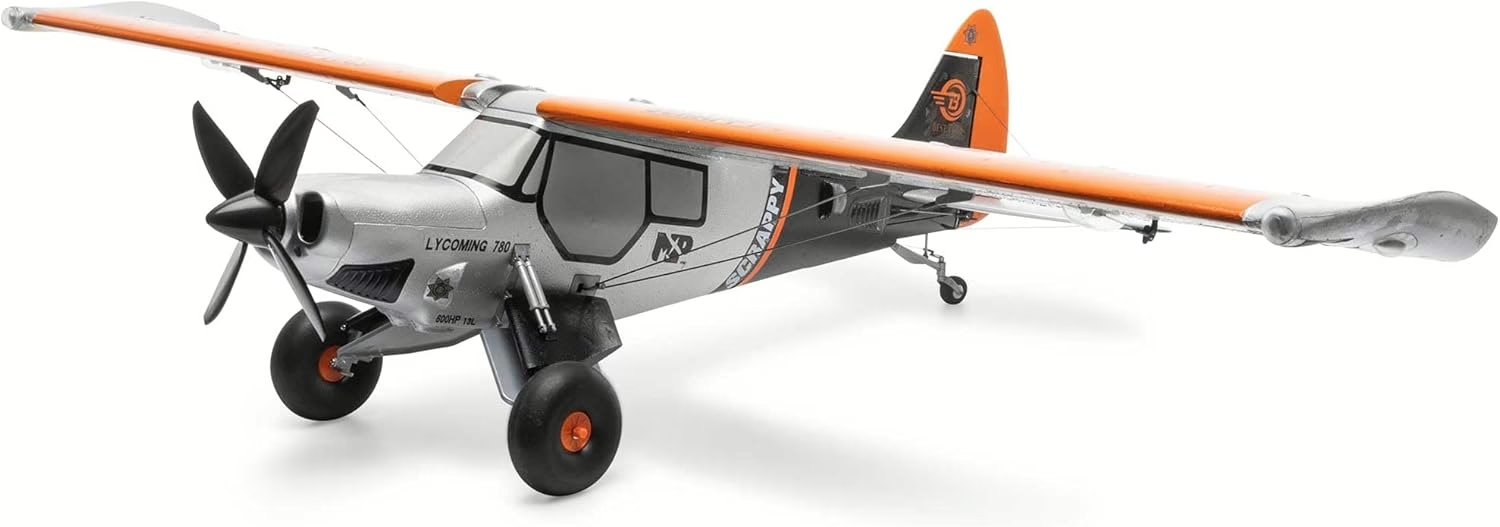
Any honest E-flite Micro Scrappy 800mm BNF Basic review starts with a buying trap: this friendly-looking micro bush plane can be the wrong purchase for a newcomer. Oversized tires and a 32.3-inch wingspan suggest an easy park flyer. A Level 3 skill rating, a real radio-programming job, and a box with no transmitter, battery, or charger tell a different story. If you’re comparing it against the best RC planes, here’s what the manual, an independent flight review, and owner reports support, and where the record runs out.
Quick Verdict
A credible micro STOL (short takeoff and landing) model for pilots who already fly capable small models, and a poor first airplane. Its case rests on a broad flight envelope, with SAFE Select assistance at one end and aerobatics at the other. Three caveats decide the purchase:
- Skill: Horizon Hobby rates it Level 3, Intermediate.
- Completeness: The BNF Basic box has no transmitter, battery, or charger.
- Paperwork: Both published 4S flying weights top the FAA’s 250-gram registration line for recreational fliers.
Flight findings here come chiefly from one experienced pilot’s review, so treat them as a report, not a consensus. New to RC? Start with our guide to the best RC planes for beginners. Everyone else, read on for the true cost, the 250-gram question, and what the stall evidence really shows.
Brief Overview
What It Is
The Micro Scrappy (EFL02150D) is an officially licensed Mike Patey replica built from EPS foam and sold by Horizon Hobby under the E-flite brand. A Spektrum brushless outrunner spins a four-blade prop, and the combined receiver/ESC (electronic speed control) handles AS3X stabilization and SAFE (Sensor Assisted Flight Envelope) Select. The “800mm” is a product name; the manual lists 32.3 in. of span.
Who It’s For
Retailer guidance points to pilots comfortable on models such as the UMX Timber series or Slow Ultra Stick. Hobby Zone’s listing also rules out first-time pilots and low-time pilots fresh off a trainer, though that passage sits under an older Level 2 heading. Horizon’s current Level 3 badge is the controlling rating.
Cool Features
- 3S or 4S operation with no modifications, so you can match the setup to your flying.
- SAFE Select plus AS3X for assisted or sporty flying from one airframe.
- Flaps, oversized tires, and a steerable tailwheel for grass and short-field work.
- A one-screw wing and magnetic hatch for quick field setup.
| AT A GLANCE | |
| Model | E-flite Micro Scrappy 800mm BNF Basic (EFL02150D) |
| Wingspan | 32.3 in. (821mm) |
| Length | 20.2 in. (512mm) |
| Weight without battery | 7.9 oz. (224.4g) |
| Flying weight, manual | 10.4 oz. (295g) on 4S 300mAh |
| Flying weight, Hobby Zone listing | 9.1 oz. (258.4g) on 4S; 8.8 oz. (248.9g) on 3S |
| Motor | Spektrum SPMX-1020 1412-1500Kv brushless outrunner |
| Prop | Four-blade, 128 x 85.4mm |
| Radio req’d | Full-range 6+ channel Spektrum DSMX/DSM2-compatible transmitter |
| Power req’d | 3S 11.1V or 4S 14.8V 300mAh LiPo, JST-RCY connector |
| CG | 35mm +/-4mm (about 1.4 in.) behind the wing’s leading edge |
| Pilot skill level | Level 3, Intermediate |
| Price | Check current price |
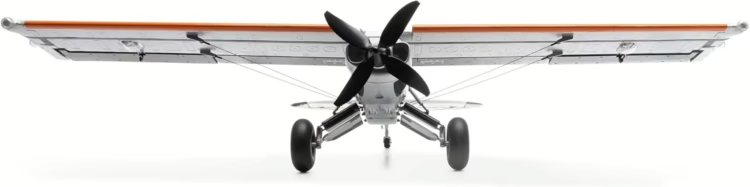
Already flying a Spektrum DSMX/DSM2 radio? Check current price on Amazon for the BNF Basic, and remember that you still need a compatible battery and charger.
Pros & Cons
Pros
- Short takeoffs on both packs, as reported in Greg Gimlick’s Model Aviation flight review
- Selectable assisted and sporty flying
- Minimal assembly, about five minutes in that review
- Cataloged replacement wing, tail, fuselage, landing gear, and prop
Cons
- Not suited to beginners, and two AMain reviewers report tip stalling
- Real cost runs well beyond the airframe
- A locked receiver rules out forward programming, and Gimlick reports that stabilization can’t be switched entirely off
- Both published 4S weights trigger FAA registration for recreational fliers
What It Really Costs to Get Airborne, and How It Compares
Value hinges on what you already own. An established Spektrum pilot buys an airplane; a newcomer buys an entire system and still doesn’t get a trainer. No long-term cost or durability data has surfaced to settle return on investment, so we can’t call this class-leading value.
The True Cost to Fly
Budget for each of these before checkout:
- Transmitter: a full-range, 6+ channel Spektrum-compatible radio.
- Packs: 3S or 4S 300mAh with JST-RCY connectors. Spektrum’s page for its 4S pack has shown it as no longer available, so confirm a source first.
- Charging: a LiPo charger, plus an IC3-to-JST-RCY adapter for Spektrum Smart chargers.
- Compliance: the FAA’s free TRUST safety test, plus registration and Remote ID or a FRIA (FAA-Recognized Identification Area) where they apply.
The Ultimate Combo (EFL02150UC) is the one-box route, adding an NX7e+ transmitter, S155 charger, adapter, 4S pack, and RealFlight Trainer Edition. Check its availability, and note that bundling the gear doesn’t lower the skill bar.
How It Compares
| Model | Size and weight | Power | Best for |
| Micro Scrappy | 32.3 in.; 8.8 oz. (248.9g) on 3S; 9.1 oz. (258.4g) or 10.4 oz. (295g) on 4S, by source | 3S/4S | Experienced micro pilots who want Patey scale character |
| Micro DRACO 800mm BNF Basic | 31.1 in.; 8.4 oz. (239g) on 4S | 3S/4S | The closest rival (Level 3), with a listed 4S weight under 250g |
| UMX Turbo Timber Evolution BNF Basic | 27.48 in.; 5.4 oz. (153g) on 3S | 2S/3S | A lower-rated (Level 2) step, not a proven first airplane; availability varies |
| Carbon Cub S 2 1.3m Cleetus McFarland Special Edition RTF Basic | 51 in.; 2.8 lb. (1,285g) on 3S 2200mAh | 3S | True beginners (Level 1); radio included, but it’s far larger, and availability varies |
Rival figures come from the DRACO, Timber, and Carbon Cub manuals, not common-scale weighings. No head-to-head flight test of these models has surfaced, so we won’t name a performance winner.
Expected Experience with E-flite Micro Scrappy 800mm BNF Basic
Gimlick, Model Aviation’s Electrics columnist, wrote the most fully documented written assembly-and-flight account cited here. His biography describes an Army instructor-pilot career and decades of RC flying. He flew a stock EFL02150D with a Spektrum iX14 on 3S and 4S 300mAh packs.
Assembly: Minutes, Not an Evening
Expect a short bench session. The manual has you plug in the wing connector, seat the wing, secure the M2 x 18mm screw with a #1 Phillips, and snap on the struts. Gimlick reports about five minutes. Watch for pinched wires and overtightening, and remember that the struts are handed, with the longer leg forward.
Radio Setup Is the Real Job
Gimlick says programming took longer than assembly, and the documented setup explains why. The manual calls for:
- High rates of 100% with 10% expo; low rates of 70% with 5% expo
- Elevator compensation of 13% and 18% with flaps, and a 2-second flap speed
- Throttle cut, plus rates at 50% or higher and trims and sub-trims at zero
- A CG of 35mm +/-4mm behind the leading edge, checked upright
Follow the manual’s table for your transmitter family, because it governs switch assignments and signs. Gimlick reports that the locked receiver prevents forward programming, so don’t plan on deep tuning.
3S or 4S: A Reviewer and an Owner Split
Both packs are approved, but the verdicts differ. Gimlick reports a takeoff of a few feet on 4S, 3S takeoffs nearly as good, and aerobatics on both. AMain Hobbies verified owner Carson Heslop reports inadequate power reserve on 3S and prefers 4S, without stating his setup or conditions. The evidence is uneven and settles nothing.
Don’t mistake 3S for a beginner mode, either. Gimlick’s warning concerns the sportier pack: “The 4S LiPo setup is extremely sporty and will challenge the novice pilot in high rates.”
In the Air: SAFE, AS3X, and High Rates
Gimlick flew from recently mowed grass, in temperatures in the 40s, with about a 5 mph breeze. He reports a gentle SAFE climb and raised high-rate expo to 30%, a personal preference rather than a factory setting. His review gives no flight count or pack-by-pack measurements.
He also reports that both stabilization systems can’t be entirely switched off; per the manual, AS3X remains active with SAFE disabled. No qualified stronger-wind test has surfaced, and a mild day sets no wind limit.
The Stall Question
Gimlick calls stalls “gentle enough” and reports easy spin recovery, but AMain reviewers disagree. Ronald Mock says the model will tip stall in AS3X if it slows too much and needs power to recover. Verified owner David Swenor, who reports 53 years of flying, says his airplane tip stalls easily, though he suspects that example may be faulty. Treat these as owner reports, not a proven defect. No measured stall speed has surfaced.
Verified AMain owner Rob Austin describes abrupt left turns around the two-minute mark on two flights, and says he reviewed his Spektrum setup between them. He cites a 600mAh battery, twice the listed capacity, but his mode, CG, and conditions are unstated, and the cause remains undiagnosed, so don’t read it as a stall or a defect.
We’d learn this airplane’s stall at altitude and keep energy on approach, knowing that a wing can stall at different airspeeds once it exceeds its critical angle of attack.
Ownership, Repairs, and Support
Hobby Zone lists foam-safe CA, Foam 2 Foam, and epoxy for repairs, and the catalog includes the wing (EFL-2944), tail set (EFL-2945), fuselage (EFL-2947), landing gear (EFL-2949), and prop (EFL-2959). Stock can change by part, so check the wing and prop shaft listings before you count on a quick repair.
Heslop praises the airframe’s robustness on hard landings, but Mock says the landing gear is complex and takes patience to reassemble after a crash. No crash-cycle or long-term reliability test has surfaced to settle it. Spektrum’s U.S. support process asks for proof of purchase, product identity, and photos. That documents a process, not service quality, and Austin describes a warranty exchange that left his case unresolved.
⚠️ Warning: Enable throttle cut before you approach the model, and disconnect the battery before handling the prop. Land immediately when low-voltage cutoff (LVC) reduces power, then disconnect the battery.
💡 Tip: Start on low rates, at altitude, in calm air. Neither this tip nor SAFE qualifies a complete beginner to fly this model.
Where the E-flite Micro Scrappy 800mm BNF Basic Really Shines
For a pilot who’s ready, the payoff is variety in a very small package.
- Short-field fun: Gimlick’s few-foot 4S takeoff from mowed grass shows the potential, though no minimum field size has been verified.
- One airframe, several personalities: You can fly assisted SAFE on 3S or sportier AS3X on 4S. That’s versatility for a competent pilot, not a training system.
- Field-to-flight convenience: A one-screw wing and magnetic hatch keep preparation short once the radio work is done.
- Scale character: Patey’s bush-plane identity comes with lights and colors that Gimlick says aid orientation.
- Telemetry: Compatible Spektrum AirWare transmitters can display battery voltage, current, and motor RPM, according to Hobby Zone.
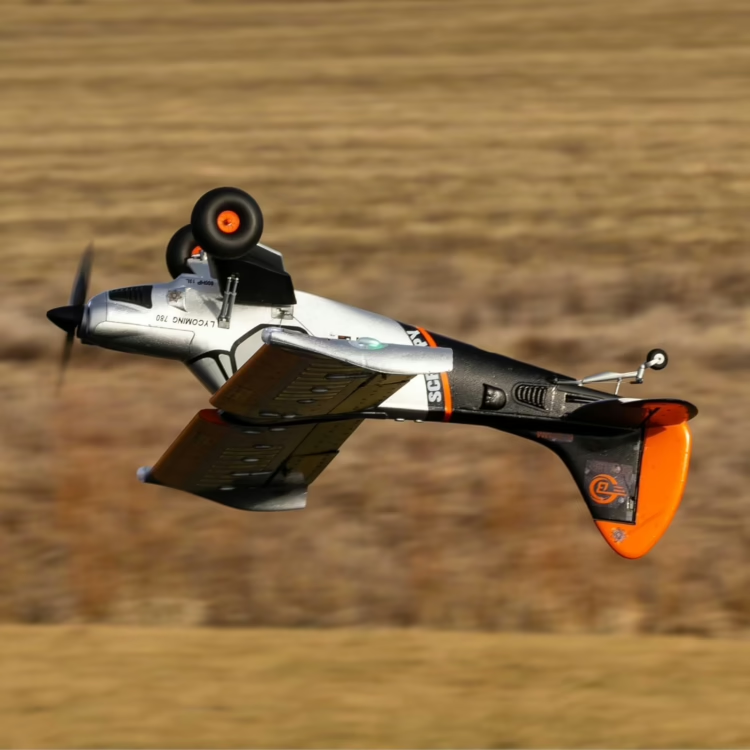
E-flite Micro Scrappy 800mm BNF Basic
A Level 3 micro STOL model for experienced pilots. You’ll need a full-range 6+ channel Spektrum radio, battery, and charger.
Check current price on Amazon
Who Should Buy It
Buy It If:
- You’re comfortable with higher-performance micros and with programming a radio.
- You already own a compatible Spektrum transmitter and charging gear.
- You want a small STOL model for permitted parks and sports fields, within FAA rules.
- You want Patey scale character more than a proven value win.
Skip It If:
- You’ve never flown RC, or you’ve only just finished a trainer.
- You want a stock Basic setup with no programming.
- You need to stay under 250g on 4S.
- You fly mostly in stronger wind, because that remains unproven either way.
FAQ
Q: Is the E-flite Micro Scrappy a good first RC plane for a complete beginner?
A: No, the E-flite Micro Scrappy is a poor first RC plane.
- Horizon rates it Level 3, Intermediate.
- Gimlick says it’s “not a beginner’s airplane” and warns that 4S in high rates will challenge a novice.
- SAFE Select doesn’t turn it into a trainer or guarantee recovery.
- We’d start with a Level 1 trainer such as the Carbon Cub S 2.
Q: What do I need to buy besides the E-flite Micro Scrappy 800mm BNF Basic to fly it?
A: The E-flite Micro Scrappy 800mm BNF Basic needs a radio, a battery, and a charger.
- A full-range 6+ channel Spektrum DSMX/DSM2-compatible transmitter
- A 3S 11.1V or 4S 14.8V 300mAh LiPo with a JST-RCY connector
- A compatible charger, plus an IC3-to-JST-RCY adapter for Spektrum Smart chargers
Q: Should I fly the E-flite Micro Scrappy on a 3S or a 4S battery?
A: The right E-flite Micro Scrappy battery depends on your skill, your flying, and your actual weight.
- 3S gives the lowest published flying weight, but one owner found its power reserve inadequate.
- 4S drew the stronger takeoff report and the sharper novice warning.
- Neither pack makes the airplane beginner-friendly.
Q: Do I need to register the E-flite Micro Scrappy with the FAA?
A: FAA registration for the E-flite Micro Scrappy depends on its flight-ready weight and how you fly.
- Recreational aircraft at 250g or more require registration, and Part 107 operations get no weight exemption.
- Both published 4S weights exceed 250g, despite the under-250g badge shown on Horizon’s listing without a pack qualification.
- The listed 3S weight clears the line by only 1.1g, so weigh your complete airplane, including additions and repairs.
- Registered aircraft fall under Remote ID, met by standard equipment, a broadcast module, or a FRIA. A FRIA doesn’t cancel registration.
- Lighter models still need TRUST and must follow FAA operating rules, including flying at or below 400 ft. in Class G airspace.
Q: How long does the E-flite Micro Scrappy fly on one battery?
A: The E-flite Micro Scrappy’s reported flight time is 5 to 7 minutes, not split by pack.
- That range comes from Gimlick’s review and isn’t a guarantee.
- The manual sets a 4-minute starting timer.
- Land immediately when LVC reduces power.
Q: What is the safest way to set up my E-flite Micro Scrappy for its first flight?
A: The safest E-flite Micro Scrappy setup follows the manual step by step, with an experienced pilot flying.
- Assemble it, then program the radio from the manual’s table for your transmitter.
- Set throttle cut, confirm mechanical centering, and keep trims and sub-trims at zero.
- Hold the airplane motionless for 5 seconds during initialization.
- Check the CG and control directions.
- Begin on low rates, and complete TRUST before flying.

Key Takeaways
- The Micro Scrappy is not a first airplane; beginners should train first.
- Budget for the full radio, battery, and charging setup.
- Both published 4S weights cross the FAA’s 250-gram line, and 3S clears it narrowly, so weigh yours.
- Stall reports conflict, and owners describe tip stalling, so learn it at altitude.
- Experienced Spektrum pilots get the best case for buying it.