


Skill Level 1 and ready to fly, this Mustang looks like an easy first warbird. Short flights, a light-wind limit, and owner complaints about the prop tell the rest of the story.
Quick Verdict
The HobbyZone P-51D 450mm RTF is a sensible buy for a beginner set on a warbird, provided you can wait for calm days and keep spare props on hand. The box makes the case: radio, charger, and two batteries come included, and SAFE flight modes limit overcontrol while you learn.
The caveats matter. This small, light, low-wing model should fly in light winds or less, according to Horizon Hobby’s manual, and flights run short. Several owners report the prop coming off in flight, though no incident rate has been verified, and no repeatable independent flight test of this package has been published.
If you just want the easiest start, we’d point you to the high-wing XCub 450mm. Still set on the Mustang? Read on for what it asks of you at the field.
Brief Overview
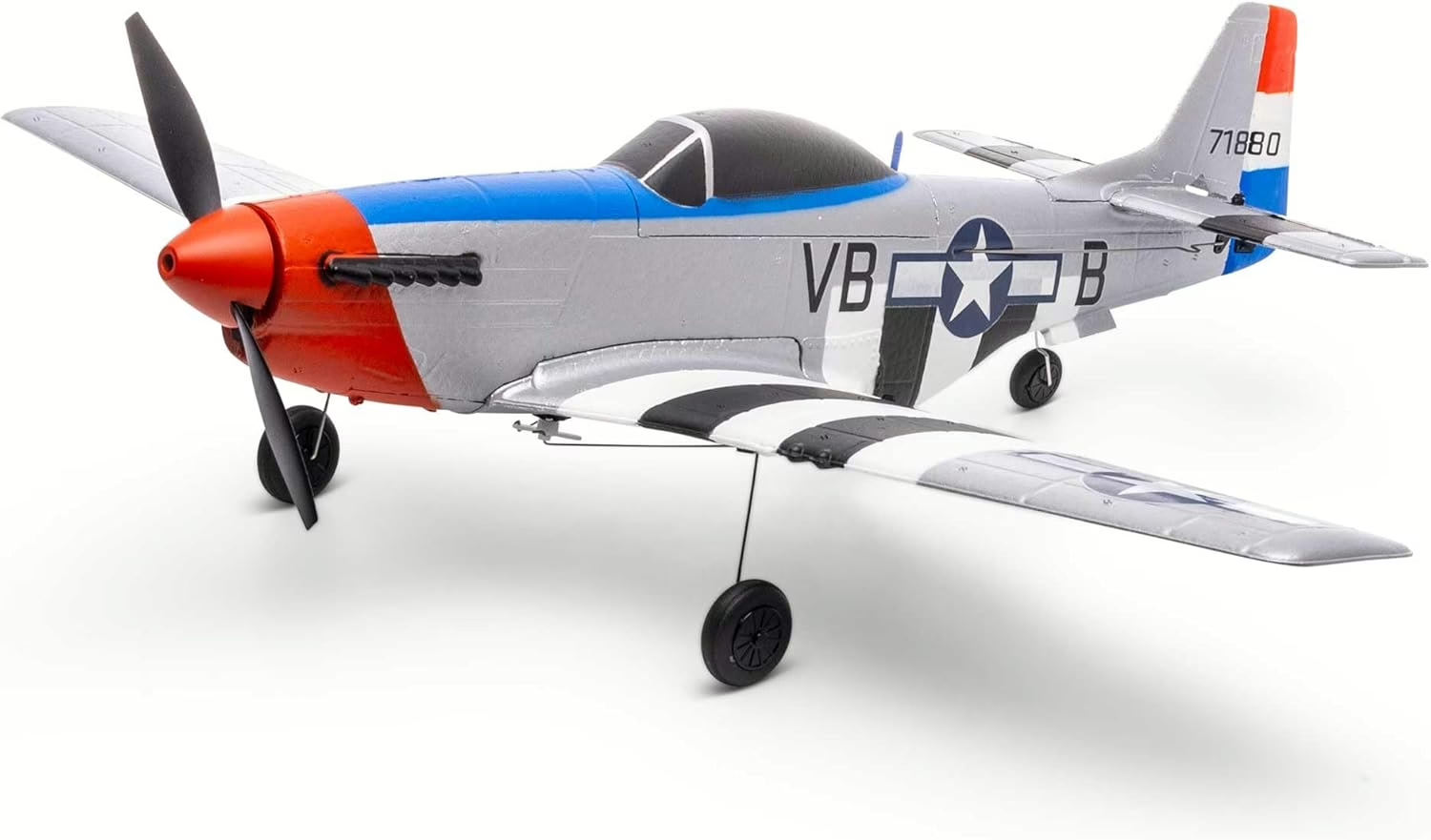
The HobbyZone P-51D Mustang 450mm RTF with SAFE (HBZ-1251) is a factory-finished micro warbird molded from expanded polypropylene (EPP) foam and sold as a complete ready-to-fly (RTF) package. Horizon Hobby rates it Skill Level 1, a manufacturer designation rather than a measured beginner success rate.
It targets first-time pilots with access to a large, open space. If you’re still comparing categories, our guide to the best RC planes shows the wider field.
Four features do most of the work for a new pilot:
- SAFE modes. Sensor Assisted Flight Envelope offers Beginner, Intermediate, and Experienced settings on one switch.
- Aerobatics button. Available in the first two modes, it starts a roll or loop.
- Pop-off prop saver. Horizon designs it to release when the prop strikes the ground or an object.
- Two flight batteries. A second pack means a second sortie after a safe turnaround.
AT A GLANCE
- Model: P-51D Mustang 450mm RTF with SAFE (HBZ-1251)
- Manufacturer: HobbyZone (Horizon Hobby)
- Wingspan: 17.7 in. (450mm)
- Length: 15.35 in. (390mm)
- Flying weight: 2.73 oz. (77.5g) with recommended pack
- Battery: Two 1S 3.7V 400mAh LiPo packs (included)
- Radio: HobbyZone 5-channel 2.4GHz, factory bound (included, with four AAs)
- Pilot skill level: Skill Level 1 (Horizon designation)
- FAA status: Exempt from registration in stock form under the limited recreational exception; TRUST still required

Pros & Cons
Pros
- Complete package: Radio, AAs, charger, and two batteries leave only a USB-A power source to supply.
- SAFE modes that grow with you: Assistance steps down as your skills step up.
- EPP construction: Horizon approves CA glue or clear tape for airframe repairs, though no published crash test measures toughness.
- Under the 250-gram registration threshold: Stock flying weight is 77.5g.
- Factory parts support: Horizon catalogs the prop, adapter, battery, landing gear, and a replacement airframe.
Cons
- Prop saver needs watching: It releases on impact and must be reseated, and several owners report in-flight release.
- Short flights per pack: Horizon estimates 6 to 8 minutes.
- Less forgiving layout: The low wing forgoes a high-wing trainer’s design advantage in roll stability.
- Wind sensitivity: Horizon’s guidance is light winds or less, though one owner reports more.
Expected Experience with HobbyZone P-51D 450mm RTF
Horizon’s manual supplies the procedures below. Owner reviews on Walmart’s listing, syndicated from Horizon, and HobbyTown’s listing add individual accounts without instruments or flight logs.
Setup: Charge, Bind, Check
Plan on light prep, not a build. Charging comes first: Horizon lists about 60 minutes on the included USB-A charger for a fully discharged, non-over-discharged pack, with a red light while charging and green at completion. Monitor the charge, use only a cool, undamaged battery away from flammables, and disconnect it as soon as charging ends.
The main gear snaps into clips under the wing, the tailwheel friction-fits without glue, and four AAs go in the transmitter with the supplied Phillips screwdriver. No timed assembly test has been published.
The radio arrives bound, so you rebind only if needed. Startup runs throttle low, transmitter on, battery in, then the manual’s full-to-low throttle movement to arm the electronic speed control. Restrain the model, keep clear of the prop, and check control directions against the manual’s diagrams. Comparing other starters? See the best RC planes for beginners.
SAFE Modes in Practice
Beginner, switch position 0, limits pitch and roll and levels the wings when you release the sticks. Intermediate, position 1, allows steeper attitudes and still self-levels, only more slowly. Experienced, position 2, removes the published angle limits.
Beginner doubles as your recovery tool. If you get disoriented in another mode, Horizon says to select Beginner, provided you have enough height and a clear path. Horizon publishes no minimum recovery height and warns that wind can affect SAFE behavior. You’re still flying the airplane; the manual claims no autopilot or return-to-home function.
Greg, one of the Walmart owners, describes a Beginner-mode hand launch after simulator practice and mode changes on a second flight. No instrumented test compares the three modes.
Warbird Handling for First-Time Pilots
The low wing is the main design difference from a trainer. Dihedral, the upward angle of the wings, contributes to an airplane’s roll response, and William McCombs’s general design analysis in Model Aviation treats wing location and geometric dihedral as components of that effect. Traditional flight-training guidance favors a high-wing powered trainer. Wing position alone won’t predict this model’s exact handling, and no stall-speed or landing-speed figures have been published for it.
Landings are where airspeed earns your attention. A wing stalls when it exceeds its critical angle of attack, so don’t stretch a slow approach with up-elevator. Horizon’s procedure calls for an into-wind approach, throttle to manage descent, wings level at the flare, and throttle fully low at touchdown. For hand launches, use Beginner, advance to full throttle, and throw firmly, slightly upward, into the wind.
Owner accounts split. Joshua reports a steeper start for his son until simulator practice helped, while Evan calls his first RC plane experience easy.
Wind and Flying Space
Horizon advises light winds or less and an open area clear of people, traffic, buildings, trees, and wires. It publishes no numeric wind limit or minimum field size.
Greg’s owner review cuts the other way, reporting successful patterns in an estimated 10 to 15 mph. That’s one self-estimated figure with no gust data, so it sets no operating limit.
We’d save first flights for calm air and postpone if conditions look doubtful.
The Prop-Saver Problem
Owners report the prop coming off in flight. On HobbyTown’s listing, Gregg Leslie says it fell off until he lost it on the fourth occasion, and Gary Lancaster says the prop and its connecting piece popped off midair. Carlton, on Walmart’s listing, says the adapter came off after only 20 minutes of flight time and wouldn’t stay on. Charlie Hairston counters that with a decent landing, the prop won’t pop off. These are individual accounts: no verified incident rate, cause, or retention redesign exists, and no documented long-term record clears the part. Horizon’s recall index shows no HBZ-1251 entry.
Horizon does document impact release, which doesn’t settle the in-flight question. With the battery disconnected, reseat the assembly by aligning the hub pieces and pressing until you feel a click. Inspect it before each flight.
Horizon’s product page lists one spare prop in the box, but we’d add another. The adapter has shown on backorder, so watch parts availability.
Batteries and Real Flight Time
Horizon advertises long flight times, but its manual estimates 6 to 8 minutes per charged pack, varying with flying style, conditions, and battery condition. It also says to set a 7-minute timer. No independent timed runs have been published. Motor pulsing or power loss can signal low-voltage cutoff, so land before you get there, then let the pack cool before charging.
Is It Worth the Money? How It Stacks Up
Yes, if the Mustang shape is why you’re buying. U.S. listings have placed the P-51D and XCub in the same price tier, so the Mustang’s value rests on its complete package and its looks. If you simply want a trainer, the XCub makes the stronger design case for the same equipment commitment. No controlled test has compared these models in the air.
| Model | Wingspan | Stabilization | Power | In the box | Best use |
| HobbyZone P-51D HBZ-1251 RTF | 17.7 in. | Three SAFE modes | Electric, 1S | Radio, AAs, two 400mAh LiPos, USB-A charger, spare prop | Mustang-focused first plane |
| HobbyZone XCub HBZ-1250 RTF | 17.7 in. | Three SAFE modes | Electric, 1S | Radio, AAs, two 400mAh LiPos, USB charger, spare prop | High-wing first plane |
| VolantexRC P-51D 761-5 RTF (red) | 15.75 in. | XPilot, three levels | 10mm coreless, 1S | Transmitter (AAs not included), two 400mAh packs on the named offer, USB charger, spare props | Direct micro-warbird rival |
| E-flite UMX P-51D Detroit Miss BNF Basic | 19.4 in. | AS3X and SAFE Select | Brushless, 2S or 3S | Installed electronics; radio, battery, and charger sold separately | Step-up warbird, Skill Level 3 |
| HobbyZone Apprentice STOL S HBZ6100 RTF | 27.6 in. | SAFE | Brushless, 2S | SLT6 radio, AAs, 300mAh LiPo, USB-C charger | Larger trainer, listed under 250g |
The VolantexRC storefront positioned its RTF near the Mustang, but bundles vary. Listings put the Apprentice materially higher, and the Bind-N-Fly (BNF) E-flite higher even before you add a compatible 5+ channel Spektrum radio, pack, and charger.
Budget beyond the box for an HBZ-1271 prop and spinner, an HBZ-1275 adapter, an extra HBZ-1266 pack, and the HBZ-1269 replacement airframe.
Don’t count on a 90-day warranty. A HobbyZone.com badge says 90 days, yet that site’s policy sends HobbyZone-brand claims to Horizon, whose manual covers defects at purchase for the original buyer, states no such term, and excludes crash damage. Horizon also excludes products not bought from an authorized dealer, so check the seller. Joshua reports a motor-gear issue and a replacement airframe sent after a support chat, which shows one outcome, not a promise. Will, on Walmart’s listing, says the motor gearbox started falling out after a couple of crashes, and Shawn Teter, on HobbyTown’s, says three planes lasted two weeks. Levi, also on Walmart’s listing, says a brick-wall hit cost him only a propeller.
Where the HobbyZone P-51D 450mm RTF Really Shines
The payoff is simple: you can fly a recognizable Mustang while you build basic control skills, without first buying a trainer you never wanted.
SAFE supports that early confidence. With height and clear air, press the Aerobatics button in Beginner or Intermediate, then give an aileron or elevator command during the beeps for a roll or loop. When your basic control and landings are solid, Intermediate and Experienced hand you more authority, and Experienced leaves those rolls and loops to your own sticks.
Progress will vary with practice and conditions, and Horizon lists RealFlight Trainer Edition as an optional add-on.
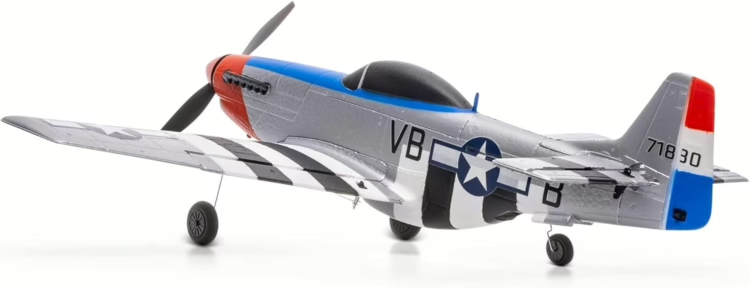
HobbyZone P-51D Mustang 450mm RTF with SAFE (HBZ-1251)
Want a Mustang as your first warbird? Check current availability for the complete RTF package, and look up spare props before ordering. Check availability on Amazon
Who Should Buy It
Buy it if you are:
- The warbird-loving beginner. You want a Mustang, have a suitable field, and can wait for calm weather.
- The adult mentoring a young pilot. You’ll prep the model together, handle all LiPo charging yourself, as the manual bars minors from charging packs, and meet Horizon’s direct-supervision requirement. Horizon recommends age 14 and up, and the Academy of Model Aeronautics offers introductory ground school and one-on-one mentorship from a certified Intro Pilot, where available.
- The experienced flyer wanting a small, casual plane. You’d use the stock package and Experienced mode. Alternative radio compatibility remains unconfirmed.
Skip it if you are:
- Stuck with consistently windy conditions.
- Without open, permitted flying space.
- After the gentlest learning curve.
- Buying for a child who would fly without an adult.
FAQ
Q: Is the HobbyZone P-51D 450mm RTF a good first RC plane for someone who has never flown?
A: The HobbyZone P-51D 450mm RTF can suit a first-time pilot who specifically wants a warbird and can start in calm conditions at an open field.
- The included equipment and Beginner-mode limits reduce setup and early control demands.
- Choose the XCub if a conventional trainer layout matters more.
- Consider club instruction with either plane.
Q: How long will it fly on one battery, and how long does charging take?
A: Horizon estimates 6 to 8 minutes of normal flight per fully charged HobbyZone P-51D 450mm RTF pack and about 60 minutes to recharge a fully discharged, non-over-discharged pack.
- Flying style, conditions, and battery condition affect airtime.
- The manual’s timer setting is 7 minutes.
- Charge both included packs before you leave home.
Q: Do I need to register it with the FAA before I fly?
A: The stock HobbyZone P-51D 450mm RTF is exempt from FAA registration when flown exclusively under the limited recreational exception.
- Pass TRUST and carry proof, as the FAA’s recreational rules require.
- Keep the plane in visual line of sight, give way to crewed aircraft, and stay at or below 400 feet in Class G airspace.
- Follow an FAA-recognized community-based organization’s safety guidelines, get authorization before flying in controlled airspace, and follow local site rules.
- Remote ID and registration depend on the operation; Part 107 has separate rules.
Q: What should I do if the propeller keeps coming off?
A: Ground the HobbyZone P-51D 450mm RTF and disconnect its flight battery before inspecting a propeller that repeatedly comes off.
- Check the prop, hub, and shaft for damage.
- Align the hub pieces and press until you feel a click.
- Replace damaged parts with the correct HBZ-1271 assembly or HBZ-1275 adapter.
- Contact Horizon support before flying again if secure retention remains in doubt.
Q: How much wind is too much for this plane?
A: Horizon recommends flying the HobbyZone P-51D 450mm RTF in light winds or less and publishes no numeric limit.
- Choose calm conditions for first flights.
- Treat one owner’s 10 to 15 mph estimate as an anecdote, not a rating.
- Use a clear, permitted site with room to recover and land.
Q: Should I buy the P-51D or the XCub as my first plane?
A: Choose the HobbyZone XCub 450mm RTF for the trainer layout, or the HobbyZone P-51D 450mm RTF if flying a Mustang is why you want to learn.
- Battery, transmitter, and charger part numbers match; airframe, landing gear, and prop numbers differ.
- No head-to-head novice data measures the learning difference.

Key Takeaways
- The P-51D is a sensible first warbird if you have a suitable field and can wait for calm air.
- The included radio, charger, and two batteries make its value case.
- Inspect the prop saver and carry a correct spare, since several owners report in-flight release.
- Plan on about 6 to 8 minutes per pack.
- Choose the XCub if a conventional trainer layout matters most.