


Big-Cub bush-plane manners in a trunk-size package—but is the FMS 1300mm PA-18 the beginner plane FMS says it is? We weigh the specs, the manuals, a veteran reviewer’s flight report, and the fine print.
Quick Verdict
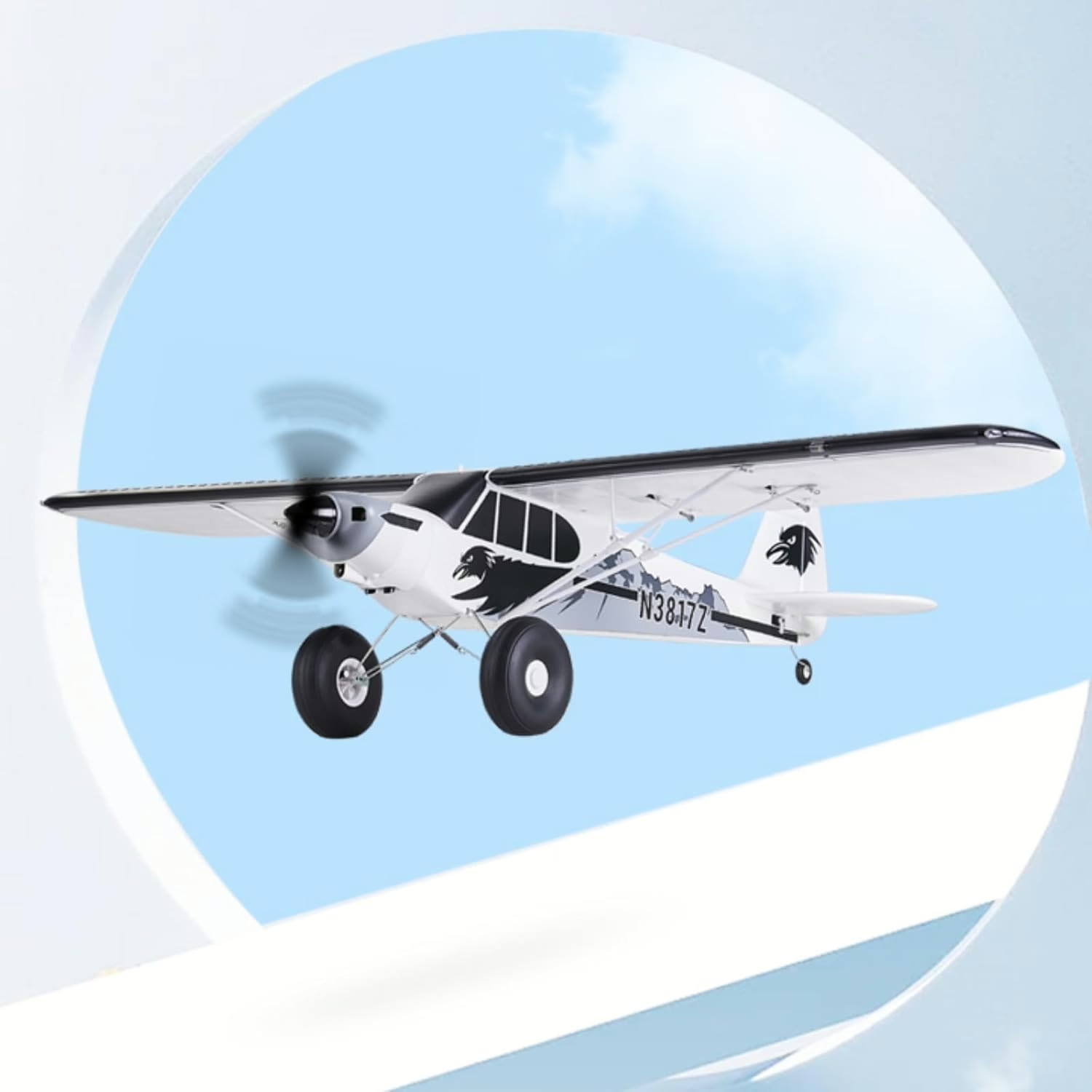
The FMS 1300mm PA-18 fits a lot of bush plane into a 51.2-inch span. You get functional flaps and Reflex V3 stabilization with three selectable modes. The CNC metal landing gear rides on 120mm pneumatic tires, and the fuselage comes apart in two sections so the plane fits in the car. For a trainer graduate, or a newcomer with an experienced pilot to help with setup and first flights, it’s a strong, well-equipped choice.
The deciding caveat is skill level, because the sellers disagree. FMS lists the PA-18 as a beginner model. Horizon Hobby’s U.S. listing for the PNP version shows a Skill Level 4 badge. Flaps, a taildragger layout, and a six-channel radio all add workload that a dedicated first trainer avoids.
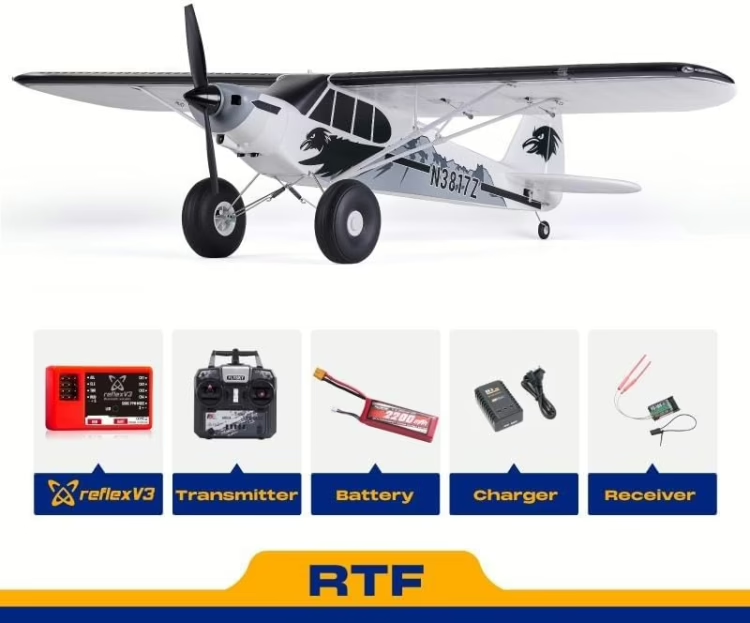
The second caveat is cost. With the PNP version, you buy the transmitter, receiver, 3S battery, and charger yourself. Even the RTF box needs four AA cells and a 2mm hex driver.
If you’re still shopping the wider field, our roundup of the best RC planes is a good starting point. Otherwise, read on to see where this Cub earns its keep, and where it can bite.
Brief Overview
The FMS 1300mm PA-18 Super Cub is a semi-scale EPO-foam replica of Piper’s classic bush plane, built as the compact sibling of FMS’s 1700mm Cub. The current Reflex V3 version comes in two packages. The RTF version (FMS138R-REFV3) adds a transmitter, receiver, battery, and charger. The PNP version (FMS138P-REFV3) has the motor, ESC, and servos installed. Horizon Hobby sells the PNP version as FMM138PRV3.
Who it’s for:
- Trainer graduates who want flaps and short-field flying
- Newer pilots who have club or buddy support
- Anyone short on storage or car space
If you’ve never flown and plan to learn on your own, look through our guide to the best RC planes for beginners before you commit.
Features that matter most:
- Reflex V3 stabilization. It has three modes. Stabilized levels the plane when you release the sticks. Optimized counters disturbances. Off disables the gyro.
- Functional flaps. FMS claims takeoff in less than 3m (10 ft.).
- Sectional airframe. The fuselage comes in two sections. The wing and horizontal stab are two-piece, with carbon-fiber wing spars and screw-together assembly.
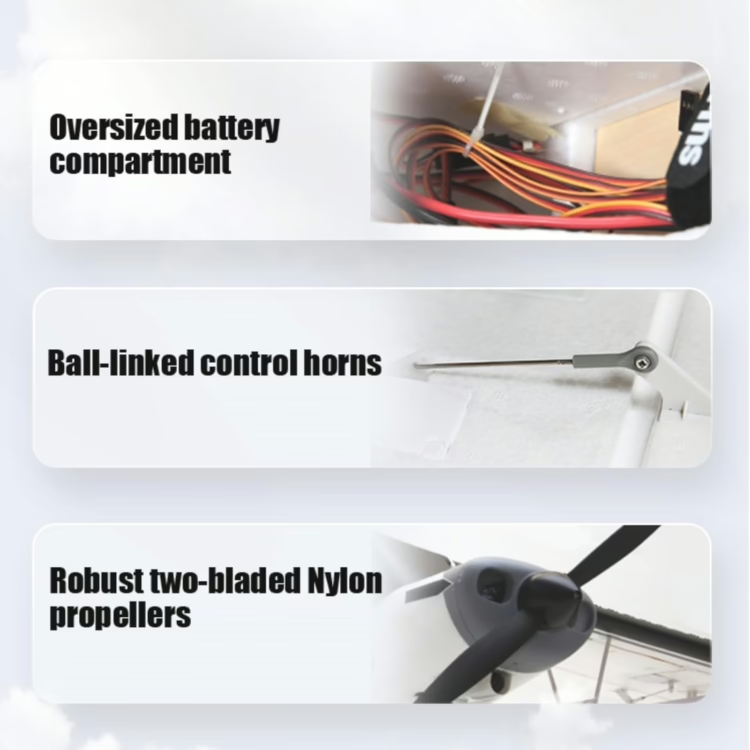
- Bush-style gear. CNC metal landing-gear structure with 120mm pneumatic rubber tires.
AT A GLANCE
Model: 1300mm PA-18 Super Cub with Reflex V3 (RTF or PNP)
Manufacturer: FMS (fmshobby.com)
Wingspan: 51.2 in. (1300mm)
Length: 38.8 in. (986mm)
Flying weight: approx. 1,450g (3.2 lb.)
Wing area / loading: 30 dm² (465 sq. in.) / 48 g/dm² (approx. 15.7 oz./sq. ft.)
Power system: 3536-KV850 motor and 40A ESC (installed), 11 x 7 prop (included)
Servos: six 9g (installed)
Power req’d: 3S 2200mAh 25C LiPo, XT60 connector
Radio req’d: 6-channel
Pilot skill level: Beginner (FMS); Skill Level 4 (Horizon Hobby)
Time to assemble: approx. 10 min. (FMS)
CG: 60–70mm (2.4–2.8 in.) behind the wing’s leading edge, battery installed
👉 Check current price and RTF/PNP availability on Amazon, and match the package to the gear you already own.
Pros & Cons
Pros
- Real STOL hardware. You get factory flaps and bush-style gear. FMS claims a takeoff roll under 10 feet.
- Selectable assistance. Reflex V3 lets you dial stabilization up, down, or off as your skills grow.
- Field-ready landing gear. The CNC metal gear and 120mm pneumatic tires suit grass strips.
- Easy to transport. The two-section fuselage and two-piece wing and stab break down for storage and travel.
Cons
- Mixed skill labels. FMS says beginner; Horizon says Level 4. Don’t treat it as a no-help first trainer.
- Short listed flight time. FMS lists about five minutes of flying per pack.
- Hidden costs. The PNP version needs a radio, a battery, and a charger.
- Assembly niggles. Jean-Louis Coussot’s build of the earlier V2 needed light grinding at the fuselage screw holes and six separate wing-lead connections, covered below.
Expected Experience with FMS 1300MM PA-18
Assembly
FMS quotes about 10 minutes of assembly. The current quick-start guide follows this order:
- Fit the wing tube, wing panels, and leads.
- Join the rear fuselage and connect its leads.
- Mount the landing gear, struts, and springs.
- Secure the wing struts to the wing with R-clips.
- Connect the elevator linkage.
Have a 2mm hex driver on hand; it isn’t in the box.
The most detailed published build comes from veteran French reviewer Jean-Louis Coussot. He is credited with the text of an assembly-and-flight review for JLC-Aviation, and his bylines include RCM, Looping, FLY International, RC Pilot, and Modèle Magazine. Coussot built the earlier Reflex V2 PNP version. He lightly ground the fuselage screw passages so they lined up with the brass nuts. He also criticized the six wing connections, and the strut attachments that share the rear gear fasteners. That’s one reviewer’s sample, but it tells you to budget patience at the wing root.
💡 TIP: FMS’s 10-minute figure covers bolting the airframe together. Wiring, radio programming, balancing, and preflight checks come on top of that, so plan your first session accordingly.
Radio & Reflex V3 setup
You need a six-channel radio. In the RTF quick-guide drawing, Reflex mode is on channel 5 and the flaps are on channel 6. On a PNP build, the channel order depends on your radio.
The Reflex V3 unit accepts SBUS, PPM, and PWM receiver outputs. Those are connection types, not a promise that any given transmitter will bind. Set the modes like this:
- A two-position switch selects Stabilized and Optimized.
- A three-position switch adds Off.
For initialization, FMS’s Reflex V3 manual calls for this sequence:
- Power the transmitter first.
- Keep the plane level and still while the Reflex unit initializes.
- Watch the ailerons cycle three times, then the elevator three times. That signals calibration is complete.
- Check the mode switching and every channel.
The manual’s control throws, listed as high/low rates:
| Surface | High rate | Low rate |
| Elevator | ±18mm | ±14mm |
| Aileron | ±16mm | ±12mm |
| Rudder | ±18mm | ±14mm |
Balance the plane at 60–70mm behind the leading edge, flight-ready with the battery installed. Move the pack to adjust the CG.
⚠️ WARNING: Fly the first flight on low rates with the manual’s linkage settings. Don’t copy a reviewer’s custom throws or improvise flap settings. Remove the propeller before testing control directions, and perform a ground range check before the first flight of every session.
Flight behavior
- Takeoff: FMS claims less than 3m (10 ft.). Coussot reported a takeoff of about 3m in no wind. He flew a V2 PNP on 3S 2200mAh, with added telemetry and his own throws and mixes, at sites on the Saône plain and at Massilly.
- Stall: Coussot describes a clean nose drop at the stall, sometimes with a slight departure on one wing. That came in the last few millimeters of up-elevator with his deliberately generous travel; with reduced travel, he says it mushes without a break but has less authority to flare and bounces more easily, especially with full flaps.
- Landing: Coussot reported the plane bounces if you don’t nail the flare.
- Endurance: Coussot got roughly ten minutes of mixed flying, or six minutes of aerobatics, on a 2200mAh pack. FMS lists about five minutes. The two figures reflect different setups and flying styles, so neither is a guarantee. For a first flight, the manual suggests a conservative 4-minute timer.
Keep the version gap in mind: Coussot’s flights were on a V2 with tuned settings, not a stock V3. His stall account supports careful elevator setup. It doesn’t make the plane a bad actor. And don’t read the short ground roll as permission to fly a small space. The manual recommends a clear area of at least two to three football fields until you understand the plane’s needs.
Build quality & durability
Coussot’s fit criticisms are the main documented build-quality notes, though he also praised the brass threaded inserts at the fuselage joint and gear mounts and the sturdy machined-metal gear fittings, and came away with an overall impression of quality and robustness. FMS sells replacement parts by part code:
- 11 x 7 propeller: FMSPROP021-1
- Spinner: FMSEL110
- 3S 2200mAh 25C XT60 battery: PRBAT006
FMS also warns that high temperatures can bubble EPO foam, especially in dark-painted and cockpit areas, and can deform the cockpit cover. Keep the plane out of direct sun when you’re not flying it.
What It Really Costs to Own
RTF: The box includes the FMS transmitter, receiver, battery, and charger. You add four AA cells for the transmitter and a 2mm hex driver.
PNP shopping list (per Horizon’s completion guide):
- A transmitter and receiver with six or more channels
- A 3S 2200mAh LiPo (Horizon suggests 30C; FMS specifies 25C)
- A LiPo charger
If you already own a compatible six-channel radio and charger, the PNP basket shrinks considerably. If you’re starting from zero, compare the complete cost of each package rather than the sticker price.
Ongoing costs:
- Spare battery packs, to make the most of each field session
- Propellers and a spinner after hard landings
- Optionally, the FMSFLT010 float set
Regulatory costs: FAA recreational rules apply. You must take the TRUST test and carry proof, follow the safety guidelines of an FAA-recognized community-based organization such as the Academy of Model Aeronautics, fly within visual line of sight, yield to other aircraft, and get authorization before flying in controlled airspace. In Class G airspace, stay at or below 400 ft. At this listed weight, the PA-18 must also be registered and marked. Under Remote ID, you either fly at an FAA-Recognized Identification Area (FRIA) or fit a broadcast module, which would add to your basket.
How It Stacks Up: Value vs. Rivals
| FMS 1300mm PA-18 (V3) | HobbyZone Carbon Cub S 2 1.3m (RTF Basic) | FMS 1700mm PA-18 V2 (PNP) | |
| Wingspan | 1300mm (51.2 in.) | 1300mm | 1700mm (66.9 in.) |
| Weight | approx. 1,450g flying | 1,285g with recommended pack | 2,100g flying |
| Battery | 3S 2200mAh 25C, XT60 | 3S 2200mAh | 4S 2200–2600mAh 35C, XT60 |
| Learning aids | Reflex V3, 3 modes | SAFE; optional GPS upgrade | Not listed by FMS |
| Flaps | Factory | Optional add-on | Factory |
| Radio in box | RTF: yes / PNP: no | Spektrum DXS + receiver | No |
| Battery & charger | RTF only | Not included | Not included |
| Skill label | Beginner (FMS) / Level 4 (Horizon) | Level 1 | Intermediate (FMS) |
The HobbyZone Carbon Cub S 2 (HBZ320001) has the same span, weighs less, and is the purpose-built learner. Its SAFE system offers:
- A beginner flight envelope with limits on bank and pitch
- Self-leveling
- Panic recovery, which needs adequate altitude to work
The RTF Basic package still needs a battery and charger. Flaps are an extra job: you buy a separate servo and extension, and the manual doesn’t recommend the supplied DXS transmitter for flaps because it lacks the needed mixing functions.
The FMS 1700mm PA-18 V2 (FMS154P) is the bigger, heavier 4S sibling. It also has a segmented fuselage, plus integrated wing-servo connectors. FMS rates it intermediate, and its 4S packs won’t carry over to the 1300mm model.
Our take: The 1300mm PA-18 delivers factory flaps and selectable stabilization in the most portable package of the three. What it doesn’t deliver is the hand-holding of a Level 1 trainer.
Where the FMS 1300MM PA-18 Really Shines
This plane is built for the moment a pilot outgrows a basic trainer and wants something with character. Factory flaps and bush gear turn a grass-strip session into a short-field practice ground. You can experiment with flaps on approach and work on your flare, with Reflex V3 ready to steady things while you learn the feel. Coussot’s report of a roughly 3m no-wind takeoff on his V2 tells you the STOL hardware isn’t just marketing.
The quieter win is logistics. A plane that splits into a two-section fuselage and two-piece flying surfaces is a plane that goes in the trunk on a whim. For flyers with small cars or crowded garages, that convenience tends to mean more flying. Just budget a few extra minutes for reconnecting the wing at the field.
Then there’s water. FMS lists a dedicated FMSFLT010 float set for the 1300mm PA-18, which gives you a path to float flying once you’re comfortable on land. Coussot flew his V2 off water on the FMS floats from his Super EZ (he notes FMS uses the same floats across its 1200 to 1700mm models), found takeoffs and landings easy with flaps up, and called it an excellent first floatplane. Use the float set’s own instructions, recheck the CG after you fit the floats, and choose a water site with a plan for retrieving the plane.
🛒 FMS 1300mm PA-18 Super Cub with Reflex V3
Functional flaps · Reflex V3 (3 modes) · CNC metal gear · 120mm pneumatic tires · Two-section fuselage
See RTF & PNP options on Amazon →
Who Should Buy It (and Who Should Skip It)
Buy it if you are:
- A trainer graduate who wants flaps and short-field flying in a scale bush plane.
- A beginner who will fly with a club instructor or an experienced friend for setup and first flights.
- Short on car or storage space.
- Interested in an affordable route to float flying later on.
Skip it, or consider an alternative, if you are:
- A self-taught first-timer who wants a beginner flight envelope and panic recovery. We’d point you to the Carbon Cub S 2 and our beginner guide.
- Expecting long flights. FMS lists about five minutes per pack, so plan on spares.
- Hoping to reuse 4S packs or wanting a bigger airframe. The 1700mm sibling is the one to look at.
FAQ
Q: Is the FMS 1300mm PA-18 a good first RC plane if I’ve never flown before?
A: The FMS 1300mm PA-18 is a reasonable first plane only with experienced help; it isn’t a self-teaching trainer.
- FMS labels it beginner, while Horizon Hobby badges it Skill Level 4.
- Flaps, a taildragger layout, and six-channel setup add workload.
- Reflex V3 assists, but setup and initialization still have to be done correctly.
Q: What else do I need to buy to fly the FMS 1300mm PA-18 PNP version?
A: The FMS 1300mm PA-18 PNP needs a six-plus-channel transmitter and receiver, a 3S 2200mAh LiPo, and a charger.
- The battery connector is XT60.
- FMS specifies a 25C pack; Horizon suggests 30C.
- Add a 2mm hex driver for assembly.
Q: How long can I fly the FMS 1300mm PA-18 on one battery, and should I use a bigger pack?
A: FMS lists about five minutes of flying on the recommended 3S 2200mAh pack, and FMS advises sticking with a similar pack.
- Coussot reported roughly ten minutes of mixed flying on his tuned V2.
- The manual calls for substitute packs of similar capacity, size, and weight to avoid big CG shifts.
- Coussot’s 2800mAh pack required modifying the hatch and moved the balance forward.
Q: How do I set up the Reflex V3 flight modes on the FMS 1300mm PA-18 for my first flights?
A: To set up Reflex V3 on the FMS 1300mm PA-18, assign a mode switch, initialize the unit level and still, and verify everything with the propeller off.
- Assign the switch: two positions give you Stabilized and Optimized; three positions add Off. (The RTF guide maps mode to channel 5.)
- Power the transmitter first, then initialize with the plane level and still.
- Wait for the ailerons to cycle three times, then the elevator three times. That confirms calibration.
- Check every channel and mode with the prop off, then balance at 60–70mm and range check.
Q: Should I buy the FMS 1300mm PA-18 or the HobbyZone Carbon Cub S 2 as a beginner?
A: For a true beginner learning without help, the HobbyZone Carbon Cub S 2 deserves first look; the FMS 1300mm PA-18 suits progressing pilots who want factory flaps.
- The Carbon Cub S 2 is rated Level 1, with SAFE’s beginner envelope and panic recovery.
- Its flaps and GPS are optional extras.
- Compare complete packages: the RTF Basic still needs a battery and charger.
Q: Can I fly the FMS 1300mm PA-18 off water, and what do I need to do it?
A: The FMS 1300mm PA-18 can fly off water with FMS’s dedicated 1300mm PA-18 Float Set (FMSFLT010).
- Master land flying first.
- Follow the float instructions and recheck the CG after installation.
- Choose a legal water site with a plan for retrieving the plane.

Key Takeaways
- Value: Factory flaps, Reflex V3, and bush gear in a sectional, trunk-friendly airframe.
- Skill caveat: FMS says beginner; Horizon says Level 4. Plan on experienced help.
- Hidden costs: The PNP version needs a radio, a 3S 2200mAh pack, and a charger. The RTF needs AA cells and a 2mm hex driver.
- Strongest use case: Short-field and grass-strip flying for trainer graduates, with floats as an option later.
- Best alternative: The HobbyZone Carbon Cub S 2 for self-taught first-timers.