


Low kinetic energy, a robust spare parts ecosystem, and algorithmic stabilization that shields new pilots from immediate failure. But can it actually teach you to fly?
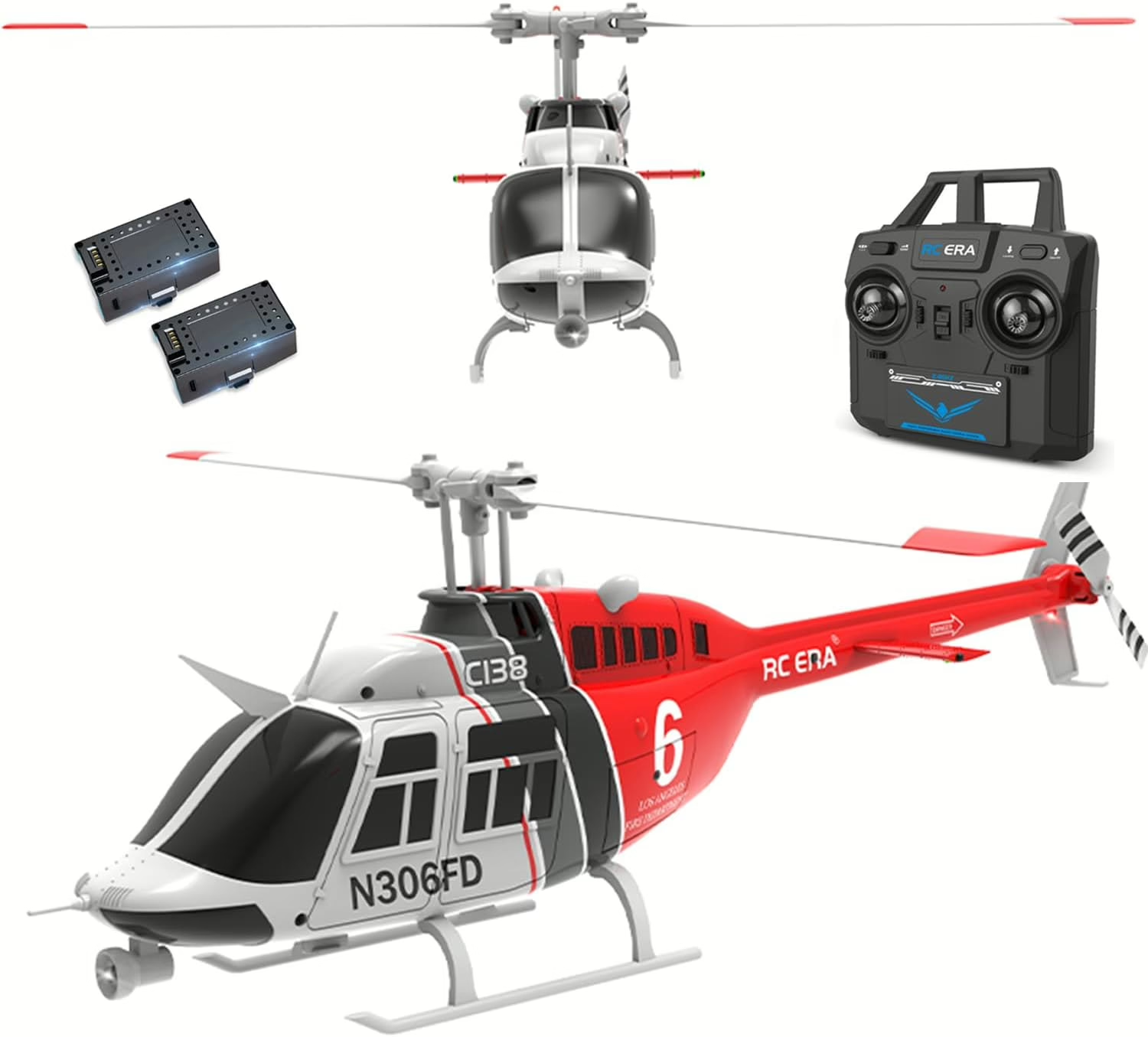
Picking the right first helicopter has always been an exercise in managing expectations. Spend too little, and you end up with an unstable coaxial toy that will never teach you real stick discipline. Spend too much, and a 700-class collective-pitch machine will destroy itself—and your confidence—in under three seconds. For U.S. hobbyists who have surveyed the market and landed on the RC ERA C138 Bell 206 as a potential candidate, the central question is legitimate: does the spec sheet actually translate to real airtime?
If you’ve been scanning roundups of the best RC helicopters in the sub-micro category, you’ve likely come across the C138 repeatedly. The marketing is aggressive. RC ERA pitches optical flow stabilization, autonomous hovering, and even one-key inverted 3D flight on a helicopter that weighs about 95 grams in base form. That combination of promises, all in a 1:33 scale Bell 206 Jet Ranger fuselage, is enough to raise any experienced hobbyist’s eyebrow. Our job is to separate the engineering reality from the promotional copy.
Brief Overview
The RC ERA C138 is a 1:33 scale replica of the Bell 206 Jet Ranger, purpose-built as a 6-channel flybarless (FBL) micro-helicopter aimed squarely at beginner-to-intermediate pilots. At 95 grams in standard trim—114 grams in the Pro variant—it falls comfortably below the FAA’s 250-gram Remote ID threshold, which means no registration, no Remote ID broadcast requirement, and no regulatory friction for backyard or park flying.
The mechanical foundation is a flybarless rotor head driven by three independent linear servos through an eCCPM swashplate. Power comes from a proprietary 7.4V 350mAh modular LiPo pack that incorporates an intelligent power management circuit and an external charge-level indicator, eliminating the exposed micro-connector leads that plague most micro-scale helicopters. Advertised flight times run 8 to 12 minutes per pack, with a 50-to-60-minute recharge cycle. The radio system operates on a proprietary 2.4GHz protocol with a stated control range of up to roughly 80–100 m.
The three features that matter most for the target buyer:
- Optical flow and barometric altitude hold: A downward-facing camera reads ground texture while a barometric altimeter manages altitude, combining to produce a hands-free geostationary hover that gives absolute beginners a genuine safety net.
- Auto Level mode: A 6-axis MEMS IMU detects attitude deviations thousands of times per second and returns the helicopter to level flight the moment the cyclic sticks are centered—a critical buffer against panic inputs.
- Modular smart battery: The hard-case LiPo eliminates fragile wire leads, provides overcharge and over-discharge protection, and features an external capacity indicator, making pack swaps fast and safe in the field.
Check current availability and pricing on Amazon
The Real-World Utility Test: Beyond the Spec Sheet
Flight Envelope and Stabilization Performance
The C138’s 306mm main rotor generates lift through a pair of asymmetrical constant-chord blades designed to maintain a high lift-to-drag ratio at the Reynolds Number range these blades occupy. Tip loss, dissymmetry of lift during forward flight, and gyroscopic precession are all real aerodynamic forces acting on this helicopter. What the C138 does is bury that complexity under layers of algorithmic correction.
In hover, the fusion of barometric and optical flow data is genuinely impressive. The flight controller runs continuous Proportional-Integral-Derivative (PID) loops that micro-adjust motor RPM and swashplate angle to resist drift and altitude variation simultaneously. For a pilot coming from a toy-grade coaxial, the locked-in quality of the C138’s hover feels almost surreal. The helicopter sits. It doesn’t drift, wander, or require constant corrections. That experience alone has real emotional and instructional value for a new pilot.
Forward flight transition is handled cleanly. As the helicopter accelerates into undisturbed air, it benefits from translational lift — a meaningful efficiency gain that causes non-stabilized helicopters to balloon unpredictably upward. The C138’s PID loops manage that tendency automatically, adjusting motor speed to keep the transition smooth and linear.
Where the Sensors Break Down
The stabilization system has known limitations that any prospective buyer should understand before making a purchase decision. The optical‑flow sensor relies on visible ground texture and adequate ambient light; flying over very reflective or uniform surfaces can deprive the camera of usable reference patterns. Under those conditions, the helicopter can produce sudden, uncommanded lateral movements. When optical flow confusion compounds with barometric turbulence from wind gusts — each system fighting the other’s outputs — the result is what many pilots have labeled the C138’s ‘flyaway’ problem: the automated systems actively working against the pilot’s corrective inputs.
Rapid yaw inputs can create a separate problem that some owners have reported. Because the belly camera sits off the exact rotation axis, fast pirouettes can confuse the optical‑flow algorithm and make it ‘see’ lateral motion that isn’t really there, which shows up as unnecessary cyclic corrections and a nervous feel in yaw. Some hobbyists describe this as the helicopter going a bit ‘haywire’ if you spin it too aggressively with optical flow enabled. Experienced pilots who have developed adequate stick discipline report that disabling the optical flow entirely produces a markedly smoother, more predictable manual flight experience — though that recommendation carries a clear prerequisite: the muscle memory to manage the flight envelope without the electronic safety net.
The auto-takeoff feature also deserves a specific caution for indoor operators. The one-key launch spikes motor RPM aggressively to vault the helicopter out of ground effect and establish a barometric hover at roughly 1 to 1.5 meters. In rooms with standard residential ceiling heights, the ascent rate can carry the model directly into the drywall before the barometer registers the target altitude and arrests the climb.
Transmitter: A Clear Hierarchy Between Versions
The standard transmitter mimics a video game controller with short, circular thumb-pads. These introduce meaningful mechanical deadband—a latency zone around stick center where no electrical output is generated—that makes precise hover corrections difficult and frequently triggers pilot-induced oscillation (PIO) as pilots overcompensate. The upgraded transmitter uses full-size, hobby-grade gimbals that reduce center-stick latency and provide the granular control resolution required for smooth, scale-like flight. For any buyer who is serious about flight fidelity, the upgraded transmitter package is a mandatory, non-negotiable selection.
The One-Key Inverted Mode: Entertainment With a Hidden Cost
The software-assisted 3D inverted flight mode is technically interesting. To execute the maneuver safely, the pilot must first switch the transmitter to its highest dual-rate setting, climb to a minimum of 3 meters, then toggle the dedicated 3D button upward. Only then does a hard lateral cyclic input trigger the sequence: the flight controller executes a rapid half-roll, then artificially remaps the control outputs so that collective “up” still moves the helicopter away from the ground and cyclic remains referenced to the pilot’s visual perspective rather than the aircraft’s chassis. For spectators, it’s visually arresting.
The instructional consequence is serious, however. Pilots who intend to eventually transition to fully manual collective-pitch 3D helicopters — machines where inverted flight genuinely reverses cyclic and collective orientation — will find that the muscle memory developed on the C138’s remapped controls actively causes crashes on advanced equipment. The feature is worth acknowledging as entertainment, not training.
Pros & Cons
Pros
- Autonomous hover stability: The dual-sensor optical flow and barometric hold system creates a genuinely geostationary hover that eliminates the steepest barrier to entry for new pilots.
- Sub-250g regulatory exemption: At 110g to 114g fully loaded, the C138 bypasses FAA Remote ID and registration mandates across most flying environments.
- Modular smart battery: Built-in overcharge and over-discharge protection, an external capacity indicator, and elimination of fragile exposed connector leads all contribute to reliable, field-friendly operation. One field caution: avoid storing the pack fully charged at 4.2V per cell for extended periods. This accelerates internal resistance buildup, shortening usable flight time and triggering early low-voltage warnings under heavy collective pitch demands.
- Detailed scale aesthetics: The 1:33 injection-molded Bell 206 fuselage with functional LED navigation lighting aids both visual appeal and low-light spatial orientation.
- Robust spare parts ecosystem: RC ERA supports the C138 with a comprehensive catalog of replacement components—main shafts, feathering shafts, digital servos, swashplates—ensuring long-term serviceability rather than disposable-toy economics.
Cons
- Optical flow environmental limitations: The belly camera performs poorly over reflective surfaces, uniform textures, and in low-light conditions; rapid yaw inputs can trigger erratic, uncommanded swashplate behavior.
- Auto-takeoff indoor hazard: The aggressive pre-programmed ascent rate poses a genuine ceiling-impact risk in standard residential spaces.
- Base transmitter deadband: The entry-level controller’s circular thumb-pads introduce mechanical latency that meaningfully degrades precise cyclic control.
- Counterproductive 3D training: The automated inverted mode instills artificial control habits that conflict directly with the physical reality of manual collective-pitch 3D aerobatics.
Where the RC ERA C138 Bell 206 Really Shines
The C138’s most important engineering achievement isn’t any individual sensor or algorithm—it’s the elimination of the immediate crash. Historically, a beginner’s first powered spool-up on a traditional single-rotor helicopter ended within seconds: a boom strike, shattered main blades, or an uncontrolled rollover before the pilot could process what was happening. That pattern destroyed confidence and wallets in equal measure. The C138 changes that experience fundamentally. A pilot can open the box, charge the battery, and achieve a stable, locked-in hover within the first session. The emotional architecture of that first success matters.
Competitive Positioning
Against its direct competitors, the C138 occupies a clearly defined space. The Blade 120 S2 from Horizon Hobby uses AS3X and SAFE gyro-based stabilization through the Spektrum DSMX ecosystem—excellent brand heritage, excellent radio integration—but it lacks optical flow positioning for true hands-free geographic hold, and user reports consistently flag its plastic rotor head linkages and linear servos as susceptible to damage under crash loads.
The Eachine E120, a scale replica of the BO-105, is the C138’s closest functional equivalent. Both share nearly identical avionics architecture: optical flow, barometric altitude hold, and 6-axis MEMS stabilization. The performance difference in actual flight telemetry is negligible. The choice between them comes down entirely to scale preference—Bell 206 versus BO-105.
Pilots whose actual goal is learning manual 3D aerobatics should look elsewhere. The OMPHobby M1 and Goosky S1 are micro collective-pitch machines with direct-drive brushless main and tail motors, no optical flow safety net, and the full, unassisted flight envelope that genuine 3D training requires. The trade-off is predictable: a crash will cause real damage, and the learning curve is orders of magnitude steeper.
The Pro Upgrade: Why It Matters
The RC ERA C138 Pro variant addresses the base model’s primary mechanical weakness: the brushed 1002 coreless main motor. Brushed motors use physical carbon contact against a commutator, generating heat, reducing battery efficiency, and guaranteeing an inherently limited lifespan. The Pro replaces this with a 3-phase brushless motor driven by a dedicated ESC that converts LiPo DC into precisely timed AC pulses—no physical contact, dramatically lower operating temperatures, superior torque, improved cyclic throttle response, and near-unlimited motor longevity assuming bearing maintenance. It also arrives in a distinctive Swedish Police livery. The slightly higher acquisition cost is justified by the mechanical improvement alone.

Who Should Buy It (And Who Should Pass)
Buy it if you are:
- A first-time rotary pilot. The optical flow and barometric hold combination provides an electronic safety net that no previous generation of micro-helicopter could offer. You will learn spatial orientation and cyclic management without the immediate, demoralizing threat of mechanical destruction.
- A scale aviation enthusiast. The Bell 206 Jet Ranger is an iconic airframe. The injection-molded fuselage, accurate panel lines, and functional LED navigation lighting make this a visually credible slow-flight scale model.
- A spontaneous backyard or indoor flyer. Sub-250g weight, no Remote ID compliance burden, and a compact footprint make the C138 ready to deploy in a cul-de-sac, a large living room, or a neighborhood park with minimal planning.
Pass it on if you are:
- Training specifically for collective-pitch 3D aerobatics. The full 6‑axis stabilization system remains heavily assisted even in its most aggressive mode, and the automated inverted mode encourages stick habits that don’t translate cleanly to true CP helicopters, increasing the risk of confusion when you move to fully manual 3D.
- Flying in consistently windy environments. The 110-gram flight weight and optical flow dependency make the C138 highly susceptible to wind drift in coastal or high-wind locations, placing constant load on the stabilization system and producing a fatiguing flight experience.
The Final Verdict: The Value-to-Performance Ratio
The RC ERA C138 Bell 206 is a well-engineered product that does exactly what it promises, for the exact audience it targets. The optical flow and barometric sensor fusion produces genuine autonomous hover capability at a price point and weight class where that technology remains genuinely impressive. The scale aesthetics are convincing. The spare parts ecosystem is real and accessible. The sub-250g exemption is a legitimate, meaningful operational advantage.
The documented limitations—optical flow sensor vulnerabilities, auto-takeoff ceiling hazards, base transmitter deadband, and the counterproductive 3D training issue—are real, but none of them invalidate the product’s core proposition. They are constraints to understand and manage, not reasons to walk away.
Buyers who select the Pro variant and the upgraded transmitter package from the outset will sidestep two of the four primary frustrations entirely. For a complete beginner seeking a capable, durable, and regulation-friendly entry point into single-rotor RC aviation, the C138 Pro with the full-size gimbal controller represents a strong, defensible purchase.

Key Takeaways
- Genuine hover stability: Optical flow and barometric sensor fusion delivers autonomous, hands-free hovering that dramatically lowers the barrier to entry for first-time pilots.
- No FAA registration required: At 110g–114g, the C138 operates below the 250-gram Remote ID threshold.
- Upgrade the transmitter: The base controller’s deadband meaningfully degrades flight precision—the full-size gimbal version is essential.
- Pro model is the better buy: Brushless motor, superior torque, better efficiency, and longer powertrain life justify the price difference.
- Not a 3D training tool: The automated inverted mode teaches control habits incompatible with manual collective-pitch flying.