


A 25g weight reduction over its predecessor produces a “floaty” buoyancy that makes tic-tocs and rainbows feel effortless. This is what 200-class flight is supposed to feel like.
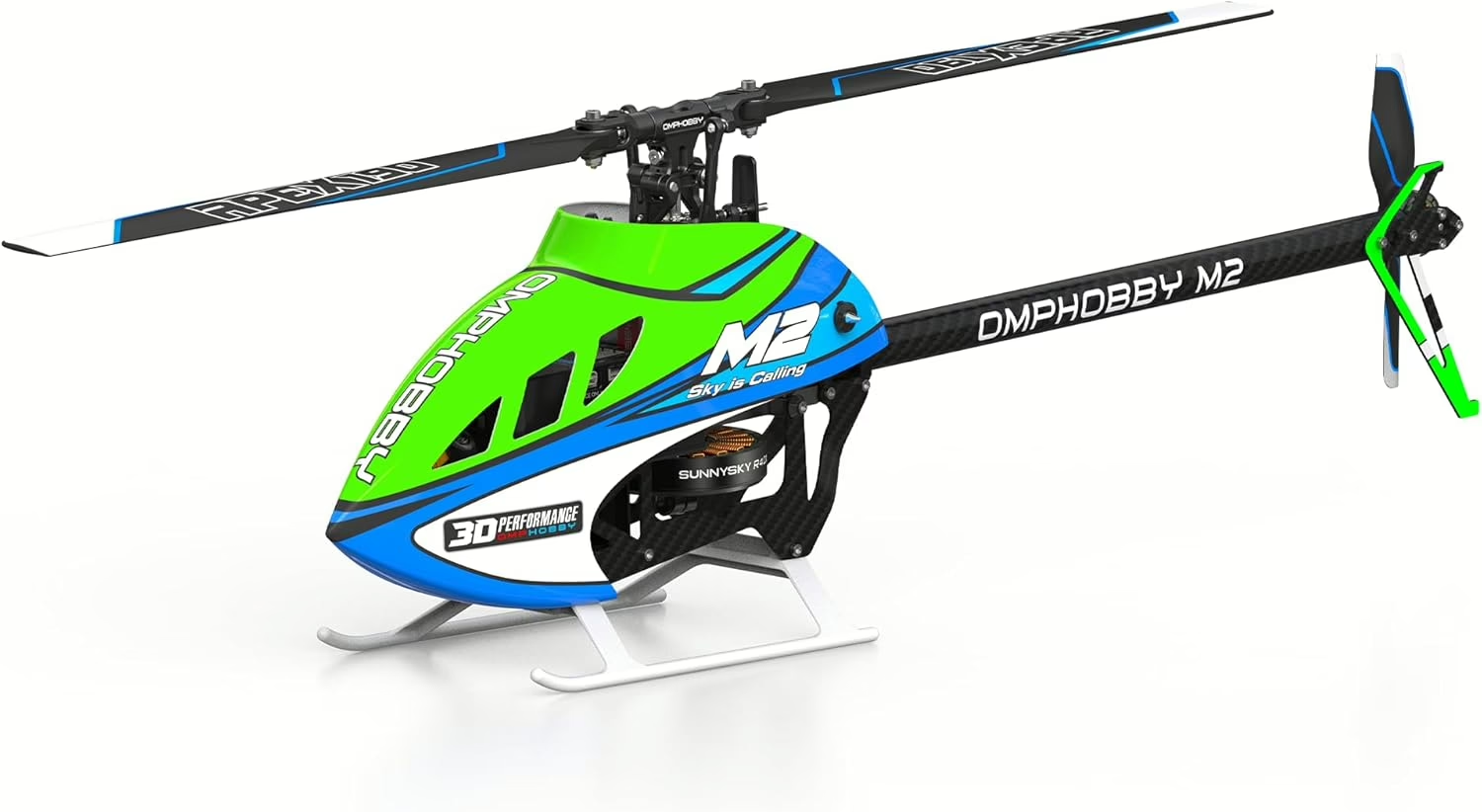
The 2026 RC helicopter market is increasingly flooded with GPS-assisted, optical-flow-stabilized machines that practically fly themselves — reducing the pilot to a spectator. That’s fine if you want a flying camera, but it obscures what authentic rotary-wing performance actually demands. Real collective pitch flight isn’t measured by how smoothly a computer holds a hover; it’s measured by how instantly a helicopter translates a split-second pilot input into a precise aerodynamic output at the edge of the flight envelope.
Our evaluation of the OMPHOBBY M2 V3 PRO cuts through the spec-sheet noise to focus on what the prospective buyer actually needs to know: how it handles daily operational friction, how it survives crashes, and whether its digital ecosystem earns its complexity. The methodology draws on structural analysis, flight control integration, and real-world kinetic impact testing — not manufacturer talking points.
For pilots actively narrowing down their options among the best RC helicopters available in the 200-class category today, this review delivers the evidence-based verdict needed to buy with confidence, or pivot to a better-matched alternative.
Brief Overview
The OMPHOBBY M2 V3 PRO is a high-performance, 200-class collective pitch (CP) helicopter engineered to dominate the micro-3D aerobatic sector. Its central design objective is clear: deliver the ballistic precision and locked-in control authority typically reserved for 700-class competition machines, scaled down into a sub-450mm rotor diameter package you can transport in a carry-on bag.
The platform ditches both gear-driven transmissions and belt-driven tail assemblies entirely. In their place, a dual-brushless direct-drive powertrain maximizes torque transfer and eliminates the mechanical parasitic drag that hobbles legacy designs.
Target Audience: The M2 V3 PRO is purpose-built for two distinct operators. First, the ambitious beginner who has outgrown sub-250g indoor trainers and is ready to graduate into unrestricted collective pitch flight. Second, the seasoned 3D professional who needs a low-friction, high-capability practice platform — one that delivers competition-grade feel without the logistical burden of hauling and charging 700-class equipment.
Cool Features Worth Knowing:
- OFS3 Flight Controller with Native ExpressLRS: The integrated ELRS receiver eliminates external receiver modules entirely, delivering a clean wiring schematic and ultra-low latency packet rates of up to 1,000Hz — far outpacing legacy 2.4GHz protocols like DSMX, which typically operate at latencies of 11–22ms.
- Weight Optimization: At a refined All-Up Weight (AUW) of 320 grams — a 25-gram reduction over the previous M2 EVO MK2 — the M2 V3 PRO achieves lower disk loading over the same 434mm rotor diameter, extending flight times by up to 25%.
- Sacrificial Crash Architecture: Engineered plastic servo horns are designed to fracture under extreme shear loads, absorbing kinetic impact energy before it reaches the DS2710MG full-metal digital servos and the carbon fiber main frame.
- Bluetooth App Tuning: The OFS3’s onboard Bluetooth module enables PID adjustments, feed-forward agility, rotational rates, and electronic deadband via a dedicated iOS or Android smartphone app — no buttons and LED codes required.

🛒 Check the OMPHOBBY M2 V3 PRO’s Current Price and Availability on Amazon
Deep Dive: Performance, Durability, and The Value Proposition
Rotor Head Geometry and Aerodynamics
The M2 V3 PRO’s rotor system reflects deliberate engineering choices, not spec-padding. The 434mm main rotor disk is driven by a newly shortened rotor mast combined with an all-metal 7075 aviation-grade aluminum flybarless (FBL) head. Lowering the rotor disk closer to the aircraft’s center of gravity sharpens cyclic roll and pitch rates, letting the helicopter pivot rapidly on a centralized axis during stationary smack 3D maneuvers rather than swinging through a wide arc.
The feathering shaft — the hardened steel axle connecting both main blade grips — rides on upgraded polyoxymethylene (POM) dampeners. In rotary-wing dynamics, these dampeners govern blade flapping, the essential mechanical function that counteracts dissymmetry of lift between the advancing and retreating blades. The stiffer POM compound in the V3 PRO restricts excessive flap, prioritizing robotically precise cyclic response over the softer, heavily dampened feel of entry-level trainers.
Lift is generated by APEX 190mm main rotor blades, optimized for the Reynolds Number range typical of 200-class aircraft (approximately 250,000 to 500,000). Their aerodynamic profile actively mitigates induced power requirements — reducing the drag penalty inherent in lift generation — which contributes to a quieter acoustic signature and measurably improved overall stability.
Dual Brushless Direct Drive Propulsion
The main mast is driven by a custom SUNNYSKY R40X-3 brushless outrunner motor coupled directly to it. There are no pinion gears, no main drive wheels, no mechanical slop. Electronic Speed Controller (ESC) commands translate into immediate rotor response, providing stall-resistant torque essential for explosive collective pitch reversals during hard 3D sequences.
Yaw authority is independently managed by a dedicated SUNNYSKY R13X-3 brushless tail motor paired with an APEX 45mm tail propeller. Traditional belt-driven or torque-tube-driven tail systems suffer predictable failure modes: belt slippage under torque, gear stripping on ground strikes, and persistent vibration harmonics. The direct-drive tail motor sidesteps every one of those failure points, altering its RPM in milliseconds to counter the gyroscopic precession and reactive torque generated by the main rotor. During aggressive funnels and sustained backward flight, the tail holds its heading with authority.
Telemetry, OFS3 Integration, and Setup Friction
The OMPHOBBY Flight System 3 (OFS3) flight controller anchors the aircraft’s digital architecture. A multi-axis IMU — incorporating three-axis gyroscopes and three-axis accelerometers — feeds a Proportional-Integral-Derivative (PID) algorithm that computes servo outputs in real time. The DS2710MG full-metal servos handle the execution; their metal casings act as integral heat sinks, dissipating thermal loads generated by the FBL system’s constant high-frequency micro-adjustments.
The native ExpressLRS (ELRS) receiver, built on Semtech LoRa spread-spectrum hardware, delivers up to 1,000Hz packet rates and bi-directional CRSF telemetry — piping live flight data back to the pilot’s transmitter without a single external module. Setup is handled through a Bluetooth-connected iOS or Android app, replacing the archaic button-and-LED programming sequences that characterized earlier FBL controllers.
That said, the digital ecosystem introduces friction for pilots entrenched in legacy systems. Transitioning from Spektrum or Futaba binding protocols to open-source ELRS, then configuring parameters via a smartphone GUI, requires a genuine adjustment period. Pilot reports confirm that selecting the correct receiver protocol within the app during initial initialization is a frequent stumbling block.
Structural Integrity and Crash Dissipation
The M2 V3 PRO’s frame is a centralized aluminum servo rack sandwiched between rigid carbon fiber side plates — a clamshell design that resists amplifying motor vibrations through structural harmonics. This architecture also creates a clear hierarchy of sacrificial components. During severe inverted ground impacts, kinetic energy flows from the main blades through the swashplate and into the control linkages. OMPHOBBY’s engineered plastic servo horns fracture cleanly under that load, absorbing the energy before it reaches the DS2710MG servos.
Crash testing validated the philosophy. A catastrophic impact produced a clean-snapped main shaft and destroyed all three plastic servo horns — yet the premium digital servos and carbon fiber main frame were entirely unscathed. In direct comparison, the Goosky S2 Max — a formidable competitor — demonstrated a critical weakness: its plastic composite main frame sustained catastrophic fracturing under identical conditions, requiring a complete teardown. Compounding the problem, the Goosky’s servo horns failed to break, channeling damaging forces directly into the mechanical linkages. The M2 V3 PRO’s localized failure points drastically reduce repair cost and workbench downtime.
Where the OMPHOBBY M2 V3 PRO Really Shines
The engineering arithmetic translates directly into a flight experience that veteran 200-class pilots will recognize immediately. The 320-gram AUW — achieved with the standard 3S 750mAh 60C LiPo installed, retaining the large 434mm rotor diameter and shedding 25 grams over the previous generation — produces exceptionally low disk loading. Pilots universally describe the result as “floaty”: a buoyancy in the air that makes continuous tic-tocs and rainbows feel less like a battle against gravity and more like an intuitive, fluid conversation between pilot and machine.
During hard 3D sequences demanding rapid collective pitch reversals, the helicopter requires significantly less kinetic energy to arrest momentum and reverse direction. It doesn’t exhibit the heavy, brick-like tendency to fall out of the sky when collective inputs are momentarily neutralized — a persistent frustration in the 200-class segment for years. That buoyancy also reduces amperage draw on the main ESC, allowing the SUNNYSKY motor to maintain head speed without bogging, and extending hard 3D flight times to an impressive 3.5 to 4 minutes. General sport flying stretches past 7 minutes on a single 3S 750mAh 60C LiPo.
Wind resilience is another area where the design earns its credentials. Despite the 320g mass, the M2 V3 PRO holds its composure in sustained 10 mph (16 km/h) winds. Being a CP machine, it combats wind shear by maintaining constant, high-energy rotor RPM and instantaneously varying blade pitch — unlike Fixed Pitch models that sluggishly modulate altitude through motor speed. The FBL system’s Heading Hold algorithms keep the direct-drive tail locked on its vector regardless of crosswind turbulence.
Advanced firmware versions 13.95 and 15.19 introduce a Rescue Mode (Bailout) that genuinely changes the psychological dynamic of learning new maneuvers. When spatial disorientation strikes mid-sequence, triggering the transmitter switch commands the accelerometers to locate the absolute horizon, self-level the swashplate, and inject positive collective pitch to force a climb — orienting upright or inverted based on proximity to each. That safety net removes the anxiety of committing to unfamiliar maneuvers and, practically speaking, prevents the auto-plows that make 3D progression so costly.
U.S. operators must account for one non-negotiable reality: at 320g, the M2 V3 PRO exceeds the FAA’s 250-gram threshold. Registration through the FAA DroneZone portal is mandatory, as is a Remote ID broadcast module for operation outside of an FAA-Recognized Identification Area (FRIA). An ultra-lightweight wired module — such as the 1.5-gram Dronetag BS or DRI — integrates cleanly without parasitic mass or ground resonance penalties. A self-powered unit like the Holy Stone FAA Module adds 14 grams to the tail boom, altering the longitudinal CG and slightly degrading optimal disk loading. The bureaucratic overhead is real, but the performance delivered makes the administrative investment worthwhile.

🛒 Check the OMPHOBBY M2 V3 PRO’s Current Price and Availability on Amazon
Pros & Cons
| ✅ Pros | ⚠️ Cons |
| Elite Disk Loading: The 25g weight reduction to 320g AUW yields a noticeably buoyant, “floaty” flight feel, cutting collective workload and extending 3D endurance by up to 25%. | Setup Friction: Moving from Spektrum or Futaba to ELRS binding and Bluetooth app tuning is a genuine learning curve — expect time at the bench before the first flight. |
| Sacrificial Crash Architecture: Breakaway plastic servo horns and a rigid carbon fiber clamshell frame localize impact damage, keeping repair costs low and teardowns rare. | Mandatory FAA Compliance: At 320g, U.S. operators must register with FAA DroneZone and retrofit an aftermarket Remote ID module for legal operation outside a FRIA. |
| Native ELRS Telemetry: The OFS3’s integrated receiver delivers 1,000Hz packet rates and bi-directional CRSF telemetry without the weight or clutter of external modules. | Single Battery in Kit: Only one 3S 750mAh battery is included, making a supplemental battery purchase essentially mandatory for any practical flying session. |
| Advanced Rescue Mode: Firmware updates 13.95 and 15.19 deliver a collective-assisted Bailout that self-levels and climbs on command, dramatically reducing the psychological cost of 3D progression. |
Who Should Buy It (And Who Should Avoid It)
The Ideal Operator: The M2 V3 PRO is the logical next step for the ambitious beginner who has mastered sub-250g indoor trainers — platforms like the Blade Infusion 120 or XK K110 — and is ready for authentic, unrestricted collective pitch flight. The OFS3 Rescue Mode provides the psychological safety net that makes that transition manageable rather than terrifying. It’s equally compelling as a low-friction training platform for the seasoned 3D professional: it delivers the locked-in tail authority, cyclic precision, and ELRS telemetry of a 700-class competition machine without the logistical overhead of transporting massive airframes and managing hazardous 12S LiPo charging routines.
Who Should Avoid It: Pilots seeking relaxed, autonomous flight — push-button takeoff, hands-free GPS hovering, slow and majestic scale cruising — will find the M2 V3 PRO aggressive, demanding, and frankly unsuitable. Those operators are far better served by GPS-governed platforms like the Flywing Bell-412 ACE or the Flywing MH-60T Jayhawk. Additionally, pilots operating strictly in heavily regulated urban environments who are unwilling to comply with FAA registration and Remote ID requirements should skip this 320g model entirely, opting instead for registration-exempt sub-250g micro-helis like the RC ERA C138.

Key Takeaways
- Weight Wins: A 25g reduction to 320g AUW slashes disk loading, producing a buoyant flight feel and extending hard 3D endurance by up to 25%.
- Next-Gen Telemetry: The OFS3’s native ELRS delivers 1,000Hz packet rates, CRSF bi-directional data, and Bluetooth PID tuning — no external modules needed.
- Crash-Engineered: Sacrificial servo horns and a carbon fiber clamshell frame localize impact damage, decisively outperforming plastic-framed rivals like the Goosky S2 Max.
- Compliance Is Mandatory: At 320g, FAA registration and an aftermarket Remote ID module are legal requirements for U.S. operators flying outside a FRIA.
- Verdict: The M2 V3 PRO is the definitive 200-class benchmark — a competition-grade direct-drive platform that earns its complexity.