


Flight attendants live out of carry-ons—here’s how they stay organized and breeze through airports with strategies most travelers never learn.
Picture this: you’re standing at the gate, watching a parade of passengers sheepishly handing over their roller bags to be checked. The overhead bins are full, your flight is boarding, and you’re about to lose access to everything you carefully packed for the trip. Or maybe you’ve experienced the opposite frustration—arriving at security only to discover your bag exceeds weight limits, triggering a panicked repacking session on the terminal floor while other travelers squeeze past you.
These scenarios play out thousands of times daily at airports across the country, but they’re entirely preventable. The difference between a smooth travel experience and a stressful one often comes down to how you pack before you ever leave home. While most travelers approach packing as a chore to rush through the night before departure, aviation professionals treat it as a critical operational component of the journey.
Flight attendants are the ultimate packing authorities. Unlike even the most frequent business travelers, crew members live out of their luggage, navigating multiple cities, climates, and aircraft types within a single rotation. Their strategies aren’t just convenient—they’re essential. When Duygu Eren Tosya, cabin chief for Turkish Airlines, recommends researching aircraft specifications before packing, it’s because she witnesses passengers struggling with non-compliant bags daily. When Atlanta-based Delta Air Lines flight attendant Katie Trebendis advocates for hardside luggage with specific wheel configurations, it’s because she’s dragged bags across miles of airport terrazzo and knows which designs fail.
These twelve flight attendant-approved strategies will help you pack smarter, move faster through airports, and arrive at your destination with everything you need exactly where you need it.
1. Research Your Aircraft Before You Pack
Not all overhead bins are created equal, and assuming your bag will fit can be an expensive mistake. The term “carry-on” suggests standardization, but aircraft bin dimensions vary dramatically by plane type and generation.
Modern Boeing 737 MAX aircraft and retrofitted Next-Generation 737s feature revolutionary “Space Bins” designed to accept standard 22-inch roller bags inserted wheels-first on their side. This vertical stowage increases capacity by 50 percent compared to older shelf-style bins. Conversely, Airbus A320neo and A321neo aircraft offer “Airspace XL” bins with similar vertical capacity, but older A320 “ceo” models have traditional shelf bins that barely accommodate 20-inch bags.
The challenge intensifies on regional jets. CRJ and Embraer E170/175 aircraft dominate domestic U.S. connecting flights, but their overhead bins have severely limited capacity for standard 22-inch rollers. On most of these flights, passengers are asked to valet-check rolling bags at the jet bridge due to insufficient bin space. If you’re flying a regional jet segment, pack a small pouch with lithium batteries (prohibited in checked luggage), medication, and travel documents that you can quickly remove before handing over your bag.
To research your specific aircraft, check your airline app for the equipment code—”7M8″ indicates a 737 MAX 8, while “739” means a 737-900ER. Tools like AeroLopa provide technical seat maps showing exact bin configurations and window placements. This research takes five minutes but can prevent the cascade of problems that comes with a surprise gate check.
2. Know the Exact Baggage Rules for Your Airline
Baggage policies in 2026 are anything but universal, and the “one size fits all” assumption is a recipe for punitive fees. Airlines have moved toward highly segmented fare models where overhead bin access is often a paid add-on.
United Airlines maintains the most restrictive Basic Economy policy among major U.S. carriers. Passengers on these tickets cannot bring full-sized carry-ons unless they hold Premier status or a qualifying credit card. Violators face a $65 gate-check fee. United requires Basic Economy passengers to put a credit card on file during check-in and agree to this charge if they bring a full-size carry-on to the gate. Delta and American allow Basic Economy passengers to bring standard carry-ons, though they board last and risk running out of bin space.
International travel introduces weight restrictions largely ignored domestically. Turkish Airlines limits Economy carry-ons to 8 kg (17.6 lbs), while Emirates enforces a 7 kg (15.4 lbs) cap. Cabin chief Duygu Eren Tosya explicitly advises weighing bags at home, as exceeding these limits results in forced checking at the counter.
European low-cost carriers add another layer of complexity. EasyJet’s standard fare includes only a small under-seat bag; overhead locker access requires purchasing a “Large Cabin Bag” add-on. A bag compliant with Delta’s rules would trigger fees on easyJet. Check the baggage policy page on your airline’s official website for every carrier operating your flight, not just the marketing airline. Measure your bag at home and factor in weight limits for international segments.
3. Layer Heavy Items at the Bottom, Then Roll Lighter Pieces
Packing is an engineering challenge. The objective: maximize mass within fixed volume while maintaining structural stability. Delta flight attendant Tifsit Teferra advocates for a “bottom-up” approach prioritizing weight distribution.
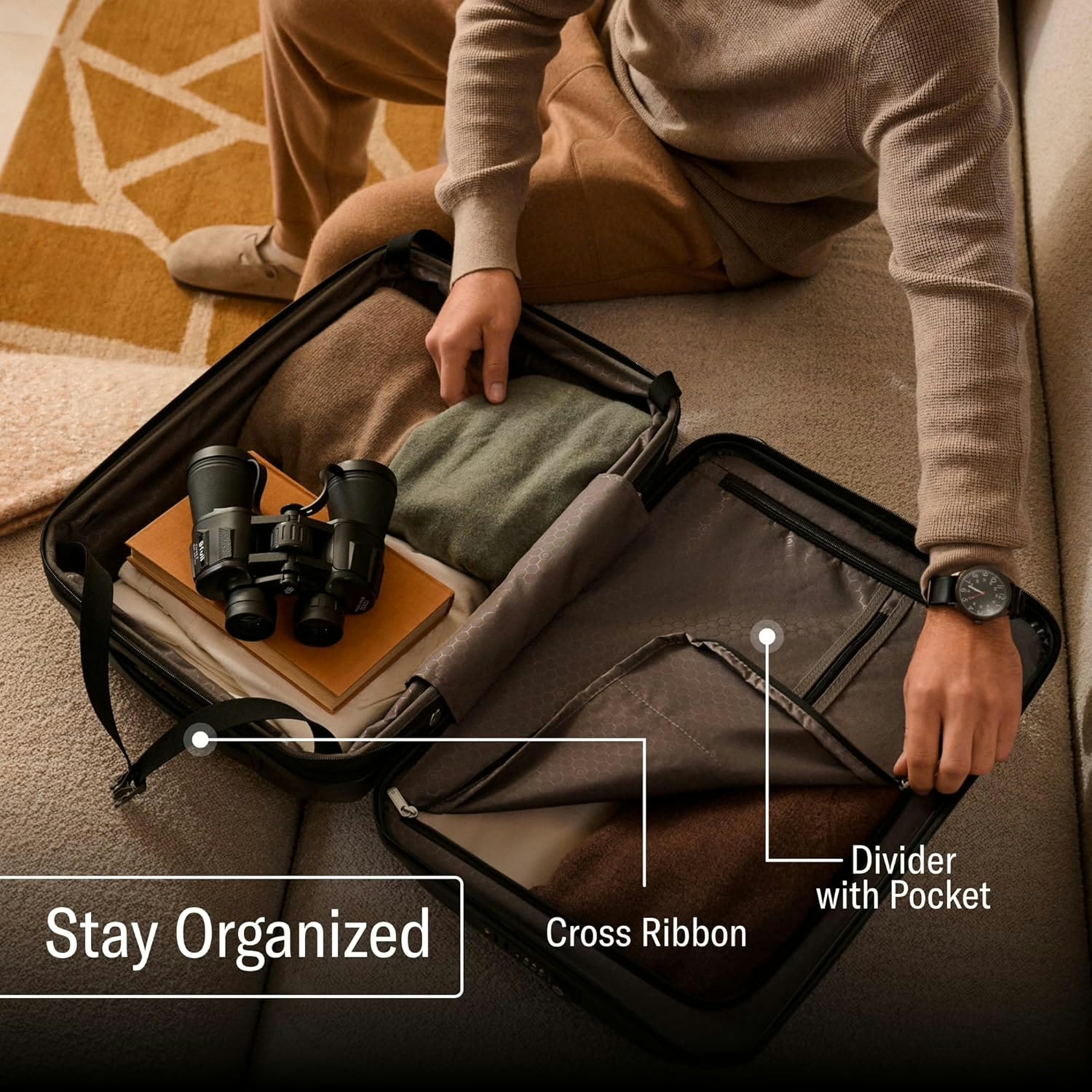
The most common failure mode for wheeled luggage is tipping—caused by a high center of gravity when heavy items sit near the top. Teferra’s method reserves the base layer (adjacent to wheel housing) for the densest items: shoes, denim, toiletry kits, and jackets. Laying bulky jackets flat at the bottom creates a stable platform and a cushioning layer against the rigid back panel where the handle mechanism resides.
Above this foundation, shift to rolling. Lighter fabrics like t-shirts, activewear, and pajamas should be tightly rolled rather than folded. Rolling compresses air out of fabric, transforming garments into dense cylinders that fill the irregular spaces created by shoes and toiletry bags. This hybrid approach—folding heavy items for structure, rolling light items for volume efficiency—maximizes internal space while ensuring your bag remains stable and predictable when rolling through terminals.
4. Use Packing Cubes to Organize by Function
The “dump and search” unpacking method, where you excavate your entire suitcase to find socks, is inefficient and chaotic. Flight attendants like Katie Trebendis and Tifsit Teferra use packing cubes to impose modular organization on their luggage.
Rather than organizing by garment type, experienced crews organize by “mission.” One cube contains gym gear (shoes, socks, shorts, shirt), while another holds business attire. This allows you to remove only the module needed for your immediate activity, leaving the rest undisturbed—particularly valuable during short layovers when you don’t want to fully unpack.
Teferra highlights a critical secondary function: sanitary separation. Designate one cube as the “dirty laundry” hamper as your trip progresses. This creates a physical barrier between soiled and clean garments, preventing odor transfer. It’s far superior to plastic laundry bags, which become shapeless lumps that are difficult to repack.
Packing cubes also facilitate security screening. TSA agents can see through mesh or translucent windows without opening them, avoiding the indignity of your belongings draped across the inspection table. Compression cubes with secondary zippers can reduce soft goods volume by 20-30 percent, creating buffer space for souvenirs or duty-free purchases.
5. Wrangle Charging Cables with a Small Toiletry Bag
In the digital age, tangled cables and scattered chargers create chaos in carry-ons. Tifsit Teferra suggests a dedicated “Tech Nest” strategy: repurpose a small, robust toiletry bag specifically for electronics.
Fold cables neatly (avoid coiling, which creates tangles) and secure them with Velcro tape or twist ties. Velcro is preferred because it’s reusable and doesn’t damage cable insulation like rubber bands. Place these secured bundles in the dedicated pouch alongside charging bricks, travel adapters, and dongles.
This centralization serves dual purposes: organization and safety compliance. Lithium-ion batteries and power banks are prohibited in checked luggage due to fire risk in cargo holds with limited suppression systems. By keeping all batteries in a single, accessible Tech Nest, you’re prepared if a gate agent forces you to check your bag at the last minute. Simply unzip the main bag, grab the Tech Nest, and hand over the suitcase, remaining compliant while retaining power for your flight.
6. Invest in Hardside Luggage with Smart Features
Atlanta-based Delta flight attendant Katie Trebendis makes a compelling case for hardside polycarbonate luggage over softside alternatives.
The primary advantage is dimensional integrity. Softside bags bulge when overstuffed, potentially exceeding airline limits even when they zip closed. A hardside case enforces discipline—it has fixed volume. If it zips, it retains its profile, guaranteeing overhead bin compliance without brute force. The rigid shell also acts as a safety cell, deflecting impacts and shielding fragile items from crushing forces in baggage carts.
Trebendis notes the hygiene factor: hard, non-porous surfaces wipe clean easily, removing grime and pathogens from airport floors and conveyor belts. Soft fabric absorbs these contaminants and resists cleaning.
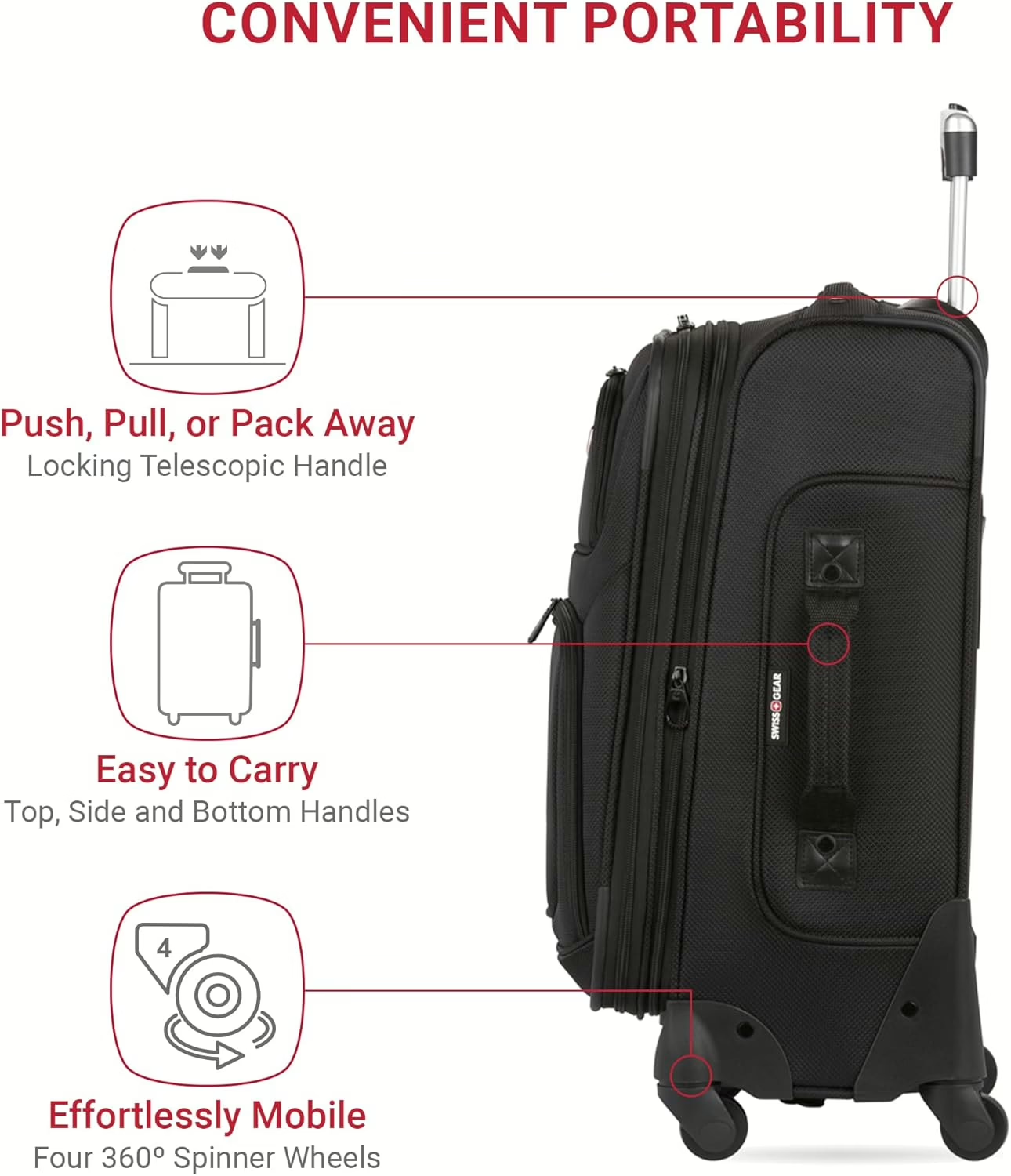
Smart features have matured beyond gimmickry. Built-in weight indicators—found on brands like Béis and Delsey’s Helium series—provide instant feedback before you reach the airport. When lifted, a window turns red if weight exceeds 50 lbs, preventing the “shame shuffle” of repacking on the check-in floor. Look for 360-degree spinner wheels (preferably dual-caster for redundancy), padded telescoping handles, and compression straps that maximize space. Durability is the ultimate luxury; prioritize sturdy construction over trendy designs that photograph well but fail under real-world conditions.
7. Choose Personal Items with a Trolley Sleeve
Navigating airports with a carry-on and personal item creates physical strain when bags lack proper integration. Katie Trebendis identifies the trolley sleeve—a pass-through panel on the bag’s back—as an ergonomic necessity.
Without a trolley sleeve, your personal item (backpack, tote, laptop bag) must be carried on your shoulder or balanced precariously on your rolling suitcase. This creates postural asymmetry leading to back pain, or results in the bag sliding off during turns. A bag with a trolley sleeve slides securely over your suitcase’s telescoping handle, shifting the personal item’s weight onto the wheels and creating a unified, stable unit maneuverable with one hand.
Trebendis advises combining this sleeve with external organization. Look for bags with dedicated quick-access pockets for boarding passes, IDs, and liquids. Accessing these shouldn’t require unzipping the main compartment and exposing your belongings to the terminal.
8. Prioritize Function Over Fashion in Your Luggage Selection
The rise of “travel aesthetic” on social media has popularized luggage that looks beautiful in staged photos but fails under real-world conditions. Flight attendants caution against prioritizing fashion over function.
Common pitfalls include color choice—white, cream, and pastel luggage attracts “ramp rash” (black rubber streaks from conveyor belts and grease from baggage carts). Professional crews opt for darker tones or textured finishes that camouflage wear. Wheel integrity is the most common failure point. Fashion brands often use single-spinner wheels that look sleek but break easily. Functional luggage features dual-caster spinner wheels (eight wheels total) providing redundancy and smoother rolling, or large rollerblade-style two-wheel systems that are virtually indestructible.
Handle ergonomics matter. Minimalist designs often omit side grab handles to maintain clean silhouettes, making bags difficult to lift into overhead bins or retrieve from carousels. Functional bags have robust handles on top, side, and bottom. You can have style and function, but function must come first. Katie Trebendis notes that durability is the ultimate luxury.
9. Download Your Airline’s App Before You Pack
Emirates crew member Alexandra Johnson identifies airline mobile apps as essential travel kit components. In 2026, these apps aren’t just boarding pass repositories—they’re command centers offering capabilities that physically impact airport navigation.
Modern apps provide RFID baggage tracking. Passengers can visualize their checked luggage’s custody chain, seeing scan timestamps as bags are inducted at counters, loaded onto aircraft, and offloaded at destination carousels. If the app shows a bag hasn’t loaded, approach the help desk immediately upon landing rather than waiting futilely at the carousel.
Apps enable self-service rebooking during irregular operations. When flights are cancelled or delayed, hundreds of passengers queue at gate podiums while savvy travelers secure seats on the next flight via the app. Apps also serve as portals for in-flight services—Emirates allows premium passengers to pre-select meals days in advance, ensuring dietary preferences are available.
Johnson advises downloading and logging into apps before leaving home. Airport Wi-Fi networks are congested and insecure; cellular signals in terminal basements are weak. Attempting to download a 200MB application while standing in the security line is a logistical failure. Pre-load the app, log in, and enable push notifications for real-time gate changes and boarding alerts.
10. Make Your Luggage Unmistakably Identifiable
Baggage claim homogeneity is real—90 percent of bags are black rectangular prisms. Emirates flight attendant Alexandra Johnson warns of “accidental theft” where tired passengers grab identical-looking bags.
High-visibility markings work: neon luggage straps or bright ribbons tied to handles break visual uniformity. In 2026, Apple AirTags or Tile Pro trackers are standard practice. Place trackers inside bag linings (not outer pockets where they dislodge) for independent location verification. While airline apps show scan data, AirTags show precise locations, helpful for proving a “lost” bag is actually sitting in the claim office 50 feet away.
Luggage tags should be durable and distinct, but privacy matters. Many crews use tags concealing names and addresses behind flaps, protecting personal data from prying eyes while allowing airlines to contact them if bags are lost. Tie ribbons before checking bags, use bold colors contrasting with luggage color, and attach tags with complete contact information.
11. Drop Your Bags Off the Night Before When Possible
One of the most effective stress-reduction strategies is decoupling baggage drop from flight departure through “Twilight Bag Drop” or early check-in services.
EasyJet pioneered this in the U.K., offering service at London Gatwick, Bristol, Manchester, Edinburgh, Glasgow, and Birmingham. Passengers on early morning departures (before 8:00 or 9:00 a.m.) can check bags the evening before (typically 4:00-9:00 p.m.). This allows you to arrive at the airport the next morning and proceed directly to security, bypassing check-in counters entirely. At Birmingham, easyJet incentivizes this with one hour of free parking in the Premium Set Down area.
In Dubai, Emirates operates a futuristic City Check-in and Travel Store at ICD Brookfield Place in the DIFC. Passengers can drop bags as early as 24 hours and up to four hours before flights. The facility features “Sara,” the world’s first robotic check-in assistant, which matches faces to passports and guides passengers through drop-off. This remote processing extends the airport’s infrastructure into the city center, allowing travelers to enjoy their final day without being tethered to luggage.
Check your airline’s website for early check-in eligibility, confirm cutoff times, and understand restrictions (usually requiring online check-in completion). Airline security protocols ensure bags remain safe overnight.
12. Pack Hydration Essentials in Your Carry-On
Aircraft cabins are hostile environments. Research indicates relative humidity on commercial jets hovers between 10-20 percent—drier than the Sahara Desert’s 25 percent average. This extreme aridity accelerates insensible water loss from skin and lungs, leading to dehydration, fatigue, and weakened immune defense.
Emirates’ Alexandra Johnson and Delta’s Tifsit Teferra emphasize that hydration must be packed, not just requested. The tiny 5-ounce cups served by crew are insufficient to offset fluid loss on long flights.
Pack a high-capacity refillable water bottle (25 ounces or more)—empty it to pass security, then fill it at filtered hydration stations airside. Teferra suggests packing powdered electrolyte packets (like Liquid IV) to improve water absorption and replace salts lost during travel, combating the jet lag headache that’s often just dehydration.
Include travel-sized moisturizer (under 3.4 ounces). Johnson recommends applying it every hour on ultra-long-haul flights to maintain skin integrity. Pack saline nasal spray to keep nasal passages moist, reinforcing your body’s natural viral defenses. Despite CT scanning advances at many checkpoints, the 3-1-1 rule (liquids in 3.4-ounce containers inside quart-sized bags) remains standard. Pack for strictest compliance to ensure velocity through checkpoints.

Key Takeaways
- Research your specific aircraft model using tools like AeroLopa to understand overhead bin dimensions and avoid gate-check fees, especially on regional jets that cannot accommodate standard 22-inch bags.
- Pack heavy items flat at the bottom of your bag and roll lighter garments to create a stable, space-efficient carry-on that won’t tip over in terminals.
- Invest in hardside polycarbonate luggage with built-in weight indicators, dual-caster spinner wheels, and trolley sleeves to protect contents, prevent overweight fees, and reduce physical strain.
- Download airline apps before leaving home to track checked bags via RFID, manage flight disruptions through self-service rebooking, and access digital boarding passes when airport Wi-Fi fails.Pack hydration essentials including a refillable water bottle, electrolyte packets, and travel-sized moisturizer to combat cabin humidity levels as low as 10 percent.