


Your gym shirt is contaminating tomorrow’s clean button-down right now. One bag—with the right seal—stops odor transfer completely. Here’s exactly how to use it.
 The Invisible Problem in Your Suitcase
Three days into a work trip, you unzip your carry-on for a fresh shirt—and get hit with the unmistakable smell of last night’s workout. Nothing looks wrong. The clothes appear fine. But somewhere between the hotel gym and the nightstand, a faint, stale odor has migrated from your worn athletic gear straight into the dress shirt folded right beside it.
This is not a packing fluke. It is a predictable chemical process that plays out inside every suitcase where worn and unworn clothing share space—which, given the surging shift toward carry-on-only travel, affects roughly half of everyone boarding your next flight.
The fix is a single item: an odor-isolating laundry bag. Unlike the mesh pouches or thin plastic sacks most travelers grab out of desperation, these bags use airtight seals and specialized inner linings to chemically block the microscopic molecules responsible for odor transfer. Add one to your packing routine, and your entire carry-on stays fresher from day one to final arrival—no midnight repacking required.
Why This Problem Is Worse Than You Think
The assumption that tossing dirty clothes into a standard mesh bag or a hotel laundry sack provides any real protection is, scientifically speaking, false. Odor molecules—the volatile compounds produced when bacteria break down sweat on fabric—typically measure between 0.5 and 1.0 nanometer in diameter. The gaps in standard plastic polymers and mesh weaves are vastly larger than 1 nanometer, which means those molecules pass through without resistance.
Research by microbiologist Amy-May Pointer found that luggage wheels alone carry approximately 400 Colony Forming Units (CFU) per 3 square centimeters—a bacterial density nearly 58 times higher than that of a standard public toilet seat. Open that suitcase on a hotel bed and those exterior microbes transfer to the interior. Add soiled clothing and you have an active biological environment running the entire length of your trip.
Textile scientist Dr. Rachel McQueen’s research adds another dimension: synthetic fabrics like polyester bind odor compounds with such high affinity that they become notoriously difficult to deodorize through standard laundering. And for the growing share of travelers locked into carry-on-only travel—survey data from Airlines for America shows roughly half of U.S. flyers recently purchased basic economy or unbundled tickets, with 70% planning to do so again—there is no separation option. Clean and dirty clothes share the same 35-to-45-liter space for days on end, with an average domestic personal trip running nearly six nights.
What Exactly Is an Odor-Isolating Laundry Bag?
Most travelers have encountered the standard mesh laundry bag—the kind that comes in hotel gym lockers or collapses into a drawstring pouch. These bags separate clothes visually. They do nothing to contain odors. Because mesh is structurally designed to facilitate airflow, and because odor molecules travel in the air phase, an open weave provides zero chemical or biological isolation.
An odor-isolating laundry bag is a different product category entirely. True isolation requires one or more technologies working together: an airtight or near-airtight sealing mechanism—roll-top closures, double-zippered seams, or welded seams; an activated carbon or charcoal inner lining, which physically adsorbs odor-causing molecules by trapping them in microscopic pores; antimicrobial fabric treatments that inhibit bacterial growth on the bag’s interior surface; and a waterproof outer layer—typically a Thermoplastic Polyurethane (TPU) laminate—that prevents liquid from wet clothing from soaking adjacent items.
These bags come in two primary formats: standalone sealed bags designed to fit inside any piece of luggage, and compression-style versions that simultaneously reduce overall volume. Both rely on the closure as the critical variable. Strip away a proper seal and everything else inside becomes irrelevant.
What to Look For — The Five Features That Actually Matter
Shopping for an odor-isolating bag gets straightforward once you know which five variables separate genuine isolation from a glorified stuff sack. Professional packing expert Anne McAlpin, who advises high-frequency travelers on maximizing carry-on efficiency, emphasizes that any containment system is only as strong as its weakest structural point—and that starts with the closure.
- Sealing Mechanism
The closure type is the single most critical variable in the entire system. Drawstrings, even those fitted with locking toggles, create unavoidable folds and gaps in the fabric collar. Because a partial seal is functionally no seal at all when dealing with sub-nanometer gas molecules, drawstrings disqualify a bag for true odor isolation. Look instead for watertight roll-top designs—which require a minimum of three folds before buckling to create an airtight barrier—or self-repairing reverse-coil zippers with polyurethane coatings. Bags featuring double-zippered or welded seams offer the highest level of molecular security.
- Material and Odor-Blocking Technology
A quality bag addresses two separate threats: liquid contamination and gaseous odor. The exterior shell should be TPU-laminated nylon—the same material category used in maritime dry bags—which provides extreme hydrostatic resistance to prevent wet clothing from soaking adjacent items. The interior is where Activated Carbon Fiber (ACF) does its work, physically adsorbing odor molecules into micropores measuring 0.8 to 2.0 nanometers. The best bags layer both technologies. Some models also integrate silver ion antimicrobial treatments, which neutralize up to 99.9% of odor-causing bacteria on contact and retain approximately 93% of their efficacy after 50 wash cycles.
- Size and Capacity
Match bag size to trip length—roughly 13 liters (approximately 14 by 18 inches) for a weekend or three-to-four-day trip, and 26 liters or more (approximately 18 by 25 inches) for extended international travel or bulky athletic gear. The critical rule: never fill a bag beyond 80% capacity. Overstuffing places lateral stress on zippers and prevents roll-tops from achieving the required three folds, which physically breaks the hermetic seal and defeats the technology entirely.
- Weight and Packability
For carry-on travelers, every ounce carries a cost. Despite the carbon felts and TPU laminates inside, a well-engineered odor-isolating bag should compress flat or roll into a negligible footprint when empty. For optimal performance, look for 420D to 600D TPU-coated ripstop nylon, which delivers extreme tear resistance at a weight of roughly 200 to 250 grams for a standard 20-liter model—light enough to disappear inside any suitcase.
- Washability
The bag accumulates bacteria with every use. Neglect washing it and the bag itself becomes the odor source on your next trip. Look for machine-washable construction, or at minimum a hand-washable design that dries quickly. Bags with Activated Carbon Fiber linings also require periodic regeneration: exposing the inverted bag to direct sunlight for two to three hours, or applying heat with a hairdryer for approximately five minutes, clears saturated micropores and restores full adsorption capacity for future use.
Step-by-Step — How to Use an Odor-Isolating Laundry Bag Correctly
Owning the right bag covers only half the equation. The technology performs only when the user follows a consistent protocol. Anne McAlpin, who recommends a 3:1 packing ratio—three tops for every one bottom—to maximize outfit options while minimizing fabric volume, puts it plainly: the gear works when the habit works. Here is the complete six-step system.
Step 1 — Choose the right size before you pack.
Match the bag’s liter capacity to the number of days you are traveling as a practical minimum, and account for bulky or thick garments by sizing up. A reliable starting point: approximately three to four liters of bag capacity per day of travel for standard clothing volume. When in doubt, size up — a half-full bag seals more effectively than an overstuffed one, and the unused space costs nothing.
Step 2 — Pack the bag flat at the bottom or side of your luggage.
Before the trip begins, place the empty, flattened bag in an accessible section of your carry-on—against a side wall, along the rigid handle channels in a rolling suitcase, or in an exterior pocket. The goal is effortless access. Depositing a worn shirt should be a single, instinctive motion, not a midnight excavation through clean clothes stacked on top of it.
Step 3 — Load dirty clothes immediately after wearing them.
The moment you remove a garment, it goes directly into the bag. Delayed loading is the most common—and most damaging—failure point in the entire system. Bacteria proliferate rapidly at room temperature, and every minute a used item sits in the open air, it incubates and generates a higher concentration of volatile organic compounds. Build the habit of sealing a garment as a direct continuation of removing it, not as a separate step hours later. One exception: for soaking-wet swimwear or heavily saturated gym gear, wring out excess moisture first, then seal immediately — skipping this step promotes Aspergillus mold growth inside the bag.
Step 4 — Seal the bag completely after every use.
For roll-top designs, fold the reinforced collar tightly a minimum of three times before engaging the buckle. For zipper closures, run a finger along the entire track from one end to the other, confirming no gaps remain. A partial seal is no seal. In the dark, static, warm environment of a closed suitcase, odor molecules will diffuse through any opening until equilibrium is reached throughout every adjacent garment.
Step 5 — Keep the sealed bag separate from clean clothes at all times.
Place the sealed bag in a dedicated quadrant of your luggage and keep it there. Professional organizers recommend pairing it with compression packing cubes for clean garments—the dirty bag occupies one zone, clean clothes occupy another. This dual-barrier approach ensures that even the brief moment of opening the laundry bag to deposit a new item does not compromise the clothing around it.
Step 6 — Empty and wash the bag immediately upon returning home.
Do not leave a packed suitcase sitting idle after landing. Empty the bag directly into the washing machine. Then wash the bag itself on a cold, delicate cycle and hang it to dry completely before storing. A damp, enclosed bag is a bacteria incubator—and an unwashed bag carried into the next trip starts the contamination cycle before you even reach the airport.
The Five Mistakes That Defeat the Whole System
Even with the right bag and the right intentions, a handful of predictable errors undo the entire system. Recognize these five failure modes before they cost you.
- Overstuffing the bag. Forcing more clothing into the bag than it can hold places extreme stress on zippers and prevents roll-tops from achieving the required three folds, creating a broken seal and uncontrolled odor release. If a bag cannot close effortlessly, it is over capacity. Pack a second bag for longer trips rather than forcing the first one beyond its limit.
- Using a regular mesh bag and expecting odor containment. Mesh is engineered to facilitate airflow—which means it actively circulates odor molecules rather than containing them. It provides visual organization and zero chemical isolation. Reserve mesh cubes exclusively for clean, unworn garments.
- Delaying the loading of dirty clothes. Every minute a used item sits in open air, it incubates and generates a higher concentration of volatile organic compounds. Load immediately, not later. The gap between removing a garment and sealing it inside the bag is where the system most commonly breaks down.
- Sealing soaking-wet items without first wringing them out. Forcing heavily saturated swimwear or gym gear directly into a sealed bag without removing excess moisture first traps liquid inside, creating the warm, anaerobic conditions that promote Aspergillus mold growth — generating musty odors that can permanently damage fabrics. The fix is a single additional step: wring out excess moisture thoroughly, then seal immediately. For items that remain heavily damp after wringing, launder within 24–48 hours rather than leaving them sealed inside the bag for the remainder of the trip.
- Never washing the bag itself. A bag used across multiple trips without laundering becomes a heavily contaminated fomite. Residual bacteria colonize every fresh garment introduced on subsequent trips, turning the bag into the very source of the odor it was bought to prevent. Treat it the same way you treat the clothes inside it: wash it after every single trip.
Pro Tips — Getting More From One Bag
Once the core system is running, a few advanced tactics extend its value significantly.
- Split into two smaller bags. Use one for gym wear and activewear, a second for general clothing. This prevents the highest-odor items from contaminating less pungent garments and simplifies sorting when you get home.
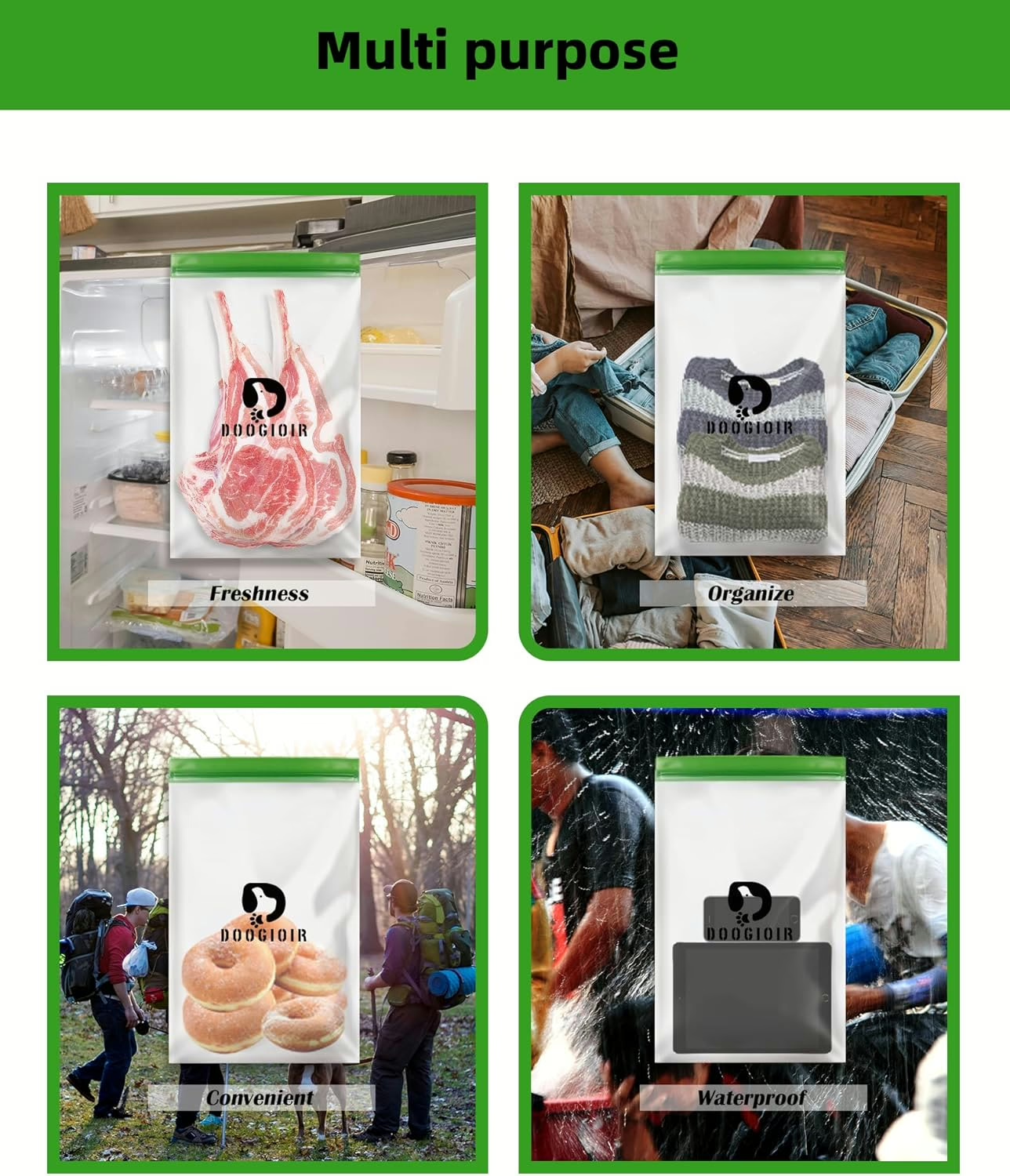
- Use it as a wet bag. TPU-laminated bags are fully waterproof. The same hydrostatic resistance that keeps odors in works equally well to contain damp swimwear after a hotel pool session or rain-soaked gear after a storm—keeping moisture away from electronics, documents, and clean clothing.
- Color-code for family travel. Professional organizer Sabrina Quairoli strongly recommends assigning a specific color bag to each family member. This eliminates inter-family cross-contamination, stops disputes over misplaced items, and dramatically simplifies sorting when loading the washing machine at home.
- Pair with packing cubes. Clean clothes live in cubes; the sealed dirty bag occupies its own designated space. This dual-barrier system is the most complete hygiene protocol available within a carry-on.
- Use one for shoes. Research by Dr. Charles Gerba, a microbiologist and professor at the University of Arizona, confirms that shoe soles frequently harbor fecal bacteria and street grime. A secondary sealed bag for footwear contains both the odor from worn insoles and the physical contamination from the soles themselves.
Who Needs This Most — The Four Traveler Types
Odor isolation is useful for everyone, but its value scales sharply with the specific constraints of the trip.
The carry-on-only business traveler. Averaging 4.3 nights per domestic trip with no checked bag option, this traveler has zero physical separation between soiled gym gear and professional attire. A single containment failure can render a suit unwearable, forcing expensive emergency dry-cleaning on the road.
The long-haul international traveler. With average trip durations reaching 9.9 nights and movement across multiple hotels, climates, and transit networks, containment is not optional—it is mandatory. Bags with heavy-duty D-rings or external attachment points allow the laundry bag to be mounted outside the main luggage compartment entirely, removing the biological hazard from the clean interior.
The athlete or adventure traveler. Hiking, gym, and martial arts gear generates extreme volumes of moisture and bacteria. Standard bags fail catastrophically in this scenario. Only heavy-duty TPU laminates combined with Activated Carbon Fiber linings can manage the odor load these items produce.
The family packer. Mixing multiple family members’ laundry into a single bag creates chaos and cross-contamination. Individual color-coded odor-isolating bags per person eliminate both problems instantly and cut post-trip sorting time significantly.
One Small Bag, One Big Difference
The carry-on-only reality of modern air travel—driven by Basic Economy fares, baggage fees, and the push for operational agility—has turned every suitcase into a high-stakes volumetric puzzle. Within that puzzle, clean and dirty clothes share millimeters of space across days of travel. The bacteria don’t know the difference; without a proper barrier, neither will your shirts.
An odor-isolating bag does not overhaul your packing routine. It does not add meaningful weight. It requires one behavioral adjustment—loading immediately after use—and one mechanical habit: seal it completely every time. That is the entire system.
Before your next trip, add one odor-isolating laundry bag to your suitcase. Pack it flat on day one, load as you go, and seal it after every deposit. The difference between opening a fresh carry-on on day six and opening one that smells like a gym locker comes down entirely to that one decision.

Key Takeaways
- Odor-isolating bags rely on airtight seals and Activated Carbon Fiber linings—not mesh—to chemically trap microscopic odor molecules; mesh bags provide visual separation and zero chemical isolation.
- Load dirty clothes immediately after wearing them; delayed loading is the single most common system failure and allows bacteria to incubate at full capacity.
- Never fill a bag beyond 80% capacity—overstuffing breaks the hermetic seal and renders the technology inside useless.
- Wash the bag after every trip; an unwashed bag becomes a bacteria source that contaminates fresh clothing on the next trip.
- Most travelers need one bag; athletes and families benefit from carrying two.