


Six hundred millimeters of Gunship Gray. Five-thousand-pound Bunker Busters on the wing. This is the Strike Eagle that stops conversations—if you have the skill to finish it right.
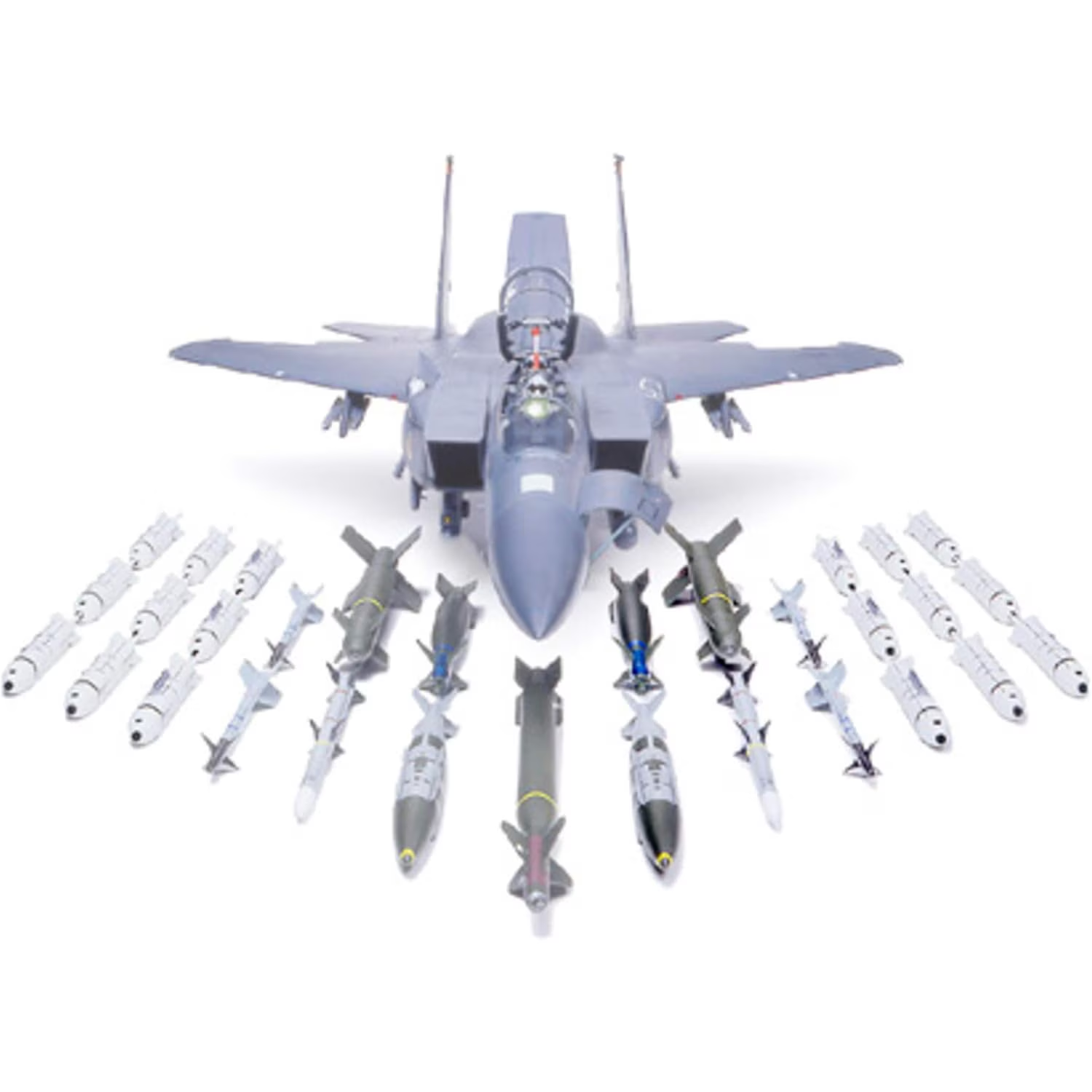
There’s a particular kind of weight to unboxing a Tamiya 1/32 F-15E Strike Eagle for the first time. Not just the physical heft of the box—though that alone signals this isn’t an impulse buy—but the weight of commitment. What you’re looking at is a 600mm airframe, a sprawling multi-media parts count, and a build that routinely demands 50 or more hours of focused bench time before a single drop of paint touches polystyrene.
This review won’t tell you it’s a perfect kit. It isn’t. But among the best model airplane kits available to U.S. modelers in 2026—from the Tamiya 1/32 Corsair Birdcage to the Airfix 1/24 Spitfire—the F-15E occupies territory almost entirely its own. And that status demands serious, unvarnished scrutiny rather than the reflexive praise that tends to follow Tamiya’s name.
The kit has a complicated lineage. The primary airframe tooling dates to 1993. The “Bunker Buster” designation arrived with a 2003 reboxing that grafted modern smart weapons onto the original plastic—but left the core engineering largely untouched. So when you invest in Kit 60312 today, you’re committing to decades-old molds dressed in contemporary ordnance. Is that still a worthwhile proposition? That’s the exact question we’re here to answer—with the technical evidence to back it up.
We’ve analyzed every sprue in the box, cross-referenced the included ordnance against operational records, pressure-tested the assembly sequences against known failure points, and benchmarked the build against its direct competitors. What follows is an evaluation built on what’s actually in the box—not brand reputation.
Brief Overview
Kit 60312—the “Bunker Buster” edition—replicates the F-15E Strike Eagle as a 1/32-scale multi-role precision strike platform. Assembled, it measures an imposing 600mm in length and 404mm across the wings; this is a big model by any measure, and it commands the display space to match. The box contains multiple sprues of finely detailed gray styrene, a duplicated clear “J” sprue (which provides a spare canopy—a detail that becomes critically important during the finishing phase), die-cast metal landing gear struts, and synthetic rubber tires with accurate tread patterns. The 2003 update added two entirely new ordnance sprues—designated K and L—loaded with post-Gulf War precision weapons.
The ideal builder here is an experienced adult modeler: someone already comfortable with multi-media construction, confident working an airbrush, and patient enough to handle complex seam remediation in confined spaces. This is emphatically not a beginner’s kit.
Four features define the build’s core value:
- Die-cast metal landing gear eliminates the structural failure that eventually claims large-scale styrene builds. Those legs will not sag or buckle under the model’s weight over years of display.
- Screw-fastened primary structure mechanically locks the fuselage halves and wing spars into correct alignment. The dihedral angle is engineered into the kit, not left to your clamping technique.
- Modern smart weapons payload includes GBU-28 Bunker Busters, GBU-31 JDAMs, AIM-120A AMRAAMs, and the modular GBU-15/AGM-130 glide bomb family—the hardware that defines the Strike Eagle’s post-Gulf War operational identity.
- Openable avionics bays expose a detailed AN/APG-70 radar array under a positionable radome and the M61A1 Vulcan 20mm rotary cannon bay, both of which provide exceptional utility for maintenance diorama scenarios.

→ Check Current Price & Availability on Amazon
The Build Experience: Promises vs. Reality
Tamiya’s reputation for fit and surface quality is well-earned, and the F-15E delivers on the majority of it. The exterior fuselage panels mate with minimal gap; the recessed panel lines are crisp, consistent, and precisely sized to accept enamel washes with satisfying predictability. Building the outer airframe feels like assembling expensive hardware. Everything keys and slots the way it should, with almost nothing demanding heroic intervention.
Then you reach the intakes.
The F-15’s variable-geometry engine intakes are deep, narrow channels, and Tamiya molded them with a horizontal split running longitudinally down the centerline of each trunk. The resulting seam disappears into a confined plastic tube where conventional sanding tools simply cannot follow. Eliminating it demands needle files, rolled sandpaper, and flexible sanding sponges worked into the channel at frustrating angles. Experienced builders universally identify this as the kit’s most discouraging phase—and they’re right.
The difficulty compounds when USAF camouflage protocols enter the picture. Gunship Gray (FS 36118) must wrap around the intake lip and extend approximately six scale feet into the trunk before transitioning to gloss white. Masking a clean, crisp demarcation line over an imperfectly filled seam inside a narrow tube is, to put it plainly, a miserable task. Most serious builders bypass the problem entirely—either by fabricating Foreign Object Damage (FOD) covers to blank the intakes altogether or by investing in aftermarket single-piece seamless resin intake trunks from suppliers like GT Resin or Seamless Suckers. Both solutions add cost and build time, but they deliver the clean result that the kit plastic alone cannot.
The canopy presents a separate but equally mandatory challenge. The blown-bubble F-15E transparency has an omega-shaped cross-section that requires a multi-part sliding mold to manufacture, which leaves a raised seam running directly down the external centerline. Removing it is non-negotiable for a competition-grade finish. The process involves careful scraping with a fresh scalpel, progressive micromesh sanding from 3,000 to 12,000 grit, polishing compounds, and a final coat of self-leveling acrylic gloss—typically Future floor polish—to restore optical clarity. It’s painstaking work, but achievable. And the duplicate “J” sprue Tamiya included in the 2003 update gives you a spare canopy, which is a far more practical safety net than it might initially appear.
The kit’s “rivet counter” problems cluster around the ordnance. Tamiya included four well-detailed AIM-120A AMRAAMs but omitted the LAU-128 launch rails and ADU-522 pylon adapters needed to physically mount them. You cannot correctly install the kit’s flagship air-to-air missiles straight out of the box without sourcing aftermarket hardware—a legitimate grievance on a premium-priced kit. Similarly, deploying the GBU-15 or AGM-130 glide bombs accurately requires the AN/AXQ-14 datalink pod on the centerline pylon; Tamiya left it out entirely. Builders must scavenge it from other kits or turn to the cottage industry.
The historical friction runs deeper. The 492nd Fighter Squadron markings on the decal sheet depict an aircraft powered by the Pratt & Whitney F100-PW-229 engines—a powerplant that requires prominent auxiliary cooling scoops on the Conformal Fuel Tanks. Those scoops are absent from the 1993-tooled fuselage. Build that scheme out of the box and the physical model represents the wrong engine configuration for the aircraft depicted. The kit also lacks the GPS dome antenna standard on modern Strike Eagles. These details are invisible to casual viewers; for the dedicated rivet counter, they represent corrective aftermarket expenditure.
Value-to-Performance Ratio & Competitor Comparison
The Tamiya F-15E commands a significant premium over every competitor in the 1/32 large-scale fighter segment, and whether that premium is justified deserves a direct answer.
The Revell 1/32 F-15E is the obvious alternative for budget-conscious builders. Available secondhand at a fraction of Tamiya’s price—it has been out of production for decades—it’s a serviceable kit with acceptable overall shape and a straightforward build—a legitimate recommendation for anyone who wants a recognizable Strike Eagle on the shelf without the investment. What it doesn’t deliver is structural engineering: no die-cast landing gear, no screw-fastened spars, softer panel lines, and significantly less precise surface detail. For a casual build or a first attempt at large-scale jets, Revell is reasonable. For anyone pursuing competition results or planning to integrate superdetailing aftermarket, its shortcomings quickly become structural obstacles.
Great Wall Hobby’s 1/32 F-15E (kit L7201) is the most significant modern challenger in the segment. It offers superior shape accuracy and a more complete modern ordnance package compared to the Revell kit, and its panel line quality approaches Tamiya’s. Where it falls short is fit consistency across production runs—poor index pins and variable molding quality are recurring complaints in build reviews—and it lacks the structural engineering that defines Tamiya’s long-term display durability: no die-cast landing gear, no screw-fastened spars.
Trumpeter’s entries in the 1/32 modern jet space carry persistent, well-documented concerns about dimensional accuracy and quality control—poor index pins, shapes that diverge from reference documentation, and variable molding quality across production runs. That track record warrants caution.
Against that field, Tamiya’s price premium is defensible. You’re paying for structural engineering that guarantees decades of display stability, surface detail precise enough for competition-level weathering work, assembly mechanics that eliminate the most common large-scale alignment failures, and tooling quality that has sustained benchmark status for over 30 years. The kit costs more than any alternative. It also outperforms all of them.
Pros & Cons
Pros
- Die-cast metal landing gear provides permanent structural support with zero risk of long-term sagging
- Screw-fastened primary structure enforces fuselage and wing alignment mechanically, eliminating the most anxiety-inducing step in large-scale assembly
- Deeply recessed panel lines are crisp and consistent, accepting enamel washes and post-shading with excellent precision
- Openable AN/APG-70 radar bay and M61A1 Vulcan cannon bay deliver exceptional diorama-building potential
- Duplicate “J” clear sprue provides a spare canopy and windscreen—insurance that costs Tamiya nothing but regularly saves builders from a catastrophic polishing accident
Cons
- Horizontally split intake trunks leave a deep seam in a confined channel; effective remediation demands specialized tools and advanced technique, and often necessitates aftermarket seamless resin replacements
- AIM-120A AMRAAMs cannot be correctly mounted without aftermarket LAU-128 launch rails and ADU-522 pylon adapters—absent from the box
- AGM-130/GBU-15 guided munitions require an omitted AN/AXQ-14 datalink pod for a historically accurate loadout
- Missing CFT auxiliary cooling scoops and dorsal GPS dome antenna lock the kit into an early-engine configuration, creating inaccuracies in the 492nd FS marking option
Where the Tamiya 1/32 F-15E Strike Eagle Really Shines
Everything resolves the first time the assembled airframe sits under a proper light source with paint on it. The Gunship Gray finish—built up through pre-shaded panel lines, thinned base coats, and post-shaded panel centers mottled with lighter tones to simulate operational sun bleaching—stops reading as paint and starts reading as worn military finish. The massive CFTs anchor the fuselage exactly as they do on the real aircraft. The screw-fastened wing join is seamless. The 600mm span simply dominates whatever surface it sits on.
Then there are the engines. The F100 nozzle area and surrounding titanium structure demand full Natural Metal Finish treatment: gloss-black enamel primer, precisely applied Alclad II or AK XTreme Metals in aluminum, steel, and jet exhaust tones, followed by transparent layers of heat-stain blues, purples, and burnt oranges that replicate the iridescent metallurgical discoloration of a hard-worked combat jet. Done well, the rear fuselage looks like it rolled off the flight line after a full combat sortie. Few finishing challenges in scale modeling are simultaneously this demanding and this rewarding.
Load the GBU-28 Bunker Busters on the wing stations and the model transforms. These are 5,000-pound bunker-penetrating weapons rendered in precise 1/32 scale detail, and their sheer mass turns the finished kit from an impressive aircraft replica into a genuine statement piece—a shelf queen that owns every room it inhabits. The Tamiya-printed decal sheet beds down beautifully over a gloss clear coat with standard setting solution, and the completed marking options—including the 391st FS “Bold Tigers” scheme—are visually striking.
The Tamiya F-15E doesn’t just get built. It gets finished, framed, and kept. That’s the point.

Who Should Buy It
This kit is built for experienced adult modelers who approach large-scale construction as a serious long-term discipline. If you’re comfortable with seam remediation on complex internal shapes, confident with an airbrush, familiar with multi-media assembly involving plastic, die-cast metal, and potentially polyurethane resin, and willing to invest 50-plus bench hours in a single build, the Tamiya F-15E will meet you at your level—and push you further.
Modern military aviation enthusiasts seeking a definitive 1/32-scale representation of the USAF’s premier multi-role strike fighter—particularly in post-Gulf War operational configuration—will find nothing more accurate or visually impressive currently available.
Superdetailers who thrive in the aftermarket ecosystem will find the base plastic an ideal foundation. Major cottage-industry manufacturers—Kopecky Scale Models, Eduard, Quinta Studio, Aires/Avionix, GT Resin—produce dedicated upgrade sets for this specific kit, and the Tamiya plastic is sophisticated enough to absorb competition-grade enhancements without fighting you.
Who should pass: beginners, young modelers, and anyone with limited display space. The Revell 1/32 F-15E—available secondhand—remains a reasonable starting point for those still developing core techniques, as does any of the more accessible 1/48-scale options currently in production. Smaller 1/72-scale Strike Eagles offer the same subject matter at a fraction of the complexity and cost. The Tamiya kit will still be the benchmark when you’re ready for it.

Key Takeaways
- Tamiya’s 1/32 F-15E remains the undisputed benchmark for large-scale Strike Eagle kits despite airframe tooling that dates to 1993.
- Die-cast metal landing gear and screw-fastened structure deliver engineering solutions no competitor currently matches.
- Horizontally split intake trunks and a prominent canopy mold seam require advanced remediation—often including aftermarket seamless resin intakes.
- Missing launch rails, pylon adapters, and a datalink pod mean the included modern ordnance cannot be accurately deployed straight out of the box.
- Best suited for experienced adult modelers prepared for a 50-plus-hour commitment; beginners should start with a simpler alternative.