


In June 1942, SBD Dauntlesses sank four Japanese fleet carriers and changed the course of the Pacific War. Revell’s 1/48 kit brings that history straight to your display shelf.
The scale modeling hobby has a well-documented affliction: Advanced Modeler Syndrome, the paralyzing pursuit of microscopic perfection that transforms a weekend project into a months-long ordeal and sends unfinished kits directly to the shelf of doom. For beginners trying to navigate that overwhelming landscape, identifying the best model airplane kits means looking past specification sheets and asking a far more practical question—will this kit actually get built?
Brief Overview
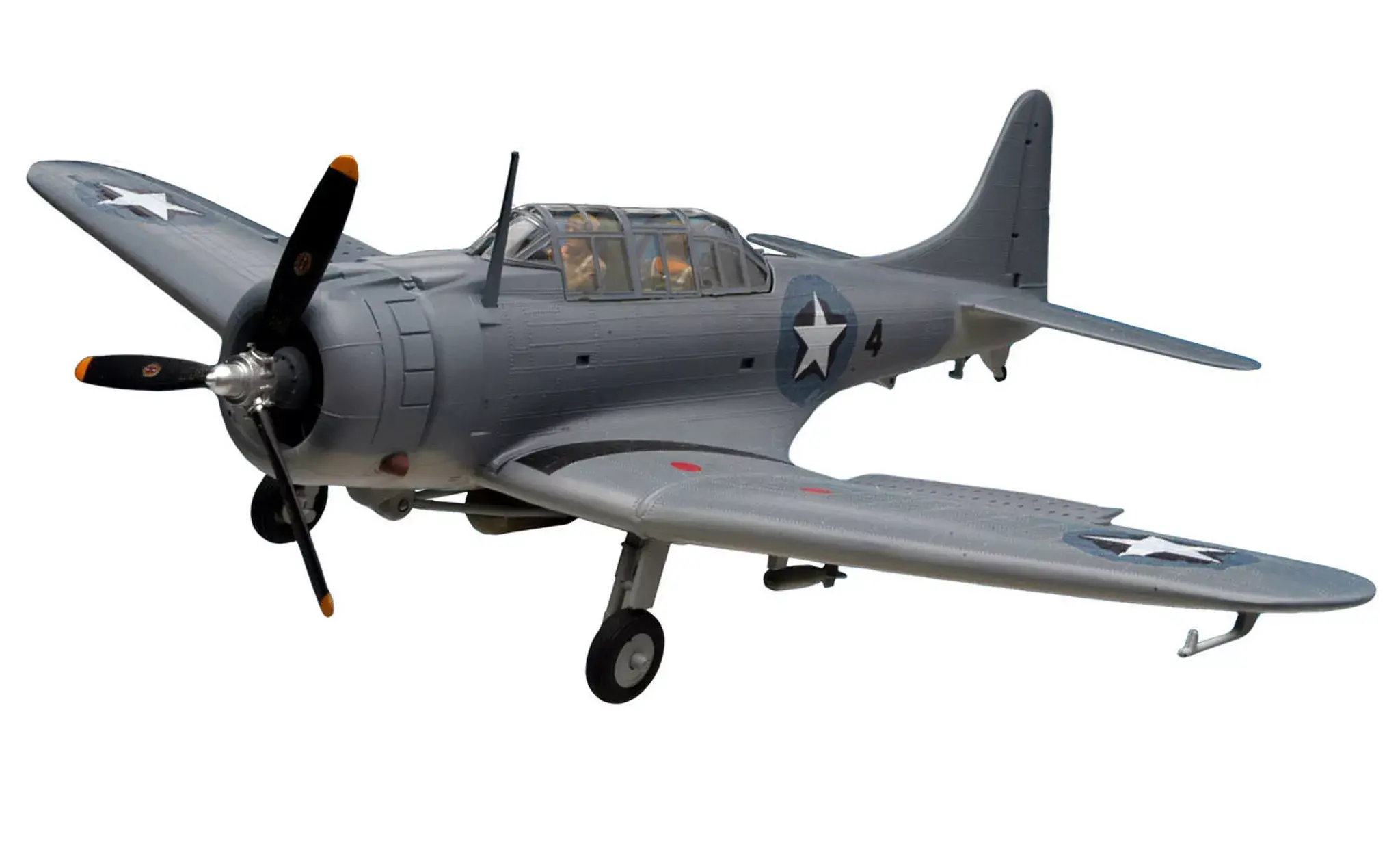
Open the box on the Revell 85-5249 and the first thing you notice is the absence of intimidation. Fifty-three parts molded in light gray and clear polystyrene are distributed across a modest number of sprues—a figure that stands in stark contrast to the 300-plus components typical of modern multimedia kits. That low part count is the kit’s defining feature and its most powerful argument for the beginner audience.
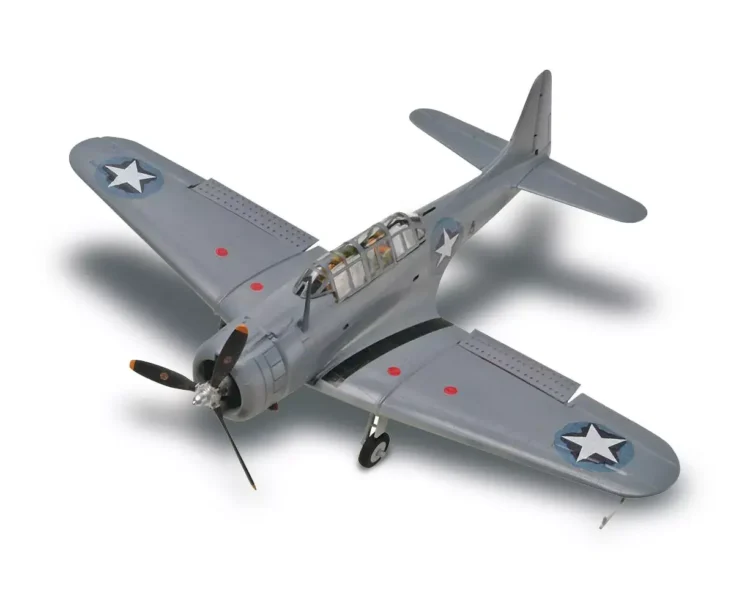
The tooling traces directly to original Monogram molds from 1960, and the heritage shows in the best possible way for its target builder. Four functional action features—retractable landing gear, a movable rear machine gun, posable dive flaps, and a dropping bomb mechanism—deliver the kind of interactive satisfaction that turns an afternoon’s work into a tangible result. Beyond the aircraft itself, Revell packs in four crew figures: a pilot, a rear gunner, a deck handler, and a landing signal officer. That quartet alone transforms a simple aircraft build into an immediately displayable diorama. The 2011-era decal sheet rounds out the package with accurate markings for two historically significant airframes: a U.S. Navy aircraft assigned to USS Wasp during the Guadalcanal campaign in August 1942, and a lend-lease example flown by No. 25 Squadron of the Royal New Zealand Air Force at Seagrove, New Zealand, in July 1943.
→ Check Current Price & Availability on Amazon
Pros & Cons
Pros
- Low part count (53 pieces) eliminates technical overwhelm and delivers a realistic weekend completion timeline for beginners.
- Four included crew figures (pilot, gunner, deck handler, LSO) provide immediate diorama potential straight out of the box.
- Accessible price point makes this a genuinely low-risk platform for developing core construction and painting skills.
- High-quality 2011 decal sheet offers accurate U.S. Navy and RNZAF marking options with reliable adhesion when paired with a setting solution.
- Durable polystyrene accepts standard MEK-based liquid cements cleanly and tolerates the gap-filling and sanding mistakes that inevitably define early builds.
Cons
- Raised panel lines and rivets complicate modern weathering techniques; targeted pin washes do not behave predictably over raised surface detail.
- Heritage 1960 molds introduce moderate flash and prominent ejector pin marks that require deliberate cleanup before assembly.
- Solid dive flaps are the kit’s most significant historical compromise—the perforated dive brakes that defined the real SBD are absent, replaced by shallow, closed indentations.
- Spartan cockpit and integrally molded engine lack the structural depth that experienced builders demand.
Where the Revell 1/48 SBD Dauntless Really Shines
The Revell Dauntless earns its keep not through accuracy benchmarks, but through something the hobby desperately needs more of: frictionless forward progress.
For the novice builder, the 53-part breakdown eliminates the decision fatigue that turns a premium kit into an unfinished monument to good intentions. Assembly follows the standard aircraft sequence—cockpit first, then fuselage, then wings—with each stage demanding genuine skill-building challenges presented at a manageable difficulty level. The cockpit tub, rollover structure, radio platform, rear gun half-ring, machine gun, and two crew figures constitute the seven-piece interior, and while the sidewalls are bare of the throttles and trim wheels found on the actual aircraft, the installed pilot and gunner figures effectively mask the simplification once the fuselage is closed. That is by design, not accident: the builder’s energy is redirected toward the visible exterior finish, where the real skill development occurs.
Seam elimination on the fuselage join provides a concrete introduction to one of modeling’s most fundamental techniques. Because the mold ages have loosened tolerances, a noticeable seam line will appear along the spine and belly after cementing—this is not a defect to apologize for but a deliberate teaching moment. The builder applies modeling putty, works through progressive sanding grits, and confronts the classic dilemma of preserving raised rivet detail near the repair area. For those who want to pursue it, a pounce wheel tool can restore lost rivets; beginners who accept minor imperfections learn that completion matters more than perfection at this stage.
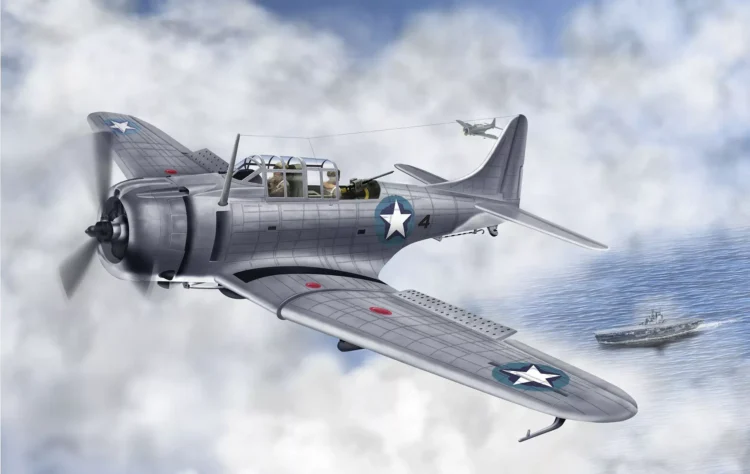
The finishing phase is where the kit’s value-to-performance ratio peaks. The 2011 decal sheet responds well to chemical softening agents such as Micro Sol, which forces the carrier film to conform over the raised rivets and produce a convincingly painted-on appearance. The classic Non-Specular Blue-Gray over Light Gull Gray Navy scheme rewards airbrushing practice and responds beautifully to post-shading—a technique where a heavily thinned lighter color is misted into panel centers to simulate the bleaching and salt spray degradation experienced by carrier-based aircraft in the Pacific. The operational history of the Douglas SBD Dauntless, the type credited with sinking four Japanese fleet carriers at Midway in June 1942, gives even a simplified representation considerable emotional weight on the display shelf. When the Dullcote flat coat comes off the airbrush and the artificial shine disappears, the finished model earns every inch of its place in the collection.
→ View the Revell 1/48 SBD Dauntless on Amazon
Who Should Buy It
The Revell 85-5249 is built for beginners. It is the right kit for anyone entering the hobby who needs a forgiving, budget-conscious platform to develop foundational skills—seam filling, canopy masking, basic airbrushing—without facing the technical overwhelm that terminates projects before they reach the paint stage. It also works well for parents and children building together, where the interactive features and manageable part count sustain engagement across a weekend session.
Advanced builders, dedicated rivet counters, and modelers preparing competition entries should look elsewhere. The raised panel lines make traditional pin-washing techniques unreliable, the solid dive flaps require either 132 individual drilling operations with a pin vise or an aftermarket photo-etched replacement set from Eduard or a similar supplier, and the cockpit interior cannot satisfy the standards of experienced builders without extensive aftermarket resin surgery. For those builders, the Accurate Miniatures 1997 tooling—regularly reboxed under the Academy, Italeri, and Eduard labels—represents the established gold standard for 1/48 SBD accuracy, with fully perforated dive flaps and museum-grade cockpit fidelity straight out of the box. The Hasegawa mid-1990s tooling offers recessed panel lines and good fit, but its solid dive flaps and thin cockpit detail make it a weaker value proposition at its typical price point. The Revell kit neither attempts nor needs to compete with either option. It occupies a distinct and necessary niche at the accessible entry level, and it fills it well.

Key Takeaways
- 53-part count keeps construction manageable, making this the lowest-friction entry point into 1/48 SBD modeling.
- Vintage 1960 Monogram tooling means flash, ejector pin marks, and raised panel lines—acceptable trade-offs for beginners, deal-breakers for advanced builders.
- Solid dive flaps are the kit’s most significant historical compromise; correcting them requires 132 individual drilling operations or aftermarket PE parts.
- Four crew figures and a 2011 decal sheet deliver strong out-of-the-box diorama potential for U.S. Navy and RNZAF markings.
- Advanced modelers seeking perforated dive brakes and recessed detail should choose the Accurate Miniatures tooling instead.