


Airlines have deployed AI-powered laser scanners that flag oversized bags in seconds. Here are the five best travel backpacks that pass — ranked by category, airline, and travel style.
The Gate-Check Reckoning Has Arrived
The boarding gate is no longer a negotiation. For years, travelers relied on a well-known survival tactic: pack a soft-sided backpack, give it a firm squeeze at the sizer, and move on. Gate agents were busy, metal cages were imprecise, and a little creative compression usually got the job done. That era is over.
Airlines across the U.S. are now replacing those manual spot-check systems with automated gate scanners, including systems such as the Smart Baggage Validator by Qmetrix and Via Guide, which use three-dimensional sensor arrays and integrated LED measurement grids to measure every millimeter of a bag as passengers walk through the boarding lane. The system maps protruding grab handles, rigid wheels, and bulging external pockets with a detection accuracy rate exceeding 98 percent. Three integrated LED strips tell the story instantly: green means the bag clears the threshold; red means it does not.
If your bag’s volumetric footprint exceeds the industry-standard maximum of 45 linear inches (22 × 14 × 9 in / 56 × 35 × 23 cm) by even a fraction, the scanner flags your boarding pass automatically. The result is a mandatory gate-check and an immediate, non-negotiable fee — typically ranging from $35 to $150 depending on your carrier and ticket class. No appeals, no exceptions.
This guide evaluates the best backpacks for air travel against that new enforcement reality — ranked by category so you can find the right bag for your specific airline, trip length, and travel style.
What Every U.S. Traveler Needs to Know About Carry-On Rules Right Now
The scanner enforces a deceptively simple standard. A carry-on bag must fit within a 22-inch height, 14-inch width, and 9-inch depth — a 45-inch linear sum. Most major domestic carriers, including Delta Air Lines, United Airlines, and Alaska Airlines, enforce precisely that threshold. Southwest Airlines remains a notable outlier at a more generous 24 × 16 × 10 inches.
The critical enforcement wrinkle is what researchers call the “squish factor” — and it no longer works. A soft-sided backpack packed to its physical limit can bulge by one to two inches in depth. What started as a technically compliant bag becomes an oversized piece of luggage the moment its packed exterior crosses the laser plane. For travelers eyeing international routes, the challenge is compounded: carriers such as Lufthansa and British Airways enforce strict cabin weight limits of 15.4 to 22 lbs (7 to 10 kg), making the weight of the bag itself as critical as its dimensions.
One meaningful upside to the 2026 enforcement landscape: the widespread deployment of Computed Tomography (CT) scanners at TSA lanes across the United States now allows travelers to leave electronics and 3-1-1-compliant liquids inside their bags during X-ray screening, reducing the frantic unpacking that previously defined security lines. The priority has shifted — keep your bag aerodynamically tidy at the gate, not in the security lane.
📐 Standard Carry-On Threshold at a Glance
|
How We Evaluated These Backpacks
Every bag in this guide was assessed against five objective criteria drawn from the technical realities of the 2026 aviation environment:
- Gate-Scanner Compliance: Exterior dimensions verified against the 22 × 14 × 9-inch threshold. Structural discipline when fully packed — does the bag hold its shape, or does it bulge past the critical 9-inch depth limit under a laser sizer?
- Volumetric Carry Efficiency (VCE): Liters of usable capacity per kilogram of empty bag weight, expressed as VCE = Volume (L) ÷ Empty Weight (kg). Higher is better — essential for international travelers where every gram of bag weight is a gram stolen from your gear.
- Organizational Architecture: Quality of internal compartmentalization, laptop sleeve design (suspended vs. back-wall), TSA-compliance of laptop access, and dedicated pockets for tech accessories and documents.
- Carry Comfort: Back panel ventilation, harness load-transfer capability, hip belt support, and real-world suitability for multi-terminal connections under a loaded pack.
- Build Quality and Weather Resistance: Primary fabric denier and material type, water-resistance standard (DWR coating vs. TPU laminate vs. fully waterproof textile), and hardware quality (YKK zipper grade, buckle material).
Which Backpack Is Right for You?
Skip to the category that matches your travel reality:
- Best Overall → The most well-rounded option for most U.S. travelers — strong compliance, versatile carry modes, excellent weather resistance.
- Best Ultralight → For international routes with strict 7–10 kg cabin weight caps, where the bag’s own weight is the enemy.
- Best for Organization → For meticulous packers and tech-heavy travelers who need a dedicated compartment for everything they own.
- Best for Comfort → For long-haul itineraries, multi-terminal connections, and heavy loads that punish a poorly fitting harness.
- Best Personal Item → For Basic Economy flyers on United, Air Canada, and budget carriers who need a bag that legally avoids overhead bin fees.
Best Overall Backpack for Air Travel
✦ BEST OVERALL
Patagonia Black Hole® MLC® 45L

The name says it all. The Black Hole® Maximum Legal Carry-On (MLC) 45L is built around a single-minded mission: push the boundaries of what a compliant carry-on bag can hold without ever crossing into gate-check territory. It succeeds — and does so without sacrificing durability or versatility.
The shell is engineered from 100% postconsumer recycled 300-denier polyester ripstop reinforced with a recycled TPU-film laminate, meeting rigorous bluesign® environmental standards. The result is a bag that laughs at rain, terminal grime, and overhead-bin abuse in equal measure. It weighs 3 lbs 10 oz (1.63 kg) empty and delivers a best-in-class VCE of 27.61 L/kg — meaning nearly every gram of weight is working for you. Its manufacturer-stated dimensions of 22 × 14.5 × 7.6 inches place the height fractionally above the strict 22-inch mark on paper, but the soft-sided upper contour compresses reliably into most physical sizers when the bag is not packed to absolute capacity.
The 7.6-inch depth profile is the MLC’s structural trump card. In a world where 3D laser scanners fail bags that bulge past 9 inches, a bag that sits more than a full inch below that threshold has genuine compliance headroom that few competitors can match.
Internally, a flat-opening TSA-compliant tech compartment swallows laptops up to 19 inches. The main compartment includes two internal organizer pockets for modular packing. Three carry modes — stowable backpack straps, a briefcase grip via top and side grab handles, and a detachable padded hip belt that doubles as a duffel shoulder strap — make it adaptable to any transit environment.
The trade-offs are real but livable. The flat back panel lacks air-channel ventilation, which means a warm, sweaty spine on any walk longer than a few terminal gates. There are no quick-access slip pockets for a passport or phone. And the vertical orientation of the luggage pass-through sleeve places the backpack sideways on a rolling suitcase handle, which some travelers find awkward in tight terminal spaces.
- Dimensions: 22 × 14.5 × 7.6 in (55.9 × 36.8 × 19.3 cm)
- Weight: 3 lbs 10 oz (1.63 kg)
- Capacity: 45L (independent testing suggests ~39.4L actual)
- VCE: 27.61 L/kg
| ✔ Pros | ✘ Cons |
| Best-in-class VCE (27.61 L/kg) | Back panel has no air-channel ventilation; heat buildup likely |
| Slim 7.6-in depth clears gate scanners comfortably | No quick-access pockets for passport or phone |
| TSA-compliant flat-opening laptop sleeve (fits up to 19 in) | Vertical luggage pass-through sits bag sideways on rolling handle |
| Three versatile carry modes | |
| TPU-laminate shell: exceptional weather and abrasion resistance |
Best for: Most U.S. domestic and international travelers who want one bag that handles every scenario without compromise.
Best Ultralight Backpack for Air Travel
✦ BEST ULTRALIGHT
ULA Equipment Ultra Dragonfly 30L
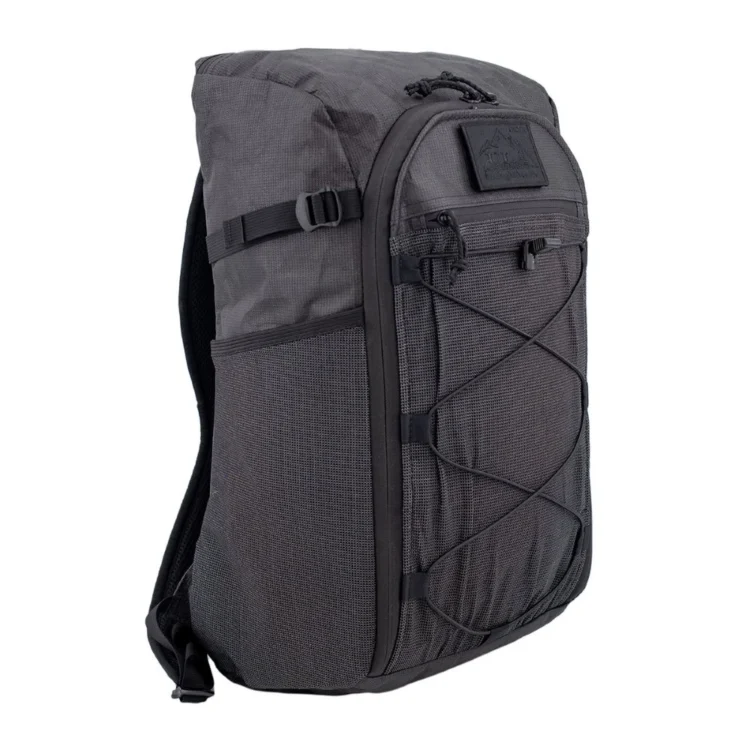 When your airline’s cabin allowance is capped at 7 kilograms and your bag weighs 2 kilograms before a single item is packed, you are already losing. The ULA Equipment Ultra Dragonfly solves that equation at its root.
The Dragonfly’s defining feature is its material: ULTRA 400TX, a 400-denier Ultra-PE (Ultra High Molecular Weight Polyethylene) laminated to a white taffeta backing. This is not standard nylon — it is 20% lighter and four times more abrasion-resistant than comparable UHMWPE fabrics, survives over 8,800 abrasion cycles in testing, and is completely waterproof up to 200 PSI without any secondary rain cover. The white taffeta interior dramatically improves light reflectivity inside the bag, making it easier to locate small items in dim terminals.
The pack weighs just 31 oz (880 g) — under two pounds. That yields a VCE of approximately 34.09 L/kg, one of the highest efficiency ratings in this guide. On a strict 7 kg (15.4 lb) international allowance, the Dragonfly consumes less than 880 grams of that budget, leaving over 6 kilograms for gear, clothing, and electronics.
Its dimensions — 18.5 × 11 × 7 inches (47 × 28 × 17.8 cm) — clear standard overhead requirements and comfortably comply with the personal item constraints of most major airlines. The main body delivers 21.8 liters of capacity, with dual 2.6-liter UltraStretch mesh side pockets and a 3-liter front stash pocket bringing total volume to 30 liters. YKK AquaGuard water-resistant zippers run the perimeter. The bag can accommodate a 17-inch laptop and is rated for loads of 25 to 30 lbs.
The drawbacks are aesthetic and ergonomic. The ULTRA 400TX fabric has a technical, slightly crinkly hand feel that reads more trail than boardroom — a consideration for corporate travelers. And because it is handmade, slight asymmetrical variations in the interior lining can occasionally cause the main zipper to rub, suggesting potential long-term wear. Under heavy loads, the absence of load-lifter straps and a padded hip belt becomes apparent; at the upper end of its 30-lb rating, the shoulder straps do the work alone.
Demand consistently outpaces supply. The Dragonfly sells out quickly when restocked, and prospective buyers often wait.
- Dimensions: 18.5 × 11 × 7 in (47 × 28 × 17.8 cm)
- Weight: 31 oz / 880 g
- Capacity: 30L (21.8L main + 5.2L side + 3L front)
- VCE: ~34.09 L/kg
| ✔ Pros | ✘ Cons |
| Under 2 lbs empty; elite VCE (~34.09 L/kg) | Crinkly, technical appearance — not suited to strict corporate environments |
| ULTRA 400TX: 4× more abrasion-resistant than standard UHMWPE | No load-lifter straps or padded hip belt; shoulder strain under heavy loads |
| Completely waterproof to 200 PSI — no rain cover needed | High demand: sells out quickly upon restock |
| Fits within personal item sizing for most airlines | Handmade lining variations can cause zipper friction over time |
| YKK AquaGuard water-resistant zippers |
Best for: International travelers facing 7–10 kg cabin weight caps, ultralight minimalists, and budget-carrier flyers who need maximum capacity at minimum weight penalty.
Best Backpack for Organization
✦ BEST FOR ORGANIZATION
Nomatic 40L Travel Bag

Most travel backpacks are empty buckets with ambitions. The Nomatic 40L is a filing cabinet that happens to fit in the overhead bin.
The interior architecture is built around 12 distinct internal pockets, engineered to eliminate the need for aftermarket packing cubes. A waterproof-lined shoe compartment at the base quarantines dirty footwear from the main wardrobe. A dedicated underwear and sock compartment keeps small items organized. A waterproof-lined water bottle pocket is tucked inside rather than hanging off an external mesh sleeve — preserving the bag’s aerodynamic exterior profile for 3D scanner compliance. A custom laundry bag is integrated for separating soiled garments mid-trip. The TSA-ready laptop sleeve accommodates a device up to 16 × 10.5 × 1.5 inches. A patented strap system converts the bag between duffel and backpack carry modes, and a rolling luggage handle pass-through and removable waist straps complete the chassis.
Constructed from heavy-duty, water-resistant tarpaulin (90% polyester / 10% nylon) with reinforced waterproof zippers, the bag measures 21 × 14 × 9 inches (53.3 × 35.6 × 22.9 cm) — fitting precisely within the universally accepted carry-on threshold. Its empty weight of 3.42 lbs (1.55 kg) delivers a respectable VCE of 25.80 L/kg, though prospective buyers should note that manufacturing variances have produced units weighing up to 4.45 lbs (2 kg), which would significantly reduce that efficiency rating. Verify the exact model iteration before purchasing.
The Nomatic’s organizational depth comes with trade-offs. The rigid, box-like aesthetic is utilitarian rather than ergonomic — it can feel bulky and disproportionate on smaller frames. The duffel conversion mechanism is somewhat clunky under time pressure. And the sheer density of the pocket system demands genuine mental mapping; small items can vanish into the labyrinth.
Travelers who want comparable organization within a classic clamshell silhouette should consider the Cotopaxi Allpa 35L as an alternative — a lay-flat bag with three left-panel split pockets and a cavernous main compartment, weighing 2.93 lbs (1.33 kg) with a VCE of 26.31 L/kg. The caveat: the Allpa’s 10-inch depth profile risks triggering automated gate-check penalties when packed to capacity, as the soft TPU shell can bulge past the 9-inch laser threshold.
- Dimensions: 21 × 14 × 9 in (53.3 × 35.6 × 22.9 cm)
- Weight: 3.42 lbs (1.55 kg) — verify; manufacturing variance up to 4.45 lbs
- Capacity: 40L
- VCE: 25.80 L/kg (based on 1.55 kg unit)
| ✔ Pros | ✘ Cons |
| 12 internal pockets; 20+ unique organizational features | Rigid, boxy silhouette — can feel bulky on smaller frames |
| Waterproof-lined shoe compartment keeps odor and debris isolated | Duffel strap conversion is clunky under time pressure |
| Internal waterproof water bottle pocket preserves aerodynamic exterior | Dense pocket system requires mental mapping to locate small items |
| Custom laundry bag included | Manufacturing weight variance up to 4.45 lbs can significantly reduce VCE |
| Water-resistant tarpaulin construction |
Best for: Meticulous packers, digital nomads, business travelers, and tech-heavy flyers who need every item instantly accessible and permanently separated.
Best Backpack for Comfort
✦ BEST FOR COMFORT
Osprey Farpoint 40 / Fairview 40

Terminal B to Terminal D at O’Hare. The connector at LAX. The entire length of Heathrow Terminal 5. These are the real tests of a travel backpack’s worth — and on those concrete corridors, the Osprey Farpoint 40 (male-specific torso geometry) and Fairview 40 (female-specific harness alignment) are in a category of their own.
Osprey’s engineering team transplanted the suspension architecture of its high-end wilderness packs directly into a carry-on chassis. The foundation is a 4-millimeter LightWire peripheral frame — a rigid internal loop that captures the gravitational force of a fully packed bag and redirects it from the trapezius muscles down into a padded hip belt. When correctly fitted, up to 80% of the load transfers to the hips, not the shoulders. Behind the frame sits the AirScape back panel: a matrix of mesh-covered, deeply ridged foam that creates deep ventilation channels between the pack and the user’s spine, exhausts heat rapidly, and significantly reduces perspiration during extended terminal transit.
Before placing the bag in an overhead bin, the entire shoulder harness and hip belt complex zips neatly behind a stowaway back panel, converting the pack into an aerodynamic, snag-free duffel that slides cleanly into overhead bins and lies flat on luggage carousels.
Built from bluesign-approved 210-denier (main) and 420-denier (bottom) recycled nylon with a PFAS-free DWR coating, both the Farpoint and Fairview maintain precise carry-on compliance at 21.7 × 13.8 × 9.1 inches (55 × 35 × 23 cm). The Farpoint weighs 3.27 lbs (1.48 kg) for a VCE of 27.03 L/kg; the Fairview comes in at 3.41 lbs (1.5 kg). Dual internal compression straps cinch the load, keeping the exterior geometry within the laser boundaries of automated gate sizers.
The comfort supremacy comes with one significant organizational compromise: the main compartment is a single panel-loading empty bucket. Travelers must independently acquire a comprehensive system of modular packing cubes; without them, gear migrates to the bottom of the bag and disrupts the center of gravity. There are no dedicated external water bottle pockets — only tight front mesh slips — and the padded hip belt cannot be detached.
- Dimensions: 21.7 × 13.8 × 9.1 in (55 × 35 × 23 cm)
- Weight: Farpoint 3.27 lbs (1.48 kg) / Fairview 3.41 lbs (1.5 kg)
- Capacity: 40L
- VCE: 27.03 L/kg (Farpoint) / 26.73 L/kg (Fairview)
| ✔ Pros | ✘ Cons |
| LightWire frame: unmatched load transfer to hip belt | Almost no internal organization — packing cubes are a mandatory purchase |
| AirScape back panel: deep ventilation channels prevent heat buildup | Padded hip belt is non-detachable |
| Gender-specific fit (Farpoint/Fairview) for a wider range of torso lengths | No dedicated external water bottle pockets; tight front mesh slips only |
| Full harness system zips away cleanly for overhead bin and luggage carousel | The 55L variant eliminates the dedicated laptop sleeve entirely — stick to the 40L |
| bluesign-approved, PFAS-free construction |
Best for: Long-haul travelers, multi-terminal commuters, anyone carrying loads over 20 lbs, and travelers who have experienced shoulder or back strain from poorly fitting packs.
Best Personal Item Backpack for Air Travel
✦ BEST PERSONAL ITEM
Patagonia Black Hole® Mini MLC® 30L

The economics of Basic Economy ticketing have elevated the personal item from an afterthought to a strategic weapon. Passengers flying United Airlines, JetBlue, or Air Canada on Basic Economy fares are barred from the overhead bin entirely. A standard 22-inch carry-on at the gate means an automatic $75–$100 penalty — instantly erasing the financial case for the budget ticket. The solution is not a smaller bag; it is the right smaller bag.
The Patagonia Black Hole® Mini MLC® 30L is a scaled-down version of the full MLC 45L, engineered to extract maximum utility from the under-seat cavity. At 20 × 12 × 7 inches (50.8 × 30.5 × 17.8 cm), its 20-inch length technically exceeds the 17- or 18-inch limits published by several carriers. In practice, because the bag is constructed from flexible 300-denier recycled ripstop polyester without a rigid internal frame sheet, the upper portion collapses when the bag is not overpacked. Empirical testing confirms it reliably fits beneath domestic airline seats, flying under the radar of gate agents focused on clearly oversized bags.
The interior is laid out with the same clamshell intelligence as its larger sibling: a lay-flat suitcase-style main compartment with internal zippered mesh organizers, and a rear tech compartment with flat-opening TSA-compliant storage for a 15-inch laptop and a tablet. Three carry modes — backpack, duffel via detachable hip belt shoulder strap, and briefcase via grab handles — give it the same transit versatility as the full-size MLC. A pass-through back panel sleeve mounts it onto rolling suitcase handles for gate-to-gate ease. Weight: 2 lbs 13 oz (1.29 kg); VCE: 23.25 L/kg. At 30 liters, it carries sufficient gear for a three-day weekend without overhead bin privileges.
Travelers who need total geometric certainty — especially on Frontier, Spirit, or Ryanair, where personal item sizers are aggressively enforced — should consider the Osprey Daylite Expandable 26+6 as a runner-up. In its compressed form (17 × 13 × 6 in / 43 × 33 × 16 cm), it meets personal item standards for approximately 85% of major airlines and drops effortlessly into even the most restrictive sizers at 1.85 lbs (0.84 kg). Unzipping the full-perimeter expansion panel adds 2 inches of depth and 6 liters of volume, reaching 32 liters total — yielding an exceptional expanded VCE of approximately 38.09 L/kg. The harness is minimalist, lacking load lifters and robust hip padding, but for a personal item that travels under the seat, that trade-off is entirely acceptable.
- Dimensions: 20 × 12 × 7 in (50.8 × 30.5 × 17.8 cm)
- Weight: 2 lbs 13 oz (1.29 kg) | VCE: 23.25 L/kg
- Daylite Expandable — Dimensions (compressed): 17 × 13 × 6 in
- Weight: 1.85 lbs (0.84 kg) | VCE (expanded, 32L): ~38.09 L/kg
| ✔ Pros | ✘ Cons |
| Fits under most domestic airline seats — avoids carry-on fees entirely | 20-inch length technically exceeds several airlines’ stated personal item limits |
| Lay-flat clamshell: suitcase-style organization in a personal item | 30L capacity insufficient for multiple pairs of shoes or bulkier gear |
| Flat-opening TSA-compliant 15-inch laptop access | No rigid frame — compliance depends on not overpacking |
| Pass-through sleeve for rolling suitcase handle | |
| Breathable mesh back panel; comfortable to carry |
Best for: Basic Economy flyers on United, JetBlue, and Air Canada; budget-carrier travelers; minimalist one-bag packers; anyone flying a route where carry-on fees apply.
Is Your Backpack Allowed on Your Airline? Check This Chart First
Before purchasing any bag in this guide, verify it against your primary carrier’s stated limits. Enforcement is no longer consistent across airlines — it is algorithmic.
| Airline | Carry-On Max | Personal Item Max | Key Caveat |
| Delta Air Lines | 22 × 14 × 9 in | 17 × 13 × 9 in | No weight limit on domestic flights |
| American Airlines | 22 × 14 × 9 in | 18 × 14 × 8 in | Shifting to automated gate-agent discretion |
| United Airlines | 22 × 14 × 9 in | 17 × 10 × 9 in | Basic Economy: personal item only |
| Southwest Airlines | 24 × 16 × 10 in | 18.5 × 13.5 × 8.5 in | Most generous sizing of major U.S. carriers |
| Alaska Airlines | 22 × 14 × 9 in | Must fit under seat | Automated sizers at gates; failure = fee |
| Air Canada | 21.5 × 15.5 × 9 in | 17 × 13 × 6 in | Basic fare excludes carry-on for U.S. routes |
| Lufthansa / British Airways | 21.7 × 13.8 × 9.9 in | 16 × 12 × 6 in | Strict 15.4–22 lb (7–10 kg) cabin weight caps |
| Ryanair | 21.7 × 15.7 × 7.9 in | 15.7 × 7.8 × 9.8 in | 22 lb (10 kg) absolute weight maximum |
Note: Power banks and lithium-ion batteries are strictly prohibited in checked luggage. Many airlines now require them to be carried in the under-seat personal item — not the overhead bin — to allow flight attendants rapid access in the event of thermal runaway. Verify your airline’s specific lithium battery policy before packing.
Five Questions to Ask Before You Buy
- What airline do you fly most often? Match your bag’s dimensions to your primary carrier. Southwest’s 24 × 16 × 10-inch allowance is the most generous of any major U.S. carrier. Nearly every other domestic airline enforces 22 × 14 × 9 inches. If you fly Alaska Airlines regularly, note that automated sizers are already in operation at its gates — failure is immediate and non-negotiable.
- Are you flying international routes with cabin weight restrictions? If so, prioritize VCE above every other metric. Divide the bag’s volume in liters by its empty weight in kilograms. A VCE above 25 L/kg is the practical threshold for international travel; above 30 L/kg indicates an elite-efficiency pack. Choosing a 4.5-pound bag on a 15.4-pound allowance means 29% of your cabin budget is already spent before you pack a single item.
- Do you actually need a carry-on, or will a personal item get the job done? Basic Economy on United and restricted fares on Air Canada restrict travelers to a personal item only. The Mini MLC 30L and Osprey Daylite Expandable 26+6 navigate that restriction efficiently and carry enough gear for three to four days.
- How heavy do you pack? Soft-sided bags packed to their physical limit can bulge 1–2 inches in depth, converting a compliant bag into a gate-check in seconds. Choose a bag with structural discipline: rigid foam sidewalls, built-in compression straps, or a baseline depth profile that sits well below 9 inches when loaded.
- Are you carrying a laptop and electronics? Ensure the laptop sleeve is at least 15 inches, TSA-accessible via a flat-opening panel, and — ideally — suspended above the bag’s base fabric to absorb drop impact. Confirm that your power banks comply with airline lithium battery policy: prohibited in checked luggage, and increasingly required in the under-seat personal item rather than the overhead bin.
Frequently Asked Questions
How do I check whether my backpack will actually pass an automated gate scanner before I get to the airport?
Verifying gate-scanner compliance before your flight requires measuring your backpack’s exterior dimensions when fully packed — not when empty — against the industry-standard 22 × 14 × 9-inch (56 × 35 × 23 cm) threshold, with a maximum linear sum of 45 inches (114 cm).
- Pack the bag fully as you would for travel, then use a flexible tape measure to record the height, width, and depth at their widest points — including any bulge created by packed contents.
- Pay closest attention to depth. The 9-inch depth limit is where most soft-sided backpacks fail. A bag that measures 8 inches empty can easily bulge to 10 or 11 inches when loaded, triggering an instant red-light failure on a 3D laser scanner.
- Use the bag’s internal compression straps to cinch the load before measuring. A bag with no compression straps or rigid sidewalls — such as the Cotopaxi Allpa 35L — relies entirely on how tightly you pack, making consistent compliance harder to guarantee.
- Check your specific airline’s threshold, not just the industry standard. Southwest Airlines allows 24 × 16 × 10 inches — meaningfully more generous than the 22 × 14 × 9-inch standard enforced by Delta, United, and Alaska.
- Choose bags engineered for structural discipline. The Patagonia Black Hole® MLC® 45L’s 7.6-inch resting depth gives it more than a full inch of compliance headroom below the scanner limit — the single most reliable defense against an automated gate-check flag.
What exactly is Volumetric Carry Efficiency (VCE), and how do I use it to pick the best travel backpack for an international flight with a strict weight limit?
Volumetric Carry Efficiency (VCE) is a metric that measures how many liters of usable bag capacity you get per kilogram of empty bag weight, calculated as VCE = Volume (L) ÷ Empty Weight (kg) — and on international flights with 7–10 kg (15.4–22 lb) cabin weight caps, it is the single most important number on a backpack’s spec sheet.
- Why VCE matters on international routes: A bag that weighs 4.5 lbs (2 kg) empty on a 15.4 lb (7 kg) international allowance consumes 29% of your total cabin budget before you pack a single item. A bag weighing under 2 lbs (0.88 kg) — like the ULA Ultra Dragonfly — leaves over 6 kg for your gear.
- How to calculate VCE: Divide the bag’s stated volume in liters by its empty weight in kilograms. For example, the Patagonia MLC 45L ÷ 1.63 kg = 27.61 L/kg. The ULA Dragonfly 30L ÷ 0.88 kg ≈ 34.09 L/kg.
- VCE benchmarks to use when shopping: A VCE above 25 L/kg is a practical baseline for international travel. A VCE above 30 L/kg signals an elite-efficiency pack. Anything below 20 L/kg — such as the Peak Design 45L at 17.07 L/kg — imposes a significant weight penalty that is difficult to justify on weight-restricted routes.
- Top VCE-rated bags in this guide: ULA Ultra Dragonfly 30L (~34.09 L/kg), Osprey Daylite Expandable 26+6 (~38.09 L/kg expanded), Patagonia MLC 45L (27.61 L/kg), and Osprey Farpoint 40 (27.03 L/kg).
How do I fly Basic Economy on United Airlines or Air Canada with only a personal item backpack and completely avoid paying any carry-on fee?
Flying Basic Economy with only a personal item backpack requires choosing a bag whose packed dimensions fit entirely within the under-seat cavity — typically around 17 × 10 × 9 inches on United Airlines — and packing it deliberately to stay within that footprint.
- Know the financial stakes first. Bringing a standard 22-inch carry-on to a Basic Economy gate on United or Air Canada triggers an automatic $75–$100 gate-check penalty, which immediately wipes out the savings from booking a budget fare.
- Best personal item pick for most flyers: The Patagonia Black Hole® Mini MLC® 30L (20 × 12 × 7 in, 2 lbs 13 oz) reliably fits beneath domestic airline seats when not overpacked. Its flexible 300-denier shell collapses at the top, allowing it to slide under the seat even though its nominal 20-inch length slightly exceeds several airlines’ stated limits.
- Best personal item pick for strict budget carriers (Frontier, Spirit, Ryanair): The Osprey Daylite Expandable 26+6 (17 × 13 × 6 in compressed, 1.85 lbs) drops effortlessly into even the most aggressively enforced personal item sizers. Unzip the expansion panel on your return journey to add 6 liters of capacity for souvenirs.
- Packing rule for Basic Economy success: Never pack a personal item backpack to its absolute capacity. A bag packed to full volume will not compress beneath the seat. Leave 15–20% of the bag’s volume empty to preserve the dimensional flexibility that keeps it under the seat and off the radar of gate agents.
What is the best way to pack a soft-sided travel backpack so it doesn’t bulge and get flagged by the laser gate scanner at the boarding gate?
Packing a soft-sided travel backpack for gate-scanner compliance means controlling depth above all else — the dimension most likely to exceed the 9-inch laser boundary when a bag is loaded — through strategic layering, compression management, and deliberate restraint on total volume.
- Use flat, compressible packing cubes. Compression packing cubes reduce the loft of clothing by up to 60%, keeping items flat and preventing them from pushing outward against the bag’s shell. Stack cubes horizontally across the width of the bag rather than stacking them front-to-back, which directly adds to the depth dimension the scanner measures.
- Engage all internal compression straps before approaching the gate. Bags such as the Osprey Farpoint 40 include dual internal compression straps specifically designed to cinch the main compartment and prevent outward shell expansion. Pulling these tight after packing can reduce depth by half an inch or more.
- Move bulky or rigid items to dedicated structured pockets. Hard-sided items — water bottles, camera bodies, portable chargers — push outward against a soft shell when placed in the main compartment. Routing them into structured side pockets or the front organizer compartment prevents depth expansion in the main cavity.
- Do not fill the bag to its published capacity. A 40L bag carrying 40L of gear will almost always exceed the 9-inch depth limit. Target 75–80% of the bag’s stated capacity as a maximum packing volume for consistent gate-scanner compliance.
- Choose bags with a low baseline depth profile. The Patagonia MLC 45L’s 7.6-inch resting depth and the Tortuga Pro 40L’s 7.9-inch resting depth provide built-in compliance headroom that bags with a 9- or 10-inch baseline simply cannot match.
Can I bring my power bank in my carry-on backpack on a flight, and where exactly does the airline require me to keep it during the flight?
Power banks are permitted in carry-on bags on U.S. commercial flights, but they are strictly prohibited in checked luggage — and on many airlines in 2026, they must be stored specifically in the under-seat personal item rather than the overhead bin, so that flight attendants can reach them immediately if a battery malfunctions.
- Why power banks are banned from checked luggage: Lithium-ion batteries are classified as a fire hazard in pressurized cargo holds. A thermal runaway event — in which a battery overheats and ignites — in a checked bag is inaccessible to the crew and can cause a catastrophic in-flight fire. The prohibition is absolute, with no exceptions.
- Under-seat vs. overhead bin storage: Many airlines now require power banks to be kept in the under-seat personal item — not the overhead bin — for the duration of the flight. Storing a power bank in an overhead bin places it out of immediate reach if a thermal event occurs. Keeping it under the seat allows a flight attendant to access it within seconds.
- What gate agents look for: Gate agents at many airlines are now required to verify that power banks carry certified factory markings confirming safety compliance. Unmarked, uncertified, or counterfeit power banks — commonly sold through discount online retailers — may be confiscated at the gate regardless of where you intend to store them.
- Backpack selection implication: If you fly Basic Economy with a personal item only, your power bank must fit in that under-seat bag. Choose a personal item backpack — such as the Patagonia Mini MLC 30L or the Osprey Daylite Expandable 26+6 — with a dedicated, accessible tech pocket where power banks are easy to reach and hand to the crew if requested.
- Always verify your specific airline’s current lithium battery policy before traveling, as enforcement protocols vary by carrier and are subject to change. The FAA’s official website (faa.gov) publishes the most current consumer guidance on lithium battery transport rules for U.S. flights.

Key Takeaways
- AI-powered, 3D laser gate scanners have eliminated the “squish factor” — in 2026, bags must comply structurally when packed, not just when empty, or face $35–$150 gate-check fees.
- The Patagonia Black Hole® MLC® 45L is the best overall pick: a best-in-class VCE of 27.61 L/kg, a 7.6-inch depth profile that clears gate scanners comfortably, and three versatile carry modes.
- For international routes with strict cabin weight caps, prioritize VCE — the ULA Ultra Dragonfly 30L leads the field at ~34.09 L/kg at under 2 lbs empty.
- Basic Economy travelers can eliminate carry-on fees entirely with the Patagonia Mini MLC 30L or the Osprey Daylite Expandable 26+6 (VCE: ~38.09 L/kg expanded).
- Always verify your bag’s dimensions against your specific airline’s gate-scanner threshold before purchasing — enforcement is now algorithmic, and airline policies vary meaningfully.