


On September 30, 1944, three B-24 groups flew the longest daylight bombing mission of the Pacific War to hit Japan’s lifeblood oil refinery at Balikpapan. America has largely forgotten it. Here’s why that’s a mistake.
The Predawn Mathematics of Survival
In the oppressive equatorial darkness of northwestern New Guinea, the flight line at Kornasoren Airfield on Noemfoor Island reeked of high-octane aviation fuel, hot lubricating oil, and pulverized coral dust. It was just after midnight on September 30, 1944. The heat was already stifling, settling over the tarmac like a damp wool blanket, trapping the exhaust fumes of dozens of idling Pratt & Whitney R-1830 radial engines. Lined up nose-to-tail along the single, hastily engineered runway were the massive silhouettes of Consolidated B-24 Liberators, their distinctively narrow, high-aspect-ratio Davis wings drooping slightly under the burden of a staggering, unprecedented internal fuel load. Inside stripped-down cockpits, young American aviators sat in the deafening vibration, acutely aware of the perilous physics governing the morning’s operation.
These aircraft had been subjected to drastic, unauthorized field modifications. Ground crews had meticulously unbolted and removed heavy steel armor plating and extracted the hydraulically operated ventral ball turrets, leaving vulnerable voids in the bombers’ defensive envelopes. The objective was survival by strict subtraction: every pound of steel removed allowed for an additional, life-saving pound of gasoline. The mission parameters dictated a one-way flight of roughly 1,243 miles — approximately 2,000 kilometers — across the open, unforgiving expanse of the Ceram and Celebes Seas, pushing the B-24 to the absolute bleeding edge of its mechanical and aerodynamic endurance.
First Lieutenant John F. Lance, a B-24 pilot with the 23rd Bombardment Squadron of the 5th Bombardment Group — known universally as the “Bomber Barons” — summarized the sheer audacity of the operation with the quiet directness of a man who had looked at the numbers and kept flying anyway: “The round-trip distance was greater than any mission that had been flown up to that time for daylight bombardment… It was an almost impossible mission, on paper.”
As the stripped-out Liberators prepared to lumber down the runway, carrying maximum gasoline and minimum armor, they were no longer flying fortresses. They were highly volatile fuel tanks with wings. The question hanging in the humid air was not merely whether they could destroy the target — it was what kind of men fly a mission balanced on such a knife-edge of survival, and why the annals of American military history have so thoroughly failed to tell their story.
“The Ploiești of the Pacific”
The target was the sprawling Pandansari oil refinery complex at Balikpapan, located on the eastern coast of Dutch Borneo. By the autumn of 1944, Balikpapan represented the beating industrial heart of the Imperial Japanese war machine. Producing seven million barrels of high-octane aviation gasoline and lubricating oils annually, it stood as Japan’s second-largest source of refined petroleum, trailing only the massive Palembang facilities on Sumatra.
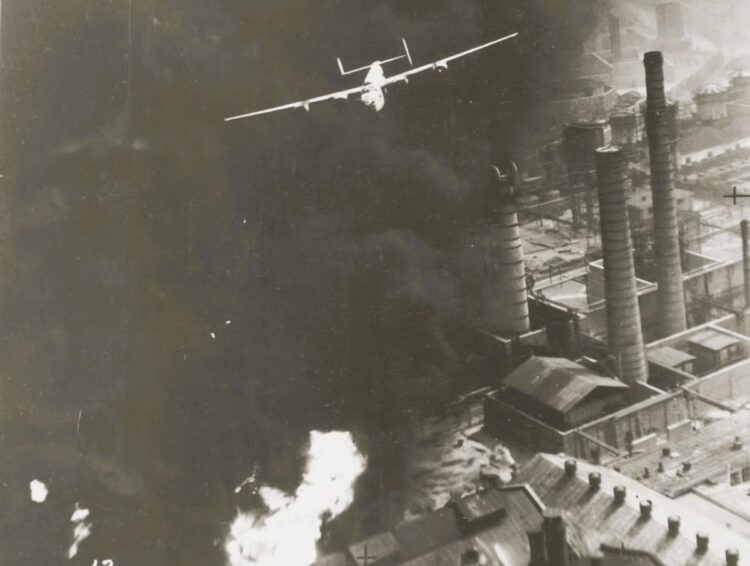
The September 30 mission was not merely a long-range strike; it was the longest daylight bombing operation ever flown by American B-24 Liberators in any theater of the Second World War. To properly understand its scale, one must look to the European theater for comparison. If the August 1943 Operation Tidal Wave raid on Ploiești, Romania — those heavily defended oil fields at Ploiești, Romania that chewed up 178 Liberators and spat out 54 of them — serves as the canonical example of the heavy bomber war’s terrible price, then Balikpapan is its Pacific twin. Ploiești has been immortalized in books, documentaries, and public memory. The daylight strikes on Balikpapan remain unsung, unremembered, and every bit as ferocious.
The strategic logic was unassailable, driven by the relentless operational tempo of General George C. Kenney, commanding the Far East Air Forces. Kenney’s intelligence officers recognized that the Japanese military was already exhibiting localized, debilitating fuel shortages following earlier Allied interdiction campaigns. Denying Japan the specialized output of Balikpapan would ground fighter interceptors, stall naval fleet deployments, and critically cripple the empire’s ability to defend the Philippine archipelago against General Douglas MacArthur’s impending invasion. The Japanese high command, fully aware of the refinery’s value, had consciously preserved their dwindling aviation assets specifically for the defense of such critical infrastructure. The airspace over Borneo was not unguarded. It was a hornet’s nest.
Balikpapan’s significance had a long, bloody history. The industrial complex — a dense labyrinth of cracking plants, distillation towers, and sprawling oil storage tank farms — had been a focal point of conflict since the earliest days of the Pacific War. When Japanese forces swept southward in early 1942, retreating Dutch colonial forces attempted to sabotage the refineries, but Japanese engineers quickly restored full operational capacity.
The USAAF’s relationship with Balikpapan began in desperation. During the chaotic and ultimately losing Java campaign in the first months of 1942, three early-model LB-30 Liberators — an export variant of the B-24 — of the 11th Bombardment Squadron, 7th Bombardment Group, struck the complex in a futile, heroic effort to stem the Japanese tide. As the Allies slowly clawed their way back across the Southwest Pacific, Balikpapan remained a high-priority target safely tucked behind thousands of miles of hostile ocean.
In August 1943, the 380th Bombardment Group — the “Flying Circus,” operating in considerable obscurity from rudimentary bases near Darwin, Australia — executed a daring, 17-hour, 2,600-mile round-trip night raid against the refineries. Launching with heavy overloads of fuel and 500-pound demolition bombs, the 380th proved that the target could be reached, sparking massive fires across the Pandansari facility. The group became a recurring, if intermittent, visitor to Borneo throughout late 1943 and early 1944. But night bombing via dead reckoning and early radar lacked the pinpoint precision required to permanently dismantle heavily reinforced steel cracking plants and specialized distillation towers. To definitively cripple Balikpapan, FEAF planners determined that a mass, coordinated daylight strike was an absolute necessity.
The nickname “Ploiești of the Pacific” was not applied by rear-echelon public relations officers. It was coined by the bomber crews themselves — a title earned in blood and aviation fuel, validated by the lethal combination of fighter attacks, flak barrages, and blinding industrial smoke that defined the contested airspace over Pandansari.
On Paper, Impossible

Executing a daylight strike on a target 1,243 miles away required overcoming logistical and aerodynamic hurdles that defied standard USAAF doctrine. The operation was organized primarily by Major General St. Clair Streett’s Thirteenth Air Force in coordination with Fifth Air Force, utilizing the newly captured Kornasoren Airfield on Noemfoor as the primary staging ground. Three highly decorated bomb groups were slated for the assault: the Fifth Air Force’s 90th BG “Jolly Rogers,” alongside the Thirteenth Air Force’s 5th BG “Bomber Barons” and the 307th BG “Long Rangers.”
The primary adversary, long before a Japanese fighter was encountered, was raw weight. The B-24 Liberator, powered by four reliable but fuel-hungry Pratt & Whitney radial engines, could not safely accommodate the gasoline required for a 2,600-mile round trip alongside a meaningful bomb load and its standard defensive armament. The bomber’s empty weight ran approximately 32,505 pounds, with a standard maximum loaded weight originally pegged at 56,000 pounds, later pushed to 64,250 pounds in theater modifications. To make Balikpapan a reality, aircraft launched weighing 12,000 to 13,000 pounds heavier than their recommended maximum load.
The solution was a masterclass in calculated, terrifying risk. The two air forces approached the weight problem differently, and those differences would have lethal consequences over the target. The Thirteenth Air Force stripped their ammunition loads to a mere 40 percent of normal capacity — accepting severe defensive vulnerability in exchange for fuel range. The Fifth Air Force took an even more visceral approach: mechanics unbolted and removed the heavy steel armor plating protecting the crew from shrapnel, and physically extracted the lower ventral ball turrets entirely, while retaining full ammunition loads for the remaining guns.
These modifications altered the aircraft’s center of gravity and severely compromised its defensive sphere. The belly of each Fifth Air Force B-24 was left completely blind and unprotected — a fatal vulnerability that Japanese interceptors would later exploit with deadly, practiced efficiency. Bomb loads were similarly restricted; while a B-24 could theoretically carry up to 8,000 pounds of ordnance over short distances, the Balikpapan raiders carried significantly reduced payloads to accommodate massive auxiliary fuel tanks installed in the bomb bays themselves.
As Lieutenant Lance stated with characteristic pilot brevity: “The trouble was it was just so damned far that you couldn’t carry a full bomb load. We had the maximum gasoline load you could put into the planes.” Beyond the physical modifications, crews were issued rigid cruise-control charts dictating exact power settings, manifold pressures, fuel-transfer timing sequences, and even the physical position of aircrew members within the fuselage during each phase of the nine-hour transit to squeeze every possible yard from their fuel. A minor navigation error, an unexpected tropical headwind, or a single punctured fuel line meant a lonely, silent death in the ocean.
Three Groups, One Sky
The launch from the single runway at Noemfoor just after midnight was a breath-holding undertaking. Heavily laden bombers, groaning under the strain of their fuel overloads, staggered off the coral strip one after another, their engines laboring against the dense, humid tropical air. The complex flight plan required the three groups to navigate independently through the pitch-black night, battling severe and turbulent weather fronts before assembling in daylight for the final, massed run to the target.
Because of the extreme distances, the complete absence of fighter escort, and the varying weather conditions encountered en route, the staggered nature of the flight resulted in the three groups arriving over Borneo in a disjointed, sequential wave rather than a single, overwhelming armada. This lack of massed formation robbed the B-24s of their mutually supporting, interlocking fields of machine-gun fire, permitting the Japanese defenders to reset, rearm, and attack each American group individually as they arrived.
After approximately nine grueling hours and 1,243 miles of over-water flying, the 5th BG “Bomber Barons” arrived at the designated rendezvous point, leading the assault with a force of 23 Liberators. The element of surprise had evaporated long before they reached the Borneo coast. At a distance of 250 miles out, two Japanese fighters intercepted the lead formation, shadowing the bombers from a safe distance and radioing their altitude, heading, and speed back to the defense command at Balikpapan. By the time the Bomber Barons reached the Pandansari refinery complex, a formidable swarm of 30 fresh, fully armed Japanese fighters was waiting.
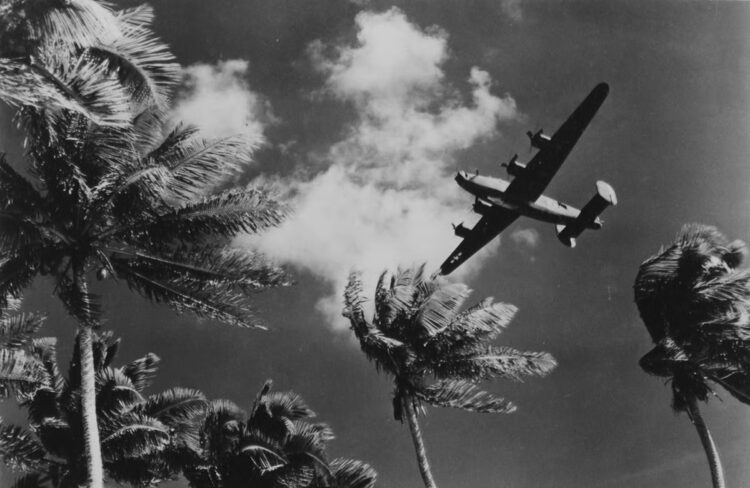
The ensuing aerial combat was savage and unforgiving. The Japanese pilots quickly recognized the absence of ventral defenses on the Fifth Air Force bombers — those removed ball turrets now a catastrophic liability — and exploited it with aggressive climbing attacks, raking the exposed bellies of the B-24s with 20mm cannon fire. The Bomber Barons fought through the gauntlet in tight formation, dropped their ordnance on the refinery installations, and pressed home the attack despite the odds. But the cost was immediate and severe. Three Liberators of the 5th BG were shot out of the sky directly over the target, spiraling downward into the jungle canopy and the Makassar Strait.
Just five minutes behind the Bomber Barons, the 23 Liberators of the 307th BG “Long Rangers” arrived in the target area. By this time, the element of surprise was entirely gone, the Japanese fighter screen was fully mobilized and blooded, and the atmospheric conditions had deteriorated drastically. The refinery was now cloaked not only by dense tropical cloud cover but by the billowing, oily black smoke generated by the 5th BG’s initial bomb hits and the Japanese defenders’ activated smoke generators. Unable to acquire the primary target visually, seven of the Long Rangers’ B-24s were forced to bomb blindly by radar; the remaining aircraft dropped their payloads into the murk by dead reckoning, hoping for a lucky strike.
When the 90th BG “Jolly Rogers” finally arrived to deliver the third and final blow of the day, the situation had devolved into near-total chaos. The target area was completely blanketed by an impenetrable mix of smoke and weather. The fighter screen that had slaughtered the lead elements was still airborne, darting through the clouds to harass exhausted stragglers. Finding no viable visual reference points and facing aggressive interception, the Jolly Rogers were forced to abort their primary run. Only a single squadron managed to release its bombs through a fleeting break in the overcast.
Crews who had just endured over nine hours of deafening engine noise, numbing vibration, and freezing altitudes in unpressurized, unarmored metal tubes were forced to fight through a heavily contested sky on critically reduced fuel margins. Every evasive maneuver consumed precious gallons of the gasoline required for the nine-hour flight home. The September 30 mission proved that Balikpapan could be reached in daylight; it also proved that the Japanese were willing and able to extract a horrific toll.
Over the Target: Earning the Moniker
If the September 30 mission was a brutal introduction to Balikpapan’s layered defenses, the return visit on October 3, 1944, was the fiery crucible that cemented the target’s legendary status. Recognizing the partial failure of the first strike due to weather and obscuring smoke, FEAF commanders ordered the bombers back into the breach just three days later.
The 307th BG “Long Rangers” returned with 20 Liberators aimed directly at the Pandansari refinery. This time, the Japanese defenders were not merely waiting; they were aggressive, highly organized, and deeply motivated. Hostile fighters ascended rapidly from a newly constructed, previously undetected airstrip situated strategically between the Manggar airdrome and the Balikpapan port, ambushing the Americans just as they commenced their straight-and-level bomb runs.
For one hour and fifteen minutes, a massive force of 30 to 40 Japanese aircraft pressed relentless, coordinated attacks against the Long Rangers’ tight formation. The sky over Borneo devolved into a chaotic swirl of tracers, exploding heavy flak, and burning aircraft. The Japanese fighters tore into the bombers, exploiting their reduced ammunition loads and capitalizing on their inability to maneuver evasively while locked onto the target.

The Long Rangers held their nerve with astonishing discipline, dropping their bomb loads precisely into the oil complex. The attrition was staggering: five Liberators were shot down in flames, representing a catastrophic 25 percent loss rate for the attacking force — a figure that mirrored the worst days of the air war over Germany. Some subsequent unit records and historical citations suggest up to seven Liberators were lost or damaged beyond repair during this specific engagement, a figure that underscores the ferocity of the defense. The embattled bomber gunners claimed 19 Japanese fighters destroyed in return.
The sheer intensity of the 75-minute running battle, the visual horror of shattered B-24s falling from the sky, and the strategic weight of the target coalesced permanently in the minds of the surviving crews. It was specifically after this second, devastating mission that “Ploiești of the Pacific” entered the vocabulary of Pacific aircrews as permanent fact. The label was not bestowed lightly by observers in the rear; it was earned in the cockpit, validated by the empty bunks in the humid barracks back at Noemfoor.
The catastrophic losses on October 3 fundamentally altered FEAF’s operational doctrine. The mathematics of flying stripped bombers without fighter protection into heavily defended airspace were no longer deemed acceptable by command. From that point forward, General Kenney mandated that drop-tank-equipped P-38 Lightnings and P-47 Thunderbolts must accompany every subsequent daylight mission to Balikpapan. The era of the unescorted, ultra-long-range daylight bomber strike in the Southwest Pacific had ended in the smoke above Borneo.
The Cost and the Strategic Reckoning
Stepping back from the immediate trauma of the combat reveals a strategic payoff that fundamentally altered the trajectory of the Pacific War. The raids did not achieve instant, absolute destruction of the facilities — Japanese engineers were adept at patching pipelines and rerouting production — but the cumulative attrition proved decisive. Relentless strikes against Pandansari and the neighboring Edeleanu refinery throughout late 1944 severely curtailed Japan’s vital supply of high-octane aviation fuel and lubricating oils. General Kenney noted in intelligence reports that Japanese fighter units encountered in subsequent campaigns over the Philippines and Formosa were noticeably restricted by fuel shortages — a direct, measurable strategic effect of the Borneo strikes. By denying the Japanese military the fuel required to train new pilots and launch massed interceptions, the B-24 crews had effectively grounded a significant portion of the enemy’s remaining air power.
The Balikpapan campaign spanned the entirety of the war, beginning with the desperate LB-30 raids of early 1942, escalating with the 380th BG’s night strikes in 1943, and peaking with the massive USAAF daylight assaults of late 1944. The ultimate objective was to neutralize the region in preparation for the Allied invasion of Borneo — Operations Oboe One, Two, and Six.
In this final decisive phase, the Royal Australian Air Force assumed a leading role. As American heavy bomber units were shifted northward to support the assault on the Japanese home islands, the RAAF’s Liberator squadrons took up the mantle over the Netherlands East Indies. RAAF B-24s, operating under 82 Wing — comprising Nos. 21, 23, and 24 Squadrons — and 85 Wing — comprising Nos. 12, 99, and 102 Squadrons — alongside No. 25 Squadron, conducted relentless strikes against Balikpapan, Labuan, and Tarakan. In July 1945, RAAF Liberators heavily bombed the Balikpapan defenses in direct preparation for the Australian 7th Division’s amphibious landings, ensuring the Japanese garrison could not rely on local fuel reserves for mechanized counterattacks.
The aggregate tonnage tells its own story: Thirteenth Air Force bombers alone dropped 61,929 tons of bombs in the Pacific theater, with the Borneo strikes representing some of their most vital, war-shortening work.
Why History Forgot
If the strategic impact of the Balikpapan raids was so decisive and the combat as harrowing as the legendary European strikes, why does the American public remain largely ignorant of the Pacific B-24 force? The erasure of these men from popular memory is not accidental. It is the result of a confluence of cultural bias, brutal geography, and fragmented military organization.
The B-24 Liberator suffered from a systemic, decades-long public relations deficit, living entirely in the shadow of the Boeing B-17 Flying Fortress. The B-17 possessed a distinct aesthetic elegance and benefited from early, highly publicized campaigns in the European theater. Journalists and film crews based in England had easy access to Eighth Air Force bases, cementing the Flying Fortress’s image in the American public consciousness.

That cultural dominance was illustrated starkly in a 1995 marketing survey commissioned to determine the most recognizable aircraft in history — the campaign that ultimately produced “B-17 Steak Sauce.” The survey found the B-17 ranked at the very top of public recognition, ahead of the Douglas DC-3, the Supermarine Spitfire, and the Boeing 747. The B-24 Liberator did not appear on the list. This historical amnesia persists despite the objective industrial reality: the United States manufactured 19,276 Liberators — more than any other American combat aircraft in history, outpacing the B-17’s 12,731 and dwarfing the Avro Lancaster’s 7,366. The Liberator carried more bombs, flew faster, and possessed far greater range than the B-17, making it the inherently superior instrument for the vast oceanic distances of the Pacific. It never captured the cultural imagination regardless.
The brutal conditions of the Pacific theater actively discouraged the glamorization and retrospective record-keeping that characterized the air war over Europe. The Pacific was a theater of malaria, oppressive heat, rotting jungle bases, and agonizing isolation. Harry Eberheim, a gunner with the 86th Combat Mapping Squadron who flew in the region, summarized the psychological reality with painful precision: “I have always felt that because of the heat, health conditions, food and living conditions being so hard on one’s body that we all just wanted to get it over with and go home. There was absolutely no glamour attached to service in the Pacific.” The men who survived the brutal long-range missions over open water simply wanted to forget the trauma and return to civilian life, leaving their stories largely untold.
Finally, the Pacific B-24 narrative was fatally fragmented. Unlike the Eighth Air Force in England, which provided a unified, geographically concentrated focal point for the press, Pacific B-24 operations were scattered across four distinct numbered air forces — the 5th, 7th, 11th, and 13th, later operating under the FEAF umbrella — across a theater that consumed a major proportion of the planet. There was no single iconic operation neatly packaged for public consumption that anchored the memory of the Pacific Liberator force the way Ploiești anchored the B-24 story in Europe. The Balikpapan raids, despite their immense scale and staggering cost, were swallowed by the vastness of the Pacific and the relentless progression of the island-hopping campaign.
The Flight Line, Full Circle
The legacy of the Balikpapan raids is not defined by the accolades of history books or the recognition of the broader public. It is defined by the cold, unforgiving reality of what happened on the flight line at Noemfoor.
To truly understand the Pacific B-24 force is to visualize those stripped-out Liberators rolling down the single coral runway in the predawn dark of September 30, 1944. Inside those vibrating aluminum hulls sat men who knew the mathematics of their survival were marginal at best. They carried the absolute maximum in fuel, the absolute minimum in armor, and every ounce of courage they possessed. They flew the longest daylight bombing mission of the Pacific War — navigating 1,243 miles of tightrope over unforgiving seas — to strike a target that was vital to the destruction of the Japanese empire. They did so in an aircraft their own country could not be bothered to remember, fighting a battle the history books have not yet properly found.
Their sacrifice remains an indelible, if largely unseen, cornerstone of the Allied victory. Quiet, precise, and permanent.

Key Takeaways
- The September 30, 1944, B-24 raid on Balikpapan, Borneo, was the longest daylight bombing mission ever flown in the Pacific War — a 1,243-mile one-way flight in aircraft stripped of armor and ball turrets, carrying maximum fuel loads and reduced bomb payloads.
- Three bomb groups — the 90th BG “Jolly Rogers,” 5th BG “Bomber Barons,” and 307th BG “Long Rangers” — assaulted Japan’s second-largest petroleum complex; the October 3 follow-up raid, in which the Long Rangers lost up to five Liberators against 30–40 Japanese fighters over 75 minutes, earned Balikpapan the permanent crew-coined nickname “Ploiești of the Pacific.”
- The B-24 Liberator, produced in greater numbers than any U.S. combat aircraft in history (19,276 built, versus 12,731 B-17s), remained systematically overlooked in wartime public memory and postwar history, overshadowed by the Boeing B-17 Flying Fortress.
- Pacific theater B-24 crews operated across five numbered air forces in conditions of extreme heat, disease, and geographic isolation — factors that discouraged glamorization at the time and historical recovery afterward.
- The cumulative Balikpapan campaign — from the desperate LB-30 raids of early 1942 through RAAF strikes by Nos. 21, 23, 24, 12, 99, 102, and 25 Squadrons in 1945 — contributed to the fuel shortages that measurably hampered Japanese air operations in the final year of the Pacific War, helping pave the way for the Allied invasion of Borneo.