


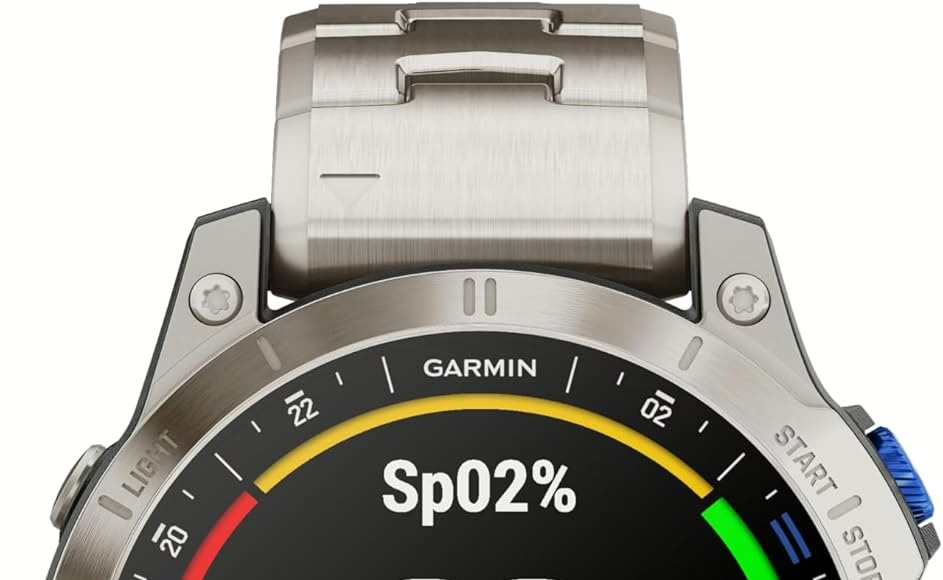

The pilot watch market is packed with gadgetry and romance — but only a few models actually earn their place on your wrist and in the cockpit. Here’s how to find yours.
More Than a Fashion Statement
Is the watch on your wrist a genuine cockpit tool, or just a very expensive accessory that looks impressive at the FBO? It’s a fair question — and one pilots have been wrestling with since 1907, when Brazilian aviator Alberto Santos-Dumont asked his friend Louis Cartier to build a wristwatch he could actually read while flying. The result, the Cartier Santos, became the world’s first truly practical pilot’s wristwatch. Not long after, in 1915, Gaston Breitling introduced the first wristwatch chronograph with an independent pusher separate from the crown — the monopusher design that laid the groundwork for every modern pilot chronograph. By 1969, Buzz Aldrin was wearing the Omega Speedmaster on the Moon during Apollo 11, cementing the pilot’s watch as both working instrument and cultural icon. (Neil Armstrong, for what it’s worth, left his Speedmaster inside the Lunar Module as a backup timer after the LM’s electronic timer malfunctioned — not a bad argument for always wearing your watch.)
Today, the market has exploded in ways Santos-Dumont could never have anticipated. With approximately 50-plus manufacturers and hundreds of models targeting pilots, and the aviation watch market valued at approximately USD 1.2 billion in 2024, choosing the right one has become genuinely complicated. Add GPS-enabled aviation smartwatches into the mix — devices with moving maps, NEXRAD weather overlays, pulse oximeters, and Direct-To navigation — and the central question sharpens: Do you need an aviation smartwatch, or is it just a prettier watch with more buttons?
This guide cuts through the noise. We’ve broken down the features that actually matter, identified the best picks from $35 to $2,400 and beyond, and mapped out exactly how to match a watch to your specific flying profile.
What Does an Aviation Smartwatch Actually Do?
Let’s be direct about something upfront: most cockpits already have panel-mounted GPS, timers, and comm radios. So what exactly does a wrist-worn device add to the equation?
The short answer is: it depends on how you fly. A traditional pilot’s watch — analog chronograph, mechanical movement, E6B slide rule bezel — gives you manual calculation capability and a measure of timeless cool. A modern aviation smartwatch gives you a built-in GPS moving map, NEXRAD radar weather overlay, METAR/TAF weather reports, a worldwide airport database, automatic flight logging, and a pulse oximeter that can detect early signs of hypoxia. The honest reality is that few pilots actually use a wrist timer during an instrument approach. As one airline pilot put it: “When I’m on the approach, my head doesn’t move, just my eyes.” Most pilots use their watch indirectly — as a tank timer, for total flight time, or as a backup to panel avionics.
Where aviation smartwatches genuinely earn their place is in three areas: as situational awareness backups (the Pulse Ox feature is particularly relevant, given that the FAA requires supplemental oxygen above 12,500 feet MSL for more than 30 minutes, and at all times above 14,000 feet MSL — and a Pulse Ox reading below 92% indicates possible hypoxia); for pre- and post-flight utility such as weather briefings, airport information, and automatic logbook entries; and for daily ground use including fitness tracking, navigation, and smartphone notifications. The category now ranges from sub-$100 digital workhorses to the Garmin D2 Mach 1 Pro at $1,399.99, with genuine pilot utility available at every tier.
The Feature Checklist — What to Look For
No single watch has every feature worth having. The goal is to identify which features match your actual flying profile. Here’s what to evaluate before you commit to anything:
- Display type: Analog, digital, or combination. The key is readability in direct sunlight and cockpit glare. Transflective LCD displays leverage ambient light for outdoor readability; a high-brightness AMOLED screen (1,000 nits or better) is competitive in direct sunlight and superior in low-light conditions. Confirm your chosen watch’s peak brightness spec before buying..
- Color contrast: White-on-black vs. black-on-white. If you can’t read it while bouncing around in turbulence, it fails its primary job.
- Digit size: Digits under 4 mm are genuinely difficult to read in poor light or turbulence. The Casio G-Shock’s 4.5 mm digits represent a practical minimum.
- GPS integration: Built-in GPS (like the Garmin D2 series) vs. connected GPS via smartphone. Built-in is more reliable and independent in the cockpit.
- Moving map/aviation database: Airspace overlays, airport frequencies, runway data, and TFRs. The Garmin D2 series includes a worldwide aeronautical database with this full suite.
- Altimeter: Barometric vs. GPS-derived. Barometric is far superior — sensitivity of approximately 10 cm vs. GPS vertical accuracy of only ±45 meters. GPS-derived altitude can show 500 to 1,000 feet of difference from barometric at typical flying altitudes. Aircraft use barometric altimeters as the FAA-mandated primary standard for good reason. On your wrist, barometric is strongly preferred.
- Compass: Magnetic vs. GPS-based heading. Know which type your watch uses and its limitations.
- Multiple time zones / UTC display: Non-negotiable for IFR pilots and cross-country flying. A selectable 12/24-hour display is essential.
- Countdown timer / count-up stopwatch: For tank switching, approach timing, and flight time tracking.
- Alarms: Fuel tank reminders and airspace alerts.
- E6B-type slide rule bezel: Sounds impressive; often impractical in the cockpit. Research on the Seiko Flightmaster confirms “the printing is just so small that an actual pilot really just couldn’t use this watch” for slide-rule calculations. The Breitling Navitimer addressed this with a beaded bezel designed for manipulation with gloved hands, but numbers remain small on most sub-$1,000 models.
- Battery life: The G-Shock runs approximately five years on a single CR2016 cell. GPS modes drain power aggressively — the Garmin D2 Mach 1 Pro drops from 25 days in smartwatch mode to just 46 hours in active Fly mode. Know your maintenance commitment before buying.
- Water resistance: The G-Shock is rated 200m/20 ATM; the Garmin D2 Mach 1 Pro is 10 ATM.
- Durability/case material: Plastic, steel, titanium. The Garmin MARQ Aviator Gen 2 uses Grade-5 titanium throughout; the Mach 1 Pro pairs a titanium bezel with DLC coating to a fiber-reinforced polymer case.
- Connectivity: Bluetooth, Wi-Fi, ANT+, smartphone pairing. Confirm EFB app compatibility with your existing ecosystem before buying.
- Pulse Ox/health monitoring: A wrist Pulse Ox reading below 92% indicates possible hypoxia — a potentially life-saving feature, not a fitness marketing gimmick.
- Appearance: Because you will wear it to dinner too.
Precision reality check: A standard mechanical watch varies ±20 to ±40 seconds per day — roughly 4.7 minutes per week at worst. A standard quartz movement varies about ±15 seconds per month, or approximately 3.5 seconds per week. A GPS-locked movement is as accurate as the satellite constellation itself.
Our Top Picks — Aviation Smartwatches for Every Budget
With hundreds of models on the market, narrowing the field requires equal parts data and hard-earned pragmatism. The following picks represent the high notes across distinct price tiers.
Tier 1: Best Budget Pick — Under $100
Casio G-Shock DW-5600 (DW5600E-1V)
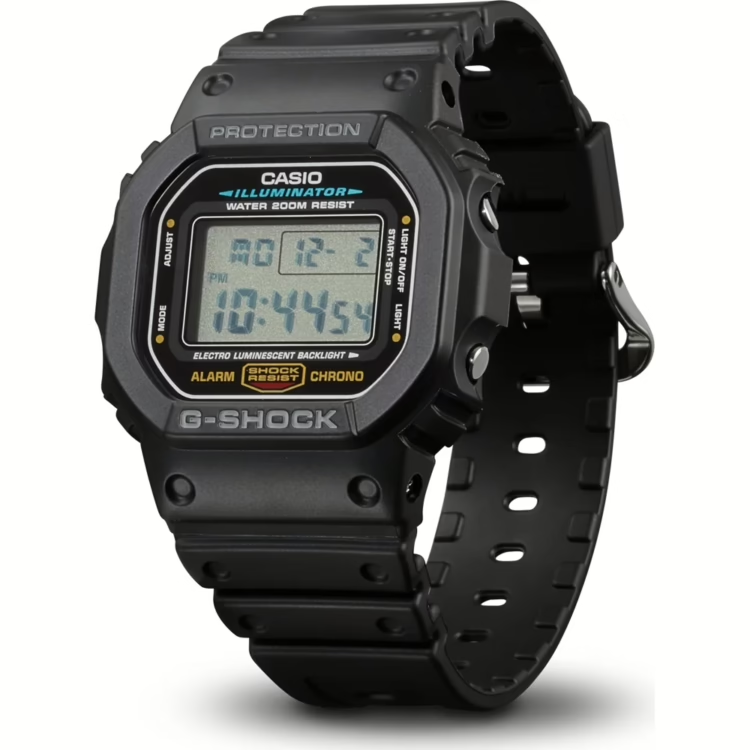
The G-Shock isn’t going to win any beauty contests. It’s a square black plastic box that looks exactly like what it is: a near-indestructible digital watch that will likely outlast your airplane’s avionics stack. The updated 2023 module 3525 (which replaced the older 3229) delivers a stopwatch, countdown timer, multi-function alarm, flash alert, and 12/24-hour format, all housed in a 42.8 × 48.9 × 13.4 mm case that weighs just 52 grams. Water resistance is rated at 200m/20 ATM. Battery life is approximately five years on a single CR2016 cell.Note that G-Shock U.S. bumped the price from $74.95 to $99.95 in 2025 with the introduction of the DW-5600UE-1 and module 3525, though the watch is typically available at a meaningful discount on Amazon. No GPS, no moving map, no Bluetooth — just a supremely readable 4.5 mm digit display and the kind of reliability that makes it the utility vehicle of pilot timepieces.
Tier 2: Best Mid-Range GPS Aviation Smartwatch
Garmin D2 Air X10
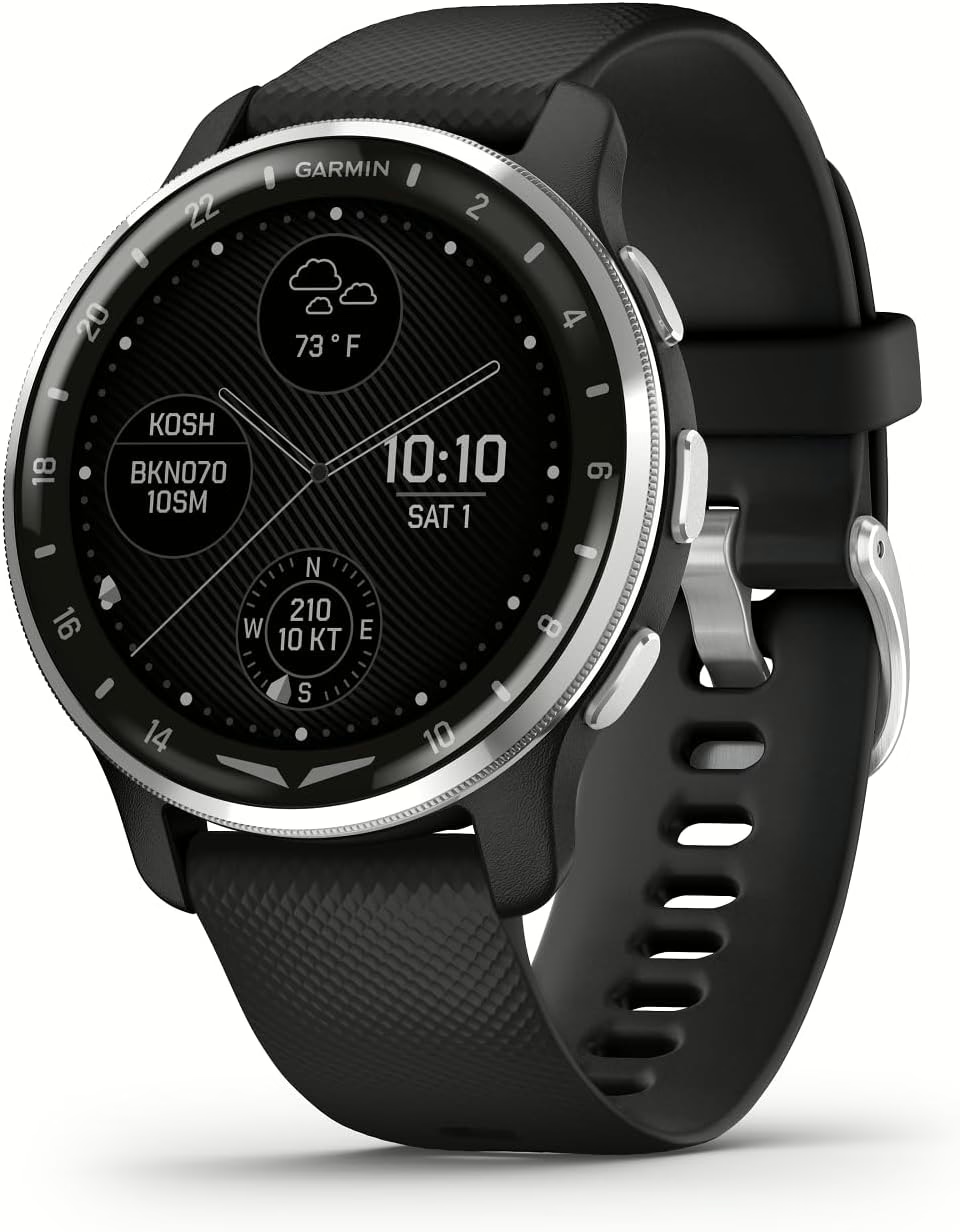
This is where the aviation smartwatch category begins to justify its presence in the cockpit in a meaningful way. The D2 Air X10 pairs a 1.3-inch AMOLED touchscreen (416 × 416 pixels) protected by Corning Gorilla Glass 3 in a 43.6 × 43.6 × 12.6 mm case weighing 51 grams. Battery runs to 7 days in smartwatch mode, 24 hours with GPS active, or 10 days in battery-saver mode. Aviation features include METAR/TAF weather, Direct-To navigation, a comprehensive airport database covering frequencies and runways, automatic flight logging, and an HSI mode. Health monitoring covers Pulse Ox (SpO2), heart rate, stress, and sleep tracking. Connectivity includes Bluetooth, Wi-Fi, and native Garmin Pilot app compatibility. Add 25-plus built-in sports apps and music storage, and this watch works as hard off the airport as it does on it.
Tier 3: Best Premium Aviation Smartwatch
Garmin D2 Mach 1
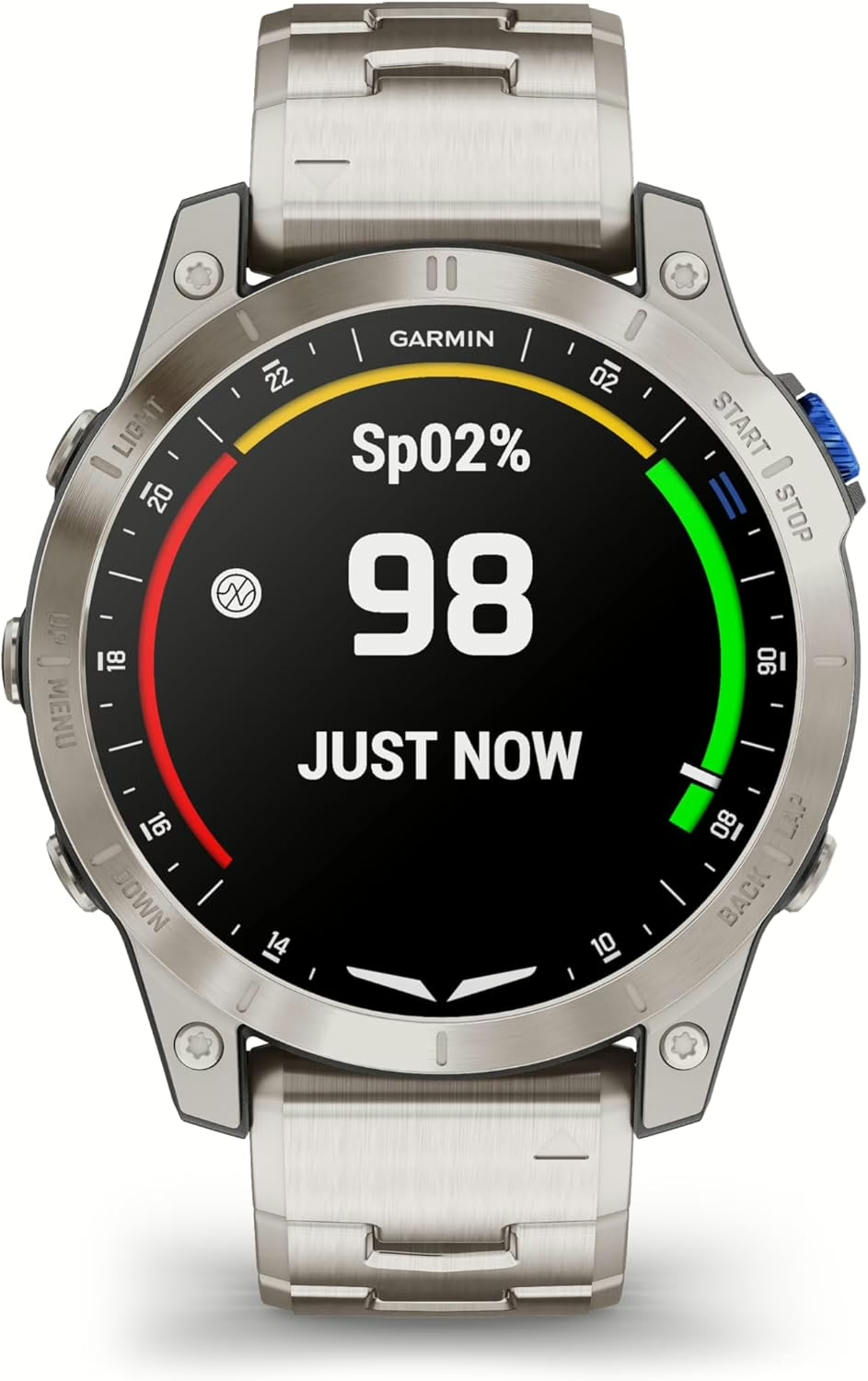
The D2 Mach 1 steps up with a 1.3-inch AMOLED touchscreen protected by sapphire crystal, a titanium bezel over a polymer case with a stainless steel rear cover, and an 11-day smartwatch battery. The aviation feature set expands meaningfully: a color moving map with NEXRAD radar overlay, a worldwide airport database, custom aviation alerts for crosswind and density altitude, a meteogram, emergency navigation mode displaying nearest airport and glide information, and automatic flight logging to flyGarmin.com. It also integrates with Garmin’s inReach satellite communicator for SOS capability.
Garmin D2 Mach 1 Pro
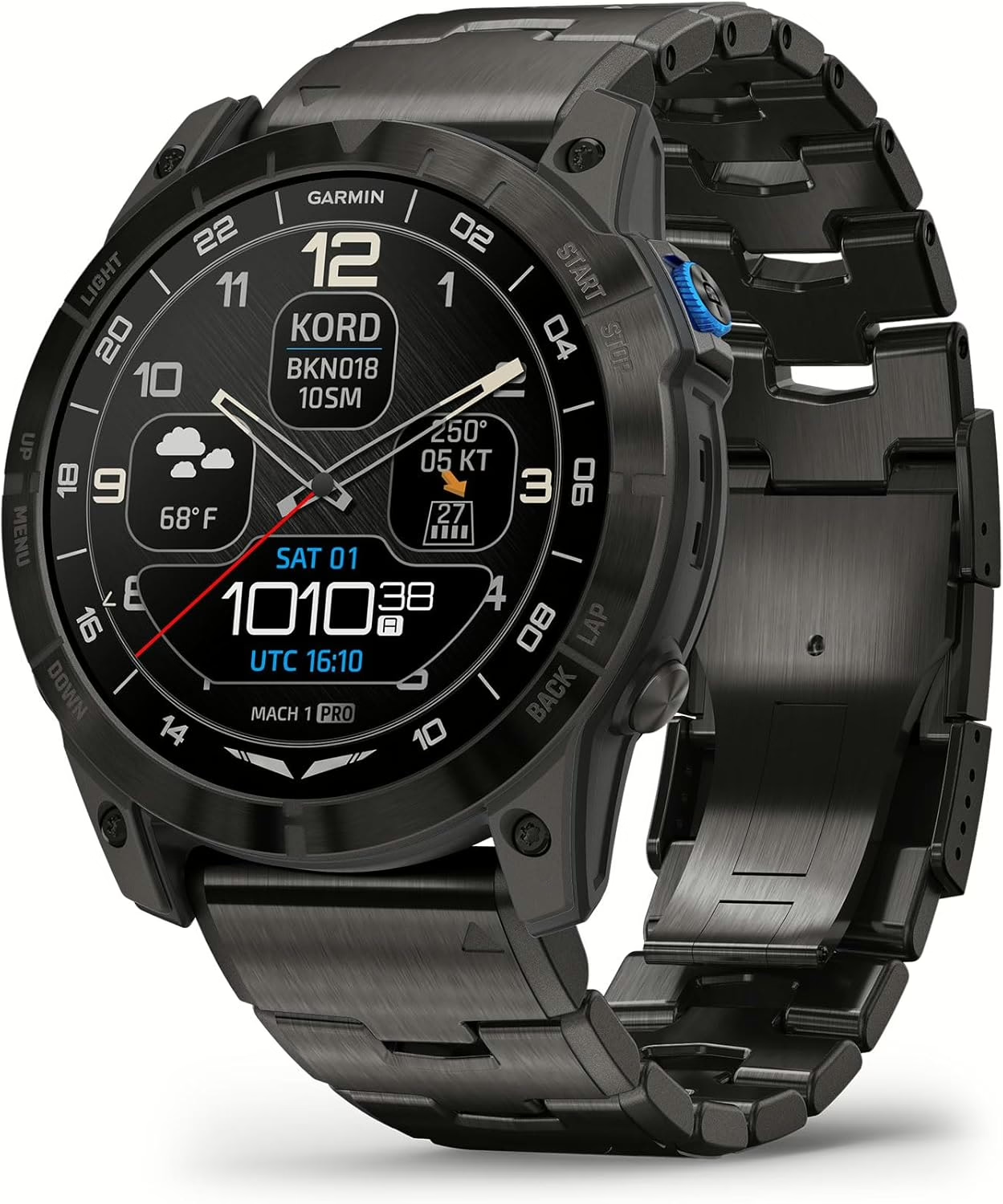
The Pro adds a larger 1.4-inch AMOLED screen (454 × 454 pixels), a 51mm titanium bezel with diamond-like carbon (DLC) coating, and a headline feature that pilots flying at night will immediately appreciate: a built-in LED flashlight with variable white light and a red-light mode specifically engineered for night-vision preservation. Battery life extends to 25 days in smartwatch mode, though it drops to 46 hours in active Fly mode — plan accordingly. The Pro also introduces Red Shift Mode (the entire interface goes red for night flying), an ECG app, and 10 ATM water resistance. Fully kitted with the titanium bracelet, it weighs 126 grams. This is a serious piece of cockpit hardware.
Tier 4: Best Luxury Aviation Smartwatch
Garmin MARQ Aviator Gen 2
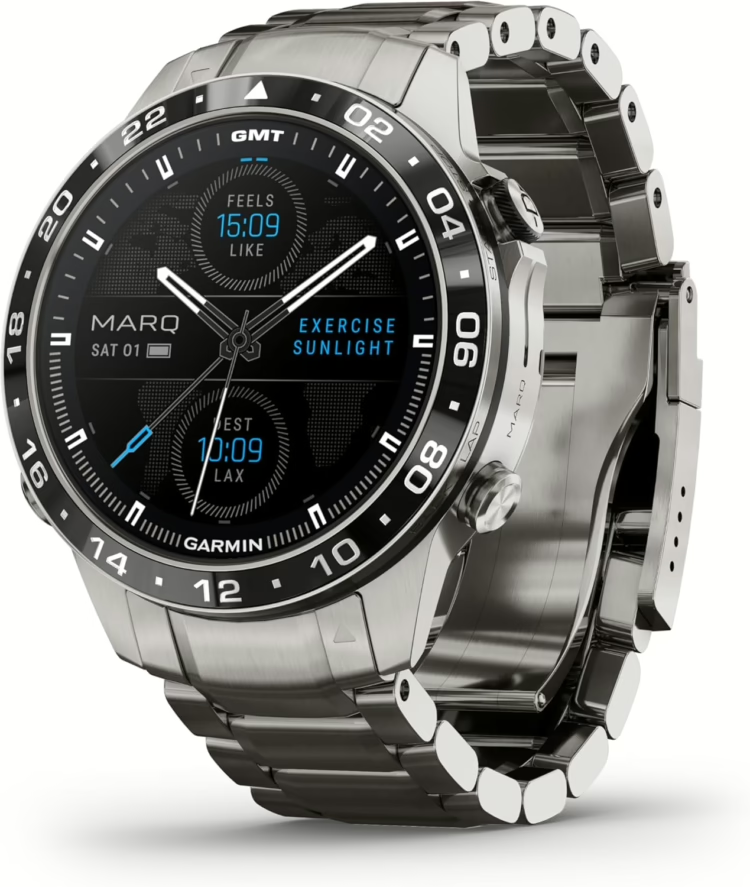
The MARQ Aviator Gen 2 occupies the summit of the functional aviation smartwatch category. The 46mm case and swept-wing bracelet are Grade-5 titanium throughout. The AMOLED touchscreen sits behind sapphire crystal. Battery runs to 16 days in smartwatch mode and 42 hours with GPS active. Aviation features include a worldwide aeronautical database, Direct-To emergency navigation, NEXRAD weather radar, and full Garmin avionics integration. Positioning is handled by multi-frequency GNSS with SatIQ technology. Onboard sensors include a barometric altimeter, compass, gyroscope, accelerometer, thermometer, ambient light sensor, and Pulse Ox. At $2,400, the MARQ Aviator is as much a precision instrument as it is a watch.
Tier 5: Premium Heritage Mechanical
The luxury mechanical segment is populated by names that need no introduction. Breitling Navitimers run $3,800 to $35,000 new (B01 Chronograph models: approximately $7,500 to $16,500, steel to gold) — the same circular slide-rule bezel that led AOPA to adopt the Navitimer as its official timepiece in 1954. IWC Pilot Chronographs start from $4,323; the IWC Big Pilot from $6,981 with a 46mm case and a seven-day power reserve. The Omega Speedmaster Moonwatch — “the first watch worn on the Moon” — runs approximately $6,000 to $8,000-plus for the manual-wind version. The Rolex GMT-Master II, with its dual-time-zone Cerachrom bezel, starts at $10,000 and climbs past $20,000.
Before falling in love with the romance of a mechanical movement, run the maintenance math: an official Breitling Navitimer service runs $1,100 to $1,300 every four to six years — roughly 14 to 17 percent of the steel model’s purchase price. Over a 20-year ownership period, maintenance costs can approach or exceed the original purchase price. An official Rolex GMT-Master II service runs $900 to $1,200 every five to ten years.
For pilots who want genuine aviation functionality without the heritage premium, the Citizen Promaster Navihawk (~$400–$650) deserves serious consideration: Eco-Drive solar charging, atomic timekeeping, a slide-rule bezel, sapphire crystal, 200m water resistance, a full chronograph, and 26 time zones.
Pitfalls and Common Mistakes to Avoid
A few traps catch even experienced buyers:
- The readability trap. Watch faces with silver hands over white sub-dials can be impossible to read at a glance. Always check dial contrast in real light before buying — if you can’t read it in your living room, you won’t read it at 6,000 feet in the bumps.
- The digit size trap. Digits under 4 mm are difficult to read in poor light or turbulence. The Casio G-Shock’s 4.5 mm digits are the practical minimum.
- The battery life trap. Some older quartz models need a battery change every 18 months. GPS-enabled watches like the Garmin D2 Mach 1 Pro swing from 25 days in smartwatch mode to just 46 hours in active Fly mode. Know your maintenance reality before you commit.
- The complexity trap. Some multi-function watches are genuinely difficult to operate without the manual at hand. One pilot owner admitted, “I don’t use the functions often enough to remain knowledgeable about how to use them.” If a watch requires a tutorial to set the alarm, it will fail you at the worst possible moment.
- The slide rule trap. An E6B bezel sounds impressive; in practice, it often isn’t. Research confirms the printing is typically too small to use reliably in flight, and the ring is too difficult to turn in most sub-$1,000 models. The Breitling Navitimer’s beaded bezel helps, but it’s still not a solution for most cockpit environments.
- The maintenance cost trap. For mechanical watches, the purchase price is just the beginning of the financial relationship. Factor in the overhaul cycle — up to $1,300 per Breitling Navitimer service — before you commit to the romance of a hand-wound chronograph.
How to Choose the Right Aviation Smartwatch for You
Six steps stand between you and the right watch:
- Define your primary use case. Are you wearing it primarily in the cockpit (tank timer, time zone tracking, Pulse Ox backup), or is the cockpit just one context in a broader daily use case? Most pilots use their watch indirectly in flight — not as a primary instrument.
- Set your budget honestly. Genuine utility exists at every tier from $35 to $2,400 and beyond. Decide your ceiling before you fall in love with a MARQ Aviator.
- Prioritize readability above everything else. Hold the watch. Operate the buttons. Check the dial in moderate light. If you can’t read it quickly and easily at your kitchen table, you won’t read it at altitude in turbulence.
- Evaluate battery life vs. features.GPS and Bluetooth drain power aggressively. Know whether your lifestyle supports daily or weekly charging, or whether you need the G-Shock’s five-year battery.
- Check connectivity compatibility.ForeFlight integrates with the Garmin D2 series via Garmin Pilot and runs natively on Apple Watch. Garmin Pilot integrates directly with the D2 Air X10, D2 Mach 1/Pro, and MARQ Aviator. If you fly with panel-mounted Garmin avionics — GTN, G1000 NXi — the D2 series connects via Flight Stream 510. Confirm compatibility with your existing ecosystem before you buy.
- Try before you buy when possible. There are so many watches out there that deciding on one is a bit like picking tomatoes — any of them will do, and the differences between them are often slight. Hold it. Wear it. Decide if it fits your budget, your tastes, and your wardrobe.
The Bottom Line
Aviation smartwatches have earned their place beyond the marketing brochure. From the Casio G-Shock’s near-indestructible simplicity to the Garmin MARQ Aviator Gen 2’s Grade-5 titanium sensor suite, the wrist-worn category now delivers real pilot value at every price point. The aviation watch market, valued at USD 1.2 billion in 2024 and projected to reach USD 1.8 to 3.4 billion by the early 2030s, isn’t growing because pilots are being fooled — it’s growing because the tools have gotten genuinely useful.
Match the features to your actual flying needs. Prioritize readability over the spec sheet. And remember: the best aviation smartwatch is the one you’ll actually use — whether that’s a pragmatic Casio G-Shock or a sophisticated Garmin D2 Mach 1 Pro painting NEXRAD weather red at 8,000 feet. The answer is on your wrist.

Key Takeaways
- The aviation watch market spans $35 to $25,000-plus, with genuine cockpit utility — Pulse Ox, moving maps, NEXRAD weather, Direct-To navigation — available from the $550 Garmin D2 Air X10 and up.
- Readability, battery life, and real-world cockpit practicality matter far more than spec-sheet features you’ll never actually use in flight.
- Most pilots use their watch indirectly in the cockpit — as a tank timer or flight time tracker — not as a primary instrument.
- For mechanical watches, factor in overhaul costs (up to $1,300 per Breitling Navitimer service) before committing to the romance of a hand-wound movement.
- The right aviation smartwatch is the one that fits your flying profile, your budget, and your daily life — in that order.