

Step away from screens and into the sky—discover how radio control aviation offers genuine mental escape through hands-on flying.
Finding Your Escape
The email notification pings. Again. Your phone buzzes with another work message, even though it’s Saturday afternoon. Your laptop sits open on the kitchen table, browser tabs multiplying like weeds. Sound familiar? Modern life keeps us perpetually tethered to digital demands, our minds never quite at rest.
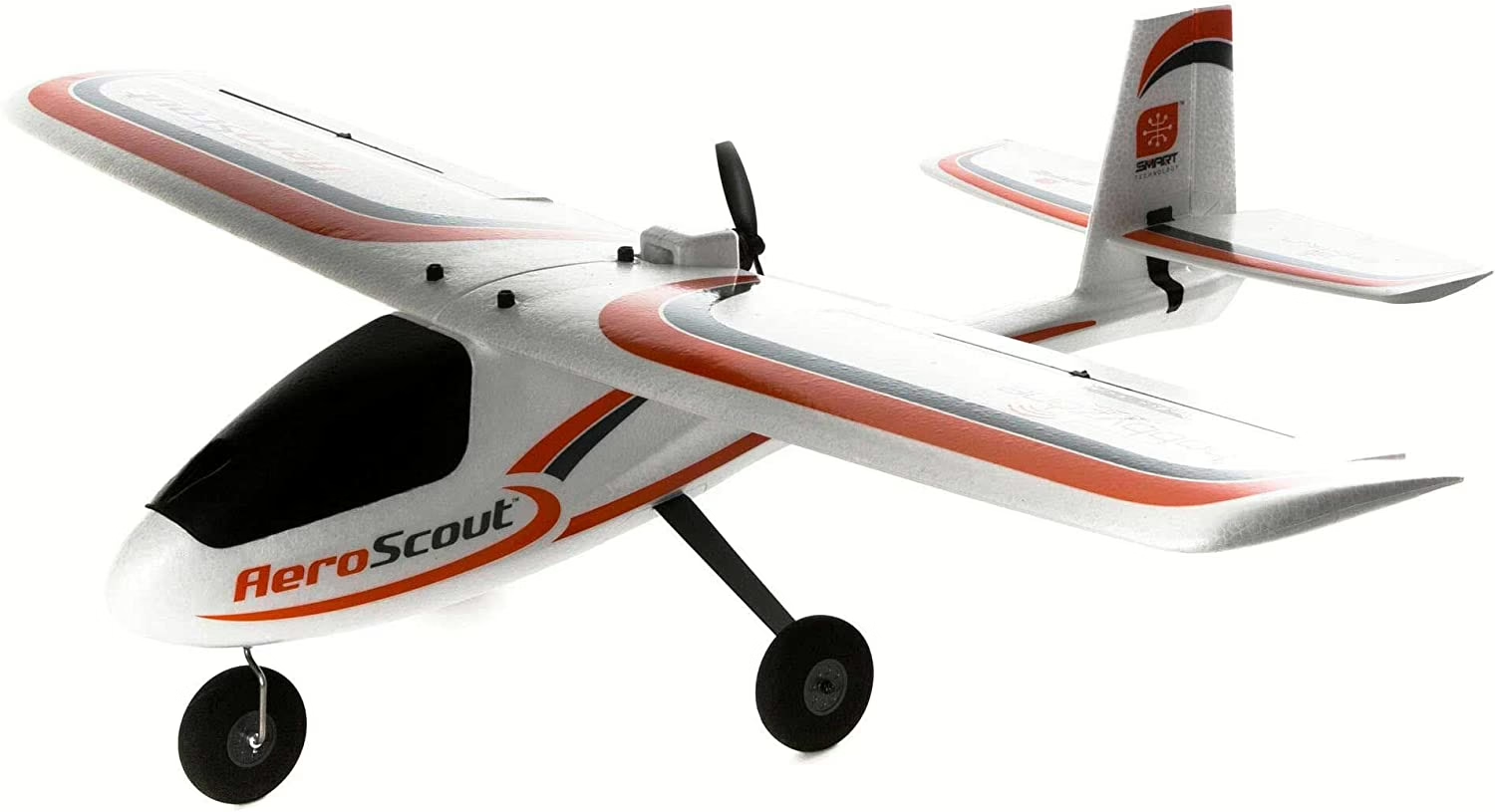
Now picture this: You’re standing at a flying field on a clear morning, transmitter in hand, watching your trainer plane climb into a blue sky. For the next hour, nothing else exists. No emails, no notifications, no mental replay of yesterday’s meeting. Just you, the aircraft, and the immediate demands of keeping it airborne. That work deadline? It’s still there, but right now, your brain doesn’t have room for it.
I learned this three years back, during what I’ll politely call a “challenging period” at work. A friend dragged me to his local flying club one Sunday, insisting I needed to “get out of my head for a while.” I figured I’d watch for twenty minutes, be polite, then head home to continue stress-scrolling through my phone. Instead, I stayed three hours. Within two weeks, I’d bought my first trainer. Within two months, my stress levels had dropped noticeably—not because my job changed, but because I’d found something that genuinely cleared my mind.
This isn’t just feel-good talk. Real science explains why RC flying works as a stress management tool. The combination of focused attention, outdoor time, hands-on work, and progressive skill development addresses multiple stress triggers simultaneously. Unlike many hobbies that keep you staring at screens, RC aviation pulls you into the physical world in ways few modern activities can match.
The Science Behind the Calm
Here’s what happens in your brain when you fly. The moment you advance the throttle for takeoff, you enter what psychologists call a “flow state”—that zone of complete absorption where time shifts and outside worries fade. RC flight demands full mental engagement. You’re processing visual information, making constant micro-adjustments to controls, planning your next maneuver, and monitoring battery life or fuel levels. Your mind literally cannot wander to that upcoming presentation or unfinished project. The aircraft won’t allow it.
Complete Mental Engagement
This forced focus is the primary feature, not a bug. When you’re keeping a trainer in the pattern, you’re managing elevator trim, coordinating turns with rudder, adjusting for wind drift, and planning your landing approach—all simultaneously. Your visual cortex tracks the aircraft’s orientation. Your motor cortex handles control inputs. Your decision-making centers evaluate conditions and choose actions. This comprehensive neural engagement pushes anxious thoughts out of working memory because there’s no processing power left for them. The penalty for distraction is immediate and obvious: the plane heads for the weeds. That clarity of consequence creates unique mental discipline that carries over into daily life.
The hand-eye coordination required for precise flying activates different brain regions than most desk work. You’re working with spatial relationships in three dimensions, exercising your visual-spatial reasoning in ways that typing emails or reviewing spreadsheets never will. This cognitive variety provides genuine mental refreshment rather than the illusory break of switching from work emails to social media scrolling.
The Outdoors Effect
Then there’s the simple fact that you’re outside. Most RC flying happens at dedicated fields—open spaces with mowed grass, often situated in parks or alongside farmland. You’re breathing fresh air instead of recycled office ventilation. You’re getting natural sunlight, which helps regulate circadian rhythms and boosts vitamin D production. The horizon is wide open rather than bounded by cubicle walls or your living room.
Studies consistently show that time in natural settings reduces cortisol levels—the primary stress hormone your body pumps out under pressure. Twenty minutes in a park setting can measurably lower blood pressure and heart rate. An hour at a flying field, fully engaged with the activity, multiplies these benefits. You’re not passively sitting on a park bench; you’re actively using the space, which deepens the psychological benefits.
The weather matters, but not in the way you might think. Yes, strong winds will keep you grounded, but even partly cloudy days work fine for flying trainers. The simple act of checking the weather forecast and planning around it gives you something positive to anticipate. That anticipation itself—knowing you’ve got a Sunday morning flight session scheduled—provides stress relief days in advance.
The Achievement Factor
Finally, there’s the reward system at work. Your first successful takeoff triggers genuine accomplishment. So does your first full pattern without assistance. Your first smooth landing. Your first figure-eight. Each milestone activates the brain’s reward circuitry, releasing dopamine—the neurotransmitter associated with pleasure and motivation. Unlike many aspects of modern work where progress feels abstract or endless, flying provides concrete, immediate feedback. You can measure improvement session by session.
This progressive skill development matters more than you might expect. Many sources of chronic stress stem from feeling stuck or ineffective. Work projects drag on without clear endpoints. Personal goals feel perpetually out of reach. RC flying offers the opposite: clear challenges with visible solutions, building from simple to complex in logical steps. You’re never truly “done” learning—there’s always a more difficult maneuver to master—but each level achieved provides genuine satisfaction.
Away From Screens, Into Reality
Let’s address the elephant in the room: we’re all tired of screens. Work happens on computers. Socializing happens on phones. Entertainment streams through tablets. Even many hobbies—gaming, photography editing, music production—keep us staring at pixels. RC flying breaks that pattern completely.
Analog Skills in a Digital World
When you fly, you’re holding a physical transmitter. Your thumbs move real control sticks that send radio signals to actual servos moving tangible control surfaces that manipulate air molecules to keep a material object aloft. There’s no app for this. You can’t swipe or tap your way through learning. The feedback is immediate and unforgiving in the best way: the plane either flies or it doesn’t.
Building and maintaining aircraft deepens this tactile engagement. Even if you start with a ready-to-fly trainer, you’ll eventually replace a propeller, reattach landing gear, or repair a wingtip after that inevitable first crash. You’ll work with real materials—foam, wood, plastic—using actual tools. You might sand a repair smooth, apply glue, balance a propeller. These hands-on tasks provide satisfying counterpoint to clicking and typing. Your hands remember how to do real things.
The maintenance work itself becomes meditative. Cleaning your aircraft after a dusty session at the field, checking screws for tightness, ensuring control linkages move freely—these pre-flight rituals create calming routine. You’re not passively consuming content; you’re actively maintaining equipment you depend on. That relationship with your tools and machines taps into something fundamental that desk work rarely provides.
Focused Single-Tasking
Here’s a liberating truth: you cannot multitask while flying. Period. You can’t check your phone while keeping a plane in the air. You can’t think about email while executing a landing pattern. The activity demands singular focus, and that forced single-tasking is remarkably freeing in an age where we’re constantly expected to juggle multiple streams of information.
This isn’t a limitation to work around—it’s a feature to embrace. For that hour at the field, you have legitimate permission to ignore everything else. Your phone stays in your field box. Your laptop stays home. Nobody expects you to be reachable because you’re clearly occupied with something requiring full attention. In our hyperconnected culture, that kind of guilt-free disconnection has become rare and valuable.
The mental clarity this creates extends beyond the flying session itself. After spending time completely focused on a single challenging task, you return to other responsibilities with improved concentration. Your brain has practiced sustained attention, which is increasingly a lost skill in our fragmented-focus world.
The Social Side: Community Without Pressure
One surprise benefit I didn’t anticipate: the flying community itself reduces stress rather than adding to it. Most social obligations come with unspoken rules, status games, or emotional complexity. RC flying clubs operate differently.
Shared Passion, Zero Drama
At the flying field, conversations naturally center on aircraft, techniques, and shared experiences. Nobody cares about your job title, your car, or your social media following. What matters is whether you’re flying a trainer or a warbird, whether you use dual rates, and how you handle crosswind landings. This technical meritocracy creates surprisingly relaxing social environment. The common interest provides built-in conversation starters while bypassing the awkward small talk that makes many social situations exhausting for introverts.
The culture at most clubs is genuinely welcoming. Experienced pilots remember their own learning struggles and typically enjoy helping newcomers. I’ve had guys with decades of experience spend an hour explaining why my plane was ballooning on takeoff (nose-heavy balance) or demonstrating proper landing approaches. There’s no gatekeeping, no “paying your dues” before earning respect. You show up, you fly, you learn, and people help. It’s refreshingly straightforward.
Learning Without Judgment
The buddy-box training system exemplifies this supportive culture. An instructor connects their transmitter to yours with a cable or wireless link. They hold a trainer switch that gives them override control. When they release the switch, you’re flying. When they flip it, they instantly take over if you get into trouble. This system allows safe learning at altitude where mistakes don’t immediately result in crashes.
What makes this powerful for stress relief is the psychological safety it creates. You can attempt new maneuvers knowing someone’s backing you up. Crashing is reframed as a learning opportunity rather than personal failure. Experienced pilots share their own crash stories freely—nobody’s pretending to be perfect. This removes the performance anxiety that accompanies many learning environments. You’re allowed to be a beginner without judgment.
Flexible Participation
Here’s another key factor: the social aspect is entirely optional and adjustable. Want to show up, fly for an hour alone, and leave? Perfectly acceptable. Want to spend the afternoon chatting with other pilots between flights? Also fine. Prefer to fly early morning when the field is empty? Nobody minds. The community is available when you want it and absent when you don’t, which removes the obligation stress that accompanies many social groups.
Most clubs have no mandatory meetings or participation requirements beyond paying modest annual dues. You’re not on a team with scheduled practices. Nobody’s tracking your attendance. This flexibility means the hobby remains a source of stress relief rather than becoming another obligation on an already-crowded calendar.
Getting Started: Making It Easy on Yourself
If you’re thinking “this sounds good, but I don’t know anything about RC planes,” you’re in the perfect position to start. The learning curve is manageable if you approach it sensibly.
Choose Your Entry Point
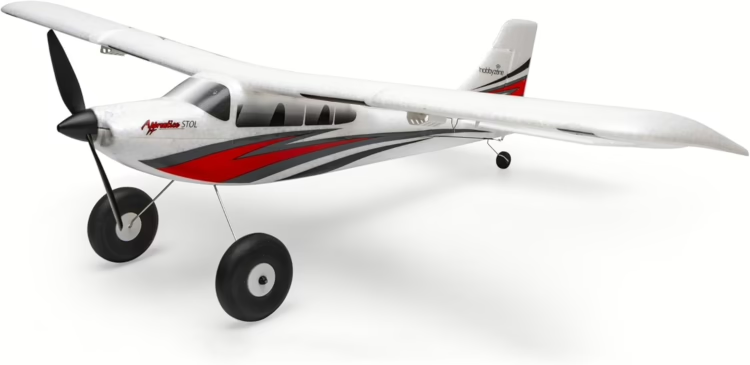
For absolute beginners, I recommend starting with a ready-to-fly trainer. These complete packages include everything needed except batteries—aircraft, transmitter, charger, basic instructions. The planes feature high-wing designs with significant dihedral (that upward V-shape to the wings), which creates inherent stability. These trainers essentially want to fly straight and level. If you release the sticks, they’ll usually right themselves instead of spiraling into the ground. This self-correcting behavior gives you time to think and react rather than demanding lightning reflexes.
Look for models specifically marketed as trainers with “beginner” or “ready to fly” in the name. Popular examples include the HobbyZone Sport Cub S or E-flite Apprentice series. Expect to spend around $200-300 for a quality starter package. Yes, cheaper options exist, but skimping here often leads to frustration. A well-designed trainer makes learning dramatically easier.
Alternative starting point: flight simulators. Programs like RealFlight or Phoenix RC let you practice on your computer using a transmitter connected via USB. You can crash virtual planes endlessly without financial consequence, which removes a major source of beginner anxiety. Many experienced pilots still use simulators for practice, especially during winter. A few hours on a simulator before your first real flight will significantly improve your initial control comfort.
Budget-Friendly Beginnings
The hobby doesn’t have to break the bank. That $200-300 trainer will serve you well for months as you build skills. Beyond that, you need a suitable flying location (many clubs charge $50-150 in annual dues), replacement propellers ($5-10 each), and spare batteries if you’re flying electric ($20-40). You don’t need a workshop full of tools or expensive upgrades.
Buying used equipment can stretch your budget further, though exercise caution. Inspect aircraft carefully for previous crash damage—cracks in the fuselage, bent landing gear, loose components. Test transmitter function before purchasing. Join local Facebook groups or club forums where members often sell equipment they’ve outgrown. The RC community is generally honest about gear condition since nobody wants to saddle a newcomer with a lemon that’ll frustrate them out of the hobby.
Find Your Local Field
The Academy of Model Aeronautics website (modelaircraft.org) maintains a club locator tool. Enter your zip code, find nearby clubs, and contact them about visitor policies. Most clubs welcome prospective members to visit and watch. You’ll typically find folks flying on weekend mornings—Saturday and Sunday from 9am until early afternoon are popular times.
What should you expect on that first visit? Arrive mid-morning rather than at dawn. Introduce yourself to whoever’s in the parking area and explain you’re considering taking up the hobby. You’ll likely get invited to watch from the flight line and offered recommendations for starting out. Many clubs have dedicated training programs with instructor pilots who’ll help newcomers. Some even have club trainers you can fly before buying your own.
Don’t feel obligated to join immediately. Visit a couple clubs if multiple options exist in your area. Look for friendly, patient people who seem genuinely interested in helping rather than just showing off their expensive equipment. The right club makes all the difference in your early experience.
Simulator Practice
Before we move on, let me emphasize the simulator option again because it genuinely reduces initial stress. Learning to fly involves significant orientation challenges, particularly when the plane is coming toward you and controls feel “reversed.” A simulator lets you practice these confusing situations safely and repeatedly until the correct responses become automatic. You can crash twenty times in twenty minutes, restart instantly, and keep practicing without financial or emotional cost.
Most simulators offer different aircraft to try and various weather conditions. Start with basic trainer models in calm conditions, then gradually introduce wind and switch to more challenging planes. Many pilots credit simulator practice with dramatically shortening their real-world learning curve. The initial investment ($100-150 for decent simulator software plus USB adapter) pays for itself by preventing real crashes.
The Rhythm of the Hobby: Why Routine Relaxes
Once you’re flying regularly, you’ll notice how the hobby creates healthy patterns in your schedule. These routines themselves contribute to stress reduction by providing structure and positive anticipation.
Pre-Flight Rituals
Every flight starts the same way: methodical checks of your equipment. Battery charged? Check. Transmitter on, receiver responding? Check. Control surfaces moving correctly—ailerons, elevator, rudder? Check. Center of gravity balanced properly? Check. This systematic process serves multiple purposes beyond safety. It creates a mental transition from whatever you were doing before to the focused state of flying. The repetitive nature becomes meditative—you’re not thinking about work or worries; you’re running through your established sequence.
These rituals become second nature remarkably quickly. After a dozen flights, you can run through pre-flight checks almost automatically, but the mental benefit remains. You’re training your brain to shift gears deliberately, setting aside one mental mode and entering another. That skill—conscious transition between different focus states—becomes valuable in other areas of life. Before a stressful meeting, you might find yourself mentally running through a similar checklist, using the same technique to center yourself.
Maintenance as Meditation
Between flying sessions, there’s upkeep work. Clean off the dust and grass from last week’s flights. Check all screws for tightness—vibration loosens them over time. Inspect the propeller for nicks. Test control surface movement. Charge batteries fully. These maintenance tasks occupy your hands and calm your mind in ways similar to gardening or woodworking. You’re caring for your equipment, which creates a satisfying sense of stewardship.
The work isn’t demanding enough to be stressful but isn’t so simple that your mind wanders back to anxieties. It’s that sweet spot of light engagement that lets you relax while still feeling productive. Maybe you’re sitting in your garage on a Wednesday evening, taking fifteen minutes to clean your plane after a weekend session. Those fifteen minutes provide genuine decompression from the workday—you’re doing something tangible with visible results, and your mind settles into the rhythm of the work.
Challenges That Heal: Why Obstacles Matter
Here’s something counterintuitive: RC flying reduces stress partly because it presents challenges. Not the soul-crushing, never-ending type that create chronic stress, but contained, solvable obstacles that provide authentic accomplishment.
Controlled Risk, Real Accomplishment
When you’re learning to land, there’s genuine difficulty involved. Too much speed and you’ll overshoot. Too slow and you’ll stall before the runway. The approach angle matters. Wind correction matters. Timing the flare matters. You will screw up your first dozen landing attempts—we all do. But here’s the key difference from work stress: the consequences are bounded and fixable. You crash? You pick up the pieces, repair the damage (often surprisingly minor with modern foam planes), and try again. The outcome is clear. The learning is immediate. And the satisfaction when you finally grease that landing is real.
This contrasts sharply with many modern stressors. Work projects drag on indefinitely. Personal goals feel perpetually out of reach. Problems lack clear solutions. RC flying provides the opposite: defined challenges with measurable outcomes. You either execute the maneuver successfully or you don’t, but you learn either way, and you can try again in five minutes.
The risk element matters, but it’s important to understand what we mean by risk. You’re not endangering yourself—you’re on the ground with a transmitter. The “risk” is to your aircraft, which sounds dramatic until you realize most crashes are survivable with foam construction and careful repairs. This creates just enough challenge to engage your attention fully without creating actual anxiety about physical harm. It’s risk with training wheels.
Learning to Let Go
Perhaps the most valuable lesson RC flying teaches: accepting imperfection and moving forward. Even experienced pilots crash occasionally. Everybody has landed on their heads at least once. Propellers break. Wings get bent. It’s part of the learning process, not personal failure. This reframing of mistakes as learning opportunities rather than catastrophes translates directly to stress management in other life areas.
When you’ve stood in a field looking at a plane that just nose-dived from 100 feet because you forgot to check your battery charge, and your immediate reaction is “well, that was stupid—let’s see what needs fixing,” you’ve learned something important about resilience. The emotional sting lasts about two minutes, then you shift into problem-solving mode. Compare that to how we often react to mistakes at work or home—ruminating for hours or days, replaying what went wrong, catastrophizing the consequences. Flying teaches a healthier response pattern: acknowledge the error, fix what’s fixable, and get back in the air.
Progress You Can See
Unlike many aspects of modern life where progress feels abstract, flying provides concrete evidence of improvement. Week one, you can barely keep the trainer level. Week four, you’re doing steady circles around the field. Week eight, you’re executing smooth landings more often than not. Week twelve, you’re starting to try basic aerobatics. The progression is visible, measurable, and satisfying in ways that spreadsheet work or endless email threads never achieve.
This clear advancement creates positive momentum. Each achieved milestone motivates effort toward the next. You’re building genuine competence in a real skill, which provides a sense of efficacy that counteracts the helplessness often underlying chronic stress. In a world where many challenges feel insurmountable or outside your control, being able to point at a skill and say “I couldn’t do this three months ago, and now I can” provides psychological ballast.
Real Stories: Pilots Who Found Their Peace
Tom, a software engineer from Oregon, picked up RC flying at 45 after his doctor suggested finding a hobby that would get him outdoors. “I was working 60-hour weeks and showing early signs of hypertension,” he told me. “My doctor actually said, ‘Find something that makes you forget about work.’ Six months into flying, my blood pressure had dropped noticeably. More importantly, I’d stopped bringing work stress home every evening. When I’m at the field, work literally doesn’t exist—my brain has no spare capacity for it while I’m keeping a plane in the air.”
Sarah, a high school teacher in her early thirties, discovered the hobby through her father. “Teaching is emotionally exhausting. You’re ‘on’ all day, managing twenty-five personalities simultaneously. Flying is the exact opposite—it’s just me and the aircraft. Nobody needs anything from me except attention to what I’m doing right now. That mental reset is invaluable. Sunday afternoon flights carry me through the following week.”
Mike, retired Air Force, returned to RC aircraft after a 20-year gap. “I flew as a teenager, picked it up again after retiring from active duty. The hobby helped significantly with the transition stress. Military retirement can be jarring—suddenly your highly structured life disappears. RC flying gave me back a sense of routine and purpose, something to look forward to and work on. Plus, the club I joined has several other veterans. We’ve formed real friendships around the shared interest.”
These aren’t outliers—these patterns show up consistently in the flying community. People come to the hobby stressed, overwhelmed, or searching for something missing in their lives. They stay because it delivers genuine relief and satisfaction that few other activities provide in quite the same combination.
Making It Stick: Sustaining the Stress-Relief Benefits
Starting the hobby is one thing; making it a consistent part of your life is where the real benefits accumulate. Here’s how to make RC flying a sustainable stress management practice rather than a passing phase.
Regular Flight Schedule
Aim for consistency over intensity. Flying for two hours every Sunday morning provides more sustained benefit than cramming eight hours into one Saturday per month. The regular rhythm matters—having that standing appointment with yourself creates positive anticipation during the week and provides reliable decompression time. Even if you can only manage an hour on weekend mornings, that regular commitment creates significant cumulative stress reduction.
Think of it like exercise. You wouldn’t expect fitness benefits from one massive workout per month. The same principle applies to stress management through flying. Frequent, moderate sessions beat occasional marathons for both mental health and skill development. The anticipation itself—knowing you’ve got flight time coming up—provides relief days in advance.
Winter and Weather Alternatives
Let’s be realistic: weather will sometimes keep you grounded. Strong winds, rain, or snow make outdoor flying impossible or unsafe. Rather than viewing this as a limitation that ruins the hobby’s consistency, treat it as an opportunity to engage differently.
Indoor flying has exploded in popularity. Tiny foam aircraft specifically designed for gymnasium flying let you maintain skills through winter. Many communities have monthly indoor flying sessions at local schools or recreation centers. These ultra-light planes operate with such low wing loading that they literally cannot hurt anyone, making them safe for indoor use.
Simulator practice becomes even more valuable during off-season. You can work on advanced maneuvers, practice in challenging simulated conditions, or just maintain your muscle memory and reaction timing. The mental engagement remains similar even though you’re not outdoors with real aircraft.
Workshop time—building, repairing, or upgrading aircraft—provides its own form of stress relief during weather-grounded periods. Many pilots maintain multiple aircraft at different stages of completion. When one’s flyable, another might be in repair, and a third might be a slow-build project. This creates year-round engagement with the hobby even when actual flying isn’t possible.
The broader point: RC aviation offers enough different aspects—flying, building, maintaining, learning—that you can engage with it consistently regardless of external conditions. The stress-relief benefits don’t depend entirely on fair weather and flyable Sundays.
Taking the First Step
If you’ve read this far, you’re probably at least curious about trying RC flying. Maybe you’re skeptical that a hobby involving miniature airplanes could genuinely reduce stress. I get it—I was skeptical too before that first Sunday at the field changed my perspective.
Here’s the truth: RC flying works as stress relief because it addresses multiple stress triggers simultaneously. It pulls you away from screens and into physical reality. It demands complete mental focus that pushes anxious thoughts aside. It provides progressive challenges with clear solutions. It happens outdoors in pleasant settings. It offers optional community without social obligation. It creates satisfying routines and tangible accomplishments. And perhaps most importantly, it’s genuinely enjoyable in ways that passive entertainment or distraction never quite achieve.
Getting started is simpler than you probably imagine. Visit modelaircraft.org to find nearby clubs. Stop by a local hobby shop to see what starter packages look like. Check out a flight simulator if you want to dip your toes in virtually before committing to real equipment. Join online forums like RC Groups or Reddit’s r/radiocontrol where friendly pilots answer beginner questions daily.
The barrier to entry isn’t high—financially or skill-wise. What matters is taking that first step of showing up at a field or ordering that starter trainer. The initial intimidation fades quickly when you discover how welcoming the community is and how accessible the learning curve proves with proper instruction.
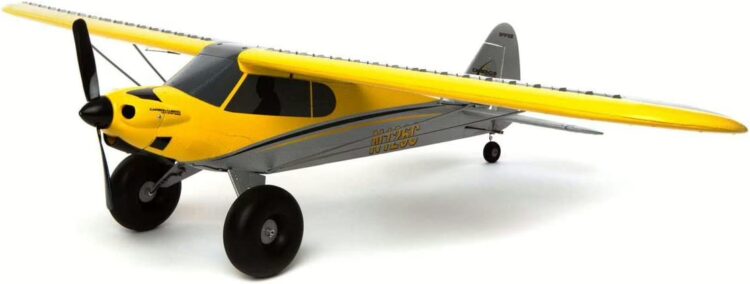
Three years ago, I was stressed, screen-addicted, and wondering why I couldn’t find anything that truly helped me decompress. Now I’m standing at a flying field on a clear morning, transmitter in hand, watching my sport plane trace lazy circles against a blue sky. My phone is in my car. Work exists somewhere in the back of my mind, but not here, not now. For this hour, I’m completely present in what I’m doing.
That presence—that genuine mental escape into flow state—is exactly what most of us are searching for when we say we need to “de-stress.” RC flying provides it reliably, repeatedly, and in ways that actually work rather than merely distracting temporarily.
The sky’s waiting. All you have to do is show up.

Key Takeaways
- RC flying creates genuine flow states that push anxious thoughts aside through complete mental engagement with the immediate demands of keeping an aircraft aloft.
- The hobby’s hands-on, outdoor nature provides relief from screen fatigue and digital stress while offering clear, measurable skill progression that builds confidence.
- Welcoming flying communities offer optional social connection without pressure, plus structured training systems that make learning safe and accessible for absolute beginners.
- Starting requires modest investment ($200-300 for quality trainers) and manageable learning curves, with flight simulators and club instructor programs reducing initial barriers and anxiety.
- The hobby’s rhythm—regular flight sessions, maintenance rituals, and weather-adaptable alternatives—creates sustainable stress-management practices that deliver long-term benefits beyond temporary distraction.