


FSM’s reviewer called it maybe the best choice for most 1/72 modelers. But 240-plus parts, a fussy engine stage, and two bare-metal schemes can ambush a newcomer. Here’s what the record shows before you buy.
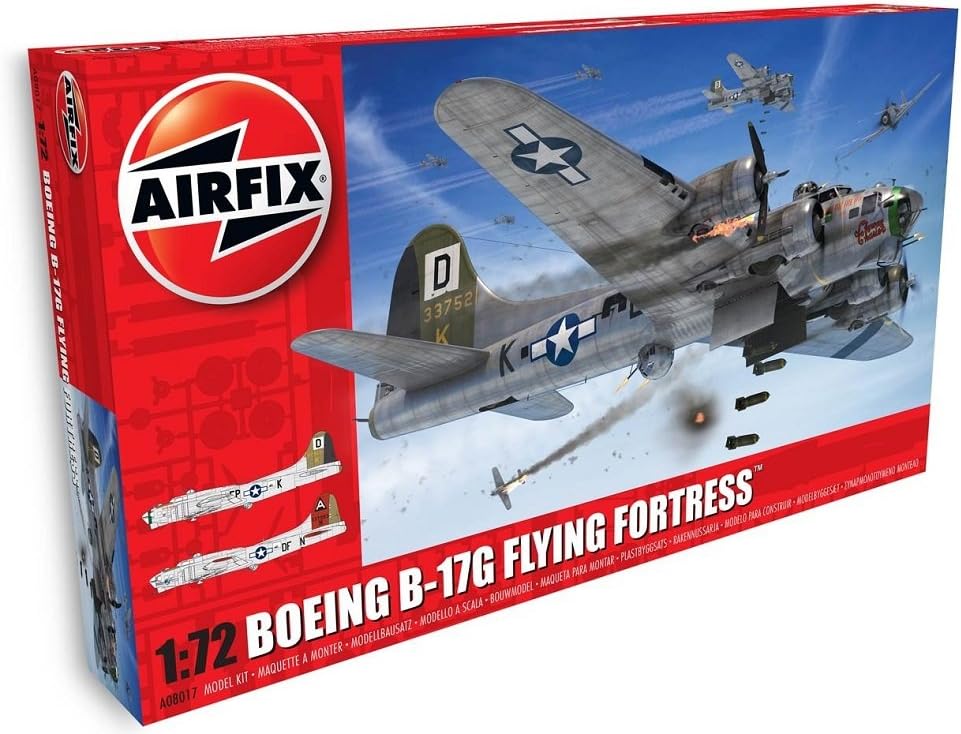
Sooner or later, as you work through the best model airplane kits, a four-engine heavy starts to tempt you. The Airfix 1/72 Boeing B-17G Flying Fortress makes a strong case: its original boxing puts two Eighth Air Force bombers on one decal sheet, Skyway Chariot of the 100th Bomb Group and Mah Ideel of the 91st.
It’s a sound buy for a modeler with a few kits finished who is ready for a natural-metal finish (NMF). It’s the wrong buy for a first model.
FineScale Modeler‘s Paul Boyer built the original A08017 for a full Workbench Review and wrote that the kit “may be the best choice for most 1/72 scale modelers.” Lee Kolosna’s full illustrated build of the later A08017B boxing at Modeling Madness went further on the shape: “It is dimensionally accurate.”
Quick Verdict
Buy it if you’ve finished several multipart kits and want a late-war B-17G. Boyer’s FSM build found the overall fit very good and the instructions excellent, and Kolosna rates the outline accurate.
Think twice if this would be your first or second model. Airfix rates the later A08017B boxing, now out of stock at Airfix, Skill Level 3. Boyer cautions that the high parts count and involved assembly may daunt beginners, though experienced builders should have no trouble.
Budget for the hidden cost. Airfix’s A08017B listing gives the contents as sprues and decals. Both original schemes are mostly bare metal, so plan on cement, filler, primer, metallic paint, and masking. An airbrush suits the Alclad method Boyer used.
So where do builders lose time? At the engines and a handful of clear parts, as the build notes below show.
Brief Overview
What it is
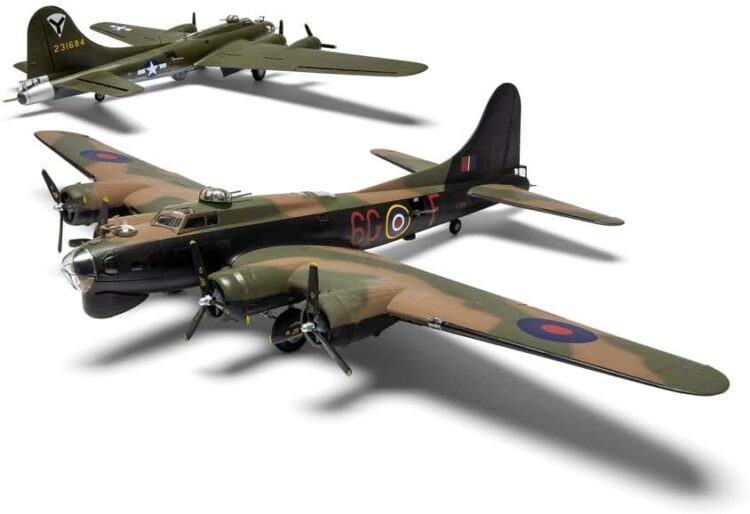
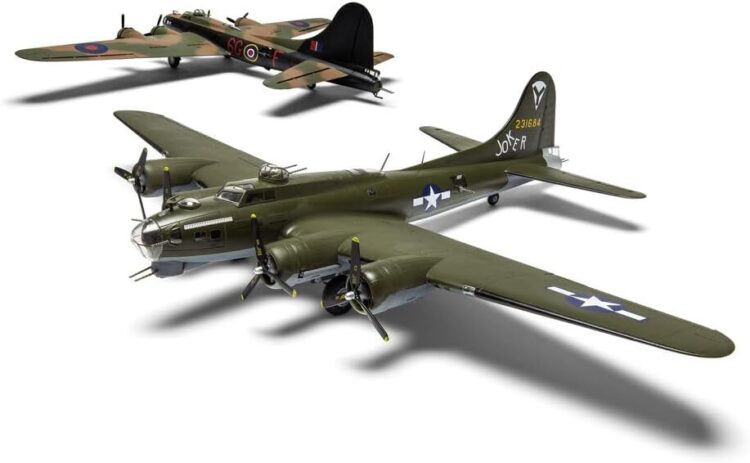
A08017 is Airfix’s 2016 new-tool, late-production B-17G. Later boxings reuse the plastic with new markings: A08017A (a 2019 decal variant, per the Airfix Collectors’ Club kit list) and A08017B, which swaps the headline pair for Milk Wagon and $5 with Breakfast. U.S. listings may show any of these codes, so check the box code for the markings you want. Don’t confuse any of them with the 2025 A08018A Fortress Mk.III, a related but altered kit.
The kit captures the late-G identifiers — staggered waist guns and the Cheyenne tail-gun position, named for United Air Lines’ modification center at Cheyenne, Wyoming — along with the Bendix chin turret every G carried.
The “legends” are the bomb groups, not the individual airplanes. Airfix calls the 100th the Bloody Hundredth and the 91st the Ragged Irregulars:
- Skyway Chariot: B-17G-65-BO, 43-37521, 351st Bomb Squadron, 100th Bomb Group, Thorpe Abbotts, March 1945.
- Mah Ideel: B-17G-75-BO, 43-37993, 324th Bomb Squadron, 91st Bomb Group, Bassingbourn, early 1945.
Both carry Boeing’s BO suffix, marking them as Seattle-built. Scale the National Park Service’s B-17G dimensions (103 ft 9 in span, 74 ft 4 in length) to 1/72, and the model spans about 17.3 in (439 mm) and runs about 12.4 in (315 mm) long. Leave clearance beyond that.
Who it’s for
- Newer builders with a few multipart kits finished who want a first heavy bomber.
- Eighth Air Force fans who want late-G details and a famous bomb group’s markings.
Features that matter
- An outline experts respect. With Kolosna rating it accurate, your hours go into the finish rather than reshaping.
- Instructions that keep a long build on track. Boyer liked the sequential diagrams, which shade parts added in earlier steps.
- Display options. Gear up or down, bomb bay open or closed, movable rudder, elevators, and ailerons, plus open or closed cowl flaps. The wing flaps are molded shut. One kit covers a parked or an in-flight pose.
- A full interior, with honest limits. Boyer notes that much of the interior and engine detail disappears once the airframe closes. The open bomb bay is where that work stays on show.
Still deciding? Check today’s price and which boxing is in stock (check the box code for the markings you want) before you read on.
Pros & Cons
Pros
- A respected outline. Kolosna calls it dimensionally accurate, and Boyer thought the finished model looked right.
- First-rate instructions, which Boyer rated excellent.
- Well-behaved decals. Boyer’s went down without trouble over his NMF.
- Posable options for gear, bomb bay, control surfaces, and cowl flaps, on main gear Boyer found sturdy.
- Aftermarket headroom. Eduard recommends its canopy mask set (CX464), cockpit interior photo-etch (PE) set (73567), and exterior PE set (72631) for the Airfix kit.
Cons
- Documented fit trouble spots. Boyer found the nose side windows loose and had to adjust small window K6. Kolosna sanded a step where the Cheyenne tail sits slightly wider than the fuselage, and he found lining up the engines with the collector rings slow.
- Both original schemes are mostly natural metal, a finish that demands a primed, polished surface.
- Only four 500-lb bombs for the detailed bay (Boyer).
- Small omissions. Kolosna noted no pitot tube or oxygen bottles and slightly overscale machine guns.
Airfix’s Claims vs. the Documented Record
Here’s how the A08017B product page, now out of stock at Airfix, holds up.
| What the listing says | What the record shows |
| Skill Level 3 | Boyer (A08017): experienced builders should have no trouble, but beginners may be daunted. |
| 245 parts | Boyer counted 242 in his A08017 sample. No tooling change is documented behind the gap. Either way, expect 240-plus parts to clean up. |
| 457.2 mm length, 254 mm span | Scale math from the full-size B-17G gives about 315 mm (12.4 in) long and 439 mm (17.3 in) across. The listed figures match neither axis, so plan your shelf from the real airplane. |
| Contents: sprues and decals | The listing names no paint, cement, filler, or masks, so budget for them separately. |
Takeaway: The plastic largely earns its reputation, but the listing doesn’t tell you the true cost in time, materials, or shelf space.
Value vs. Rival 1/72 Fortresses
| Airfix B-17G | Revell B-17G | Academy B-17G | |
| Version | Late G, staggered waist guns | Early G, unstaggered waist guns (original 2010 boxing) | G (“Nose Art,” No. 12414) |
| Shape | Kolosna: dimensionally accurate | Disputed. Boyer praised it in 2011; Kolosna faults the wing thickness, nose taper, and top-turret height | Kolosna, on Academy’s 1/72 B-17 series generally: exaggerated dihedral, sparse interior |
| Standout strength | Fit and instructions (Boyer) | Engines and flaps (Boyer) | Not documented for this boxing |
| Watch for | Nose glazing, engine alignment | Confusing part numbering, a bomb-bay assembly glitch (Boyer) | No published full build of this boxing as of September 2026 |
Boyer’s 2011 FSM Workbench Review of the Revell Germany kit praised its shapes, while Kolosna’s full Revell build found real geometry problems. As of September 2026, no published measured comparison settles it. Also note that Revell’s current listing (No. 042839090) shows 237 parts against the 317 in Boyer’s 2011 sample, so don’t assume today’s box matches that review. Academy’s No. 12414 remains the least documented of the three.
The value verdict: For a late-war, natural-metal B-17G, the published record favors Airfix. Boyer, who has built both, judged the Airfix kit the likely best choice for most 1/72 modelers while crediting Revell with more detail. Choose Revell if an early G or its optional flaps matter more to you.
Considering a different heavy? Airfix’s B-24H Liberator (A09010) is also Skill Level 3, with 278 parts, so it’s no easier on-ramp.
Expected Experience with Airfix 1/72 Boeing B-17G Flying Fortress
Out of the box
Boyer describes soft, light-gray styrene with restrained engraved panel lines and parting seams on small parts. With 240-plus pieces, that cleanup becomes a real line in your time budget. Check each small part before it goes on.
Interior and fuselage
The flight deck, bombardier’s station, radio room, waist, tail, and bomb bay all build up before the fuselage closes. Kolosna built the bay and crew compartments into one interior assembly before inserting it between the fuselage halves, so painting decisions come early. Put your effort where it stays visible. Per Boyer, the ball turret hangs from the waist compartment ceiling.
Tip: Boyer notes that most guns install from inside, though the waist guns can go in from outside. Plan that before you close the fuselage. Kolosna temporarily cut the cheek barrels to protect them during handling, a useful trick rather than a kit step.
Engines and nacelles: the stage both builders flag
Boyer calls the nacelle breakdown complex. The engines carry separate intake and exhaust details, yet much of that detail vanishes inside the cowls. Kolosna names lining up the engines with the exhaust collector rings as his one unexpectedly slow construction step.
Warning: Dry-fit each engine, collector ring, and cowling before any glue touches them, and follow the diagrams closely.
Wings, tail, and overall fit
Boyer rated the overall fit very good, so plan on routine seam work for a kit this size. Kolosna’s build adds one local fix: the Cheyenne tail sat slightly wider than the fuselage and needed sanding. Dry-fit the tail before any filler, and restore panel lines you sand away. Natural metal shows every missing line.
Clear parts and bomb bay
Boyer praised the fit of the flight-deck glazing but found the nose side inserts loose and window K6 in need of adjustment. Kolosna filled and smoothed his glazing joins.
- Dry-fit every transparency, and use a canopy-safe adhesive such as white glue so nothing fogs. Airfix recommends Humbrol Clear Fix (AC5708) alongside the kit for clear-part work.
- Choose open or closed bomb-bay doors early. Boyer flags instruction steps 112–113, which call for trimming a door-opening part. Study them before gluing.
Finishing and time investment
Natural metal is where the Airfix B-17G gets serious, because metallic paint magnifies every scratch and seam. Alclad’s directions call for primer on plastic, lightly polished smooth, before its regular metal finishes go on; high-shine shades, including the Polished Aluminum Boyer used, need a gloss base coat instead. Boyer used Alclad polished aluminum and Mr. Color lacquers; Kolosna closed his fuselage joins with CA to head off ghost seams. Those are builders’ choices, not requirements.
Masking the extensive glazing takes time, too; a pre-cut set such as Eduard’s CX464 can shorten it.
Time: Boyer logged 26 hours at an experienced reviewer’s pace. No published build records a beginner’s time as of September 2026, so treat that figure as a reference point, not a schedule.
Where the Airfix 1/72 Boeing B-17G Flying Fortress Really Shines
- No major reshaping on record. Neither documented build reports correcting the nose or wing; the recorded fixes are local ones, at the tail and glazing.
- A long build that stays on track. Boyer’s praise for the instructions counts most across 240-plus parts.
- A bomber that earns its shelf. A gleaming, 17-inch-span Eighth Air Force Fortress in the markings of the Bloody Hundredth or the Ragged Irregulars, bomb bay open or gear up. That combination is the payoff for the extra work.
Airfix 1/72 Boeing B-17G Flying Fortress 240-plus parts · Skill Level 3 (A08017B) · Two Eighth Air Force mostly natural-metal schemes (A08017) A late-G Fortress Kolosna calls dimensionally accurate, with instructions Boyer rated excellent. Check price and availability
Who Should Buy It
Ideal buyers
- The newer builder with a few kits finished who wants a first heavy bomber and is ready to learn metallic finishes.
- The Eighth Air Force enthusiast who wants late-G details and a famous bomb group’s markings.
- The detailer who plans to add Eduard masks and PE.
Wait, or choose differently
- First-time builders. Finish a few simpler kits first; the parts count and metal finish stack up.
- Anyone avoiding a metallic finish, since both original schemes are mostly bare metal.
- Early-G fans. Revell’s original 2010 boxing modeled the earlier configuration; confirm what the current box holds.
- Anyone short on shelf space. You need about 17.3 in of clear span, plus margin.
FAQ
Q: I’ve only built one or two model kits. Is the Airfix 1/72 B-17G Flying Fortress too hard for me?
A: The Airfix 1/72 B-17G is a stretch after only one or two kits, though not an impossible one.
- Airfix rates the later A08017B boxing, now out of stock at Airfix, Skill Level 3.
- Boyer counted 242 parts in A08017; Airfix lists 245 for A08017B.
- Boyer warns that beginners may be daunted by the parts count and involved assembly.
- The natural-metal finish is a second hurdle, so practice metallic paint on a simpler kit first.
Q: What tools and paints do I need to buy separately to finish the Airfix 1/72 B-17G kit?
A: The Airfix 1/72 B-17G box holds plastic and decals, so finishing supplies are a separate purchase.
- Plastic cement and CA
- Filler and fine sanding or polishing supplies
- Primer and metallic paint, ideally airbrushed
- Masking tape or a pre-cut mask set such as Eduard CX464
Check your chosen metallic paint’s current primer directions before you start.
Q: What is the hardest part of building the Airfix 1/72 B-17G, and how do I avoid mistakes?
A: Both full builds cited here, Boyer’s and Kolosna’s, flag the Airfix 1/72 B-17G’s engine stage, and each adds its own trouble spots.
- Dry-fit engines, collector rings, and cowls before gluing (Boyer, Kolosna).
- Test the nose side windows and window K6 before committing (Boyer).
- Dry-fit the Cheyenne tail and sand any step before filling (Kolosna).
- Read steps 112–113 for the bomb-bay doors early (Boyer).
Q: How long does it take to build the Airfix 1/72 B-17G Flying Fortress from start to finish?
A: Build time for the Airfix 1/72 B-17G was 26 hours for one experienced reviewer.
- That figure comes from Boyer’s single FSM Workbench build.
- No published build records a beginner’s time as of September 2026.
Q: Should I buy the Airfix or the Revell 1/72 B-17G for my first bomber model?
A: The Airfix-or-Revell 1/72 B-17G choice comes down to which version you want, because neither is documented as an easy first bomber.
- Airfix models a late G; Revell’s original boxing models an early G.
- Boyer and Kolosna both rate the Airfix shape well but disagree on Revell’s.
- Boyer found Revell’s engines and flaps strong but its numbering confusing.
- Check the current Revell box, since its listed part count differs from the 2011 review sample.
Q: What is the difference between Airfix B-17G kits A08017 and A08017B, and which one should I buy?
A: Airfix A08017 and A08017B share the 2016 plastic but carry different markings.
- A08017: Skyway Chariot (100th Bomb Group) and Mah Ideel (91st Bomb Group).
- A08017B: Milk Wagon and $5 with Breakfast.
- Choose by the scheme you want, and confirm the box code before buying.

Key Takeaways
- Experts rate the Airfix B-17G’s shape and instructions highly, and the original box carries 100th and 91st Bomb Group markings.
- Overall fit is very good, with known trouble spots at the engines, nose glazing, and tail join.
- The natural-metal finish drives much of the real cost and difficulty.
- Expect 240-plus parts and a long build; one experienced reviewer took 26 hours.
- It’s a strong buy for newer modelers with a few kits behind them. First-timers should build up to it.