


If you’ve been postponing the jump to single-rotor flight, Blade’s safe technology and three-mode skill progression may have just removed your last valid reason to wait. Here’s why

The beginner RC helicopter market is crowded and frequently misleading. Toy-grade coaxials promise “stable flight” and deliver tumbling plastic; collective-pitch machines demand skills that most newcomers haven’t developed yet. Finding a machine that genuinely occupies the middle ground — capable enough to teach real discipline, forgiving enough to survive the process — remains harder than it should be.
For a broader look at where the 120 S2 fits against the full field of options, our guide to the best RC helicopters covers that ground comprehensively. Here, we focus entirely on whether this specific machine earns your money in 2026.
Brief Overview
What It Is
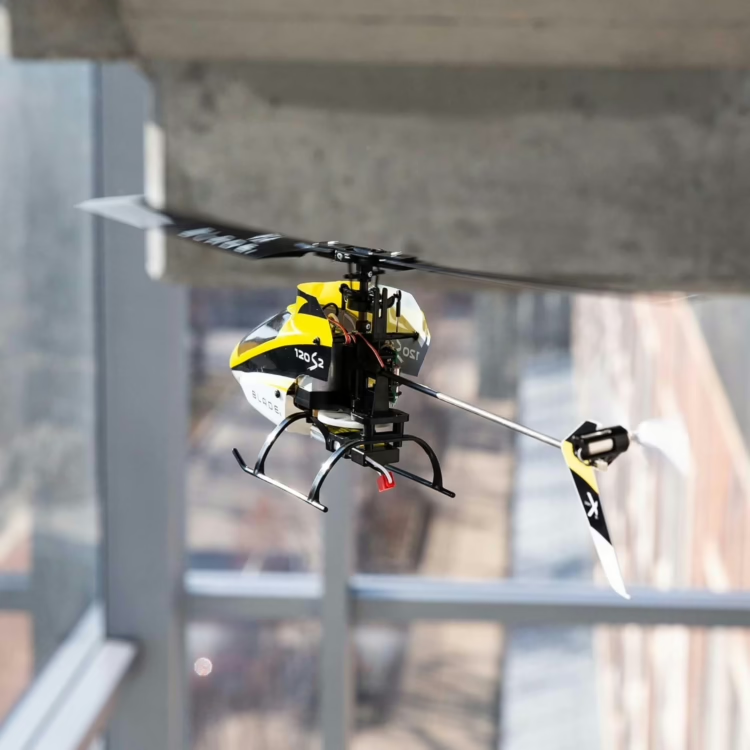
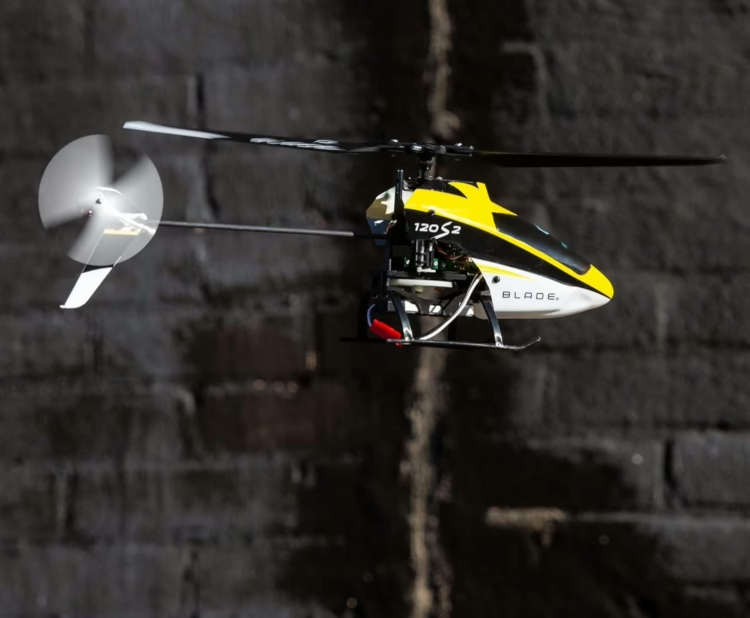
The Blade 120 S2 BNF (part number BLH11800) is a fully assembled, sub-micro, fixed-pitch flybarless RC helicopter in Bind-N-Fly format. BNF means the helicopter ships with all onboard electronics installed but requires a compatible 6+ channel Spektrum DSMX/DSM2 transmitter to fly. It is not a collective-pitch machine — the main rotor blade pitch is fixed, and altitude is managed entirely through motor RPM. That fixed-pitch architecture makes the mechanical system simpler, more durable, and substantially more beginner-appropriate than collective-pitch designs.
In Blade’s lineup, the 120 S2 sits above the micro-class Blade Revolution 90 FP and below the smallest collective-pitch machines including the Nano S3 and 150 S. It is the natural next step for a pilot graduating from a coaxial trainer — large enough for calm outdoor flying, compact enough for indoor use in a gymnasium or a generously sized room.
The 120 S2 builds directly on the lineage of the original Blade 120SR. That original platform used a flybar for stabilization; the S2 replaces it with an integrated flybarless system and SAFE technology, eliminating the flybar’s known shortcomings: asymmetric lift tendencies, weather-vaning behavior, and added mass. The S2 also relocated the 4-in-1 control board forward on the airframe and separated the cyclic servos from the main board — a meaningful serviceability upgrade.
Who It’s For
Horizon Hobby rates the 120 S2 at Skill Level 1 — their entry-level designation — for pilots 14 and up. Three audiences are well-served: pilots graduating from coaxial machines like the Blade mCX who are ready for single-rotor discipline; RC airplane or drone pilots already flying on a Spektrum transmitter who want to add a helicopter without buying new equipment; and indoor or apartment flyers who need a year-round, weather-independent flying machine.
Key Features
SAFE Technology with Panic Recovery is the headline. SAFE’s self-leveling modes keep the helicopter oriented when the cyclic stick is released; the dedicated Panic Recovery button instantly forces a level attitude when disorientation strikes — the most consequential feature available to a beginner single-rotor pilot. Three progressive flight modes — FM0 (Stability Low-Angle), FM1 (Stability High-Angle), and FM2 (Agility) — map to a deliberate skill-building progression from first flight through developing intermediate. The flybarless rotor head eliminates the mechanical complexity and fragility of older flybar designs. And full DSMX BNF compatibility means any Spektrum radio already in your collection flies it immediately.
Ready to pick one up? Check current pricing and availability on Amazon →
Specifications at a Glance
| Specification | Value |
| Part Number | BLH11800 (BNF) |
| Length | 12.6 in (320 mm) |
| Height | 4.25 in (108 mm) |
| Main Rotor Diameter | 13 in (330 mm) |
| Tail Rotor Diameter | 2.75 in (70 mm) |
| Flying Weight | 3.74 oz (106 g) |
| Motor | Brushed main; coreless brushed tail |
| Rotor Head | Fixed-pitch flybarless (FBL) |
| Battery | E-flite 500mAh 1S 3.7V 25C LiPo (JST) |
| Est. Flight Time | ~5 min (4–6 min typical) |
| Charge Time | ~60 min (USB charger) |
| Receiver Protocol | Spektrum 2.4GHz DSMX/DSM2 |
| Required Transmitter | 6+ channel Spektrum DSM2/DSMX |
| SAFE Flight Modes | 3 (FM0, FM1, FM2) |
| Skill Level | 1 (Beginner) |
| Regulatory Class | Under 250g |
Pros & Cons
Pros
- SAFE Technology with Panic Recovery genuinely reduces crash rates. The bank-limiting modes and instant attitude-recovery button address the disorientation spiral — the most common cause of beginner crashes — with an effectiveness that registers in actual flight, not just on a marketing sheet.
- Flybarless rotor head means fewer fragile parts. A beginner will crash; fewer mechanical components to break translates directly to more flying and less time on the bench performing repairs.
- BNF economics work for Spektrum pilots. Any 6+ channel Spektrum DSM2/DSMX transmitter — DX6, DX7, DX8, DX9, NX6, NX8, or compatible JR DSM2/X — binds directly. No new radio required.
- Genuine dual indoor/outdoor usability. At 3.74 oz / 106g, the 120 S2 covers ground that true-micro helis cannot — calm outdoor flying is accessible while it remains manageable in large indoor spaces.
- Voltage telemetry with compatible Spektrum radios flags low battery before the Low Voltage Cutoff (LVC) reduces motor power mid-hover. On a five-minute pack, that advance warning is a practical advantage.
Cons
- BNF format requires a transmitter the box doesn’t include. Buyers without a Spektrum radio must purchase the RTF version or budget a transmitter separately. First-timers who don’t catch this early face an unexpected additional cost of entry.
- Wind sensitivity is a hard outdoor limit. Horizon Hobby recommends 3 mph or less for initial flights; in practice, the outdoor ceiling for station-keeping sits at roughly 5–7 mph before the sub-micro physics work against the pilot. This is not an afternoon park flyer.
- ~5-minute flight time per pack demands multi-battery ownership. With a 60-minute charge cycle, sustaining a useful session requires a minimum of 3–5 batteries. The ratio of fly time to charge time is unfavorable.
- Fixed-pitch ceiling — no aerobatic upgrade path. The simplicity that makes the 120 S2 a good trainer is also a hard limit. Pilots who develop ambition for inverted flight or 3D aerobatics will outgrow this airframe entirely.
In the Box & First Impressions
The BNF package (BLH11800) contains the fully assembled 120 S2 helicopter, an E-flite 500mAh 1S 3.7V 25C LiPo flight battery with JST connector, a 1S LiPo USB charger (EFLC1010), tools and hardware extras, and the instruction manual. Transmitter and AA batteries are not included — worth confirming before assuming the package is complete.
Out of the box, the 120 S2 makes a solid first impression. The polymer and carbon-fiber construction feels purposeful rather than toy-grade; the canopy sits cleanly with no significant panel gaps; and the flybarless rotor head is visibly tidy compared to the original 120SR’s flybar assembly — fewer exposed linkages, less to misalign. Swashplate alignment is factory-correct, blade grip tension is properly set, and servo response is crisp. No pre-flight concerns were identified.
The USB charging dongle is a sensible modern update over the wall-wart Celectra charger the original 120SR shipped with. Any USB power source — phone charger, laptop port, USB hub — serves. The trade-off is speed: approximately 60 minutes per pack makes multi-battery ownership a practical necessity from day one.
Binding to a Spektrum radio takes 10–15 minutes for pilots familiar with DSM transmitter menus. The manual provides specific programming tables for DX6i, DX7s, DX6, DX7, DX8, DX9, DX18, and DXe — comprehensive coverage for the most common Spektrum radios in the U.S. market. A complete newcomer to computerized radios should budget 30–45 minutes. Once bound, initialization is straightforward: throttle to zero, transmitter on, battery plugged in, wait for solid blue on the receiver LED. One firm rule: the helicopter must remain stationary through the gyro calibration window. Disturb it during that sequence and the calibration will be corrupted, producing unpredictable behavior at lift-off.
Construction & Design
The main frame is lightweight polymer reinforced with carbon-fiber components — a standard Blade sub-micro combination that balances impact resistance and weight with consistent results. All-up flying weight with battery is 3.74 oz / 106g, which places the 120 S2 under the FAA’s 250g regulatory threshold — a relevant consideration for U.S. hobby pilots flying in FAA-managed airspace. The polymer landing skids are built to flex slightly on impact rather than transmit crash forces directly to the frame. The tail boom is a separately replaceable assembly (BLH4102); tail boom strikes are among the most common damage modes on micro helicopters, and the ability to swap it without replacing the entire airframe is a practical serviceability advantage.
The rotor system is a fixed-pitch flybarless (FBL) design. In a fixed-pitch system, main rotor blade pitch is static — altitude is controlled purely through motor RPM. This eliminates the collective pitch mechanism entirely, reducing parts count and improving crash resilience. Stabilization is handled electronically by the 4-in-1 control board’s 3-axis sensor package rather than mechanically by a flybar’s gyroscopic inertia. For a beginner, this is the superior arrangement: FBL response is more precise, more consistent, and produces none of the pendulum-like over-correction behavior that characterized the original 120SR in gusty conditions. Main rotor diameter is 13 in / 330mm; the tail rotor measures 2.75 in / 70mm, driven by a separate coreless tail motor.
The 4-in-1 control board integrates four functions in a single compact package: the Spektrum 2.4GHz DSMX-compatible receiver, the main brushed motor ESC, the tail coreless motor ESC, and the flybarless controller handling SAFE stabilization and flight mode logic. Two independent sub-micro cyclic servos — SPMSH2029L for elevator/cyclic pitch and SPMSH2030L (60mm lead) — drive the swashplate. Their independence from the main board is a meaningful design improvement over the original 120SR, where a servo failure required replacing the entire PCB. The board also supports voltage telemetry, transmitting real-time battery data to compatible Spektrum transmitters. The injection-molded canopy (BLH4107) mounts on rubber grommet isolators (BLH3121) for vibration damping; fit on production units is clean throughout.
Where the Blade 120 S2 BNF Really Shines
The first flight in Stability Low-Angle Mode (FM0) is a genuinely different experience from anything in toy-grade helicopters. Bank angle is constrained by software; the helicopter physically resists over-aggressive cyclic inputs and self-levels immediately when the stick is released. In a living room with furniture on all sides, that behavior removes the runaway-crash dynamic that ends so many first flights in expensive wreckage. The machine recovers from beginner over-inputs before they escalate into accidents. That is not a trivial capability — it is the difference between a new pilot learning something and a new pilot quitting the hobby after one session.
The Panic Recovery button delivers on its promise. In testing, pressing the switch from a steep, disoriented bank attitude produces a rapid return to wings-level in approximately one rotor revolution — fast enough to prevent most crashes if triggered early. The manual states the conditions clearly: the aircraft needs sufficient altitude and an obstacle-free recovery path. This is a disorientation recovery system, not a collision avoidance system. Within that well-defined scope, it works exactly as described.
What this helicopter teaches that a coaxial cannot: coordinated throttle-altitude management, heading control during yaw, and the fundamentals of cyclic inputs without the false security of a mechanically stabilized twin-rotor system. These are precisely the skills that make stepping into a collective-pitch machine feel like progression rather than starting over. The 120 S2 earns its bridge-machine designation — and holds it more elegantly than its flybar-equipped predecessor.
Indoors, the precision is real. In a 20×20 ft room, a garage, or a gymnasium, hover stability at FM0 and FM1 is excellent for the class — light hands on the controls, minimal correction needed, predictable behavior throughout the envelope. The compact footprint makes furniture a navigable challenge rather than an obstacle; the sub-micro mass means an inadvertent blade strike on a low object typically produces no structural damage.
Once basic throttle management is internalized, the flying is genuinely satisfying. A 330mm main rotor in motion has presence. Achieving a steady hover, transitioning through deliberate figures-of-eight at FM1, then pulling back to FM0 on demand — the built-in progression makes each session feel like measurable improvement rather than just surviving the flight.
Blade 120 S2 BNF with SAFE Technology — BLH11800
Check current pricing and availability on Amazon
Flight Performance
In FM0 in calm indoor conditions, hover stability is excellent for the class. The FBL controller compensates for minor air disturbances smoothly, holding a roughly 2-foot hover with minimal corrective input. FM1 retains self-leveling while allowing steeper banks — active management is required, but the helicopter stays predictable for a pilot with 30–60 minutes of platform time.
Cyclic response at FM0 and FM1 is appropriately tame for the target audience. The factory setup positions FM0 at 100% cyclic rate and FM2 at 75% for aileron, elevator, and rudder — a counterintuitive arrangement where the Stability mode switch position carries the higher transmitter dual-rate value; the 75% DR on FM2’s switch position is a factory programming convention, not a reflection of increased control authority in that mode. In FM2 (Agility Mode, SAFE off), feel is noticeably sharper and more demanding. That’s accurate to its purpose; it is not a beginner’s starting point.
The three-mode SAFE progression functions as a genuine training ladder. Spending 10–15 minutes per session in FM0 before stepping to FM1 builds real muscle memory — throttle coordination, heading management, corrective cyclic discipline — rather than creating indefinite dependency on electronic stabilization. That designed progression is one of the 120 S2’s most effective arguments as a training platform.
Wind sensitivity remains the most significant real-world outdoor limitation. Horizon Hobby recommends 3 mph or less for initial flights; pilot experience places the practical outdoor ceiling at approximately 5–7 mph before station-keeping becomes genuinely difficult. Calm early mornings or sheltered yards are the viable outdoor venue — afternoon park flying is not a realistic use case for this machine.
Typical flight time with the included 500mAh 1S LiPo is approximately 5 minutes (4–6 min depending on aggressiveness), with a 60-minute USB charge time per pack. To sustain a useful flying session, plan on owning at least 3–5 batteries. The LVC system flashes the ESC LED before voltage collapse; voltage telemetry to compatible Spektrum transmitters provides a second early-warning layer before the LVC intervenes.
Crash durability is solid. Light impacts on carpet or grass typically produce no structural damage; harder impacts most commonly break main rotor blades (BLH4111 — inexpensive, widely stocked) or the tail boom assembly (BLH4102 — equally accessible). The polymer-and-carbon construction handles impact energy effectively for the class.
Value & the Competition
The Blade 120 S2 BNF occupies the mid-range of the beginner micro helicopter market — above toy-grade impulse purchases, below dedicated intermediate machines like the XK K110S or the OMP Hobby M1. It is a considered training investment, and its price reflects that positioning.
The XK K110S is the most common direct comparison. It delivers genuine collective pitch capability and stronger 3D potential, but it lacks a SAFE-style panic recovery system and integrates less cleanly into the Spektrum ecosystem. For a pilot prioritizing structured learning with a genuine safety net, the 120 S2 makes the stronger argument. The Blade Nano S3 is smaller and indoor-only — appropriate for pilots not yet ready for the 120 S2’s size class. The Eachine E120 offers a lower entry price at the cost of Spektrum ecosystem integration and after-sales support depth.
Parts availability for the 120 S2 is excellent. Horizon Hobby and established third-party retailers stock all key replacement components — main blades, tail boom set, main control board, servos, tail motor, and canopy. The Spektrum DSMX-compatible transmitter used to fly the 120 S2 extends directly to Blade’s Revolution 235, Fusion 360, and third-party collective-pitch machines from Align, SAB, and OMP. For a buyer planning to grow beyond this airframe, that ecosystem pathway represents the more important long-term value proposition.
At its price point, the 120 S2 BNF delivers genuine value for the Spektrum-equipped buyer seeking a legitimate single-rotor training platform. For a buyer without a Spektrum radio, the total cost of entry requires more careful consideration — the RTF version or an alternative platform should be evaluated alongside the BNF.
Who Should Buy It
Buy it if you are:
- The coaxial graduate. You’ve logged meaningful time on a Blade mCX or similar twin-rotor machine and are ready for the demands of single-rotor control. SAFE’s structured flight modes provide a managed transition; the flybarless mechanics offer more precision than the flybar-equipped 120SR that older reviews describe, with fewer fragile components to worry about in those early flights.
- The Spektrum ecosystem pilot. You already fly an RC airplane or drone on a DX6, NX6, or equivalent 6+ channel Spektrum radio. The BNF format makes adding helicopter flying a cost-efficient next step — no new transmitter purchase, no new protocol to learn, no extra equipment to acquire.
- The indoor or apartment flyer. Limited outdoor access, urban environment, or a climate that restricts outdoor flying to certain months. The 120 S2 is one of the genuinely rare single-rotor machines that can be flown responsibly indoors in a sufficiently large room, year-round, without requiring a field.
Look elsewhere if you are:
A pilot targeting 3D aerobatics or collective pitch control from the outset — the 120 S2 is a fixed-pitch trainer, full stop, and the airframe offers no path to aerobatics. A buyer without a Spektrum radio who has not accounted for that additional cost. Or anyone expecting reliable outdoor performance in conditions above a very light breeze — the sub-micro physics simply do not support it, and no amount of SAFE technology changes that wind equation.
Experienced intermediate pilots seeking a sport or performance machine should also look elsewhere; the Skill Level 1 designation is accurate, and the helicopter will feel limiting within minutes on an experienced pilot’s controls.

Key Takeaways
- The Blade 120 S2 BNF is the best-structured beginner single-rotor trainer in Blade’s lineup; SAFE’s self-leveling and Panic Recovery genuinely reduce new-pilot crash rates.
- Flybarless, fixed-pitch architecture improves on the original 120SR: fewer parts, better crash resilience, and more precise cyclic response.
- BNF format delivers real value for Spektrum pilots; that DSMX radio investment extends across Blade’s full lineup.
- Flight time (~5 min per pack) and wind sensitivity (3 mph outdoors recommended) are genuine constraints requiring planning.Pilots wanting collective pitch, 3D capability, or wind-resistant outdoor performance should look at a different machine.