


Airline fees are climbing and baggage policies keep changing. Here’s everything you need to fly with golf clubs smart — packed right, priced right, and fully protected.
Golf travel in the U.S. is serious business. According to the National Golf Foundation, the sport generates more than $30 billion annually in tourism-related expenditures — travel, lodging, meals, and incidentals. Globally, the golf tourism market was valued at approximately $27 billion in 2025 and is projected to reach $60 billion by 2033, according to Grand View Research. That enormous population of traveling golfers confronts the same logistical challenge every time they book a flight: how do you get your clubs there — intact and without getting blindsided at the check-in counter?

The financial stakes have sharpened considerably. U.S. airlines collected more than $7.2 billion in checked baggage fees in 2024 — a new industry record, according to Yahoo Finance. In April 2026 alone, four major carriers — Delta, Southwest, JetBlue, and Alaska — raised their checked bag fees within a two-week window, with American updating its fee structure simultaneously, citing rising jet fuel costs. For a golfer flying with golf clubs and a suitcase, those fees stack up fast before a single ball is teed up.
This guide covers the three things every traveling golfer needs to know: what each major U.S. airline actually charges and permits for golf equipment, how to pack your clubs so they survive the journey, and how to cut costs without compromising your game. By the end of it, you’ll book your next flight with full confidence.
Why Flying with Golf Clubs Is More Complicated Than You Think
Most golfers assume their travel bag will be treated like any other piece of checked luggage at the counter. It won’t be.
Airlines classify golf clubs as sports equipment or special items — a category with its own rules, size limits, weight thresholds, and handling protocols. Most U.S. carriers enforce a 62-linear-inch limit (the combined measurement of length plus width plus height) and a 50-lb weight cap. Exceeding either triggers substantial surcharges. On some international routes, airlines require advance notification before a golfer even arrives at the airport with clubs.
The inconsistency makes it worse. Policies differ significantly from carrier to carrier — and sometimes from route to route. One airline may treat a golf bag as a standard checked bag with no additional fee; another charges a separate sports-handling fee on the same itinerary. Showing up uninformed creates real exposure: unexpected fees at the counter, equipment damaged by inadequate packing, or clubs that don’t make your flight at all. Knowing the rules before you travel is the only reliable defense.

Airline Golf Club Policies and Fees: What the Major U.S. Carriers Charge
Important: Airline baggage fees change frequently and without notice — four major carriers raised fees within a single two-week window in April 2026. The information below reflects current research as of May 2026. Always verify current fees and policies directly on each airline’s official website before you travel.
American Airlines
American treats golf clubs as a standard checked bag — not a separate sports equipment category — making the process more straightforward than most carriers. One golf bag may contain clubs, golf balls, tees, and one pair of golf shoes. Note: swingless golf club load strips are not permitted.
Standard weight limit: 50 lbs and 62 linear inches for Economy. Golf equipment can be accepted up to 115 linear inches and up to 70 lbs with a sports equipment fee. Fee waivers are available for eligible AAdvantage co-branded credit card holders and AAdvantage status members: Gold earns one free bag, Platinum earns two, and Executive Platinum earns three on eligible domestic itineraries. Check aa.com for current fees.
Delta Air Lines
Delta counts one golf bag as one standard checked bag. Permitted contents: clubs, golf balls, tees, and one pair of golf shoes. Delta’s contract of carriage does not include towels, clothing, or other non-golf items. Weight and size limits: 50 lbs and 62 linear inches.
Delta raised its first checked bag fee in April 2026 — a $10 increase for tickets purchased on or after April 7, 2026. Delta SkyMiles American Express cardholders (Gold, Platinum, and Reserve) receive a free first checked bag for themselves and up to eight companions on the same reservation. Medallion status members receive free checked bags at all tiers: Silver earns one free bag; Gold earns two; Platinum and Diamond earn three. Delta has also implemented AI-based baggage tracking tools that allow passengers to share an AirTag location link directly within their delayed bag report form — a notable improvement for golf travelers whose bags are misrouted. Check delta.com for current fees.
United Airlines
United accepts golf equipment as a standard checked bag, counting it toward a passenger’s checked bag allowance. One item of golf equipment: one golf bag containing clubs, balls, tees, and one pair of golf shoes. Bags over 100 lbs or 115 inches will not be accepted.
Weight limit: 50 lbs for Economy. Premier Silver members and above may check bags up to 70 lbs. Bags between 63 and 115 linear inches incur a $200 oversize surcharge. Holders of United co-branded credit cards may receive the first bag free on eligible itineraries. Check united.com for current fees.
Southwest Airlines
Southwest’s legendary free checked bag policy ended in May 2025, and the airline raised fees again in April 2026. A golf bag counts as one standard checked bag subject to the same 50-lb and 62-linear-inch limits as any other bag.
Southwest makes a critical liability distinction: clubs in a hard plastic travel case are covered under standard airline liability. Clubs in a soft-sided case may require the customer to sign a limited release of liability — meaning Southwest may disclaim responsibility for damage. Bags over 50 lbs incur an overweight fee; bags between 62 and 80 inches face a separate oversize fee. Rapid Rewards A-List Preferred members, A-List members, Rapid Rewards credit cardholders, Choice Extra fare passengers, and active-duty military retain checked bag benefits. Check southwest.com for current fees.
JetBlue
JetBlue charges no separate sports equipment fee for golf clubs — they’re treated as a standard checked bag as long as weight limits are not exceeded. What makes JetBlue unique: it operates a peak/off-peak pricing model for checked bags — fees are lower during off-peak periods and higher during summer and major holidays. Passengers who check bags at the airport within 24 hours of departure pay an additional surcharge on top of that.
JetBlue Mosaic frequent flyers and co-branded JetBlue credit card holders receive a free first checked bag. Check jetblue.com for current fees.
Alaska Airlines
Alaska is the standout carrier for golfers: it explicitly waives the oversize fee for golf clubs — meaning a travel bag that exceeds the standard 62-inch limit will not trigger the oversize surcharge that applies to general baggage. Standard checked baggage fees and overweight fees apply for bags between 51 and 100 lbs; bags over 100 lbs are not accepted.
Alaska raised its checked bag fees effective April 10, 2026. Alaska Airlines Visa credit card holders, Atmos Rewards status members, and active U.S. military on official orders receive checked bag fee waivers. First Class passengers receive two free checked bags up to 70 lbs. The oversize waiver for golf clubs is a genuine differentiator worth factoring into carrier selection. Check alaskaair.com for current fees.
At-a-Glance Airline Golf Club Policy Comparison (May 2026)
| Carrier | Golf Bag Classification | Weight Limit | Oversize Fee Waiver? | Free Bag Waiver Options | Verify Current Fees At |
| American Airlines | Standard checked bag | 50 lbs / 62 lin. in. | Sports fee applies if oversized | AAdvantage card; AAdvantage status (Gold+) | aa.com |
| Delta Air Lines | Standard checked bag | 50 lbs / 62 lin. in. | Standard fees apply | SkyMiles Amex card; Medallion status (Silver+) | delta.com |
| United Airlines | Standard checked bag | 50 lbs / 62 lin. in. | $200 surcharge if >62″ | United co-branded card; Premier status | united.com |
| Southwest Airlines | Standard checked bag | 50 lbs / 62 lin. in. | $200 if 62”–80”; liability waived for hard case | A-List Preferred; A-List; RR Credit Card; military | southwest.com |
| JetBlue | Standard checked bag | 50 lbs / 62 lin. in. | No sports fee; overweight fee applies | Mosaic status; co-branded JetBlue card | jetblue.com |
| Alaska Airlines | Standard checked bag | 50 lbs / 62 lin. in. | WAIVED for golf clubs ✓ | Alaska Visa card; Atmos status; military | alaskaair.com |
All fees subject to change. Verify directly with the airline before travel.
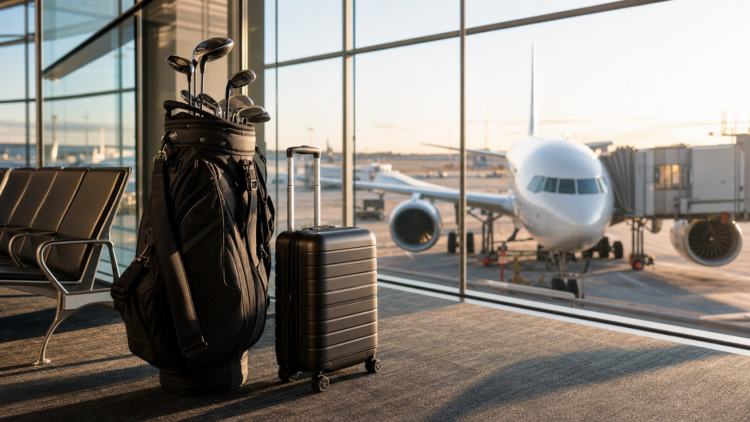

How to Pack Golf Clubs for a Flight: A Step-by-Step Guide
Improper packing is the leading cause of golf club damage in air travel. Follow these seven steps on every trip.
- Choose the right travel bag. Hard-shell cases — polycarbonate or ABS plastic — offer maximum protection and make airline liability claims far easier to support. Soft travel bags are lighter and simpler to store at home, but quality is everything: a premium, well-padded soft case with a stiff arm installed performs very well; a budget bag does not. Look for YKK-grade zippers, thick EVA foam padding, and sturdy wheels. One critical weight calculation: a typical soft bag weighs around 10–11 lbs, and that weight counts against your 50-lb limit before a single club goes in.
- Remove heads from adjustable clubs. Modern drivers, fairway woods, and hybrids use an adjustable hosel adapter that allows the head to be detached with a torque wrench. Removing the head eliminates the most common travel damage scenario: the shaft snapping at the hosel under compression. Store detached heads in their head covers in a side pocket of the travel bag. Before disassembly, photograph your club settings — loft, lie angle, face angle — so you can reset them precisely on arrival. And pack the torque wrench; forgetting it means your clubs can’t be assembled when you get there.
- Install a stiff arm. A stiff arm — a telescoping metal or rigid pole — is arguably the single most important accessory for flying with golf clubs. Insert it into the putter well and extend it 1–2 inches above the tallest club in the bag. If luggage handlers stack heavy items on top of the travel case, the stiff arm absorbs the compression instead of your shafts and club heads. No stiff arm? A broomstick or PVC pipe cut to length with a tennis ball on top works as a capable DIY alternative.
- Pad the heads and fill dead space. Wrap club heads in golf towels. Pack your golf shoes around and above the club heads — shoes serve as cushioning and free up room in your carry-on suitcase at the same time. Fill remaining gaps with rain gear or rolled soft clothing. For additional shaft protection, wrap several shafts together with painter’s tape or athletic tape to reduce independent movement and prevent shaft-on-shaft scratching.
- Account for all accessories — and the TSA rules that govern them. Every golf club — including a single putter or 9-iron — must be checked. The TSA explicitly prohibits golf clubs from carry-on luggage with no exceptions for partial sets or single clubs. Golf balls, tees, and divot tools may travel in carry-on bags. Rangefinders and GPS devices should go in your carry-on, as electronics are often excluded from airline baggage liability. Before sealing the bag, remove all non-essential items — old scorecards, loose change, extra balls — to protect your weight margin.
- Weigh the packed bag at home. Overweight surcharges are among the most avoidable expenses in golf travel. Airlines consistently charge $100–$200 extra per direction for bags over 50 lbs. Pack the bag completely as you intend to check it, then weigh the entire travel bag on a home luggage scale. If it exceeds 50 lbs, remove items until it clears the limit.
- Label the bag inside and out. Attach at least two external baggage tags with your full name, phone number, email, and home address — redundancy matters when one tag gets torn off in handling. Place a card with the same information inside the bag. Insert an Apple AirTag, Tile, or similar Bluetooth tracker in the bag; several airlines, including American Airlines, now support AirTag location link sharing directly within their online delayed bag report forms, which can significantly speed up recovery when a bag goes astray.
Smart Strategies to Reduce or Avoid Golf Club Baggage Fees
- Ship your clubs ahead. Services like Ship Sticks — which has shipped more than 4 million golf bags — and Luggage Forward act as intermediaries, booking shipments through carriers like FedEx and UPS at negotiated group rates, marketing savings of up to 60% compared to standard retail shipping. Door-to-door service picks clubs up at your home and delivers them to your hotel or course. Plan 2–5 business days in advance. This approach works best for resort golf vacations and destination trips, rather than quick-turnaround itineraries.
- Choose a golf-friendly carrier. Alaska Airlines is the standout: it explicitly waives the oversize fee for golf clubs — a benefit most travelers never discover until they read the fine print. JetBlue also charges no separate sports equipment fee for golf bags. Factor carrier-specific golf policies into your booking decision, not just the base ticket price.
- Use a co-branded airline credit card. This is the most underutilized fee-reduction strategy for regular golf travelers. Most major U.S. airline credit cards include a free first checked bag for the cardholder and, in many cases, companions on the same reservation. Examples: Delta SkyMiles Amex cardholders get the first bag free for themselves and up to eight companions; Alaska Visa and AAdvantage cardholders receive similar waivers on eligible domestic itineraries. A single round trip with waivers on two bags can pay for a card’s annual fee in full.
- Rent clubs at your destination. Approximately 30% of traveling golfers rent clubs instead of bringing their own. Rental sets at most resort courses range from budget-friendly standard sets to premium-brand options, often competing directly with round-trip bag fees for short trips or casual rounds. Major golf resort destinations — Scottsdale, Myrtle Beach, Pebble Beach, Pinehurst, Hawaii, and Palm Springs — all offer premium rental options. For serious players requiring custom-fitted equipment, renting rarely satisfies; for occasional players, the math often works in favor of renting.
- Travel with a Sunday bag (partial set). A Sunday bag — a minimalist carry-bag holding 6–9 clubs rather than a full 14-club set — weighs significantly less than a full travel case, which can make the difference between clearing 50 lbs and paying a surcharge. All clubs in a Sunday bag must still be checked; the TSA permits no exceptions, including for a single club or putter.
What to Do If the Airline Damages Your Golf Clubs
The cardinal rule: do not leave the airport with damaged equipment before filing a report. Once a passenger exits the baggage claim area, their leverage against the airline diminishes sharply.
- Inspect the bag before you leave baggage claim. Golf bags are typically delivered to the oversized baggage claim area, not the standard carousel. Retrieve the bag, inspect the exterior for visible damage, and open it to examine the clubs before proceeding further.
- File a Property Irregularity Report (PIR) at the airline’s Baggage Service desk. The PIR is the foundational document for any damage claim — without it, no claim can be made against the airline. It contains a unique reference number in a five-letter, five-digit format that you’ll need for all subsequent communication. Filing a PIR does not guarantee compensation, but it establishes the record. For domestic U.S. flights, file before leaving the airport — American Airlines, for example, sets a 6-hour window from the time you receive your bags. For international flights under the Montreal Convention, you have up to 7 days from receipt of the bag. American Airlines has implemented a QR code system at baggage claim, allowing passengers to begin a report digitally from their phone without visiting the desk.
- Document everything. Photograph the exterior of the bag, any visible damage, the interior, and each damaged club individually. Retain your boarding pass, baggage claim tag receipts, and itinerary confirmation. Note the date, flight number, and airports in writing. Golfers who photographed their packed bag — open and closed — before check-in have a timestamped baseline that makes it virtually impossible for the airline to dispute when damage occurred.
- Know your liability limits. Under 14 CFR Part 254, U.S. airlines must compensate for up to $4,700 per passenger for lost, delayed, or damaged checked baggage on domestic flights — a limit updated on January 22, 2025, representing a 23.7% increase from the previous $3,800 cap. For international flights, the Montreal Convention caps liability at approximately 1,519 Special Drawing Rights per passenger (roughly $2,000–$2,200 USD as of December 2024). These are maximum limits, not automatic payouts; airlines pay the depreciated value of demonstrated losses within those caps. For maximum compensation, cite 14 CFR Part 254 in your written claim and provide itemized documentation of all damaged equipment.
- Supplement with travel insurance or credit card coverage. Comprehensive golf travel insurance can cover equipment damage or loss beyond what the airline compensates, plus non-refundable green fees and rental equipment costs during a delay. Many premium travel rewards credit cards include baggage protection coverage as a cardholder benefit. Review your card’s benefits guide before every trip — not after the clubs arrive damaged.
Pro Tips: What Experienced Golf Travelers Always Do
These habits separate golfers who travel with clubs confidently from those who spend the first hour of every trip at the baggage service desk.
- Book direct flights whenever possible. Every connection is a new opportunity for the airline to misroute or damage a golf bag during an interline transfer. The premium for a nonstop is often worth paying — particularly for expensive, custom-fitted equipment.
- Arrive at the airport earlier than usual. Oversized sporting goods, including golf bags, often require check-in at a dedicated oversized baggage counter that is separate from standard bag drops. Showing up at your usual time risks missing the cutoff for checked bags entirely.
- Photograph your packed bag before check-in — open and closed. A timestamped photo of your clubs in good condition, taken moments before you hand the bag to the airline, creates an irrefutable pre-travel baseline for any damage claim. Make this a pre-trip habit, not a post-incident reaction.
- Use TSA-approved locks on hard cases. TSA agents are authorized to cut non-TSA-approved locks if they need to inspect bag contents. TSA-approved locks — identifiable by the red diamond symbol — can be opened and re-locked without destruction.
- Check your airline’s current policy within 72 hours of departure. Baggage policies can change on short notice. Four major carriers raised fees within a two-week window in April 2026 — with a fifth, American, updating its fee structure simultaneously. A quick pre-departure check confirms current weight limits, fee structures, and any sports equipment advisories that could affect your trip.

Key Takeaways
- Verify airline policies before every trip. Golf club rules and fees vary by carrier and change without notice. Check the airline’s official website within 72 hours of departure.
- Smart packing is your best protection. A stiff arm, head covers, shoes as cushioning, and a pre-departure weigh-in dramatically reduce damage risk.
- Most fees are avoidable. Co-branded airline cards, elite status, and golf-friendly carriers like Alaska Airlines (which waives the oversize fee for golf clubs) can eliminate most checked bag costs.
- File a PIR before leaving the airport. It is the required first step in any damage claim. U.S. domestic liability is capped at $4,700 per passenger under 14 CFR Part 254.
- Direct flights, early arrival, and pre-departure photos. These three habits protect your equipment and your claim options on every trip.