


Its cover promises balloons to spaceplanes, and DK counts more than 800 aircraft in its 320 pages. Here’s what this Smithsonian-branded DK survey offers—and what to weigh before you buy.
Before You Turn the First Page
Sooner or later, every serious aviation library runs into the same problem. There is a book on the Spitfire, another on the jetliner, a third on the pioneers—and still no single place where the whole procession of flight can be seen at once. Aircraft: The Definitive Visual History is DK’s answer to that gap: a 320-page hardcover, published in 2022 with the Smithsonian name on its cover, that DK says covers more than 800 aircraft models, arranged decade by decade across the world’s military and commercial aviation.
The book pairs period catalogs—spreads of aircraft with compact data panels—with larger features on selected aircraft, engines and manufacturers. For civil and military enthusiasts who want breadth, and for the spouses, children and friends who buy books for them, that combination is the main attraction.
The essential qualification belongs up front. In DK’s own online sample pages, the catalog entries are concise: a short caption and a small panel of figures, several aircraft to a spread. Readers who want the full development story of a favorite type will need a specialist reference alongside it.
What follows covers what lies between the covers, whom the book suits, where it stops, and how to make sure you order the 2022 hardcover. The short version: this is a book for surveying the whole forest, not for counting the rivets on a single tree.
Aircraft: The Definitive Visual History at a Glance: Inside the Covers
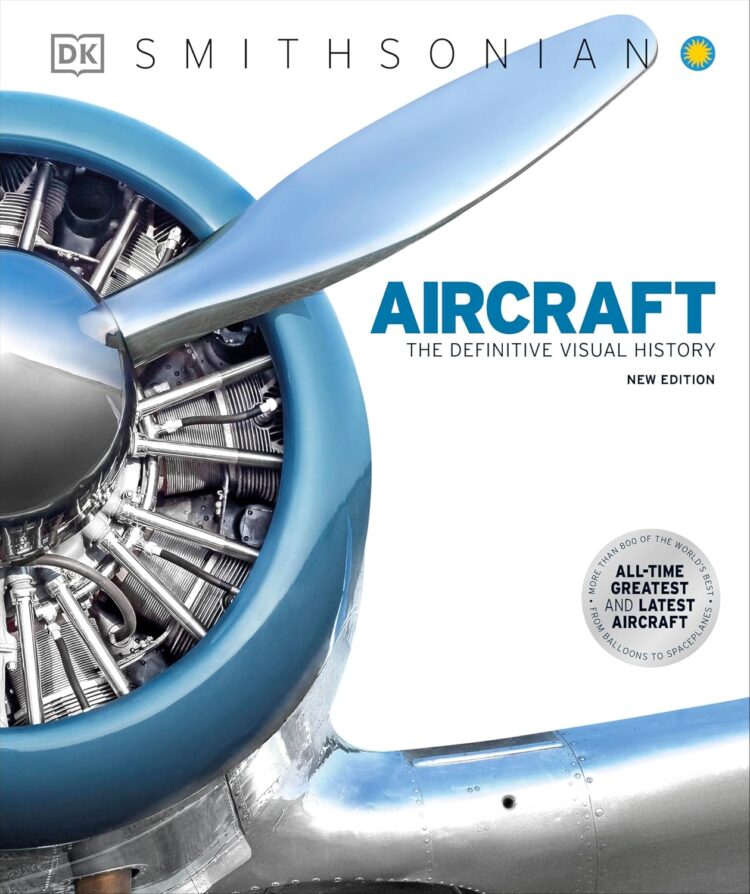
The publisher credits the book simply to DK; no individual author is named in its listing. The cover carries both the DK and Smithsonian names, a pairing best read as an association rather than as a description of who checked which page. The title sits in DK’s visual-history range of transport references, sold under the DK Definitive Transport Guides label, and the cover identifies it as a new edition.
| Detail | 2022 U.S. edition (promoted) |
| Title | Aircraft: The Definitive Visual History |
| Author credit | DK |
| Cover branding | DK and Smithsonian |
| Edition | New edition, published April 26, 2022 |
| Format and length | Hardcover, 320 pages |
| ISBN | 978-0744027457 (ISBN-10: 0744027454) |
| Size | Large format; the publisher lists 8-3/8 by 10-1/16 inches |
| Scope | More than 800 aircraft models, according to DK |
The architecture is easy to grasp. DK describes a decade-by-decade history, and the sample pages the publisher has posted online show how the parts fit together:
- Chronological chapters. Period running heads in the samples range from “Before 1920” to “After 2000.”
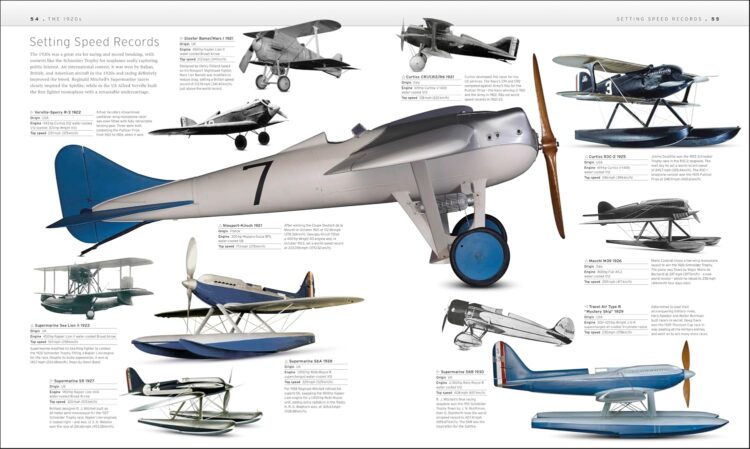
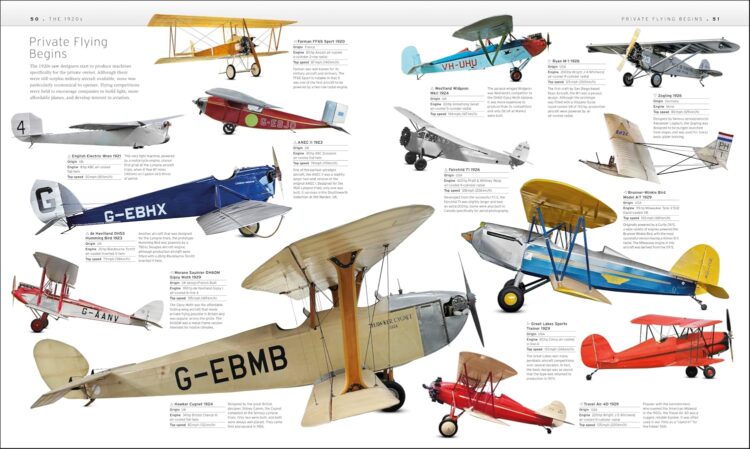
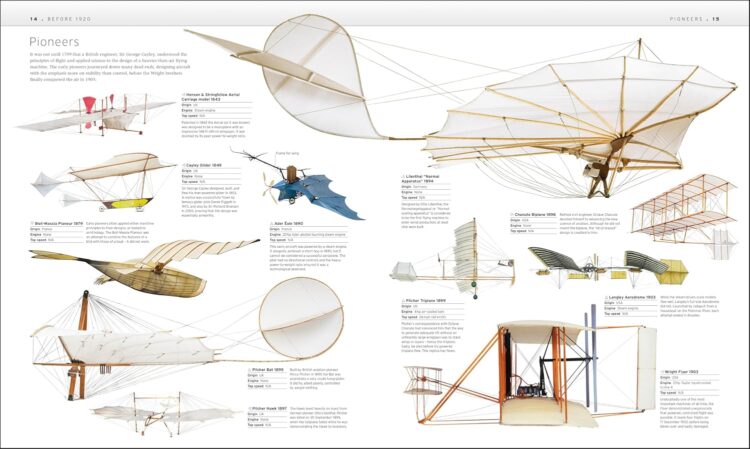
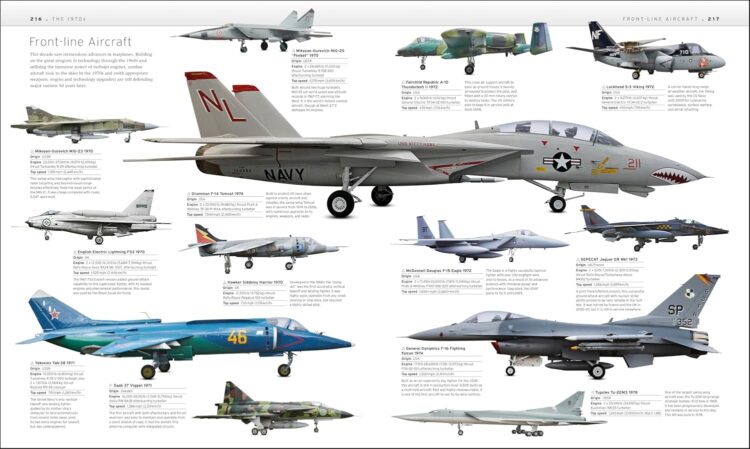
- Period catalogs. The pioneer pages and 1920s spreads such as “Private Flying Begins” and “Setting Speed Records” place several aircraft on each spread, with short captions and compact panels listing fields such as origin, engine and top speed.
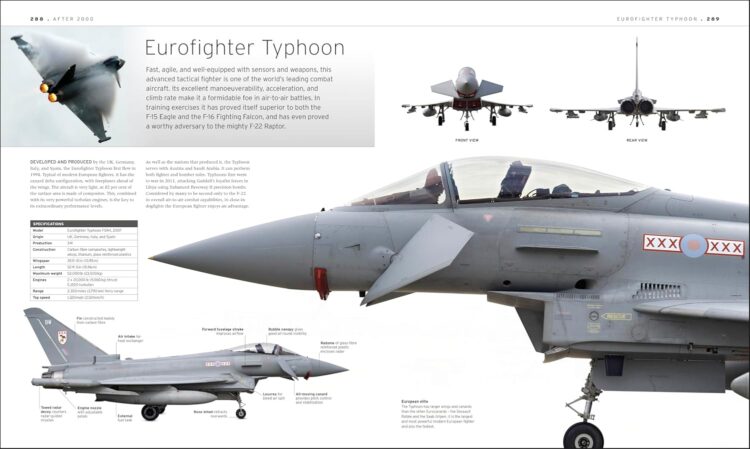
- Showcases. DK identifies photographic showcases of the Supermarine Spitfire and Concorde, running from exterior to cockpit; a sample Eurofighter Typhoon spread combines several exterior views, labeled details and a specification table.
- Makers and engines. The samples include illustrated features on Fokker, Boeing and Airbus, plus large, labeled engine studies of the Pratt & Whitney R-1830 Twin Wasp, the Rolls-Royce Pegasus and a Rotax ultralight two-stroke in its single-carburetor UL-1V form; DK’s description also mentions Lockheed.
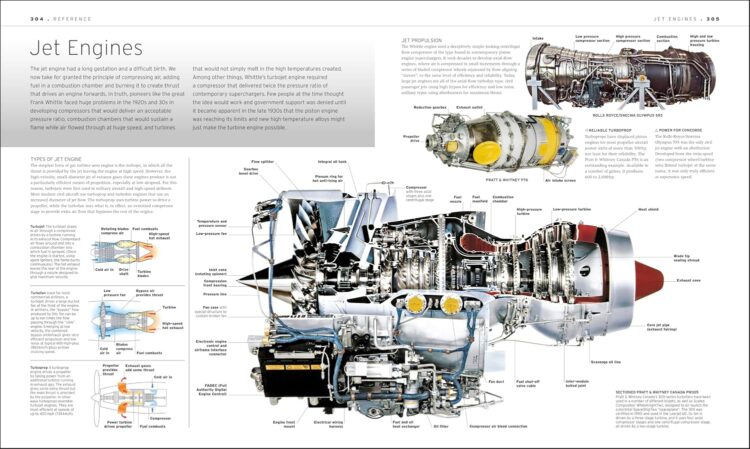
- Reference pages. A back-matter “Jet Engines” spread (pp. 304–305) covers the jet engine with diagrams, labeled components and a sectioned engine photograph.
As for range, the cover itself promises balloons to spaceplanes, and a U.S. bookseller’s description for this ISBN lists planes, helicopters and airships.
The format leads with photography and keeps text in short blocks, so it suits readers comfortable with captions and data panels. The publisher’s listing for this edition states no age range or assumed background.
If one well-illustrated survey is what your shelf is missing, you can check the 2022 hardcover on Amazon for its current price and availability. A Kindle edition appears among the format choices on the same page, so confirm that the hardcover, ISBN 978-0744027457, is the version selected.
What This Book Gives You
- The whole arc of flight in one sequence. Decade-by-decade chapters set each era’s aircraft side by side; it is a survey, not a narrative history.
- A catalog built for browsing. DK’s period catalogs carry specifications and distinguishing features, in compact entries rather than exhaustive tables.
- Closer looks at selected icons. Expanded showcases, which DK says include the Spitfire and Concorde, give a handful of aircraft multiple views and labeled details.
- Context beyond the airframes. Features on manufacturers and engines—from Fokker to Airbus, from the Twin Wasp to the Pegasus—explain the industry behind the silhouettes.
- A volume to keep and give. A large-format hardcover suits the coffee table and the gift list, though its size makes it a book for home rather than the flight bag.
Who Should Read It — or Give It
Interest in aviation alone does not settle the question. What matters is whether the reader wants a broad illustrated survey or deep treatment of one aircraft.
Ideal readers and recipients
- For the generalist enthusiast, civil or military, who would rather have one overview than a shelf of single-type monographs, this is the natural fit.
- Museum-goers and airshow regulars who want to place the aircraft they have seen within a larger chronology will find the period arrangement useful.
- Pilots and veterans who know their own aircraft intimately may enjoy seeing where those types sit in the wider story—though it is worth checking first that a particular aircraft appears.
- Scale modelers may value it for era context and quick type recognition before choosing a kit; the photographs are not presented as modeling references.
- Curious newcomers and teenagers who enjoy illustrated reference books are plausible readers, provided dense labels and summary entries suit them.
- Gift buyers should ask one question before ordering: does the recipient prefer breadth or depth? If the answer is breadth, the book fits the brief.
Who may prefer something else
- Specialists and researchers who need detailed development histories, exact variants or complete performance data should choose, or add, a type-specific reference.
- Readers who want a narrative history, with sustained argument and analysis, will find this a visual catalog first.
- Owners of the earlier edition should compare pages before buying again. DK labels the 2022 book a new edition, and a U.S. bookseller’s description for this ISBN says it adds examples of the latest aircraft, but as of October 2026 no published account located for this article details how much changed.
- Readers who want a compact or portable book may find the large hardcover unwieldy; DK also lists an ebook edition.
Keeping the book you already have, or buying a deeper study of one aircraft, is a perfectly sound decision.
Why Aircraft: The Definitive Visual History Deserves a Place on Your Bookshelf
The case for this book rests on a single proposition: breadth made visible. Each of its strengths serves that idea, and each comes with a boundary worth knowing.
Seeing a Century of Flight Unfold, Decade by Decade
Most aviation books isolate their subject. This one groups aircraft by period, so a reader turning from the “Before 1920” pioneers toward the “After 2000” pages watches the airplane change shape, power and purpose in sequence. The practical gain is orientation. Seeing contemporaries on the same spread makes it easier to grasp what a given aircraft was up against, what came just before it and what was about to replace it—something that reading about a type in isolation does not always offer.
That benefit is a matter of preference rather than a promise of better learning, and readers who think in timelines will feel it most. The arrangement also favors overview over storytelling. Even so, context does not live only in captions: the manufacturer spreads in DK’s samples carry sustained prose alongside their photographs and illustrations, giving the chronology connective tissue between the catalog pages.
A Catalog That Rewards Browsing and Quick Reference
The period catalogs are where the 800-plus figure lives. DK describes them as listings of each era’s aircraft with specifications and distinguishing features, and the sample pages bear that out in compact form: several aircraft per spread, a short caption for each, and data panels with fields such as origin, engine and top speed. The Typhoon showcase adds a fuller specification table, including wingspan.
For identifying a type, comparing contemporaries or getting oriented before deeper reading, that format works well. Something has to give when more than 800 aircraft share 320 pages, however, and what gives is the word count. Readers should not assume that every entry carries identical fields, and the panels are summaries rather than complete performance tables. Anyone settling a fine point about a particular variant should take it to a specialist source.
Virtual Tours That Take You From the Nose to the Flight Deck
Selected aircraft receive the expanded treatment. DK says its photographic showcases include the Supermarine Spitfire and Concorde and run from exterior to cockpit. The Typhoon sample shows the approach in practice: several exterior views, labeled details and a specification panel on one spread, though that particular spread stays outside the aircraft rather than taking the reader into the cockpit.
DK’s description also mentions the de Havilland Gipsy Moth, though its copy groups the airplane among present-day marvels. The DH.60G Gipsy Moth in fact belongs to the 1920s and 1930s, which makes it a classic of the interwar years rather than a modern marvel.
The layout philosophy is not new to this title. Writing in May 2013 about the earlier book, Ben Sclair, publisher of General Aviation News, observed: “The layout is compelling and makes flipping through the book easy and enjoyable.” His verdict concerned that edition, not the 2022 hardcover; still, it describes the browsing experience this format is built to deliver.
The Makers, the Engines and the Stories Between the Specs
Airframes are only half the story, and the book’s features on companies and powerplants supply much of the rest. DK’s samples include illustrated spreads on Fokker, Boeing and Airbus, each combining text with photographs or illustrations under a company heading; DK’s description also mentions Lockheed and engine context. The engine features stand out in the samples: large, labeled photographs of the Pratt & Whitney R-1830 Twin Wasp, the Rolls-Royce Pegasus and a Rotax ultralight two-stroke in UL-1V form, each with its own specification panel. The “Jet Engines” reference spread then illustrates the jet engine with diagrams, labeled components and a sectioned engine photograph.
For the reader who has always wanted to know what sat behind the propeller or inside the nacelle, these pages add interpretation to recognition. They are illustrated features, however, not maintenance or operating references.
A Book Built to Stay on the Shelf
A survey of this kind earns its keep through return visits: to check when a type appeared, to place a museum visit in context, or to share the pages with a younger family member who has just caught the bug. The hardcover format, the DK visual style and the Smithsonian branding all suit a book meant to stay out on the coffee table rather than in a box.
Two cautions keep that enthusiasm honest. As of October 2026, no substantive independent review of the 2022 edition addressing its accuracy or print quality could be found, so the Smithsonian name is best taken as an association rather than a fact-checking guarantee. And more than 800 is a generous number, but a finite one; a reader buying for the sake of one particular aircraft should confirm it appears. For everyone else, the reward is simple. It shows the long sweep of the story, and it leaves the footnotes to others.
Aircraft: The Definitive Visual History DK, with Smithsonian branding · New edition (2022) · Hardcover, 320 pages · ISBN 978-0744027457
A decade-by-decade visual survey that DK says covers more than 800 military and commercial aircraft.
Add It to Your Aviation Library
The decision rule is straightforward. If you want one richly illustrated overview of aviation’s whole sweep, and you accept concise entries in exchange for that breadth, this volume earns its shelf space. If you need depth on particular types, treat it as a companion to specialist references rather than a substitute, and if you already own the earlier edition, compare pages first.
The link below opens the Amazon listing, where you can check the current price, seller, condition and delivery options before deciding whether to order. Because a Kindle edition appears among the format choices and other editions circulate under similar titles, confirm that the selected item is the 2022 hardcover, ISBN 978-0744027457.
See the 2022 edition on Amazon
Frequently Asked Questions
Q: Is Aircraft: The Definitive Visual History a good gift for a pilot or veteran who already knows a lot about aviation?
A: It may suit a pilot or veteran who wants a broad visual survey. Expertise alone does not decide the matter. The book’s strength is breadth across eras, presented in concise catalog entries alongside selected longer features, so an expert hoping for deep coverage of one aircraft may find the treatment brief. Before buying, check whether the recipient enjoys wide-ranging illustrated books, whether they already own an edition, and whether their interest is confined to a single type.
Q: How is the 2022 edition of Aircraft: The Definitive Visual History different from the 2013 edition?
A: The two books have different ISBNs and different listed dimensions; the extent of the content revision has not been publicly detailed. The 2022 hardcover is ISBN 978-0744027457, with the publisher listing 8-3/8 by 10-1/16 inches. The earlier U.S. book, ISBN 978-1465402127, was also 320 pages, and DK’s 2017 catalog listed it at a larger 9-7/8 by 11-7/8 inches, crediting Philip Whiteman. DK calls the 2022 book a new edition, but as of October 2026 no published account located for this article details how much changed between the two.
Q: Does Aircraft: The Definitive Visual History include specifications for each aircraft?
A: DK describes catalogs with specifications, but uniform data for every aircraft should not be assumed. The publisher’s sample catalog pages show compact panels with fields such as origin, engine and top speed, while the Typhoon showcase adds a fuller table that includes wingspan. These are summaries, not complete performance records. Readers who need exact variant data should consult a specialist source.
Q: Does the book cover military and civil aircraft, including helicopters and airships?
A: DK describes military and commercial coverage, and a U.S. bookseller’s description for this ISBN also lists helicopters and airships. The cover presents the span as balloons to spaceplanes. Neither description amounts to a list of every rotorcraft or airship included, nor does it establish equal space for each category, so a buyer seeking one specific type should confirm it appears.
Q: Is Aircraft: The Definitive Visual History suitable for a teenager interested in aviation?
A: It could suit a teenager who enjoys illustrated reference books, though the publisher’s listing gives no age range. The book leads with photographs, short captions and data panels rather than long chapters. Whether that suits a particular young reader depends on their appetite for labels and summary entries, so a look at DK’s online sample pages is a sensible first step.
Q: Is The Aircraft Book the same as Aircraft: The Definitive Visual History?
A: The Aircraft Book is a separately identified Commonwealth-market title, and complete equivalence has not been established. The Aircraft Book: The Definitive Visual History is listed as a 320-page hardback, ISBN 978-0241446355, published March 16, 2021. It should not be assumed identical in text, photographs or design. U.S. buyers seeking the edition described here should order ISBN 978-0744027457.
Q: Is there a Kindle version, and is the hardcover the better buy?
A: An ebook edition is listed, but which format works better depends on the reader. DK lists an ebook, and Kindle appears among the format choices on the Amazon page. Readers weighing the two should preview the digital version on the device they intend to use, and confirm which format is selected before ordering.

Key Takeaways
- A DK survey with Smithsonian cover branding that, by DK’s count, covers more than 800 military and commercial aircraft, decade by decade, in a 320-page 2022 hardcover.
- Its strengths are chronological sweep, browsable catalogs and expanded features on selected aircraft, manufacturers and engines.
- Catalog entries are concise; specialists will want deeper references alongside it.
- Earlier-edition owners should compare pages first, and buyers should confirm the hardcover, ISBN 978-0744027457, at checkout.