


Thirteen years after launch, this snap-together American 777-300ER still owns the “big, easy, accurate” corner of the shelf. It snaps together faster than your coffee cools, then sits on the shelf like a serious model. Here’s what that shortcut actually costs you.
Brief Overview
A word on method before we start: nobody on this desk cut a sprue gate for this review, because there aren’t any to cut. The Daron Skymarks 1/200 American 777-300 is not a kit in the traditional sense, so we evaluated it the way it deserves to be evaluated — against manufacturer specifications, Scalemates tooling records, Boeing dimensional data, retailer listings, and the accumulated Amazon owner record. Where the public record is thin, we say so.
What It Is
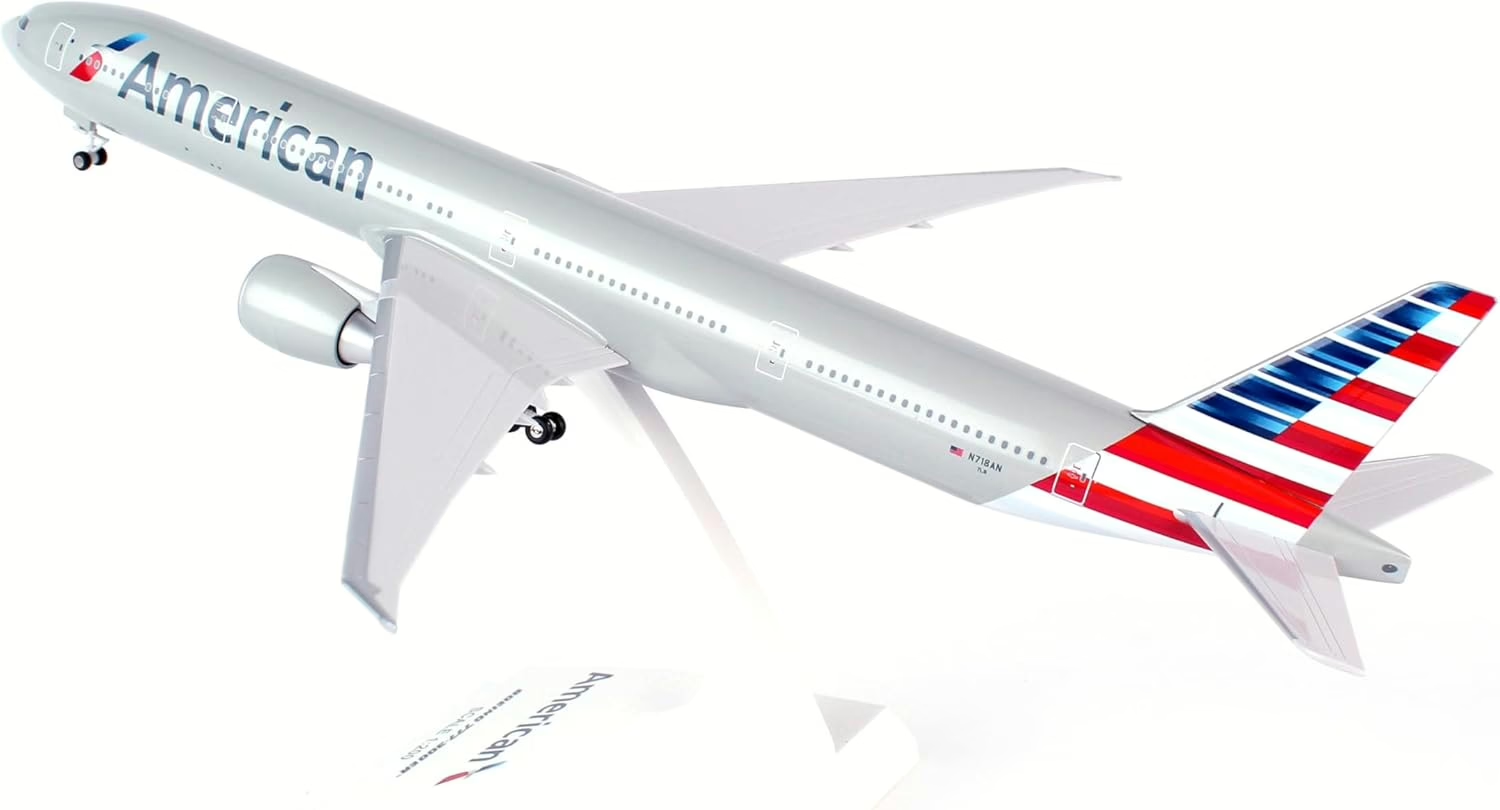
The Daron Skymarks SKR715 is a 1/200-scale static snap-fit display model of the American Airlines Boeing 777-300ER, wearing the carrier’s post-2013 “New Livery” — flag tail, polished-style fuselage, American titles. Some listings reference registration N718AN. It is not a styrene glue-and-paint kit. There is no cement, no filler, no paint, no decal sheet. The parts arrive pre-colored in solid injection-molded plastic with the livery applied at the factory — pad printing, by the standard practice in this category, though Daron’s copy promises only “highly detailed graphics”; you snap them together and set the finished airplane on its stand or on its own wheels. Scalemates classifies it plainly under “static snap-fit kits,” and that classification is the single most important thing a buyer needs to understand before clicking purchase. If you came looking for a construction project, this isn’t one — and our roundup of the best model airplane kits is the better starting point.
Target Audience
Daron built this for four people: the beginner who wants a finished airliner on the shelf tonight; the airline-livery collector filling an American Airlines or Boeing 777 slot; the desk, office, or bookshelf buyer who wants roughly 14.5 inches of presence without the bulk or cost of metal; and the gift buyer shopping for an aviation enthusiast who may never have held a hobby knife. It is graded as an adult collectible, ages 14+, with a small-parts warning on the box.
Cool Features
- No glue, no paint, no tools. Keyed tabs and slots. Daron’s Skymarks copy promises models that “assemble in minutes,” and the owner record backs that up.
- Factory pad-printed current livery. No silvering, no misplaced decals, no clear coat — and the scheme it depicts is still American’s livery in 2026.
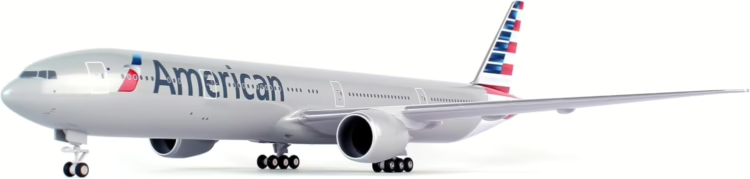
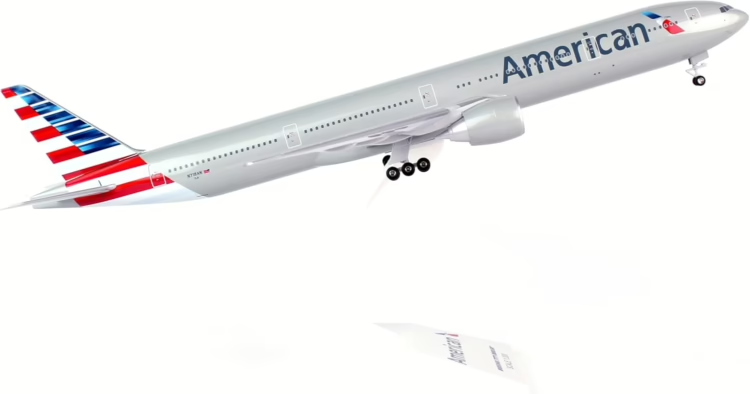
- Landing gear in the box. This is the “w/Gear” boxing, so the six-wheel mains and nose gear are included. Skymarks lists spinning engine fans only on models where noted, and Daron’s copy for this SKU doesn’t — so confirm on the listing you buy.
- Solid plastic, not a hollow shell. That construction choice is why owners keep using the word “hefty.”
Ready to put a 777-300ER on your desk this week? Check current availability on Amazon →
Pros & Cons
Pros
- Zero-barrier accessibility. Complete assembly in minutes with nothing added from your bench. For a first-time buyer, that eliminates the most common failure mode in this hobby: the unfinished project in the closet.
- Livery fidelity that survives handling. Pad printing on pre-colored plastic represents the post-2013 American scheme correctly and sidesteps the tearing and silvering risks of water-slide markings.
- Genuine display presence. At roughly 14.5 inches (368 mm) long with a 12-inch (305 mm) span per Daron’s own listing, this reads as a serious model across a room. Smaller scales simply cannot do that.
- Interactive without being a toy. Rolling six-wheel main bogies and dual nose wheels give it more tactile life than a fixed-gear display piece; owners on some listings also report free-spinning engine fans, though that’s not on Daron’s spec sheet for this SKU.
- Complete in the box. A display stand is included, so it’s shelf-ready out of the carton.
Cons
- The detail ceiling is real. Panel lines are cleanly scribed but simplified. Micro-stenciling — “No Step,” door labels, maintenance markings — is absent, as is interior detail. Antennae and probes are omitted or heavily simplified, and control surfaces are molded in place. That’s the category, not a defect, but you should know it going in.
- The gear struts are the weak point. The locating pins are thin plastic and can shear if forced at an angle. Multiple owners report nose-gear looseness after repeated removal and reinstallation.
- Stand type varies by listing. Skymarks sells a wood-stand version of this airplane alongside the standard plastic-arm SKR715, and retail listings don’t always make clear which is in the carton. Several owners also report the stand needing firm pressure to seat. If you specifically want the wooden base, confirm with the seller first.
- The gloss is a shade too bright. The “polished” fuselage areas are high-gloss, which owner accounts flag as less nuanced than the real aircraft’s satin silver-mica finish.
Expected Experience with the Daron Skymarks 1/200 American 777-300
Build/Handling Complexity
You’ll get a small number of large, pre-finished parts and a sequence that explains itself. Owner reports converge on the same order: fuselage first (the vertical stabilizer is molded integrally and already carries most of the printing), then the left and right wing assemblies into keyed roots that set dihedral and incidence for you, then the horizontal stabilizers, then the GE90 nacelles onto the pylons. The six-wheel main bogies and the dual nose gear go in last, followed optionally by the stand into its fuselage receptacle. Reports differ on whether the gear ships loose or already fitted, so check before you start pulling at it.
Daron supplies instructions, but they’re largely beside the point — the keyed parts only go together one way. Reported completion times cluster between under five minutes and ten. The one place to slow down is gear installation — insert the struts straight, don’t lever them, and don’t make a habit of pulling them back out.
Detailing & Fit/Finish Quality
Owner and retailer accounts describe a tight snap fit with minimal gaps and panel lines appropriate to the scale and category. Those same accounts read the GE90 nacelle shape as accurate, and the six-wheel main bogies and dual nose wheels are correctly configured for a 777-300ER. The raked wingtips — the visual tell that separates the ER from the earlier 777-300 — are correctly reproduced.
On proportions, the arithmetic holds up. The real airplane measures 242 ft 4 in (73.86 m) long with a 212 ft 7 in (64.80 m) span, which converts to 14.54 inches and 12.76 inches at 1/200. The stated length lands within a twentieth of an inch of that. The wingspan is the open question: Daron’s own copy says 12 inches, roughly three-quarters of an inch short of true scale. The only larger figure in circulation, 12.75 inches, appears in a commercially affiliated online review and is unsupported by any published measurement. Nobody appears to have settled it with calipers. We should be straight about the limits of that check: as of August 2026 we could locate no independent dimensional audit against published scale drawings by a tier-1 modeling publication, and no laboratory testing of gear-strut strength or long-term UV stability of the pad printing. Anyone claiming otherwise is guessing.
Overall First Impressions
Owners consistently describe the same arc. The box is a side-opening folding carton, with the major parts cradled inside; owner reports of transit damage are uncommon. Parts come out looking finished. Assembly ends before the coffee cools. And then the thing is simply big — the recurring first reaction across years of owner commentary is size and heft, followed by the solid feel of the fuselage — and, on units that have them, the satisfying free-spin of the fans.
Where the Daron Skymarks 1/200 American 777-300 Really Shines
The SKR715 solves a specific frustration: wanting a large, accurate American flagship on the shelf without committing to a multi-week project. Traditional 1/144 and 1/200 airliner kits from the major Japanese and European manufacturers routinely run to many bench hours for a clean result once you factor cement, filler, paint, clear coats, and aftermarket markings. This collapses that to a few minutes of careful handling.
The emotional payoff is more specific than “a big Boeing.” American operates 20 777-300ERs, its largest and most premium long-haul type. That has long meant a four-cabin, 304-seat layout — eight Flagship First suites, 52 Flagship Business, 28 Premium Economy, and 216 Main Cabin — making American the last U.S. carrier still selling international first class. That’s changing: all 20 jets are slated for reconfiguration under Project Olympus to 330 seats, with 70 Flagship Suites, 44 Premium Economy, and Flagship First deleted entirely. The first airframe went into the shop in December 2025, and the fleet-wide program is expected to run about two more years. Deliveries began in December 2012; the livery this model wears was unveiled the following month. For a U.S. collector, that’s the airplane that carried them on a first long-haul trip, or the one that represents the modern face of the carrier. The flag tail, the American titles, the GE90 shape, the stretched proportions — the model delivers the cues that trigger the recognition.
It also works where a fragile die-cast wouldn’t: an office shelf, a conversation-starting desk, a gift for someone who has never built anything and shouldn’t be handed a project. And it’s a low-friction entry into 1/200 before anyone spends serious money on metal.
See the Daron Skymarks American 777-300 (SKR715) on Amazon →
1/200 scale · with landing gear · New Livery · snap-fit, no glue or paint required
Who Should Buy It
Ideal Buyer Profiles
Buy the SKR715 if you want a finished 1/200 American 777-300ER on your shelf this weekend, value authentic current livery and functional rolling gear, and prefer solid plastic to the higher cost and small-parts fragility of metal. That covers beginners and casual enthusiasts who care about the finished appearance more than the process; American Airlines and Boeing 777 collectors who need a correctly liveried, large-footprint example; gift purchasers buying for aviation fans of any skill level; and desk or office display buyers.
Who Should Consider Alternatives
Look elsewhere if you want a construction challenge with a high parts count, interior detail, and painting or weathering opportunities — traditional injection kits from Zvezda or Revell are the right tool. Collectors demanding maximum surface detail, metal construction, or interchangeable gear should price out GeminiJets, JC Wings, Herpa Wings metal, or Inflight 200 in 1/200, accepting the higher cost. Strict-budget buyers who can live with less detail or a smaller model have Herpa SnapFit and the 1/400–1/500 metal ranges. And if you specifically require a wooden base with a metal nameplate, listing variation makes the SKR715 an unreliable way to get one.
One more caveat worth stating plainly: no dedicated aftermarket sets — photo-etch, resin, replacement gear — are known for this tooling. Customization means irreversible modification.
Frequently Asked Questions
What skill level do I need to get a good-looking result from the Daron Skymarks 1/200 American 777-300?
The Daron Skymarks 1/200 American 777-300 requires no modeling experience at all.
- Parts are pre-colored and pad-printed at the factory; nothing needs painting or decaling.
- Assembly is snap-fit via keyed tabs and slots — no glue, tools, or filler.
- Adult motor skills are sufficient; the only caution is inserting the thin landing-gear struts straight rather than at an angle.
Does the Skymarks SKR715 actually live up to Daron’s reputation for quality snap-fit models?
The Skymarks SKR715 lives up to Daron’s mid-tier reputation, within the limits of its category.
- Daron Worldwide Trading, founded in 1987 and based in New Jersey, builds Skymarks around removing barriers, not maximizing detail.
- Solid plastic construction and accurate pad-printed livery are consistently praised in the owner record.
- It sits above basic economy snap-fit lines and below premium die-cast — and Daron markets its airline models as officially licensed, with the SKR715 carrying American Airlines branding under that program.
How does the Skymarks 1/200 American 777-300 compare to GeminiJets, Herpa, and Hogan models in the same scale?
The Skymarks 1/200 American 777-300 trades surface detail and material prestige for accessibility and value.
- Versus premium die-cast (GeminiJets, JC Wings, Herpa metal): less surface detail and none of the metal heft, but lower cost and fewer fine parts to lose. Gemini200 rolls too, and offers interchangeable gear — so function isn’t the dividing line. Price and material are.
- Versus economy snap-fit (Herpa SnapFit): solid rather than thin-wall construction and landing gear included in this boxing; Herpa’s 1/200 Snap-Fit models typically ship stand-only and cost noticeably less.
- Versus other mid-tier plastic (Hogan): comparable or better, with strong livery fidelity.
Is the Daron Skymarks 1/200 American 777-300 good value for what it costs?
The Daron Skymarks 1/200 American 777-300 is strong value for display-focused buyers and weak value for builders.
- You get a complete, finished, roughly 14.5-inch model with a stand and no additional purchases required.
- A higher-detail alternative does exist — GeminiJets’ Gemini200 American 777-300ER — but as of August 2026 it runs roughly half again the Skymarks price and is produced in limited runs.
- If you measure value in bench hours and painting opportunities, this product doesn’t provide any.
Who should avoid buying the Skymarks SKR715?
Skip the Skymarks SKR715 if you want a build project or premium die-cast detail.
- Modelers seeking a multi-hour construction, painting, and weathering project.
- Collectors who require metal construction or the finest surface detail and full stenciling.
- Buyers unwilling to accept possible stand-type variation or the need to handle gear struts gently.

Key Takeaways
- The SKR715 is a snap-fit, factory-finished 1/200 American Airlines 777-300ER that assembles in minutes without glue, paint, or tools.
- Strengths: accurate current livery, solid plastic construction, rolling gear, and roughly 14.5 inches of display presence.
- Limitations: simplified surface detail, no micro-stenciling, fragile gear struts, and stand type that varies by listing.
- Best for beginners, casual collectors, gift buyers, and desk display; not for modelers wanting a build.
- Still carried by major retailers, still relevant in 2026, with no discontinuation announced.