


The F-15 kill record tops 100 victories with no confirmed loss to an enemy aircraft. But friendly fire over Kuwait, ground fire, and accidents show why the exact wording matters.
The short answer is yes, as long as the claim is worded precisely. The Smithsonian’s National Air and Space Museum credits F-15s with destroying more than 100 enemy aircraft and records no Eagle lost in air-to-air combat to enemy action. That F-15 kill record does not belong to one service. Israeli, American, and Saudi pilots all contributed to it, beginning with an engagement against Syrian MiG-21s in June 1979.

Being undefeated, however, is not the same as being invulnerable. Early on March 2, 2026, local time, three USAF F-15E Strike Eagles went down over Kuwait. U.S. Central Command (CENTCOM) said the jets were mistakenly shot down by Kuwaiti air defenses in an apparent friendly fire incident and that all six aircrew were recovered. The command said the cause was under investigation. About a month later, another F-15E was shot down over Iran. Over the decades, ground fire, structural failures, and loss-of-control accidents have also destroyed Eagles.
That makes the popular slogan “zero air-to-air losses” too loose. The accurate wording is narrower, and it is more interesting. Here is what the F-15 kill record actually shows, how its victories are credited, and how to judge every claim that the streak was broken.
How The F-15 Kill Record Is Counted: What “Undefeated” Actually Means
An aerial victory is a bookkeeping decision, and the USAF’s process is formal. Under Air Force Instruction 84-105, the Air Force Historical Research Agency (AFHRA) confirms USAF aerial victory credits and publishes the only official lists. A credit is validated by documents such as an official order or a victory credit board report, and a board of review can be appointed to examine the evidence.
A credit can be removed only on overwhelming evidence of an error in the original confirmation. The instruction also keeps a separate category for victories over remotely piloted aircraft, so drone kills stay out of the manned-aircraft tally.
The USAF process is not the whole story, though. Other operators keep their own records, and no single reconciled multinational ledger exists. That is why published totals differ:
- A 2002 USAF retrospective reported 104 victories across American, Israeli, and Saudi service.
- A 2012 Edwards Air Force Base article cited program officials giving the same 104.
- Boeing’s historical compilation gives 101.
- A Spring 2021 book review in Air Power History describes 104.5 credits worldwide. The fraction reflects a shared kill.
No single explanation accounts for every difference between these numbers. They are best read as snapshots of the record, each with its own date and scope.
The table below shows how different kinds of events fit, or do not fit, into the manned-aircraft victory record that underpins the “undefeated” claim.
| Event type | How it fits the record | Documented example |
| Enemy manned aircraft destroyed | Counted when credited | Capt. Jeff Hwang’s two MiG-29s, 1999 |
| Enemy helicopter destroyed in flight | Can count | F-15E kill of an Iraqi Mi-24 with a guided bomb, 1991 |
| Enemy crashes while evading | Can earn credit without a weapon hit | Capt. Cesar Rodriguez’s MiG-29, 1991 |
| Drone or cruise-missile intercept | Kept separate from the manned-aircraft tally | Separate remotely piloted vehicle category in AFI 84-105 |
| Loss to ground fire | Not a defeat by an enemy aircraft | Desert Storm Strike Eagle losses |
| Accident | Outside the combat record | 2011 F-15E crash in Libya |
| Air-to-air loss to an ally | A loss, but not a defeat by an enemy | Kuwait, 2026, if the Hornet account is confirmed |
Where The Kills Came From: Israel, America, And Saudi Arabia
The Eagle’s record combines the results of several air forces, each fighting its own wars under its own doctrine. The figures below come from different kinds of sources, including campaign statistics, a reviewed book ledger, and official announcements. They should not be added together into one score.
| Operator | Evidence-supported figure or event | Main setting | Earliest documented victory |
| Israeli Air Force (IAF) | 50.5 credits, per a 2021 Air Power History book review | Syrian aircraft; Lebanon | June 27, 1979 |
| U.S. Air Force | 34 of the USAF’s 37 Desert Storm victories by F-15Cs; four F-15 victories in Allied Force | Iraq 1991; Yugoslavia 1999 | January 17, 1991 |
| Royal Saudi Air Force (RSAF) | One Iranian F-4 in 1984; two Iraqi Mirage F1s in 1991 | Persian Gulf | June 5, 1984 |
| Qatar Emiri Air Force (QEAF) | Two Iranian Su-24s, officially announced; the aircraft type that shot them down has not been confirmed | Regional conflict, 2026 | March 2, 2026 (announcement) |
Israel: First Blood And The Bekaa Valley
Israel scored first. Retired USAF Col. Scott A. Willey, book review editor for Air Power History and a docent at the National Air and Space Museum’s Udvar-Hazy Center, credits then-Maj. Moshe Melnik with the first F-15 victory, scored on June 27, 1979, against Syrian MiG-21s. Willey’s review also reports the book’s table of 50.5 Israeli credits. That figure is a reviewer’s account of a published ledger, not an audit of the IAF’s own files.
The biggest test came in the 1982 Lebanon war, including the air battles over the Bekaa Valley. According to Air & Space Forces Magazine‘s history of that year’s fighting, Israel’s account credits F-15s with 40 Syrian aircraft without a loss, and F-16s with another 44. The same history says two or three Israeli fighters are believed to have been lost to ground fire, and it records differing Syrian claims and admissions. Those opposing totals are not matched loss records, and not every aircraft destroyed in the campaign was an Eagle kill.
Israel’s F-15s kept scoring. A 2013 Air & Space Forces Magazine retrospective reports that Israel claimed two Syrian MiG-29s in 2001.
The U.S. Air Force: The Beyond-Visual-Range Revolution
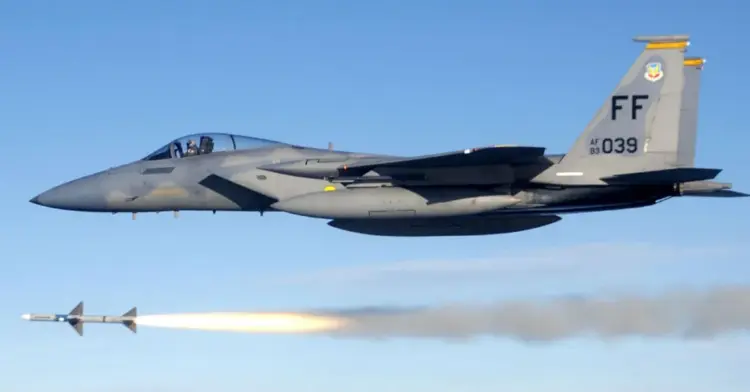
Operation Desert Storm made the Eagle a household name. The USAF’s F-15 fact sheet says F-15Cs scored 34 of the Air Force’s 37 air-to-air victories in the 1991 war. That denominator is USAF victories, not coalition-wide ones.
Official historian Daniel L. Haulman’s study, No Contest: Aerial Combat in the 1990s, explains how those victories were won. Between January 17 and February 28, 1991, USAF F-15s scored 23 kills with the AIM-7 Sparrow, and 16 of them came beyond visual range (BVR), meaning the pilot fired without seeing the target. Haulman links that capability to the E-3 Airborne Warning and Control System (AWACS), a radar aircraft that watches the airspace and directs fighters. AWACS helped crews identify targets they could not see. It did not make the identification problem disappear.
Haulman counts 35 F-15 victories over Iraqi aircraft during the 1990s, across the whole type family, a broader scope than the 34 Desert Storm victories credited to the F-15C alone. Several engagements stand out:
- The opening night. Eglin Air Force Base’s history credits Capt. Jon K. Kelk with a MiG-29 near Mudaysis on January 17, 1991.
- A kill without a shot. On January 19, a MiG-29 bracketed by Capt. Cesar Rodriguez and Capt. Craig Underhill crashed into the desert while its pilot tried to evade them. This is the textbook case of a maneuver kill.
- A bomb against a helicopter. In February 1991, an F-15E crew of Tim Bennett and Dan Bakke destroyed an Iraqi Mi-24 helicopter with a GBU-10 laser-guided bomb.
By Operation Allied Force in 1999, the Sparrow had given way to the AIM-120 Advanced Medium-Range Air-to-Air Missile (AMRAAM). Haulman reports that every USAF aerial victory in that campaign was an AMRAAM kill, and F-15s scored four of them. The National Museum of the United States Air Force records that on March 26, 1999, Capt. Jeff Hwang downed two MiG-29s with two AIM-120s fired from 16 miles (26 km).
Saudi Arabia, And A Newcomer In Qatar
Saudi Arabia’s first kill shows why first reports need checking. On June 5, 1984, Saudi F-15s engaged Iranian F-4 Phantoms over the Gulf. Initial reports said two were shot down. United Press International (UPI) reported on June 12 that Pentagon spokesman Michael Burch had revised the result to one F-4, downed with an AIM-7F Sparrow.
The best-known Saudi engagement came in Desert Storm. UPI’s January 24, 1991 report names Capt. Ayedh Al-Shamrani as the pilot who downed two Iraqi Mirage F1s. The Air Force Historical Foundation describes the Mirages as attempting an Exocet missile attack on coalition warships. No verified lifetime Saudi total has been published.
Qatar may be the newest name on the list. On March 2, 2026, Qatar’s Ministry of Defense announced that its air force had shot down two Iranian Su-24 bombers. The statement was carried by the Qatar News Agency and by Jane’s, but it did not name the fighter type. Stars and Stripes, citing CNN’s reporting, attributes the kills to F-15s. The same report says Gen. Dan Caine, chairman of the Joint Chiefs of Staff, confirmed that Qatari fighters had downed two Iranian bombers, without naming the type. The National, an Abu Dhabi newspaper, reported instead that a Eurofighter Typhoon made the kills. Neither attribution has been officially confirmed. Until the type is, Qatar’s place in the F-15 record should be treated as reported, not settled.
Why The Eagle Kept Winning: Design, Radar, Missiles, And Matchups
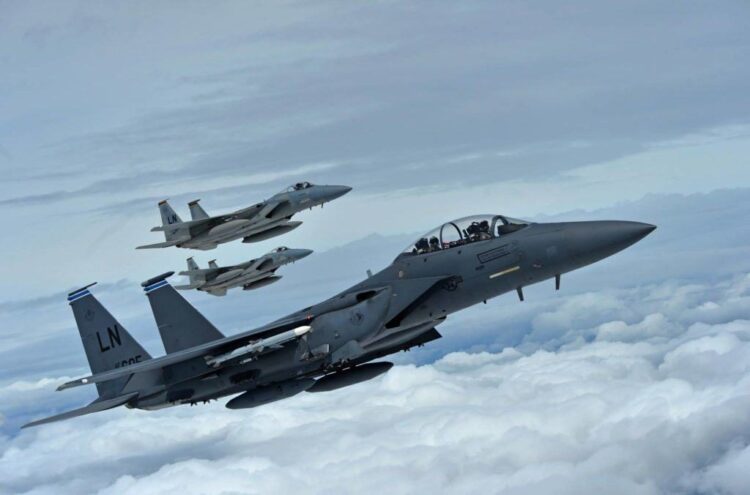
No single factor explains the record. Design, weapons, support, training, and the quality of the opposition all played a part.
The design came first. The USAF attributes the Eagle’s maneuverability and acceleration to a high thrust-to-weight ratio and low wing loading, which is the aircraft’s weight relative to its wing area. Historian John T. Correll, writing in The Reformers, credits John R. Boyd’s Energy-Maneuverability theory with helping turn the F-X project into a lighter, more agile F-15. Harry Hillaker, the chief designer of the F-16, said Boyd’s Energy-Maneuverability theory “concluded that maneuvering for position was basically an energy problem.” Correll also notes that the production F-15 was still not as light or agile as Boyd wanted, and that Boyd went on to champion a smaller, cheaper lightweight fighter.
Raw power backed up the theory. The 2013 Air & Space Forces Magazine retrospective describes two Pratt & Whitney F100 engines and a design requirement for thrust greater than the aircraft’s weight under specified conditions. That ratio depends on conditions; it is not a constant at every fuel and weapons load. The point was made in public in early 1975, when the specially prepared Streak Eagle set eight time-to-climb world records between January 16 and February 1. It was a stripped, weight-reduced airframe, not a combat-loaded jet.
Sensors, missiles, and support turned that performance into kills. The progression from Sparrow-era BVR shots in 1991 to all-AMRAAM victories in 1999, with AWACS controllers behind both, is documented above. Training mattered just as much. Red Flag began in 1975, drawing on the lessons of Vietnam, to put aircrews through realistic simulated combat. “I think another real key is the superior training and capabilities of the pilots who fly it,” Lt. Col. Matt Donovan, then commander of the 95th Fighter Squadron, said in a 2002 USAF retrospective.
The matchups deserve honest context. Haulman’s study describes USAF advantages in training and equipment, restrictions on opponents’ readiness, and the importance of air-control support. These conditions support a combined explanation. They are not a controlled test of one aircraft against another, and the record does not predict how the Eagle would fare against a peer air force on equal terms.
Testing The Shootdown Claims: Syria, Iraq, Yemen, And Iran
Adversaries have claimed F-15 kills several times. The useful questions are the same each time: who made the claim, what corroborates it, and what kind of weapon was involved. Missing public wreckage does not by itself disprove a loss, and an operator’s denial is evidence but not a full technical reconstruction.
| Claim or event | Date | Evidence | Assessment |
| Syrian MiG-25 shootdown near Tyre | June 1981 | No confirmed incident record | Unverified allegation |
| Syrian MiG-21 shootdown | July 1982 | No confirmed incident record | Unverified allegation |
| Iraqi MiG-25 claim at Samurra | January 30, 1991 | No incident reconstruction; USAF history records no F-15 lost to enemy pilots in the 1990s | Unverified |
| Saudi F-15 hit over Yemen | March 2018 | Houthi hit claim; coalition says jet returned | Hit reported; not a loss |
| Iranian claim near Hormuz | March 2026 | CENTCOM denial | Disputed |
| F-15E downed over Iran | April 2026 | CENTCOM acknowledgment | Real loss, reportedly to a ground-launched missile |
Syria
A secondary account by historian Tom Cooper recounts two Syrian allegations: an F-15 shot down by a MiG-25 near Tyre in June 1981, and another by a MiG-21 in July 1982. Neither has been matched to an airframe identity, a crew outcome, or Israeli loss records. These claims remain unverified. That does not prove every detail was invented, but it falls well short of a confirmed loss.
Iraq
Iraq’s best-known claim concerns a January 30, 1991 engagement near Samurra in which, according to the claim, a MiG-25 downed an F-15. No incident-level reconstruction has been published. Haulman’s official study reports that enemy pilots shot down no F-15 or F-16 during the 1990s. That is meaningful contrary evidence at the campaign level, although it does not explain what the Iraqi pilots believed they saw.
Yemen
The Yemen case shows why the type of weapon matters. Xinhua’s March 2018 report carried a Houthi statement that an F-15 had been hit over Saada. The same report quoted coalition spokesman Col. Turki al-Maliki, who said the missile caused no serious damage and that the aircraft returned successfully. Arab News carried al-Maliki’s account that the missile was launched from Saada airport. A missile fired from the ground creates a surface-to-air engagement, even if the weapon was originally designed for air-to-air use. So even a destroyed jet would not have been a defeat by an enemy fighter.
Iran
In March 2026, Iran claimed an F-15 had been downed near the Strait of Hormuz. Anadolu reported on March 23 that CENTCOM denied it and described the allegations as part of a disinformation campaign. That denial covered the March claim only. In April, CENTCOM acknowledged a separate, real loss, covered in the ground-fire section below.
The F-117 Comparison
A confirmed loss looks different from these claims. When an F-117 was shot down over Yugoslavia on March 27, 1999, during Operation Allied Force (one day after Hwang’s double kill), the loss was recorded in USAF history and later examined in a National Museum of the United States Air Force presentation on the shootdown and the pilot’s experience. None of the F-15 claims above has that kind of official acknowledgment behind it.
Hit But Not Killed: When F-15s Were Damaged And Came Home
The best-known survival story did not happen in combat. Air Force Magazine‘s March 2016 Flashback identifies Zivi Nedivi as the pilot who landed an Israeli F-15D after losing its right wing in a May 1, 1983 collision with an A-4 Skyhawk. The 2013 retrospective places the collision during a training flight and reports that the jet was repaired and returned to service.
The episode is often cited as proof of a nearly indestructible airframe. The records establish the outcome, though, not an engineering explanation or a guarantee about how much damage any Eagle can absorb. It was an extraordinary recovery, not a combat victory.
The 2018 Yemen incident fits the same category, but less firmly. The coalition says its jet came home after a missile hit. That is an attributed safe-return statement, not an independently inspected damage record.
The bookkeeping rule is simple. A damaged jet that returns, is repaired, and flies again is not a loss.
The Biggest Asterisk: Friendly Fire And The 2026 Kuwait Shootdown
The most significant recent event is not an enemy claim at all. CENTCOM’s release described an apparent friendly fire incident in which three F-15Es were mistakenly shot down by Kuwaiti air defenses during active combat, and it said all six aircrew were recovered. Air & Space Forces Magazine placed the incident at 7:03 a.m. local time on March 2, which was 11:03 p.m. on March 1 Eastern Time. The two dates describe the same event.
The release named no weapon system and said the cause was under investigation. On March 3, Air & Space Forces Magazine reported, citing people familiar with the matter, that Kuwaiti aircraft were suspected. “It would be inappropriate to comment given the incident is under investigation,” CENTCOM spokesman Navy Capt. Tim Hawkins told the magazine. AeroTime then relayed the Wall Street Journal‘s account of early investigative findings pointing to a Kuwaiti F/A-18 Hornet. AeroTime also reported that Kuwaiti Ministry of Defense spokesman Col. Saud Al-Atwan described the evacuation of the crews and coordination with U.S. forces on the investigation. As of mid-November 2026, no final public report had assigned the weapon.
The roles have been reversed before. On April 14, 1994, during Operation Provide Comfort, USAF F-15s mistakenly shot down two U.S. Army Black Hawk helicopters over Iraq, killing 26 people. The Government Accountability Office (GAO) later reviewed the military investigations.
The Kuwait case changes how the claim should be worded. If the Hornet account is confirmed, F-15s will have been lost air-to-air, though not to an enemy aircraft. Friendly fire cannot be left out of any statement about all air-to-air losses, so “zero air-to-air losses” no longer works. “Never shot down by an enemy aircraft” still does.
Undefeated Is Not Invulnerable: Ground Fire And Accidents
Enemy defenses on the ground have succeeded where enemy fighters have not. A USAF Desert Storm history describes two early F-15E losses. The first killed Donnie Holland and Thomas Koritz, and Holland’s official memorial associates that loss with the January 17 mission. Two nights later, an SA-2 surface-to-air missile brought down another Strike Eagle; David Eberly and Thomas Griffith ejected and were captured.
On April 7, 2003, Capt. Eric B. Das and Maj. William R. Watkins III died when their F-15E went down during a combat mission over Iraq. Official notices at the time said the incident was under investigation and did not give a cause.
The 2026 Iran loss followed the same ground-fire pattern. CENTCOM’s April 5 release acknowledged an F-15E shot down on April 2 and said two separate rescues had been completed on April 4. Stephen Losey’s reconstruction of the DUDE 44 rescue for Air & Space Forces Magazine explains the date gap: the jet was hit early on April 3 in Iran, which was late April 2 on the U.S. East Coast, and air support for the second rescue continued into the morning of April 5 local time. In that account, President Donald Trump described the weapon as a shoulder-fired heat-seeking missile. That is a public explanation, not a published technical finding. If that account is accurate, the missile was fired from the ground, not by an enemy aircraft.
Accidents account for many more losses:
- Libya, 2011. The official investigation into the March 21 crash found that the F-15E departed controlled flight after exceeding its critical angle of attack during an approved combat maneuver. Contributing factors included flying at an untested altitude and lateral asymmetry, meaning the aircraft was unevenly loaded from side to side. Both crew members ejected and survived. Calling it a “mechanical failure” misstates the board’s finding.
- Missouri, 2007. On November 2, an F-15C broke apart in flight. Investigators traced the breakup to an upper-right longeron, a main structural member of the fuselage, that did not meet blueprint specifications. The Air Force grounded its F-15s, and on December 3, Air Combat Command stood down all of its F-15A through D models until further notice while inspections continued.
- Florida, 2008. An August 2008 report blamed pilot error for the February 20 collision of two Eglin F-15Cs off the Florida coast.
The Air Force Safety Center’s F-15 mishap history, updated June 5, 2026, counts 127 destroyed aircraft through fiscal 2025. That figure covers only USAF flight mishaps. It is not a worldwide count of every F-15 lost to every cause.
The Verdict: What The F-15 Kill Record Really Proves
Taken together, the evidence supports a precise conclusion. The Eagle has more than 100 credited aerial victories and no confirmed loss to an enemy aircraft. Every adversary claim examined here is still an unverified allegation, a disputed claim, or a hit that the jet survived. None has the corroboration that surrounded a genuine loss such as the F-117 in 1999.
The record does not show that the F-15 cannot be lost. Allied fire, surface-to-air missiles, structural failure, and loss of control have all destroyed Eagles. Its success also does not come from one feature. It combines Boyd-influenced design, powerful engines, BVR missiles, AWACS support, realistic training, and opponents who often fought at a disadvantage.
For a sentence you can share accurately, we would use this one: No F-15 has ever been confirmed shot down by an enemy aircraft.
That legacy now passes to the F-15EX Eagle II. Boeing describes the new variant as having an active electronically scanned array (AESA) radar, the Eagle Passive/Active Warning Survivability System (EPAWSS), advanced networking, and room for up to 12 AMRAAMs. Those are the manufacturer’s stated capabilities. The F-15EX inherits the Eagle name, but it will have to earn its own record.

Key Takeaways
- The F-15 kill record holds in its precise form: more than 100 credited victories and no confirmed loss to an enemy aircraft.
- Published totals range from 101 to 104.5 because no reconciled multinational ledger exists.
- Syrian, Iraqi, and Iranian shootdown claims remain unverified or disputed, and the 2018 Yemen hit did not destroy the jet.
- Three F-15Es were downed over Kuwait in 2026 in what CENTCOM called apparent friendly fire, so “zero air-to-air losses” is no longer safe wording.
- Ground fire and accidents have destroyed many Eagles, but they fall outside the “undefeated” claim.